



Key numbers
- Backspacing = (rim width + 1 in) ÷ 2 + offset ÷ 25.4; an 8.5 in ET35 wheel has about 6.13 in
- Same width, lower offset: the whole wheel moves out by the offset difference (ET45 → ET33 = 12 mm out)
- Each extra inch of rim width at the same offset adds 12.7 mm (0.50 in) on both the inner and outer side
- UN R124 replacement wheels must clear brakes by 3 mm and suspension and steering parts by 4 mm
On this page
- How to use the Wheel Offset Calculator
- What does a wheel offset calculator do?
- What is wheel offset: positive, zero and negative?
- How do you convert offset to backspacing?
- How far will my new wheels stick out?
- How much clearance do wheels need?
- Does wheel offset affect handling and the speedometer?
- Hub-centric rings, spacers and lug-centric wheels
- How accurate is this calculator?
- Frequently asked questions
How to use the Wheel Offset Calculator
- 1Get a clear view of the skyMount your phone in a holder with a clear view of the sky before you set off.
- 2Tap Start and allow locationYour browser asks for location permission once. The first GPS fix usually arrives in 5–30 seconds.
- 3Pick your unitChoose km/h, mph, knots or m/s. Your choice is remembered on this device.
- 4Read speed, max, average and distanceThe gauge and digital readout update about once a second. Distance and average count only while you are moving.
- 5Stop or resetTap Stop to pause, Reset to clear the trip. Nothing is stored or sent anywhere.
Works in any modern phone browser. Back to the tool ↑
What does a wheel offset calculator do?
A wheel offset calculator tells you where a new wheel will sit compared with the one you have now: how many millimeters the outer face moves toward the fender, and how much closer the inner lip gets to the brakes and suspension. It also converts the offset stamped on the wheel (ET, in millimeters) into backspacing (in inches), the number most US truck and off-road catalogs quote.
Enter the rim width and offset of both wheels above. Add the tire section widths (the 245 in 245/40R18) if you want to see where the tire sidewalls end up too. The result reads in plain language, for example “outer edge sits 12 mm (0.47 in) further out”.
Key terms on this page. Offset (ET): distance from the rim’s centreline to the hub mounting face, in mm. Backspacing: distance from the mounting face to the inner rim lip, in inches. Front spacing: mounting face to outer lip. Poke: how far the wheel or tire sticks out toward or past the fender. Hub-centric: a wheel located on the hub’s center pilot rather than only by the lug nuts. Scrub radius: the distance at the road between the tire’s center and the line the wheel steers around.
What is wheel offset: positive, zero and negative?
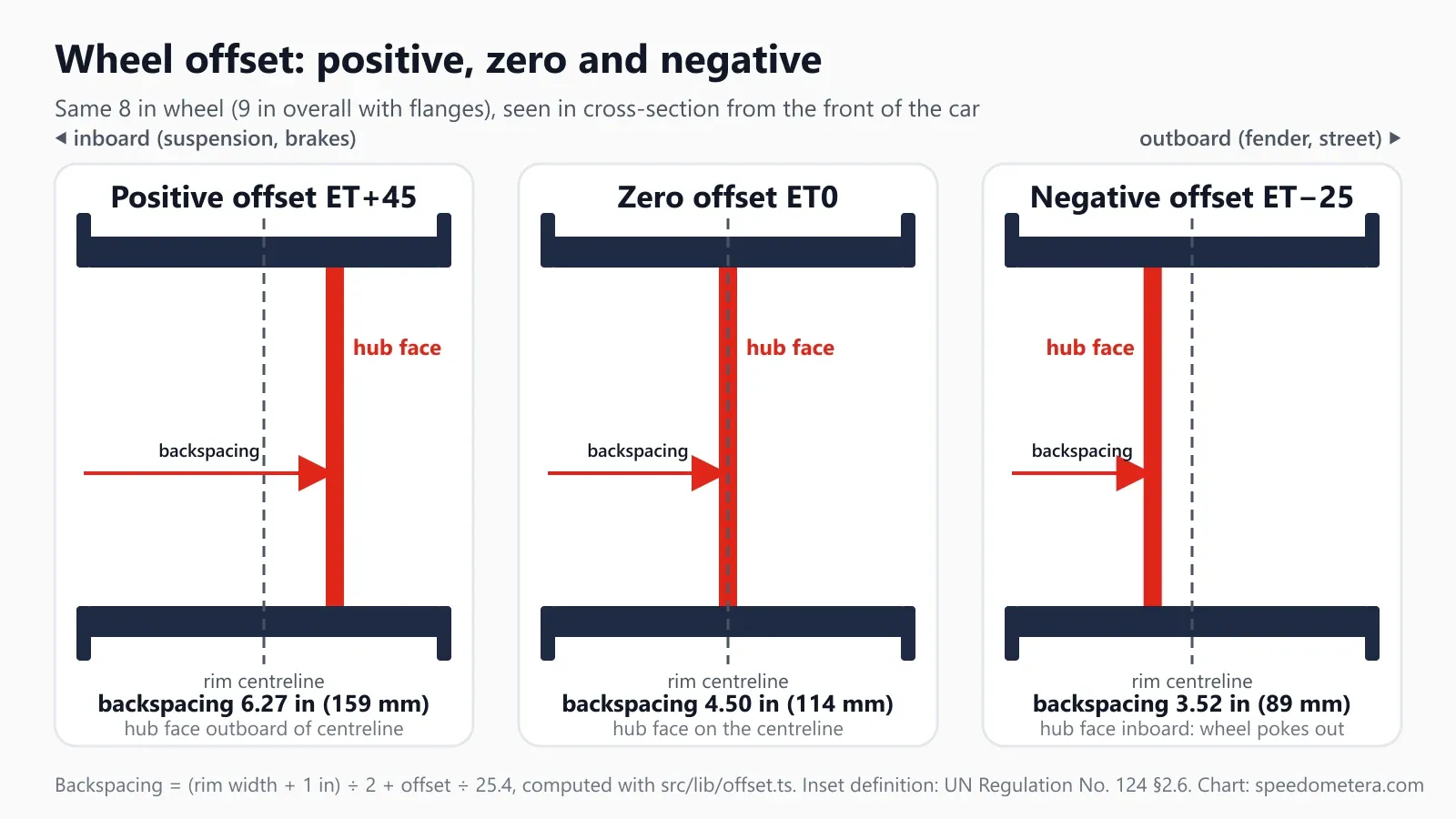
Offset is the distance between the wheel’s mounting face and its centreline. UN Regulation No. 124, the international standard for replacement passenger-car wheels, defines this “inset” as “the distance from the attachment face of the disc to the centre line of the rim”, and notes it can be positive, zero or negative. The same regulation requires the inset to be permanently marked on the wheel, which is why you find “ET45” or similar cast on the back of a spoke.
- Positive offset (ET+): the mounting face is outboard of the centreline, toward the street side. The wheel tucks in under the body. Typical for front-wheel-drive cars and crossovers.
- Zero offset (ET0): the mounting face is exactly on the centreline.
- Negative offset (ET−): the mounting face is inboard of the centreline. The wheel sits further out, which gives the “deep dish” look on lifted trucks.
Heavy-truck wheels use different words for the same idea. Wheel maker Accuride explains that commercial wheels which can run as duals use an offset measurement, while single wheels use inset (wheel centerline inboard of the hub mounting surface) or outset (centerline outboard). If you shop for truck wheels, check which convention a catalog uses before comparing numbers.
What do +35, +40 and negative offsets mean? (8 in wheel table)
The number is millimeters: +35 means the mounting face sits 35 mm outboard of the rim centreline, +40 means 40 mm, and −44 means 44 mm inboard. On its own the number tells you little; what matters is the change from your car’s original offset. The table compares common offsets on the same 8 in wide wheel against an ET45 baseline, computed with this calculator:
| Offset | Mounting face vs centreline | Backspacing (8 in wheel) | Outer edge vs ET45 | Inner clearance vs ET45 |
|---|---|---|---|---|
| ET+45 | 45 mm outboard | 6.27 in | 0 | 0 |
| ET+40 | 40 mm outboard | 6.07 in | 5 mm (0.20 in) further out | 5 mm more |
| ET+35 | 35 mm outboard | 5.88 in | 10 mm (0.39 in) further out | 10 mm more |
| ET+20 | 20 mm outboard | 5.29 in | 25 mm (0.98 in) further out | 25 mm more |
| ET0 | on the centreline | 4.50 in | 45 mm (1.77 in) further out | 45 mm more |
| ET−12 | 12 mm inboard | 4.03 in | 57 mm (2.24 in) further out | 57 mm more |
| ET−44 | 44 mm inboard | 2.77 in | 89 mm (3.50 in) further out | 89 mm more |
So a +40 wheel on a car that came with +45 pokes out just 5 mm, while a −44 “deep dish” wheel on the same hub would sit 3.5 in further out, which is why heavily negative offsets usually go with lifted trucks, fender flares and wide-track builds. A “good” offset is the one that keeps the tire inside the fender and clears the brakes and suspension: start from the original ET on your placard or owner’s manual and change it in small steps.
How do you convert offset to backspacing?
Backspacing = (rim width + 1 in) ÷ 2 + offset ÷ 25.4. The extra inch is a convention, not a law of physics. The rim width on a size such as 18x8.5J is the nominal width between the flanges (FMVSS 120 defines rim width as “the nominal distance between the rim flanges”), but backspacing is measured to the outside edge of the inner flange. The flanges add roughly half an inch on each side, so the overall lip-to-lip width of a typical 8.5 in wheel is about 9.5 in. If you can, measure your own wheel with a straightedge across the back lip: flange shapes vary by maker.
backspacing (in) = (width + 1) ÷ 2 + ET ÷ 25.4 · ET (mm) = (backspacing − (width + 1) ÷ 2) × 25.4
Worked example: 18x8.5 ET35
Half of (8.5 + 1) is 4.75 in. 35 mm is 35 ÷ 25.4 = 1.38 in. Backspacing = 4.75 + 1.38 = 6.13 in (156 mm). Front spacing is the rest of the 9.5 in overall width: 3.37 in.
This table gives backspacing in inches for common widths and offsets, computed with the same code as the calculator:
| Rim width | ET−25 | ET−12 | ET0 | ET+20 | ET+35 | ET+45 |
|---|---|---|---|---|---|---|
| 7 in | 3.02 in | 3.53 in | 4.00 in | 4.79 in | 5.38 in | 5.77 in |
| 8 in | 3.52 in | 4.03 in | 4.50 in | 5.29 in | 5.88 in | 6.27 in |
| 9 in | 4.02 in | 4.53 in | 5.00 in | 5.79 in | 6.38 in | 6.77 in |
| 10 in | 4.52 in | 5.03 in | 5.50 in | 6.29 in | 6.88 in | 7.27 in |
How far will my new wheels stick out?
Two things move the wheel’s edges: the change in offset and the change in width. Lowering the offset shifts the whole wheel outward by the difference. Adding width grows the wheel equally on both sides, half the extra width on each (12.7 mm per side for every extra inch). The calculator combines both:
| Current wheel | New wheel | Backspacing (in) | Inner edge (toward strut) | Outer edge (poke) |
|---|---|---|---|---|
| 7.5 in ET45 | 7.5 in ET35 | 6.02 → 5.63 | −10 mm (−0.39 in) | +10 mm (+0.39 in) |
| 8 in ET45 | 8 in ET38 | 6.27 → 6.00 | −7 mm (−0.28 in) | +7 mm (+0.28 in) |
| 8 in ET40 | 9 in ET40 | 6.07 → 6.57 | +13 mm (+0.50 in) | +13 mm (+0.50 in) |
| 7.5 in ET45 | 8.5 in ET35 | 6.02 → 6.13 | +3 mm (+0.11 in) | +23 mm (+0.89 in) |
| 8 in ET45 | 9 in ET30 | 6.27 → 6.18 | −2 mm (−0.09 in) | +28 mm (+1.09 in) |
| 8 in ET18 | 9 in ET−12 | 5.21 → 4.53 | −17 mm (−0.68 in) | +43 mm (+1.68 in) |
| 8 in ET0 | 9 in ET−12 | 4.50 → 4.53 | +1 mm (+0.03 in) | +25 mm (+0.97 in) |
A plus sign on the inner edge means less room between the wheel and the suspension; a minus sign means more. A plus sign on the outer edge means more poke. Read the two together: a wider wheel with a lower offset (row four) can keep almost the same inner clearance while pushing the face nearly an inch further out.
The tire adds its own width. The calculator assumes the tire is centred on the rim, so a 245 mm tire on a wheel that replaces a 225 mm tire adds 10 mm per side before any offset change.
How much clearance do wheels need?
There is no single US number: check your vehicle manual, the door-jamb placard and the wheel maker’s fitment data. In the US, FMVSS 110 makes carmakers list the original tire size on the placard and FMVSS 120 governs rim size marking for heavier vehicles, but neither sets an aftermarket offset limit for passenger cars.
The clearest published benchmark is international. Annex 10 of UN Regulation No. 124 says that when a replacement wheel’s inner contour is tighter than the carmaker’s, the check should, “as a rule”, find at least 3 mm of clearance to brake components (with new pads), 4 mm to suspension parts such as control arms, 4 mm to steering parts such as tie rods, and 2 mm between balance weights and the vehicle. Treat those as a minimum test benchmark, not a target: tires flex and suspensions move.
Test-fit before you drive
Mount one wheel and tire, then check the inner lip against the strut and caliper, and the tire against the fender lip at full steering lock in both directions. A small inner change from the calculator (a few millimeters) is the one most likely to cause a surprise.
Does wheel offset affect handling and the speedometer?
Offset changes steering geometry, but it does not change your speedometer. Moving the wheel outward changes the scrub radius: the distance at the road between the tire’s contact patch and the steering axis. Carmakers tune scrub radius with the original offset, so a large change can add steering kickback over bumps, tramlining (the car following ruts) and extra load on wheel bearings. In our view, a few millimeters is rarely noticeable, while a change of 20 mm or more deserves a careful test drive and an alignment check.
Your speedometer counts wheel revolutions, so only a change in the tire’s overall diameter alters the reading. If you change tire size with your new wheels, run both sizes through the tire size calculator, then check the result with a GPS reading as explained in speedometer calibration and GPS vs car speedometer. The online speedometer works for that check from a passenger seat.
Hub-centric rings, spacers and lug-centric wheels
A hub-centric wheel centres on the hub’s pilot diameter; a lug-centric wheel relies on the tapered lug nuts. UN R124 treats the “spigot mounting diameter” (the center bore) as a fitment dimension alongside inset and bolt pattern. Aftermarket wheels often have a larger center bore to fit many cars, so hub-centric rings fill the gap. Rings do not change offset.
Wheel spacers do. A 15 mm spacer moves the mounting face outward by 15 mm, so an ET45 wheel on a 15 mm spacer behaves like ET30. Enter the effective offset in the calculator to see the result, and follow the spacer maker’s torque and stud-length instructions.
How accurate is this calculator?
The geometry is exact for the numbers you enter; the uncertainty is in the inputs. The 1 in flange allowance is a convention, real tires bulge differently by brand and rim width, and suspension movement changes clearance as you drive. The calculator uses one tested formula (src/lib/offset.ts) and shows millimeters and inches side by side so you can compare with any catalog. It’s a planning tool, not a fitment guarantee: always confirm with your vehicle manual, the wheel maker and a physical test fit.
FAQ
Frequently asked questions
What does ET mean on a wheel?
ET is short for the German Einpresstiefe, the wheel's offset in millimeters: the distance from the hub mounting face to the rim's centreline. ET45 means the mounting face sits 45 mm outboard of the centreline. UN Regulation No. 124 calls the same measurement inset and requires it to be marked on replacement wheels.
Is positive or negative offset better?
Neither is better in general: the right offset is the one that clears your brakes and suspension and keeps the tire inside the fender. Positive offsets tuck the wheel under the body, as on most front-wheel-drive cars; negative offsets push it out for a wider stance, as on many lifted trucks. Your car's original ET is the safest baseline.
What is a good wheel offset?
The best offset is usually your car's original one, printed in the owner's manual or wheel-maker fitment data. On the same rim width, each millimeter lower pushes the wheel 1 mm further out. Going from ET45 to ET35 moves the tire 10 mm (0.39 in) toward the fender; check the outer change here and test-fit at full lock.
What does a +35 or +40 offset mean?
It means the wheel's mounting face sits 35 or 40 mm outboard of the rim centreline, a positive offset typical of cars and crossovers. On an 8 in wheel, ET35 gives 5.88 in of backspacing and ET40 gives 6.07 in, so a +35 wheel sits 5 mm (0.20 in) further out than a +40.
What does a negative 44 offset mean?
ET−44 puts the mounting face 44 mm inboard of the rim centreline, so the rim sticks far out from the hub. On an 8 in wheel it leaves only 2.77 in of backspacing and sits 89 mm (3.5 in) further out than an ET45 wheel. It is a lifted-truck style that usually needs fender flares.
How do I convert offset to backspacing?
Add 1 in to the nominal rim width, halve it, then add the offset in inches (offset in mm ÷ 25.4). For an 8.5 in ET35 wheel: (8.5 + 1) ÷ 2 = 4.75 in, plus 35 ÷ 25.4 = 1.38 in, so backspacing is about 6.13 in. Negative offsets subtract.
How much does 10 mm of offset change?
On the same rim width, lowering the offset by 10 mm moves the whole wheel and tire 10 mm (0.39 in) further out: the outer face gains 10 mm of poke and the inner edge gains 10 mm of clearance from the strut. Raising the offset by 10 mm does the reverse.
Will a lower offset rub?
It can. A lower offset pushes the tire toward the fender lip, which may rub over bumps or at full steering lock, especially combined with a wider tire. Check the outer change in this calculator, then test-fit at full lock and with the suspension compressed before driving.
Does wheel offset affect the speedometer?
Not directly. The speedometer counts wheel revolutions, so only the tire's overall diameter changes the reading. Offset moves the wheel sideways, not up or down. If you also change the tire size, check the speedometer error with the tire size calculator.
What is the difference between offset and backspacing?
Offset is measured from the rim centreline to the hub mounting face, in millimeters, and can be positive, zero or negative. Backspacing is measured from the mounting face to the inner lip, in inches, and is always positive. Backspacing depends on rim width; offset does not.
Do hub-centric rings change offset?
No. Hub-centric rings fill the gap between the wheel's center bore and the hub pilot so the wheel centres on the hub, not only on the lug nuts. They don't move the mounting face, so offset and backspacing stay the same. Wheel spacers, by contrast, reduce effective offset by their thickness.
4 Sources
- UN Regulation No. 124 (UNECE, 2007): wheels for passenger cars; §2.6 inset definition, §5.1.3 inset marking, Annex 10 clearance criteria (UK Parliament deposited copy, PDF)
- 49 CFR 571.120 (FMVSS 120): rim size designation, rim width between flanges, rim marking (Cornell LII)
- 49 CFR 571.110 (FMVSS 110): tire and rim selection, tire information placard (Cornell LII)
- Accuride Corporation (wheel manufacturer): Wheel Nomenclature flyer W1.057, offset vs inset/outset (PDF, 2022)
Last updated October 25, 2026 by Izhar Ahmad Danish. Found an error? Tell us.