



Key numbers
- Diameter = 2 × sidewall + wheel size; a P225/45R17 is about 24.97 in tall
- Most fitment guides keep a new size within ±3% of the original diameter
- A tire 3.5% taller turns an indicated 70 mph into about 72.4 mph
- TPMS must warn within 20 minutes of a tire falling 25% below placard pressure (FMVSS 138)
- FMCSA-regulated trucks and buses must read within ±5 mph at 50 mph (49 CFR 393.82)
On this page
- How to use the Tire Size Calculator
- What does a tire size calculator tell you?
- How do you use the tire size calculator?
- How is tire size calculated? (Formula and worked examples)
- How do bigger tires affect your speedometer and odometer?
- What is plus sizing, and which sizes keep the same diameter?
- What do the load index and speed rating mean?
- Does changing tire size affect TPMS, ABS and stability control?
- Is there a legal limit on speedometer error in the US?
- Can I use a different tire size? (225/65 vs 225/60, 235 vs 225 and more)
- How do you choose a replacement tire size safely?
- Frequently asked questions
How to use the Tire Size Calculator
- 1Enter your original tire sizeType the size from the sidewall or door-jamb placard, such as P225/45R17, LT265/75R16 or 33x12.50R15.
- 2Enter the new tire sizeType the size you are considering. Diameter, sidewall, circumference and revolutions per mile appear for both.
- 3Check the difference and speedometer errorSee the diameter change in percent and your true speed when the speedometer shows 30, 45, 60, 70 and 80 mph.
Works in any modern phone browser. Back to the tool ↑
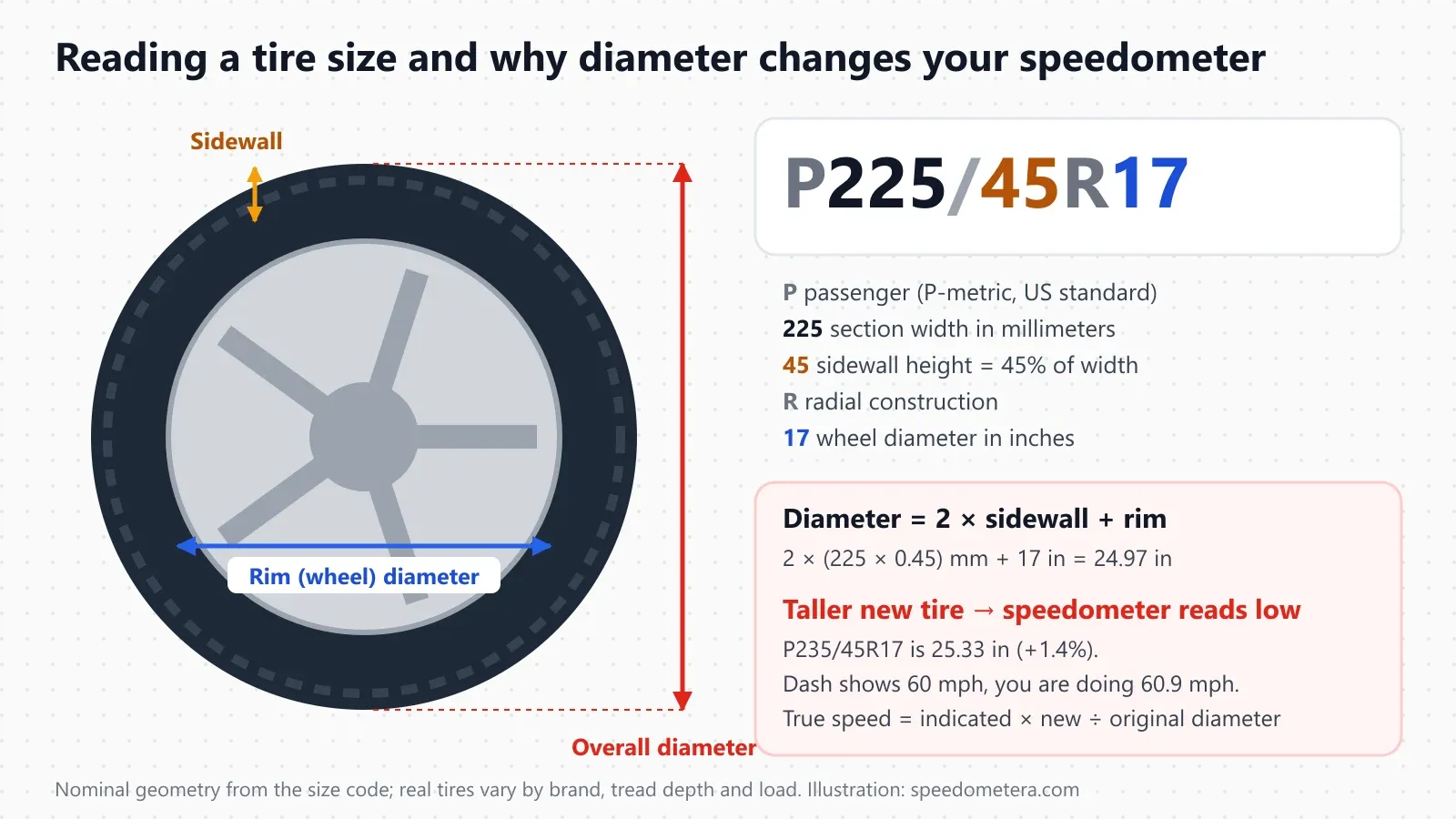
What does a tire size calculator tell you?
A tire size calculator turns the code on the sidewall into real dimensions, then compares two sizes so you can see whether a new tire will fit and how far it will throw off your speedometer. The two numbers that matter most are the change in overall diameter and the speedometer error that follows from it. Everything else (sidewall, width, circumference, revolutions per mile) explains why.
Your vehicle’s original size is printed on the “Tire and Loading Information” placard. Federal Motor Vehicle Safety Standard 110 requires that placard to list the tire size designation of the tires fitted at first sale, including the spare, and to sit on the driver’s side B-pillar (the door jamb) wherever possible. The same size is molded into each tire’s sidewall, as FMVSS 139 requires for light-vehicle radial tires.
Key terms on this page. Section width: the tire’s widest point, in millimeters, sidewall to sidewall. Aspect ratio: sidewall height as a percentage of section width. Overall diameter: the tire’s height from ground to top, unloaded. Revolutions per mile: how many times the tire turns in one mile; your speedometer and odometer count these. Plus sizing: a bigger wheel with a lower-profile tire that keeps the same overall diameter. Service description: the load index and speed symbol after the size, such as 91W. TPMS: the tire pressure monitoring system required by FMVSS 138.
These are the most common US questions the calculator answers:
| You want to know | Look at | Rule of thumb |
|---|---|---|
| Will the new size fit? | Diameter change, width change | Within ±3% diameter is the usual target |
| Will my speedometer be off? | Speedometer error % and true-speed table | 1% taller = about 0.6 mph low at 60 mph |
| Will my odometer be off? | Revolutions per mile | Fewer revs per mile = more real miles than recorded |
| How tall is my tire? | Overall diameter (in) | Equals 2 × sidewall + wheel size |
| How much lift or rub risk? | Diameter difference ÷ 2 | Only half the diameter gain raises the axle |
How do you use the tire size calculator?
Enter the size on your car now, enter the size you’re considering, and read the two tiles at the top: diameter change and speedometer error.
- Find your original size on the driver’s door-jamb placard or the sidewall, such as P225/45R17, LT265/75R16 or 33x12.50R15. Load and speed codes after the size (like 91W) are ignored by the calculator, but write them down for the checks below.
- Type the new size in the second box. The table fills in diameter, sidewall, section width, circumference and revolutions per mile for both tires, plus the difference.
- Check the diameter tile. “Within ±3%” means the size is in the range most fitment guides accept; “Outside ±3%” means you should check clearance and expect a noticeable speedometer error.
- Read the true-speed table. It shows what you’re really doing when the dashboard reads 30, 45, 60, 70 and 80 mph on the new tires.
- Confirm on the road. After fitting, have a passenger run the GPS speedometer at a steady 60 mph and enter both readings in the speedometer calibration calculator to measure the real error.
Typos the calculator catches
If you see an error, check the slash and the R: 225/45R17 and 225/45-17 both work, but 2254517 doesn’t. Flotation sizes use an x: 35x12.50R17. Sizes outside realistic ranges (width 100–455 mm, wheel 10–30 in) are rejected rather than guessed.
Changing wheels as well? The wheel offset calculator shows how far a new wheel and tire will poke out or tuck in, in mm and inches.
How is tire size calculated? (Formula and worked examples)
Every number in the table comes from three values in the size code: width, aspect ratio and wheel diameter. Sidewall = width × aspect ÷ 100; diameter = 2 × sidewall + wheel.
Diameter (in) = 2 × (width mm × aspect ÷ 100) ÷ 25.4 + wheel (in)
The steps, for a metric size like P225/45R17:
| Step | Formula | P225/45R17 |
|---|---|---|
| Sidewall height | width × aspect ratio ÷ 100 | 225 × 45 ÷ 100 = 101.25 mm (3.99 in) |
| Wheel diameter in mm | wheel (in) × 25.4 | 17 × 25.4 = 431.8 mm |
| Overall diameter | 2 × sidewall + wheel | 2 × 101.25 + 431.8 = 634.3 mm (24.97 in) |
| Circumference | π × diameter | 3.1416 × 24.97 = 78.45 in |
| Revolutions per mile | 63,360 in ÷ circumference | 63,360 ÷ 78.45 = 808 |
| Section width | width ÷ 25.4 | 8.86 in |
For flotation sizes the work is shorter, because the first number already is the diameter. A 33x12.50R15 is 33.0 in tall and 12.50 in wide, with a sidewall of (33 − 15) ÷ 2 = 9.0 in.
Worked example: P225/45R17 → P235/45R17. The wider tire has a taller sidewall too, because the 45% is now taken of 235 mm: 105.75 mm. Overall diameter becomes 643.3 mm (25.33 in), so the change is +1.42%. Revolutions per mile drop from 808 to 796.
Worked example: P265/70R17 → 285/70R17, a popular “33-inch look” on half-ton pickups. Diameter grows from 31.61 in to 32.71 in, +3.49%, just outside the ±3% band. Ground clearance at the axle rises by half the diameter gain: (32.71 − 31.61) ÷ 2 = 0.55 in.
Width and aspect ratio interact. Because the sidewall is a percentage of width, changing only the first number also changes height. From a 225/45R17, our calculations give:
| New size | Width change (mm) | Diameter change | What it means |
|---|---|---|---|
| 215/45R17 | −10 | −1.42% | Narrower and shorter; speedometer reads slightly high |
| 235/45R17 | +10 | +1.42% | One width up; the usual safe “wider” swap |
| 245/45R17 | +20 | +2.84% | Two widths up; near the 3% edge |
| 235/40R17 | +10 | −2.29% | Wider but lower profile; shorter overall |
| 245/40R17 | +20 | −1.02% | Wider with a lower profile; height nearly kept |
The calculator shows nominal geometry from the size code. A real tire’s measured height varies by brand, tread depth and inflation, and a worn tire is shorter than a new one, so treat results within a few tenths of a percent as equal.
How do bigger tires affect your speedometer and odometer?
Your speedometer counts wheel revolutions and multiplies by the circumference it was set for at the factory. Fit a taller tire and each turn covers more road, so the speedometer and odometer read low; fit a shorter one and they read high.
- True speed = indicated speed × (new diameter ÷ original diameter)
- Speedometer error = (original diameter ÷ new diameter − 1) × 100%
So for P225/45R17 → P235/45R17, true speed at an indicated 60 mph is 60 × 25.33 ÷ 24.97 = 60.9 mph. True speed at each dashboard reading, for common US size changes (calculated with this tool):
| Original → new size | Diameter change | 30 mph | 45 mph | 60 mph | 70 mph | 80 mph |
|---|---|---|---|---|---|---|
| 205/55R16 → 225/40R18 (plus-two wheels) | +0.84% | 30.3 | 45.4 | 60.5 | 70.6 | 80.7 |
| P225/45R17 → P235/45R17 | +1.42% | 30.4 | 45.6 | 60.9 | 71.0 | 81.1 |
| 225/65R17 → 235/65R17 (compact SUV) | +1.79% | 30.5 | 45.8 | 61.1 | 71.3 | 81.4 |
| P225/45R17 → 245/40R18 | +2.98% | 30.9 | 46.3 | 61.8 | 72.1 | 82.4 |
| P275/55R20 → 275/60R20 (full-size SUV) | +3.39% | 31.0 | 46.5 | 62.0 | 72.4 | 82.7 |
| P265/70R17 → 285/70R17 (pickup) | +3.49% | 31.0 | 46.6 | 62.1 | 72.4 | 82.8 |
| P225/45R17 → 215/55R17 | +5.36% | 31.6 | 47.4 | 63.2 | 73.8 | 84.3 |
| P265/70R17 → LT315/70R17 (35-inch class) | +8.72% | 32.6 | 48.9 | 65.2 | 76.1 | 87.0 |
The odometer drifts by the same percentage, which matters for warranty, lease and maintenance intervals and for a mileage log. Starting from a stock P265/70R17 pickup tire:
| New size | Diameter change | Real miles per 10,000 on the odometer | Dash reading at a true 50 mph |
|---|---|---|---|
| 275/70R17 | +1.74% | 10,174 | 49.1 mph |
| 285/70R17 | +3.49% | 10,349 | 48.3 mph |
| LT315/70R17 | +8.72% | 10,872 | 46.0 mph |
| 35x12.50R17 | +10.74% | 11,074 | 45.2 mph |
| 37x12.50R17 | +17.07% | 11,707 | 42.7 mph |
Your speedometer may not have been exact on the original tires either, so these tables show the change, not the final error. To know the final error, measure: compare the dash with a GPS speedometer at a steady speed on a straight, open road. GPS.gov reports typical smartphone accuracy of about 4.9 m (16 ft) under open sky; why the two disagree is explained in GPS vs car speedometer, and the GPS trip odometer lets you check distance against mile markers.
What is plus sizing, and which sizes keep the same diameter?
Plus sizing means fitting a wheel one or more inches larger while lowering the tire’s aspect ratio, so the overall diameter, and your speedometer, stay within about 1–3%. Plus-one is one inch of wheel, plus-two is two inches, and so on. The sidewall gets shorter and the wheel gets bigger by the same amount.
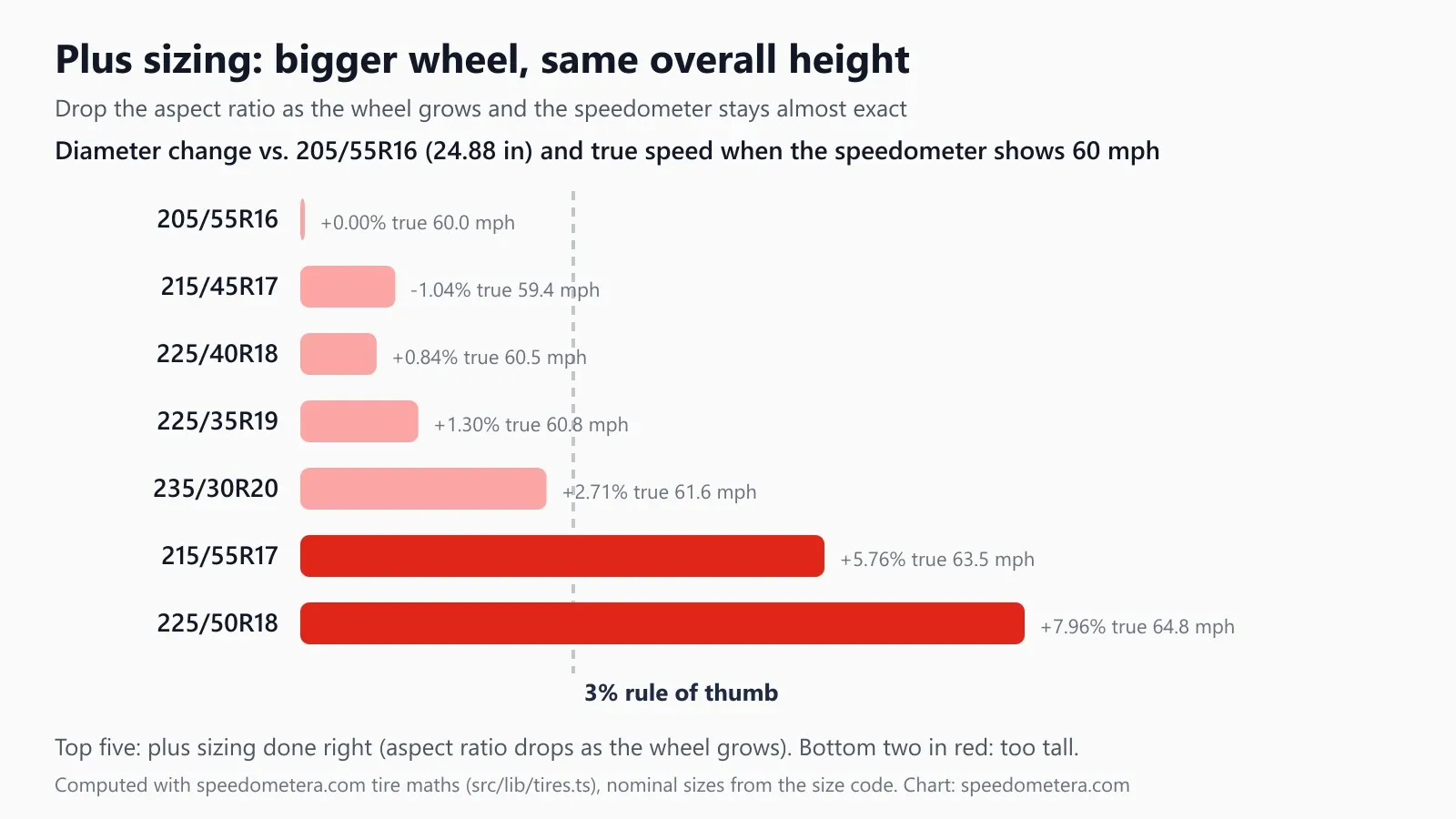
Three common US starting points, computed with the calculator:
| Stock size → plus size | Wheel | Sidewall (in) | Diameter (in) | Change | True speed at 60 mph |
|---|---|---|---|---|---|
| 205/55R16 (compact sedan) | 16 in | 4.44 | 24.88 | 0 | 60.0 |
| → 215/45R17 (plus-one) | 17 in | 3.81 | 24.62 | −1.04% | 59.4 |
| → 225/40R18 (plus-two) | 18 in | 3.54 | 25.09 | +0.84% | 60.5 |
| → 225/35R19 (plus-three) | 19 in | 3.10 | 25.20 | +1.30% | 60.8 |
| 225/65R17 (compact SUV) | 17 in | 5.76 | 28.52 | 0 | 60.0 |
| → 235/55R18 (plus-one) | 18 in | 5.09 | 28.18 | −1.19% | 59.3 |
| → 245/50R19 (plus-two) | 19 in | 4.82 | 28.65 | +0.46% | 60.3 |
| → 255/45R20 (plus-three) | 20 in | 4.52 | 29.04 | +1.82% | 61.1 |
| P265/70R17 (half-ton pickup) | 17 in | 7.30 | 31.61 | 0 | 60.0 |
| → 265/65R18 (plus-one) | 18 in | 6.78 | 31.56 | −0.14% | 59.9 |
| → 275/55R20 (plus-three) | 20 in | 5.95 | 31.91 | +0.96% | 60.6 |
| → 285/45R22 (plus-five) | 22 in | 5.05 | 32.10 | +1.56% | 60.9 |
The usual mistake is keeping the old aspect ratio on a bigger wheel. A 215/55R17 on a car that came with 205/55R16 is 5.76% taller, and a 225/50R18 is 7.96% taller: the speedometer then reads 56.7 and 55.6 mph at a true 60. Plus sizing also trades sidewall for looks and steering response; a shorter sidewall cushions potholes less, and the wider tire must fit your new wheel’s approved rim-width range.
What do the load index and speed rating mean?
The service description after the size, such as 91W, is two codes: 91 is the load index (615 kg, or 1,356 lb, per tire) and W is the speed symbol (168 mph, 270 km/h). A replacement should match or exceed both. The U.S. Tire Manufacturers Association says replacement tires should “be the same size, load index and speed rating designation” recommended by the vehicle or tire maker, and should “not be of a smaller size or load-carrying capacity than what was originally specified.”
Speed symbols you’ll see on US passenger and light-truck tires, from Hankook’s US tire guide:
| Speed symbol | Max speed (mph) | Max speed (km/h) | Typically found on |
|---|---|---|---|
| S | 112 | 180 | Light trucks, some family cars |
| T | 118 | 190 | Family sedans and minivans |
| U | 124 | 200 | Less common, some all-season tires |
| H | 130 | 210 | Sedans, crossovers, SUVs |
| V | 149 | 240 | Sport sedans, performance trims |
| W | 168 | 270 | High-performance cars |
| Y | 186 | 300 | Sports cars |
| (Y) | over 186 | over 300 | Supercars (size reads ZR) |
Load index examples from the same table: 91 = 615 kg (1,356 lb), 95 = 690 kg (1,521 lb), 100 = 800 kg (1,764 lb) per tire. Multiply by four for the set’s rated capacity at the tire’s maximum pressure, but your real limit is the placard’s gross weight. FMVSS 139 defines load rating as “the maximum load that a tire is rated to carry for a given inflation pressure”, so a tire run below the placard pressure carries less.
A speed rating is a laboratory rating, not a recommendation. For comparison, the federal FMVSS 139 high-speed test runs a light-vehicle tire at 85% of its maximum load for three 30-minute stages at 140, 150 and 160 km/h (87, 93 and 99 mph). Every legal US passenger tire passes that; the letter tells you how far beyond it the maker rates the tire.
Does changing tire size affect TPMS, ABS and stability control?
Usually only slightly, if you stay within about 3% of the original diameter. TPMS still has to warn within 20 minutes when a tire is 25% below the placard pressure, so after a size change reset or relearn it and keep inflating to the placard (or the tire maker’s load-table) pressure.
FMVSS 138 requires the TPMS telltale on cars, SUVs, pickups and vans with a gross vehicle weight rating of 10,000 lb or less (excluding dual-wheel axles) to light within 20 minutes of a tire reaching 25% below the manufacturer’s recommended cold pressure, or a minimum activation pressure if that is higher. On a 35 psi placard, that’s about 26 psi.
Two kinds of system react differently to a new size:
- Direct TPMS has a pressure sensor inside each wheel. Swapping tires on the same wheels keeps the sensors; moving to new wheels means new or transferred sensors and a relearn. If a bigger or different-load tire needs a different pressure, the warning threshold won’t know unless the vehicle can be reprogrammed.
- Indirect TPMS compares wheel speeds from the ABS sensors, because a low tire is slightly smaller and spins faster. New tires change those speeds, so most owner’s manuals call for a reset after any tire change; mixing sizes across axles can cause false warnings.
ABS, traction and stability control use the same wheel-speed signals. They tolerate the small differences from wear, but staggered or mismatched sizes the vehicle wasn’t built for can confuse them. Keep all four the same size unless the maker fits a staggered setup, and don’t mix a new tire with three badly worn ones on all-wheel-drive vehicles without checking the owner’s manual.
Is there a legal limit on speedometer error in the US?
For private cars there is no current federal accuracy standard; for commercial trucks and buses there is: ±5 mph at 50 mph.
| Vehicle | Rule | What it requires |
|---|---|---|
| Buses, trucks and truck-tractors covered by FMCSA safety rules | 49 CFR 393.82 (FMCSA) | Speedometer in mph and/or km/h, accurate within ±5 mph at 50 mph |
| Passenger cars and light trucks | No FMVSS accuracy rule | NHTSA rescinded FMVSS 127 (speedometers and odometers) in 1982 (47 FR 7250) |
| Any driver | State speed laws | You’re responsible for your true speed, whatever the dash shows |
That 5 mph at 50 mph limit is a 10% band. A truck that went from P265/70R17 to LT315/70R17 (+8.72%) would show 46.0 mph at a true 50 mph, inside the federal limit but close to its edge; a 35x12.50R17 (45.2 mph) would fall outside it. For everyone else, a “speedometer was wrong” argument rarely helps with a ticket, so recalibrate after any change beyond a couple of percent. Many modern vehicles store the tire size in a module a dealer or tuning tool can update; older cable-driven speedometers use a swappable driven gear.
Can I use a different tire size? (225/65 vs 225/60, 235 vs 225 and more)
Usually yes when the new size stays within about 3% of the original diameter, fits your wheel and carries an equal or higher load index and speed rating. That 3% figure is a trade rule of thumb, not a law: tire retailer Les Schwab tells drivers to stay “within 3 percent” of the original height and to match or beat the load and speed ratings, and the U.S. Tire Manufacturers Association advises the size on your placard first. These are the swaps people ask about most, computed from nominal sizes with this calculator:
| Question | Original → new | Diameter (in) | Change | Width change | True speed at 60 mph | Verdict |
|---|---|---|---|---|---|---|
| Can I use 225/65R17 instead of 225/60R17? | 225/60R17 → 225/65R17 | 27.63 → 28.52 | +3.21% | 0 | 61.9 | Just over 3%: check clearance, expect speedo to read low |
| Is a 235 bigger than a 225? | 225/65R17 → 235/65R17 | 28.52 → 29.03 | +1.79% | +0.39 in | 61.1 | Yes, taller and wider; usually fine on the same wheel |
| Can I use 215 instead of 205? | 205/55R16 → 215/55R16 | 24.88 → 25.31 | +1.74% | +0.39 in | 61.0 | Usually fine; check rim width range |
| Can I use 205/60 instead of 205/55? | 205/55R16 → 205/60R16 | 24.88 → 25.69 | +3.24% | 0 | 61.9 | Just over 3%: not a like-for-like swap |
| Can I use 235/65R18 instead of 235/60R18? | 235/60R18 → 235/65R18 | 29.10 → 30.03 | +3.18% | 0 | 61.9 | Just over 3%: check fender clearance |
| Can I run 255 instead of 235? | 235/65R17 → 255/65R17 | 29.03 → 30.05 | +3.53% | +0.79 in | 62.1 | Outside 3% and two widths up: needs a wider wheel and a test fit |
| Is 245 bigger than 235? | 235/45R18 → 245/45R18 | 26.33 → 26.68 | +1.35% | +0.39 in | 60.8 | Yes, slightly; usually fine |
Three patterns fall out of the table:
- A 5-point jump in aspect ratio (55 → 60, 60 → 65) adds about 3.2–3.3% to the diameter on common 16–18 in sizes, right at the edge of the rule. It is not a like-for-like replacement, and your speedometer will read about 2 mph low at 60 mph.
- One width step (10 mm) at the same aspect ratio adds about 1.3–1.8% because the sidewall grows with the width. It is the gentlest upsize, as long as the tire’s approved rim-width range includes your wheel.
- A bigger number is not always a wider-looking tire. In 225/50 versus 225/60 the width is the same 225 mm; the 60 only has a taller sidewall (60% of 225 mm versus 50%). So “is a 50 or 60 tire wider?” has the answer: neither, the 60 is taller.
A 17-inch tire needs a 17-inch wheel: the last number must match the rim exactly, so “17s instead of 16s” means new wheels and a lower aspect ratio (plus sizing, above). Whatever you pick, mixing sizes on one axle is a no: keep both tires on an axle the same size, and on AWD cars follow the maker’s rule for matching all four.
How do you choose a replacement tire size safely?
Diameter is only one of five checks: load index, speed rating, wheel width, clearance and, on trucks, the LT designation all have to pass too.
- Load capacity. Match or beat the original load index. P-metric and Euro-metric tires with the same numbers can carry different loads at the same pressure, so compare the index, not the size.
- Speed rating. Match or exceed the original symbol (the letter after the load index).
- Wheel width. A wider tire needs a wheel inside its approved rim-width range. One width step (225 to 235 mm) is usually fine on the same wheel; two or three may not be.
- Clearance. Turn to full lock and load the suspension (passengers in the back, a loaded bed) to check rubbing on fenders, liners and control arms. Remember only half the diameter gain lifts the axle.
- LT vs P-metric. If the placard shows LT tires, keep LT. Light-truck and passenger tires use different load and inflation tables, and swapping LT for P-metric on a truck is a common mistake.
Sizes sold as “33s, 35s and 37s” vary more than the name suggests:
| Size | Sold as | Diameter (in) | Width (in) | Revs per mile |
|---|---|---|---|---|
| 285/65R18 | 33 | 32.59 | 11.22 | 619 |
| 285/70R17 | 33 | 32.71 | 11.22 | 617 |
| LT285/75R16 | 33 | 32.83 | 11.22 | 614 |
| 275/70R18 | 33 | 33.16 | 10.83 | 608 |
| LT285/75R17 | 34 | 33.83 | 11.22 | 596 |
| LT315/70R17 | 35 | 34.36 | 12.40 | 587 |
| LT315/75R16 | 35 | 34.60 | 12.40 | 583 |
| LT325/65R18 | 35 | 34.63 | 12.80 | 582 |
| 35x12.50R17 | 35 | 35.00 | 12.50 | 576 |
| 37x12.50R17 | 37 | 37.00 | 12.50 | 545 |
And the everyday sizes on US roads, for quick reference:
| Size | Typical use | Diameter (in) | Sidewall (in) | Width (in) | Revs per mile |
|---|---|---|---|---|---|
| 205/55R16 | Compact sedan | 24.88 | 4.44 | 8.07 | 811 |
| P225/45R17 | Midsize sedan, sport trim | 24.97 | 3.99 | 8.86 | 808 |
| 225/65R17 | Compact SUV | 28.52 | 5.76 | 8.86 | 707 |
| 235/65R17 | Midsize SUV | 29.03 | 6.01 | 9.25 | 695 |
| P265/70R17 | Half-ton pickup | 31.61 | 7.30 | 10.43 | 638 |
| P275/55R20 | Full-size SUV or pickup | 31.91 | 5.95 | 10.83 | 632 |
The 3% rule is a convention, not a law
No federal rule sets ±3%. It’s a fitment rule of thumb used across the tire trade as the range where speedometer error and clearance usually stay acceptable. Your owner’s manual’s approved sizes and the door-jamb placard always come first, and the person doing the install is responsible for fitment.
Speeds on this page are in mph first because US speedometers are; for metric figures on an import or a trip abroad, the mph to km/h converter and the speed converter do the maths. Want the corrected speed in your line of sight? The HUD speedometer mirrors your phone’s GPS speed onto the windshield. Never type sizes or check a GPS reading while driving; pull over or let a passenger do it.
FAQ
Frequently asked questions
How do I read a tire size like 225/45R17?
225 is the section width in millimeters, 45 is the aspect ratio (sidewall height as a percentage of width), R means radial construction and 17 is the wheel diameter in inches. A leading P means a P-metric passenger tire, LT a light-truck tire; no letter means a Euro-metric size.
How do I calculate tire diameter?
Multiply width by aspect ratio to get the sidewall: 225 × 0.45 = 101.25 mm. Double it and add the wheel in millimeters (17 × 25.4 = 431.8 mm): 634.3 mm, or 24.97 inches. For flotation sizes like 33x12.50R15 the first number already is the diameter.
Do bigger tires change my speedometer?
Yes. The speedometer counts wheel revolutions, so a taller tire covers more ground per turn and the speedometer reads low. Going from 265/70R17 to 285/70R17 (3.49% taller) means an indicated 70 mph is really about 72.4 mph, and the odometer under-counts by the same share.
How much bigger can I go on tire size?
A common fitment rule of thumb is to stay within about 3% of the original overall diameter. Beyond that, check fender and suspension clearance at full steering lock, the load index and speed rating, and your vehicle maker's approved sizes. Larger jumps usually need a lift, recalibration or both.
Is it OK to put 235 tires instead of 225?
Often, yes, on the same wheel. A P235/45R17 is 1.42% taller and 0.39 in wider than a P225/45R17, well within 3%, so 60 mph on the dash is 60.9 mph true. Check that your wheel width suits a 235 and that the load index is equal or higher.
Do tire sizes have to be exact?
The wheel diameter must match exactly: a 17-inch tire fits only a 17-inch wheel. Width and aspect ratio can change if the overall diameter stays within about 3% of the original, the wheel width is in the tire's range and the load index and speed rating are equal or higher. Keep both tires on an axle identical.
Is a 50 or 60 tire wider?
Neither: the 50 or 60 is the aspect ratio, so it sets sidewall height, not width. A 225/60R17 and a 225/50R17 are both 225 mm (8.86 in) wide, but the 60 has a 5.31 in sidewall versus 4.43 in, making it 1.77 in taller overall. Width is the first number.
What tire size is equivalent to a 33-inch tire?
On a 17-inch wheel, 285/70R17 is 32.71 in; on an 18-inch wheel, 275/70R18 is 33.16 in; on a 16-inch wheel, LT285/75R16 is 32.83 in. Labels round to the nearest inch, so measured height varies by brand, tread pattern and wear.
What tire size is equivalent to a 35-inch tire?
LT315/70R17 is 34.36 in and LT315/75R16 is 34.60 in, both sold as 35-inch tires; a flotation 35x12.50R17 is nominally 35.00 in. Coming from a stock P265/70R17, a 35 is about 8.7 to 10.7% taller, so expect a lift, regearing talk and a speedometer recalibration.
What does 33x12.50R15 mean?
It's a flotation (inch) size used on off-road trucks: 33 inches overall diameter, 12.50 inches section width, radial construction, for a 15-inch wheel. Its sidewall is (33 − 15) ÷ 2 = 9 inches, and it turns about 611 times per mile.
What does the 91W after the tire size mean?
It's the service description: 91 is the load index, a code for 615 kg (1,356 lb) per tire, and W is the speed symbol, 168 mph (270 km/h). Replacement tires should carry the same or higher load index and speed rating as the original, as USTMA advises.
Do I need to reset TPMS after changing tire size?
Usually you should. Direct TPMS sensors stay with the wheels, but a new placard pressure or new wheels may need a relearn, and indirect systems that read wheel speed often need a reset after any tire change. FMVSS 138 requires a warning within 20 minutes of 25% underinflation.
10 Sources
- 49 CFR 571.110 (FMVSS 110): tire information placard and tire size designation (Cornell LII)
- 49 CFR 571.138 (FMVSS 138): tire pressure monitoring systems, 25% underinflation, 20-minute warning (Cornell LII)
- 49 CFR 571.139 (FMVSS 139): new pneumatic radial tires for light vehicles, load rating and high-speed test (Cornell LII)
- 49 CFR 575.104: Uniform Tire Quality Grading Standards (Cornell LII)
- 49 CFR 393.82 (FMCSA): speedometer accuracy for buses, trucks and truck-tractors (Cornell LII)
- NHTSA interpretation letter: rescission of FMVSS 127, speedometers and odometers (47 FR 7250)
- U.S. Tire Manufacturers Association: Replacing tires (same size, load index and speed rating)
- Les Schwab Tire Centers: Tire size calculator guide (stay within 3% of original diameter; meet or exceed load index and speed rating)
- Hankook Tire US (manufacturer): load index and speed symbol tables
- GPS.gov: GPS accuracy
Last updated October 25, 2026 by Izhar Ahmad Danish. Found an error? Tell us.