



Key numbers
- 1 km = 0.621371 miles; 1 mile = 1.609344 km exactly
- 5K = 3.11 miles, 10K = 6.21 miles, half marathon = 13.11 miles
- Marathon: 42.195 km = 26.22 miles
- Quick rule: km × 0.6 (about 3.5% low); closer rule: km ÷ 8 × 5 (0.6% high)
On this page
- How to use the km to miles Converter
- How do you use the km to miles converter?
- What is the formula for km to miles?
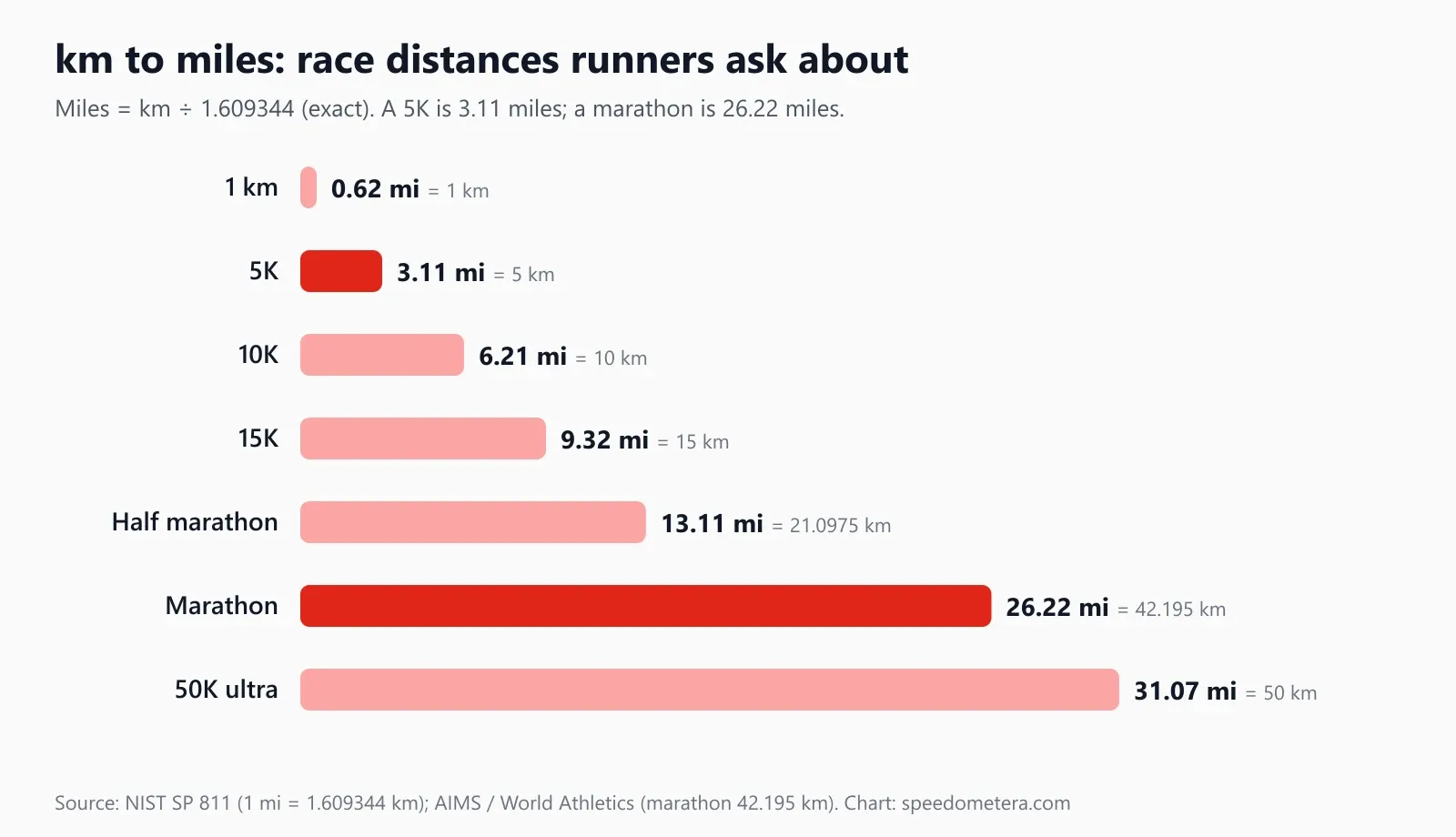
- How many miles is a 5K, 10K, half marathon and marathon?
- km to miles conversion table (1 to 1,000 km)
- How do you convert km to miles in your head?
- Where will you see km instead of miles?
- Common km to miles mistakes
- About this page
- Frequently asked questions
How to use the km to miles Converter
- 1Get a clear view of the skyMount your phone in a holder with a clear view of the sky before you set off.
- 2Tap Start and allow locationYour browser asks for location permission once. The first GPS fix usually arrives in 5–30 seconds.
- 3Pick your unitChoose km/h, mph, knots or m/s. Your choice is remembered on this device.
- 4Read speed, max, average and distanceThe gauge and digital readout update about once a second. Distance and average count only while you are moving.
- 5Stop or resetTap Stop to pause, Reset to clear the trip. Nothing is stored or sent anywhere.
Works in any modern phone browser. Back to the tool ↑
How do you use the km to miles converter?
Type a distance in the Kilometers box and the Miles box updates as you type; the line underneath reads it back, for example “10 km = 6.214 mi”. There is no Convert button and nothing is sent to a server. Step by step:
- Enter the km value in the left box. It starts at 10 so you can see the format.
- Read the miles result on the right and in the sentence below, shown to three decimals.
- Tap swap (⇄) for the reverse. The same tool on miles to km leads with miles.
- Copy the result to paste into a training log, a text or homework.
- Open “All units” to see the same distance in meters, feet, yards and nautical miles, and edit any of them.
- Scan the quick table under the inputs for 1 to 1,000 km without typing.
Need a speed rather than a distance? Use km/h to mph; the factor is the same, but the unit describes how fast, not how far.
What is the formula for km to miles?
miles = km ÷ 1.609344, which is the same as km × 0.621371. The divisor is exact by definition. NIST’s SI guide (SP 811, Appendix B.8) lists the mile as exactly 1.609344 km, because the international foot has been fixed at 0.3048 m since 1959 and a mile is 5,280 feet. NIST retired the slightly different US survey foot on January 1, 2023, so there is now one mile for every purpose in the US.
miles = km ÷ 1.609344 · miles = km × 0.621371
Worked example: a 25 km bike ride
25 ÷ 1.609344 = 15.53 miles. The quick rule says 25 × 0.6 = 15 miles, about half a mile short. The closer rule says 25 ÷ 8 × 5 = 15.63 miles, a tenth of a mile long.
How many miles is a 5K, 10K, half marathon and marathon?
A 5K is 3.11 miles, a 10K is 6.21 miles, a half marathon is 13.11 miles and a marathon is 26.22 miles. These are the km to miles conversions people search for most, because US races are named in kilometers but US runners train in miles. The marathon (42.195 km) and half marathon are the distances World Athletics uses for road world records, as listed by AIMS, the body whose measurers certify courses.
| Race | Distance (km) | Distance (miles) | Time at 10:00 min/mile | Time at 8:00 min/mile |
|---|---|---|---|---|
| 1K | 1 | 0.62 | 6:13 | 4:58 |
| 5K | 5 | 3.11 | 31:04 | 24:51 |
| 8K | 8 | 4.97 | 49:43 | 39:46 |
| 10K | 10 | 6.21 | 1:02:08 | 49:43 |
| 15K | 15 | 9.32 | 1:33:12 | 1:14:34 |
| Half marathon | 21.0975 | 13.11 | 2:11:06 | 1:44:53 |
| Marathon | 42.195 | 26.22 | 4:22:11 | 3:29:45 |
| 50K ultra | 50 | 31.07 | 5:10:41 | 4:08:33 |
| 100K ultra | 100 | 62.14 | 10:21:22 | 8:17:06 |
Want your own finish time? The pace calculator turns any pace in min/mile or min/km into a 5K, 10K or marathon time. Note that real courses are measured along the shortest legal line, so your GPS watch will usually show a little more than 3.11 miles for a 5K.
km to miles conversion table (1 to 1,000 km)
Every common distance converted with the exact factor and rounded to two decimals. Use the left pair for walks, runs and city trips, and the right pair for road trips and flights.
| km | miles | km | miles |
|---|---|---|---|
| 1 | 0.62 | 50 | 31.07 |
| 2 | 1.24 | 60 | 37.28 |
| 3 | 1.86 | 75 | 46.60 |
| 4 | 2.49 | 80 | 49.71 |
| 5 | 3.11 | 100 | 62.14 |
| 6 | 3.73 | 150 | 93.21 |
| 7 | 4.35 | 160 | 99.42 |
| 8 | 4.97 | 200 | 124.27 |
| 10 | 6.21 | 250 | 155.34 |
| 15 | 9.32 | 300 | 186.41 |
| 20 | 12.43 | 400 | 248.55 |
| 25 | 15.53 | 500 | 310.69 |
| 30 | 18.64 | 750 | 466.03 |
| 40 | 24.85 | 1,000 | 621.37 |
Two landmarks make the rest easy: 8 km is almost exactly 5 miles (4.97) and 160 km is almost exactly 100 miles (99.42). Scale from those and you will rarely be more than a few percent off.
How do you convert km to miles in your head?
Multiply by 6 and drop the last digit: 40 km → 240 → 24 miles (exact 24.85). It reads about 3.5% low, which is fine for “how far is the next town”. For closer answers, pick one of these:
- Halve three times, then × 5 (that is × 5/8). 80 km → 40 → 20 → 10 → 50 miles. Exact: 49.71. About 0.6% high.
- Half plus a tenth, plus a fiftieth. 100 km → 50 + 10 + 2 = 62 miles. Exact: 62.14. Within 0.2%.
- Fibonacci pairs read backward. 8 km ≈ 5 mi, 13 ≈ 8, 21 ≈ 13, 34 ≈ 21, 55 ≈ 34, 89 ≈ 55. The miles to km page explains why this works.
Which way is bigger?
For the same distance, the km number is always the bigger one. If your “miles” answer is larger than the km you started with, you multiplied by 1.6 instead of dividing.
Where will you see km instead of miles?
On road signs in Canada, Mexico, India and almost every country outside the US and UK, on race bibs, and on many trail and park maps. Canada switched its road signs to kilometers in the late 1970s, according to The Canadian Encyclopedia, so a sign reading “Toronto 120” means 120 km, or 74.6 miles. In India, highway milestones and Google Maps directions are in km; a 300 km drive is 186.4 miles.
Odometers and trip meters. A car sold in a km country counts kilometers. If a used import shows 80,000 on the odometer, that is 49,710 miles. Our GPS odometer can show a trip in either unit, which is handy in a rental car whose display you cannot switch.
Fitness apps and treadmills. Many treadmills and watches default to km outside the US. A 5 km treadmill session is 3.11 miles; 1 km splits of 6:00 are 9:39 per mile. If you also need speed, the speed, distance and time calculator does both units.
Nautical charts are different. Boats and aircraft use nautical miles: 1 nautical mile is exactly 1,852 m, or 1.15 statute miles. The All units panel shows nautical miles alongside km and miles.
Common km to miles mistakes
The most common slip is multiplying by 1.609 instead of dividing, turning 10 km into a bogus 16 miles. Miles are always the smaller number.
- Rounding the factor too early. 0.6 instead of 0.621371 loses 21 miles over 1,000 km. Convert first, round last.
- Treating “K” as a thousand miles or meters. In running, “5K” means 5 kilometers, never 5,000 miles; 5,000 meters, yes.
- Mixing up distance and speed. “100 km” is how far (62.14 miles); “100 km/h” is how fast (62.14 mph). Same number, different unit; see km/h to mph.
- Using GPS track length as the official race distance. GPS traces wander and usually read long; certified course length is what counts.
About this page
Every number on this page was computed with the site’s tested distance code (src/lib/distance.ts), which uses the exact NIST definition of the mile, and rounded only for display. Race distances come from AIMS and World Athletics; see the sources below. Written by Izhar Ahmad Danish. For your live distance and speed, open the GPS speedometer on the homepage.
FAQ
Frequently asked questions
How many miles is a 5K?
A 5K is 3.11 miles (3.107 to three decimals). Race organisers often round it to 3.1 miles. At a 10-minute-mile jogging pace it takes about 31 minutes; at a 12-minute walking-jog pace, about 37 minutes.
How many miles is a 10K?
A 10K is 6.21 miles (6.214 to three decimals), exactly twice a 5K. A 10-minute-mile runner finishes in about 62 minutes. The quick rule 10 × 0.6 gives 6 miles, about 0.2 miles short of the real distance.
How many minutes should a 5K take?
A 5K is 3.11 miles, so your time depends on pace: 31 minutes at a 10-minute-mile jog and about 1 hour 2 minutes at a 3 mph walk. Running USA found only two of the top 100 US races had an average 5K finish under 30 minutes.
Is a 30 minute 5K good?
Yes. A 30:00 5K means holding 9:39 per mile (6:00 per km), about 6.2 mph, for 3.11 miles. That beats the whole-field average at almost every big US 5K, according to Running USA's 2024 Top Races report. A 40-minute 5K (12:52 per mile) is a normal first-race time.
How many miles is 1 km?
1 km is 0.621 miles (0.621371), a little under five-eighths of a mile. Put the other way, a mile is 1.609 km, so one kilometer is roughly 1,094 yards or 3,281 feet, about ten US football fields end to end.
Is a km longer than a mile?
No. A mile is about 61% longer than a kilometer: 1 mile = 1.609344 km and 1 km = 0.621 miles. That is why any distance has a bigger number in km than in miles; 100 km is only 62.1 miles.
How many miles is a marathon in km?
A marathon is 42.195 km, which is 26.22 miles (26.219). The half marathon is half that, 21.0975 km or 13.11 miles. These distances are fixed by World Athletics, which recognises road world records over the marathon distance.
How do you convert km to miles in your head?
Multiply km by 6 and drop a zero: 50 km becomes 30 miles (exact 31.07). For a closer answer, halve three times and multiply by 5: 80 km → 40 → 20 → 10, × 5 = 50 miles (exact 49.71).
How far is 100 km in miles?
100 km is 62.14 miles. That is about an hour on a 62 mph highway. A 100 km ultramarathon is 62.1 miles, and a 160 km race is 99.4 miles, which is why a '100-mile' race is often described as 160 km.
Why is it 1.609344 and not 1.6?
Because the mile is 5,280 feet and the international foot has been exactly 0.3048 m since 1959, so 5,280 × 0.3048 = 1,609.344 m. Dividing by 1.6 is fine for estimates but reads 0.6% high: 625 miles for 1,000 km instead of 621.4.
5 Sources
- NIST SP 811, Appendix B.8: Factors for units listed alphabetically (mile = 1.609344 km, exact)
- NIST: international foot 0.3048 m exactly (1959); U.S. survey foot obsolete from January 1, 2023
- AIMS: World Athletics road world record distances (Half Marathon; Marathon 42.195 km)
- Running USA: 2024 Top Races report (Feb 2025), fastest average finish times at top US races
- The Canadian Encyclopedia: Metric conversion in Canada (road signs in km, 1977)
Last updated October 25, 2026 by Izhar Ahmad Danish. Found an error? Tell us.