



Key numbers
- 1 mph = 0.868976 knots; 1 knot = 1.150779 mph
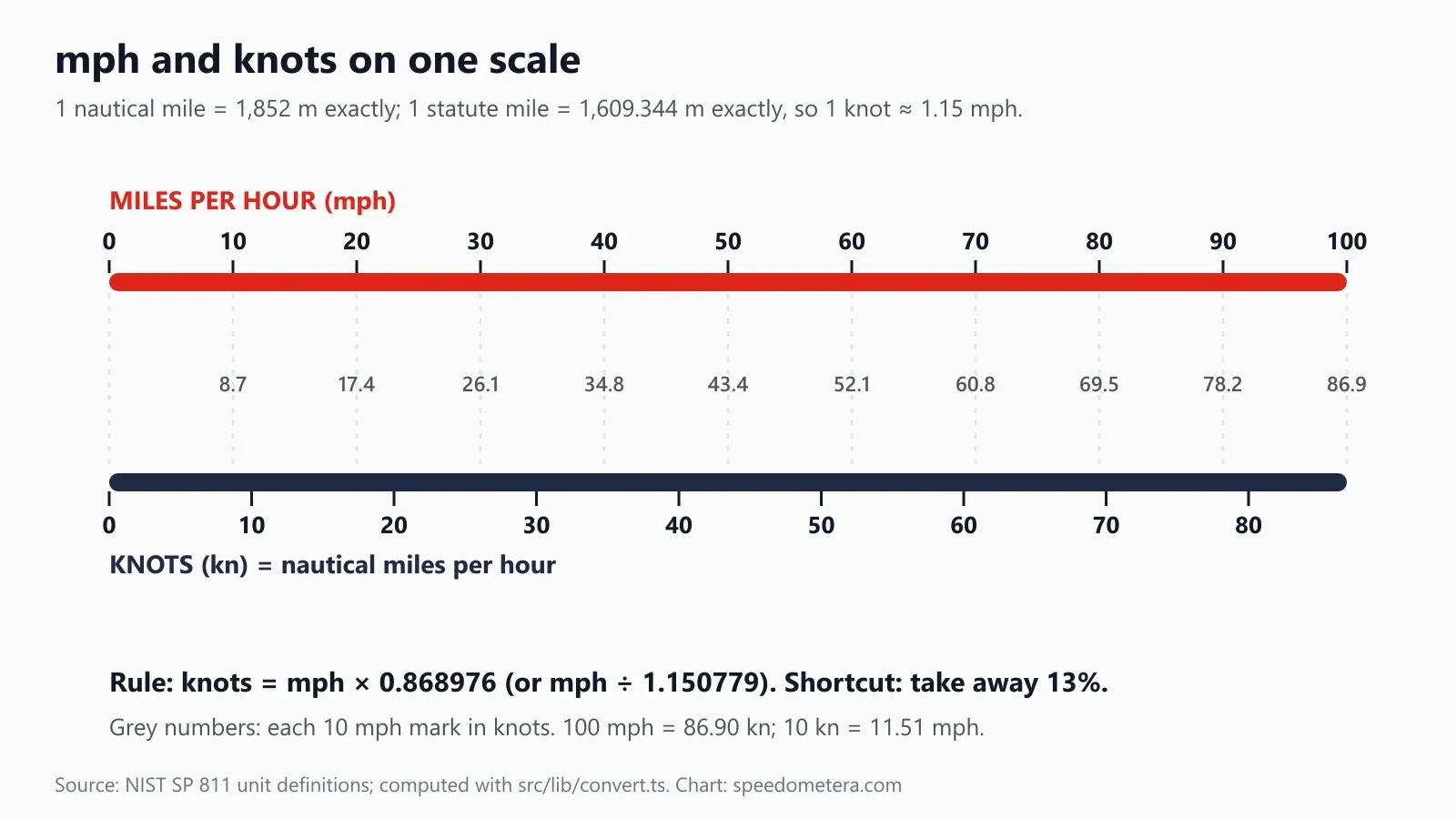
- Shortcut: mph minus 13% ≈ knots (60 mph → 52.2 kn; exact 52.14)
- 1 nautical mile = 1,852 m exactly; 1 statute mile = 1,609.344 m exactly
- 100 mph = 86.90 knots; 10 knots = 11.51 mph
- FAA limit below 10,000 ft: 250 knots (288 mph)
On this page
- How to use the mph to Knots Converter
- How do you convert mph to knots?
- mph to knots chart: 1 to 500 mph
- Is there a quick way to convert mph to knots in your head?
- Why is a knot bigger than a mile per hour?
- Do US boaters and the Coast Guard use knots or mph?
- How do mph and knots compare for wind speed?
- What speed is that in knots for pilots?
- Is GPS speed in knots accurate on a boat?
- Frequently asked questions
How to use the mph to Knots Converter
- 1Type a speed in any boxEnter a number in mph, km/h, knots, m/s, ft/s or Mach. Every other box updates as you type.
- 2Read the other unitsResults use exact definitions: 1 mile = 1,609.344 m, 1 nautical mile = 1,852 m, 1 foot = 0.3048 m.
- 3Swap or copyUse Swap to flip the main pair and Copy to copy a result. The quick table below lists common speeds.
Works in any modern phone browser. Back to the tool ↑
How do you convert mph to knots?
Multiply the speed in miles per hour by 0.868976 to get knots. That one factor is all an mph to knots conversion needs, and the converter at the top of this page applies it as you type. Dividing by 1.150779 gives the same answer, because 1.150779 is simply how many mph fit in one knot.
knots = mph × 0.868976 · mph = knots × 1.150779
Where the factor comes from: both units are defined in meters. Since 1959 the international (statute) mile has been exactly 1,609.344 m, and the international nautical mile is exactly 1,852 m. NIST’s Special Publication 811 marks both of those, and the mile-per-hour factor of 0.44704 m/s, as exact. Divide one by the other and you get 1,609.344 ÷ 1,852 = 0.868976… knots per mph. The decimals never end, which is why converters round the factor; this page keeps the full value internally and rounds only the number it shows you.
Definitions used on this page. mph (miles per hour): statute miles of 1,609.344 m per hour, the unit on US car speedometers and road signs. Knot (kn or kt): one nautical mile per hour. Nautical mile (NM): exactly 1,852 m, roughly one minute of latitude. Speed over ground (SOG): speed relative to the earth, what GPS measures. Speed through the water (STW): speed relative to the water, what a paddlewheel log measures. Indicated airspeed (IAS): the airspeed an aircraft’s instrument shows, which FAA speed limits refer to.
Worked examples, step by step
- 25 mph on a lake. 25 × 0.868976 = 21.72 knots.
- A 45 mph bass boat run. 45 × 0.868976 = 39.10 knots.
- A small plane’s 140 mph cruise. 140 × 0.868976 = 121.66 knots.
- A hurricane’s 74 mph threshold. 74 × 0.868976 = 64.30 knots, which the National Hurricane Center lists as 64 kt.
How to use the mph to knots converter
Type a number in the “Miles per hour” box and the “Knots” box fills in instantly, with no Convert button. The converter works both ways, so you can also type knots and read mph.
- Enter a speed in mph. The line under the boxes reads it back, for example “30 mph = 26.07 kn”.
- Swap the direction with the ⇄ button if you are starting from knots, for example a marine forecast or a chartplotter reading.
- Copy the result to paste it into a float plan, a logbook, a spreadsheet or a homework answer.
- Check other units in the “All units” grid: km/h, m/s, ft/s and Mach update from the same number.
- Use the “mph to kn quick table” under the converter for common speeds without typing at all.
On a boat and want your actual speed rather than a conversion? The live GPS speedometer on the homepage can show knots directly; set the unit to knots and keep the phone where it can see open sky.
mph to knots chart: 1 to 500 mph
This mph to knots chart covers walking pace to airliner speeds, with km/h alongside. Every value was calculated with the site’s conversion code from the exact definitions above and rounded to two decimals for knots.
| mph | knots (kn) | km/h | Where you meet this speed |
|---|---|---|---|
| 1 | 0.87 | 1.6 | Drifting with a light current |
| 5 | 4.34 | 8.0 | Slow, no-wake style speeds |
| 10 | 8.69 | 16.1 | Just under the 10-knot right whale limit |
| 15 | 13.03 | 24.1 | Moderate boat speed |
| 20 | 17.38 | 32.2 | Typical outboard cruising range |
| 25 | 21.72 | 40.2 | Residential street limit (by car) |
| 30 | 26.07 | 48.3 | Typical outboard cruising range |
| 35 | 30.41 | 56.3 | Urban arterial road limit (by car) |
| 40 | 34.76 | 64.4 | Fast for a recreational boat |
| 45 | 39.10 | 72.4 | Gale-force wind starts at 39 mph |
| 50 | 43.45 | 80.5 | Performance-boat territory |
| 55 | 47.79 | 88.5 | Two-lane highway in a car |
| 60 | 52.14 | 96.6 | Highway driving |
| 65 | 56.48 | 104.6 | Interstate limit in many states |
| 70 | 60.83 | 112.7 | Rural interstate limit |
| 75 | 65.17 | 120.7 | Western interstate limit |
| 80 | 69.52 | 128.7 | Top US posted limits |
| 90 | 78.21 | 144.8 | Light-aircraft range |
| 100 | 86.90 | 160.9 | Light-aircraft range |
| 150 | 130.35 | 241.4 | Category 4 hurricane winds (130–156 mph) |
| 200 | 173.80 | 321.9 | Under the 200-knot (230 mph) Class C/D limit |
| 250 | 217.24 | 402.3 | Under the 250-knot (288 mph) limit below 10,000 ft |
| 300 | 260.69 | 482.8 | Over the 250-knot limit below 10,000 ft |
| 500 | 434.49 | 804.7 | Jet cruise ground-speed range |
The “where you meet it” column is a rough guide for scale, not a specification: the speed of any one boat or aircraft depends on its design, load, weather and, for airplanes, altitude. For actual figures by aircraft type, see how fast planes fly, and for hull types and real-world boat speeds, see the boat speed guide.
Is there a quick way to convert mph to knots in your head?
Yes: take away 13%. Subtracting 13% is the same as multiplying by 0.87, which is within 0.12% of the exact factor 0.868976, so the shortcut is good enough for any helm, cockpit or classroom estimate.
Three ways to do it mentally, compared with the exact answer:
| mph | Exact knots | mph − 13% (× 0.87) | mph ÷ 1.15 | mph − 1/8 | Error of “− 1/8” |
|---|---|---|---|---|---|
| 10 | 8.69 | 8.70 | 8.70 | 8.75 | +0.7% |
| 30 | 26.07 | 26.10 | 26.09 | 26.25 | +0.7% |
| 50 | 43.45 | 43.50 | 43.48 | 43.75 | +0.7% |
| 100 | 86.90 | 87.00 | 86.96 | 87.50 | +0.7% |
| 300 | 260.69 | 261.00 | 260.87 | 262.50 | +0.7% |
- Minus 13% is the most accurate easy method. For 40 mph: 10% is 4, 3% is 1.2, so 40 − 5.2 = 34.8 knots (exact 34.76).
- Divide by 1.15 is the classic sailor’s rule and is even closer, but dividing by 1.15 is harder in your head than subtracting.
- Minus one-eighth is the fastest (halve three times, then subtract) and reads about 0.7% high. At 50 mph that is 43.75 instead of 43.45 knots, a difference a boat’s instruments could not even resolve.
The reverse rule, for knots to mph, is “add 15%”: 20 knots + 3 = 23 mph (exact 23.02). Our knots to mph converter has the full reverse chart.
Worked example: planning a 26-mile run across a bay
Your chart shows the crossing as 22.6 nautical miles and your boat cruises at 30 mph. Convert the speed first: 30 × 0.868976 = 26.07 knots. Time = distance ÷ speed = 22.6 ÷ 26.07 = 0.867 hours, or about 52 minutes. Mixing units, 22.6 “miles” at 30 mph, would give 45 minutes and leave you 7 minutes short on a fuel or daylight plan. The speed, distance and time calculator accepts nautical miles and knots directly.
Why is a knot bigger than a mile per hour?
Because a nautical mile (1,852 m) is about 15% longer than a statute mile (1,609.344 m), and a knot is one nautical mile per hour. The two units measure the same thing, speed, with different-length miles.
The nautical mile comes from the shape of the earth. NOAA’s National Ocean Service explains that one nautical mile corresponds to one minute of latitude, so a navigator can measure distance straight off the latitude scale on the side of a chart: 60 nautical miles is one degree. The statute mile has no such link; it is a land unit of exactly 5,280 feet. The modern nautical mile was rounded to exactly 1,852 m, so it is no longer precisely one minute of latitude everywhere (the earth is slightly flattened), but it is within a fraction of a percent.
The word “knot” is older than the definition. NOAA dates it to 17th-century sailors who threw a “common log”, a wooden board on a line knotted at regular intervals, over the stern and counted how many knots ran out while a sandglass emptied. The count gave the ship’s speed directly, and the name stuck.
| Unit | Exact length | In feet | Typical US user |
|---|---|---|---|
| Statute mile | 1,609.344 m | 5,280 ft | Drivers, road signs, car speedometers |
| Nautical mile | 1,852 m | 6,076.1 ft | Mariners, pilots, NOAA charts |
| Kilometer | 1,000 m | 3,280.8 ft | Most of the world; science |
That 15% gap is why the unit on a display matters. If a passenger reads “30” off a chartplotter set to knots and assumes mph, they underestimate the boat’s speed by 4.5 mph.
Do US boaters and the Coast Guard use knots or mph?
Both appear, but navigation is done in knots and nautical miles. NOAA nautical charts use nautical miles, marine forecasts give wind in knots, and federal marine rules are written in knots, while many recreational boats, especially smaller outboard and pontoon boats, ship with speedometers in mph.
What the federal rules actually say about speed:
- There is no single federal speed limit for recreational boats. Rule 6 of the Coast Guard’s Navigation Rules requires every vessel to “proceed at a safe speed” so it can avoid a collision and stop within a distance appropriate to the conditions, considering visibility, traffic density, maneuverability, wind, sea, current and nearby hazards. No-wake zones and numeric limits are set by states and local authorities, so check your state boating agency and posted buoys.
- Rule 23 of the international rules lets a power-driven vessel under 7 m (about 23 ft) whose maximum speed does not exceed 7 knots (8.06 mph) show a simpler all-round white light instead of full sidelights.
- NOAA’s right whale rule (50 CFR 224.105) requires most vessels 65 feet or longer to travel at 10 knots (11.51 mph) or less in seasonal management areas along the US East Coast, such as Cape Cod Bay from January 1 to May 15. Smaller vessels are asked to slow down voluntarily.
Speed does show up in accident data. In its Recreational Boating Statistics 2024, the Coast Guard counted 3,887 recreational boating incidents with 556 deaths and 2,170 injuries. Excessive speed was the sixth most common primary contributing factor, linked to 279 incidents, 26 deaths and 245 injuries. Where the cause of death was known, 76% of victims drowned, and where life jacket use was known, 87% of them were not wearing one.
| Boating speed reference | knots | mph | km/h | Source |
|---|---|---|---|---|
| Rule 23 small-boat light exemption | 7 | 8.06 | 12.96 | USCG Navigation Rules |
| Right whale seasonal limit (65 ft+) | 10 | 11.51 | 18.52 | NOAA Fisheries, 50 CFR 224.105 |
| Gale-force wind begins (Beaufort 8) | 34 | 39.13 | 62.97 | NOAA SPC Beaufort scale |
| Storm-force wind begins (Beaufort 10) | 48 | 55.24 | 88.90 | NOAA SPC Beaufort scale |
| Hurricane-force wind (Category 1) | 64 | 74 | 119 | NOAA NHC (rounded as published) |
How do mph and knots compare for wind speed?
US marine and aviation forecasts give wind in knots, and public forecasts mostly use mph, so boaters convert constantly. The Beaufort scale, which the NOAA Storm Prediction Center publishes in knots, converts to mph like this (lower bound of each force, calculated):
| Beaufort force | Description | Wind from (knots) | Wind from (mph) |
|---|---|---|---|
| 1 | Light air | 1 | 1.2 |
| 2 | Light breeze | 4 | 4.6 |
| 3 | Gentle breeze | 7 | 8.1 |
| 4 | Moderate breeze | 11 | 12.7 |
| 5 | Fresh breeze | 17 | 19.6 |
| 6 | Strong breeze | 22 | 25.3 |
| 7 | Near gale | 28 | 32.2 |
| 8 | Gale | 34 | 39.1 |
| 9 | Strong gale | 41 | 47.2 |
| 10 | Storm | 48 | 55.2 |
| 11 | Violent storm | 56 | 64.4 |
| 12 | Hurricane | 64 | 73.6 |
A practical reading: if a public forecast says “winds 20 to 25 mph”, that is 17.4 to 21.7 knots, squarely Beaufort 5 (fresh breeze), where small open boats often find conditions uncomfortable. The National Hurricane Center publishes its categories in both units, with Category 3, the first “major” hurricane, starting at 111 mph or 96 knots. Note that the NHC rounds its published thresholds, so they can differ by a unit from a straight conversion.
What speed is that in knots for pilots?
US aviation speeds and limits are in knots, so a pilot quoting mph is converting. The FAA’s 14 CFR 91.117 writes the rule out in both units: no aircraft may fly below 10,000 feet MSL faster than 250 knots (288 mph) indicated airspeed unless authorized, and near the primary airport of Class C or D airspace, at or below 2,500 ft above the surface, the limit is 200 knots (230 mph). The site’s converter gives 250 kn = 287.69 mph and 200 kn = 230.16 mph, matching the FAA’s rounded figures.
If an older aircraft manual or airspeed indicator is marked in mph, check which unit its speeds use before comparing them with knots-based charts and limits: 100 on an mph scale is only 86.9 knots.
Two things to keep apart:
- Airspeed vs ground speed. FAA limits refer to indicated airspeed. A GPS speedometer on a phone shows ground speed, which adds a tailwind or subtracts a headwind, so the GPS knots on a flight can be well above or below what the cockpit shows.
- Knots vs Mach. At airliner altitudes, speed limits and cruise numbers switch to Mach. A Mach figure in mph depends on air temperature, so convert it only with the altitude in mind; the speed converter explains how its Mach box works.
Is GPS speed in knots accurate on a boat?
GPS gives speed over ground, and on a boat that is usually the number you want for navigation, but it can differ from the speed through the water by the speed of any current. If you run at 20 knots through the water against a 2-knot ebb, a GPS speedometer reads about 18 knots, while a paddlewheel log reads 20. Both are correct; they measure different things.
Tips for a steadier GPS knots reading:
- Give the phone a clear view of the sky. A cabin roof, T-top or bimini with a metal frame can weaken the signal and make readings jump.
- Expect a lag of a second or two. GPS speed is calculated from successive position and Doppler measurements, so it trails sudden acceleration slightly.
- Average over a straight run. For a speed trial, hold a steady heading and throttle for a minute and read the average, or time a measured distance and use the speed, distance and time calculator.
- Treat it as an estimate. Like any phone speedometer, the reading depends on the device, signal and sky view. It is for information, not for legal evidence or instrument calibration.
Keep the phone in a waterproof case or mount, and let a passenger handle it rather than the person at the helm. For a fuller explanation of why GPS and dashboard speeds disagree on the road, see GPS vs car speedometer.
Common mph to knots mistakes
The most common error is multiplying when you should divide: mph × 1.15 gives a number 32% too large, not knots. Remember that the knot figure is always the smaller of the two.
- Using 1.15 the wrong way. 30 mph × 1.15 = 34.5 is the knots-to-mph answer for 30 knots. The correct mph-to-knots result is 30 ÷ 1.15 = 26.1 knots.
- Mixing nautical and statute miles in time-distance planning. If the chart distance is in nautical miles, the speed must be in knots, as in the bay-crossing example above.
- Writing “knots per hour”. A knot already means “per hour”, so “20 knots per hour” would be an acceleration. Say “20 knots”.
- Confusing kn with km/h. The symbol for knots is kn (aviation often writes kt); km/h is kilometers per hour. 30 kn is 55.56 km/h, not 30 km/h. If you need km/h as well, the mph to km/h converter and the full speed converter cover it.
- Over-rounding the factor. Using 0.87 is fine for estimates, but in a long chain of calculations (fuel burn, ETA over several legs), keep 0.868976 or let the converter do it.
About this page
Conversion factors come from NIST Special Publication 811 and the exact international definitions of the mile (1,609.344 m) and nautical mile (1,852 m). Every value in the tables was calculated with the site’s tested conversion code in src/lib/convert.ts and rounded only for display. Boating, weather and aviation figures are taken from the US Coast Guard, NOAA and the FAA’s regulations as listed in the sources, checked on October 25, 2026. Researched and written by Izhar Ahmad Danish.
FAQ
Frequently asked questions
How do you convert mph to knots?
Multiply the speed in mph by 0.868976, or divide it by 1.150779. For example, 40 mph × 0.868976 = 34.76 knots. For a quick estimate, subtract 13%: 40 minus 5.2 is 34.8 knots, within 0.1% of the exact answer.
How many knots is 1 mph?
1 mph is 0.868976 knots, a little under nine-tenths of a knot. That is because a statute mile (1,609.344 m) is shorter than a nautical mile (1,852 m). Going the other way, 1 knot is 1.150779 mph.
How many knots is 60 mph?
60 mph is 52.14 knots. The mental shortcut gives 60 minus 13% = 52.2 knots. On the water that is very fast for a recreational boat; in the air it is slower than the approach speed of most light airplanes.
What is 100 mph in knots?
100 mph is 86.90 knots. Multiply 100 by 0.868976 to get 86.8976 and round. The reverse is also handy: 100 knots is 115.08 mph, which is why a 100-knot airplane is often described as cruising at about 115 mph.
How many knots is 35 mph?
35 mph is 30.4 knots (30.41). Multiply by 0.868976, or take off 13%: 35 minus 4.6 is 30.4. For a planing powerboat that is a fast cruise, and as a wind it sits in the Beaufort near-gale band of 28 to 33 knots.
How many knots is a 20 mph wind?
A 20 mph wind is 17.4 knots (32.2 km/h). That is the bottom of Beaufort force 5, a fresh breeze of 17 to 21 knots. Marine and aviation forecasts from the National Weather Service give wind in knots, so convert a land forecast in mph before comparing the two.
What is 200 mph in knots?
200 mph is 173.8 knots (321.9 km/h). Multiply 200 by 0.868976. Aircraft speeds are quoted in knots, so a plane cruising at 174 knots is doing about 200 mph. Under 14 CFR 91.117, most aircraft must fly at or below 250 knots (287.7 mph) below 10,000 feet.
Is mph or knots used for wind speed in the US?
Both. The National Weather Service uses knots in marine and aviation forecasts and mph in most public forecasts. The National Hurricane Center lists each category in both: Category 1 starts at 64 knots, or 74 mph.
How do I get my boat's speed in knots on my phone?
Open the GPS speedometer on this site, switch the unit to knots and stand where your phone can see open sky. It shows speed over ground from GPS, which differs from speed through the water when there is a current. Keep the phone secured in a waterproof case.
8 Sources
- NIST SP 811, Appendix B.8: conversion factors (mile per hour, knot, nautical mile)
- NOAA National Ocean Service: What is the difference between a nautical mile and a knot?
- U.S. Coast Guard Navigation Center: Navigation Rules (Rule 6 safe speed, Rule 23)
- U.S. Coast Guard: Recreational Boating Statistics 2024 (COMDTPUB P16754.38)
- NOAA Fisheries: Reducing vessel strikes to North Atlantic right whales (10-knot rule, 50 CFR 224.105)
- NOAA Storm Prediction Center: Beaufort wind force scale
- NOAA National Hurricane Center: Saffir-Simpson Hurricane Wind Scale
- 14 CFR 91.117: Aircraft speed (Cornell LII)
Last updated October 25, 2026 by Izhar Ahmad Danish. Found an error? Tell us.