


Key numbers
- UN R39: shown speed may never be below true speed, and at most 10% + 4 km/h above it
- At a true 65 mph, an R39 speedometer may show anywhere from 65 to 74 mph
- US passenger cars: no federal accuracy limit. Trucks and buses: ±5 mph at 50 mph (49 CFR 393.82)
- Worn tread (8/32 in lost) shrinks a 265/70R17 tire 1.6%: an indicated 70 mph becomes 68.9 mph
- GPS signal speed error commitment: ≤0.006 m/s (0.013 mph), but phones lag 1–2 s when speed changes
On this page
- How to use the GPS vs Car Speedometer
- How accurate is a car speedometer?
- Why do car speedometers read high?
- What does UN Regulation 39 allow? (with mph table)
- What are the US rules for speedometer accuracy?
- How do tire wear and tire size change speedometer accuracy?
- Is GPS speed more accurate than a car speedometer?
- How do I test my speedometer accuracy with GPS?
- How do I convert or correct speedometer readings?
- Speedometer accuracy: what this page does not claim
- Frequently asked questions
How to use the GPS vs Car Speedometer
- 1Get a clear view of the skyMount your phone in a holder with a clear view of the sky before you set off.
- 2Tap Start and allow locationYour browser asks for location permission once. The first GPS fix usually arrives in 5–30 seconds.
- 3Pick your unitChoose km/h, mph, knots or m/s. Your choice is remembered on this device.
- 4Read speed, max, average and distanceThe gauge and digital readout update about once a second. Distance and average count only while you are moving.
- 5Stop or resetTap Stop to pause, Reset to clear the trip. Nothing is stored or sent anywhere.
Works in any modern phone browser. Back to the speedometer ↑
How accurate is a car speedometer?
Speedometer accuracy in most cars is a few percent, and the error almost always points one way: the dash shows more than your true speed. That is by design. The rule most of the world uses, UN Regulation No. 39, says a speedometer may never read below true speed but may read up to 10% plus 4 km/h above it. A typical car lands well inside that window, often 1–4 mph high at highway speed, but the only way to know your own car is to measure it, which takes two minutes with the GPS speedometer at the top of this page.
Key terms on this page. Indicated speed (V1) is what the dashboard shows. True speed (V2) is your real speed over the ground. Speedometer error is (indicated − true) ÷ true × 100, positive when the dash reads high. GPS speed is the speed your phone’s satellite receiver calculates, mostly from the Doppler shift of the signals. UN R39 is the United Nations vehicle regulation for speedometers; FMVSS is the US Federal Motor Vehicle Safety Standards from NHTSA.
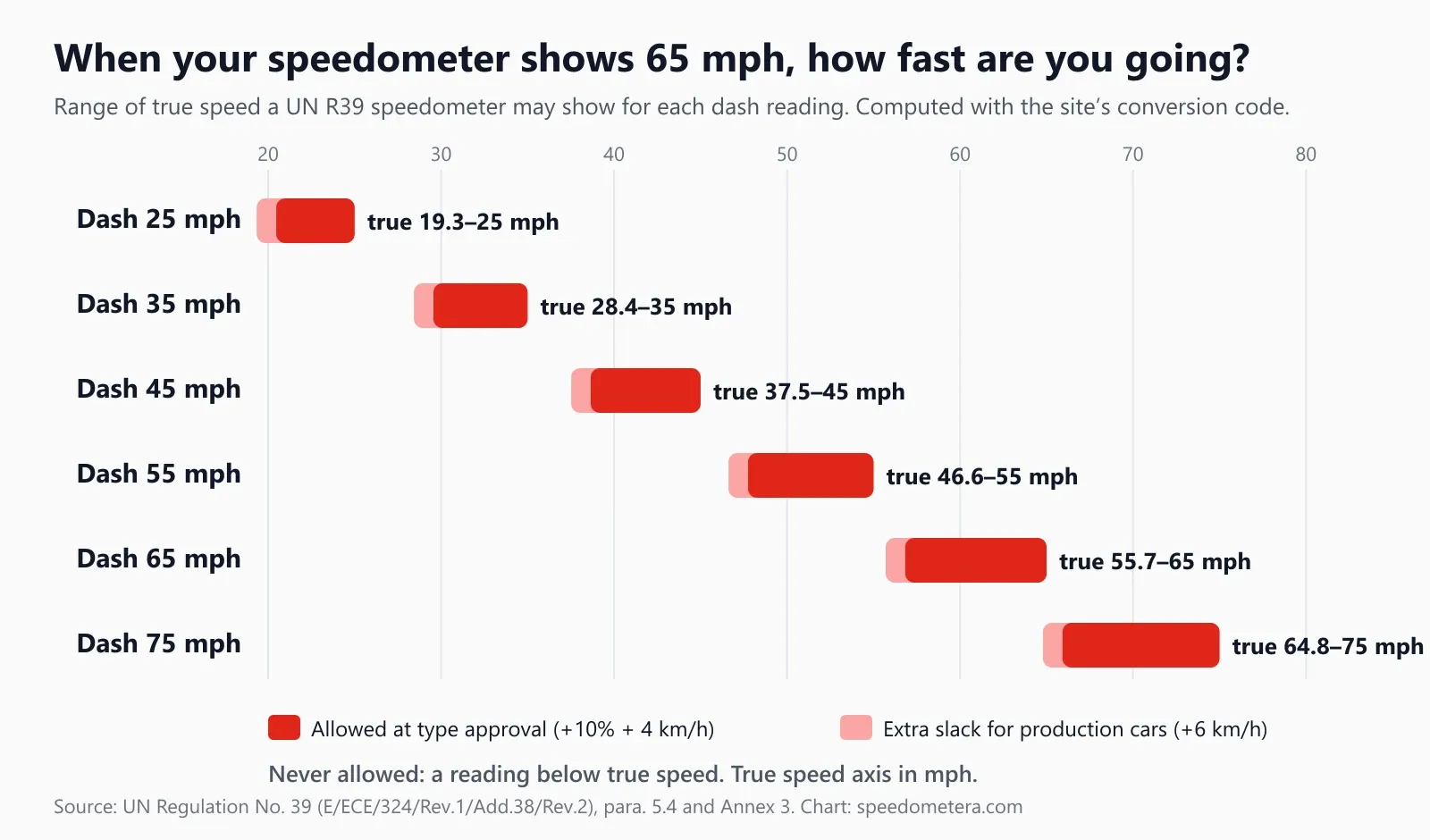
Two things follow from the chart. First, a speedometer built to R39 can be wrong by a lot more than most drivers assume: a reading of 65 mph is legal anywhere from a true 55.7 mph to 65 mph. Second, it is never legal for that same reading to mean 66 mph. If you are going to be wrong, the rules want you to be slower than you think, not faster.
Why do car speedometers read high?
Speedometers read high because the rules punish reading low and allow reading high, and because tires shrink as they wear. A car doesn’t measure speed directly. It counts wheel or transmission revolutions and multiplies by the distance one tire revolution is assumed to cover. Every source of error then pushes in a predictable direction.
- The regulation is one-sided. R39 paragraph 5.4 states that the speed indicated “shall not be less than the true speed of the vehicle.” A maker that calibrated exactly to true speed would risk some cars, through tolerance stacking, reading below it and failing. So they aim above zero.
- Production gets extra slack. Type approval uses +4 km/h. For checking cars coming off the line (conformity of production), Annex 3 allows +6 km/h for passenger cars and trucks (categories M and N) and +8 km/h for larger motorcycles (L3–L5). That 2 km/h is about 1.2 mph more headroom.
- Tires are calibrated new and run worn. A tire is largest the day it is fitted. Every 32nd of an inch of tread that wears off makes it turn slightly more often per mile, which the car counts as extra speed. Worn tires push the reading further high.
- Global platforms. US-market cars are not type-approved under R39, but most are designed once for many markets, and the same instrument calibration tends to ship everywhere. The “never read low” bias therefore shows up on US dashboards too.
- Liability and tickets. A speedometer that reads 2 mph low could get its owner a speeding ticket at an indicated limit. One that reads 2 mph high costs the driver nothing but a slightly slower trip.
Under-inflated tires add a little more high-reading error, because a soft tire’s rolling radius is smaller. The effect is small next to tread wear, but it is another reason to set pressures before you test.
What does UN Regulation 39 allow? (with mph table)
R39 requires 0 ≤ (V1 − V2) ≤ 0.1 × V2 + 4 km/h at its test speeds: never below true speed, and at most 10% plus 4 km/h above it. The formula is in km/h, so the allowance in mph is a little over 10% plus 2.5 mph.
0 ≤ (V1 − V2) ≤ 0.1 × V2 + 4 km/h
Worked example: true speed 65 mph = 104.6 km/h. The upper limit is 1.1 × 104.6 + 4 = 119.1 km/h = 74.0 mph. So a 2026 car approved to R39 may show anything from 65.0 to 74.0 mph at a true 65 mph.
The test is tightly defined. Paragraph 5.3 says the vehicle is tested unladen on one of its normally fitted tire types (snow tires excluded) at normal running pressure, with the speedometer at 23 ± 5 °C, and the equipment measuring true speed must itself be accurate to ±0.5%. For a car with a top speed above 150 km/h, the test speeds are 40, 80 and 120 km/h (24.9, 49.7 and 74.6 mph). Outside those points the regulation doesn’t set a figure, though a well-built speedometer behaves the same way across its range.
Widest legal over-read under R39, by true speed
| True speed | Lowest allowed reading | Highest at type approval (+4 km/h) | Highest in production, cars (+6 km/h) |
|---|---|---|---|
| 25 mph (40.2 km/h) | 25 mph | 30.0 mph (+5.0) | 31.2 mph (+6.2) |
| 35 mph (56.3 km/h) | 35 mph | 41.0 mph (+6.0) | 42.2 mph (+7.2) |
| 45 mph (72.4 km/h) | 45 mph | 52.0 mph (+7.0) | 53.2 mph (+8.2) |
| 55 mph (88.5 km/h) | 55 mph | 63.0 mph (+8.0) | 64.2 mph (+9.2) |
| 65 mph (104.6 km/h) | 65 mph | 74.0 mph (+9.0) | 75.2 mph (+10.2) |
| 70 mph (112.7 km/h) | 70 mph | 79.5 mph (+9.5) | 80.7 mph (+10.7) |
| 75 mph (120.7 km/h) | 75 mph | 85.0 mph (+10.0) | 86.2 mph (+11.2) |
| 80 mph (128.7 km/h) | 80 mph | 90.5 mph (+10.5) | 91.7 mph (+11.7) |
Computed with the site’s exact conversion (1 mph = 1.609344 km/h), rounded to 0.1 mph. The +6 km/h column applies to category M and N vehicles at conformity of production (R39 Annex 3).
What a dash reading can mean in true speed
Drivers rarely know their true speed and want to read the table the other way round: “my dash says 70, how fast could I really be going?” Solving the formula for V2 gives the lowest true speed: (V1 − 4 km/h) ÷ 1.1.
| Dash shows | True speed, type approval limit | True speed, production limit | Largest possible over-read |
|---|---|---|---|
| 25 mph | 20.5–25 mph | 19.3–25 mph | 29.3% |
| 35 mph | 29.6–35 mph | 28.4–35 mph | 23.1% |
| 45 mph | 38.6–45 mph | 37.5–45 mph | 19.9% |
| 55 mph | 47.7–55 mph | 46.6–55 mph | 18.0% |
| 65 mph | 56.8–65 mph | 55.7–65 mph | 16.7% |
| 70 mph | 61.4–70 mph | 60.2–70 mph | 16.2% |
| 75 mph | 65.9–75 mph | 64.8–75 mph | 15.8% |
| 80 mph | 70.5–80 mph | 69.3–80 mph | 15.4% |
Notice the percentage shrinks as speed rises. The fixed 4 or 6 km/h part dominates at town speeds, so the legal error is largest exactly where speed limits are lowest, around schools and in residential streets. Real cars use only a small part of this envelope, but it explains why a dash 25 mph can feel slow next to a GPS reading.
What are the US rules for speedometer accuracy?
For US passenger cars there is no federal accuracy limit. Trucks and buses run by motor carriers must read within ±5 mph at 50 mph, and carmakers follow voluntary SAE practice.
| Vehicle or standard | Rule | Accuracy requirement |
|---|---|---|
| Passenger cars, SUVs, pickups (new) | FMVSS No. 101, 49 CFR 571.101 (NHTSA) | None. Covers how the speedometer is identified and lit, not how accurate it is |
| Buses, trucks and truck-tractors (motor carriers) | 49 CFR 393.82 (FMCSA) | Within ±5 mph (8 km/h) at 50 mph (80 km/h) |
| Electric speedometers, all on-road vehicles | SAE J1226 (voluntary, issued 1983, stabilized 2011) | Limits behind SAE’s paywall; not quoted here |
| Cars approved for Europe, UK, Japan, Australia and others | UN R39 | Never low; at most +10% + 4 km/h (+6 km/h in production) |
FMVSS No. 101 is the federal standard that governs controls and displays: it says which indicators must be identified, with what word or symbol, and how they are illuminated. Its text sets no tolerance for how close the speedometer reading must be to true speed. The trucking rule in 49 CFR 393.82 is the only federal accuracy figure, and it is loose: ±5 mph at 50 mph is a ±10% window that can be wrong in either direction.
In practice, US-market cars are engineered to the manufacturer’s own targets and to SAE recommended practices such as J1226. Because the SAE text is paid and we have not read it, we don’t quote figures for it. You will see “SAE allows ±2% or +4%” claims on forums; treat them as unverified.
The law that does matter to you is traffic law. Police radar and lidar measure true speed, and in US states the driver is responsible for the vehicle’s actual speed. “My speedometer was wrong” is not a defense that courts can be expected to accept, especially after you fitted bigger tires.
How do tire wear and tire size change speedometer accuracy?
Worn tires make the speedometer read higher, by about 1.5–1.9% between new and legally worn tread; taller tires make it read lower, by the same percentage the diameter grows. The car assumes a fixed number of revolutions per mile, so every change in tire diameter shifts every reading by the same percentage.
Tire wear: new vs worn tread on common sizes
The table assumes a tire calibrated with 10/32 inch of tread that wears to 2/32 inch, the depth at which the FMVSS No. 139 treadwear indicators begin to show (1/16 inch). That is 8/32 inch lost on each side, so the diameter shrinks by 0.5 inch. Your tire’s new tread depth may differ; check the maker’s spec.
| Tire size | New diameter | Revolutions per mile (new) | Worn diameter | Diameter change | True speed at an indicated 70 mph (worn) |
|---|---|---|---|---|---|
| P215/55R17 (compact sedan) | 26.3 in | 767 | 25.8 in | −1.90% | 68.7 mph |
| 235/45R18 (sport sedan) | 26.3 in | 766 | 25.8 in | −1.90% | 68.7 mph |
| 225/65R17 (compact SUV) | 28.5 in | 707 | 28.0 in | −1.75% | 68.8 mph |
| 265/70R17 (full-size pickup) | 31.6 in | 638 | 31.1 in | −1.58% | 68.9 mph |
| LT275/65R20 (heavy-duty pickup) | 34.1 in | 592 | 33.6 in | −1.47% | 69.0 mph |
Nominal geometry from the size code, computed with the same code as our tire size calculator. Real tires differ slightly by brand and load.
Small tires lose a larger share of their diameter to the same tread wear, so low-profile tires on sedans drift more than pickup tires. When you fit a fresh set, the speedometer of an older car can read about 1 mph lower at 70 mph than it did the week before. Neither is “wrong”; the tire changed.
Tire size changes: the big errors
| Change | Diameter change | True speed at an indicated 70 mph | Speedometer error |
|---|---|---|---|
| 225/65R17 → 235/65R17 (one size wider) | +1.8% | 71.3 mph | reads 1.8% low |
| 225/65R17 → 225/60R17 (lower profile) | −3.1% | 67.8 mph | reads 3.2% high |
| 265/70R17 → 285/70R17 | +3.5% | 72.4 mph | reads 3.4% low |
| 265/70R17 → 33x12.50R17 | +4.4% | 73.1 mph | reads 4.2% low |
| 265/70R17 → 35x12.50R17 | +10.7% | 77.5 mph | reads 9.7% low |
The last row is why lifted trucks get speeding tickets. On 35s without reprogramming, an indicated 65 mph is a true 72 mph, which is past R39’s whole envelope in the wrong direction. Fix it with a reprogram, then confirm with GPS. The speedometer calibration calculator turns your measured error into a correction factor, and covers axle gear swaps as well.
Is GPS speed more accurate than a car speedometer?
At a steady speed on an open road, a phone’s GPS speed is usually more accurate than the dashboard, typically within about 1 mph, while the speedometer is deliberately biased high. GPS loses that advantage while you accelerate, brake or drive through tunnels and downtown streets.
Phones don’t just divide distance by time. The receiver measures the Doppler shift of each satellite’s signal, which gives velocity directly. GPS.gov states the government’s commitment for the signal itself as a user range-rate error of no more than 0.006 m/s over any 3-second interval, which is 0.013 mph. The signal is therefore not the weak link; your phone’s antenna, its view of the sky and its filtering are. GPS.gov also gives typical smartphone position accuracy as 4.9 m (16 ft) under open sky, and lists what degrades it: buildings, bridges and trees blocking signals, reflections off buildings, indoor use and interference.
| Situation | Car speedometer | Phone GPS speed | Better choice |
|---|---|---|---|
| Steady highway speed, open sky | Biased high, often 1–4 mph | Usually within ~1 mph | GPS |
| Hard braking or acceleration | Instant | Lags 1–2 s | Speedometer |
| Tunnels, parking garages | Works | No reading | Speedometer |
| Downtown “urban canyons” | Works | Jumps of a few mph possible | Speedometer |
| After fitting bigger tires | Reads low by the diameter change | Unaffected | GPS |
| Legal evidence or calibration certificate | Not either | Not either | Calibrated radar/test equipment |
The lag matters more than people expect. Braking at 0.3 g, a car sheds 6.6 mph every second, so a GPS display that is one second behind can show a number 6–7 mph higher than the dashboard during the stop. That is not GPS being inaccurate; it is GPS being late. Always compare the two at a steady speed.
Distance works the same way: a GPS distance tracker is unaffected by tire wear, which is why our trip odometer is handy for checking your car’s odometer over a measured trip, and a HUD speedometer puts the GPS number in your line of sight without picking up the phone.
How do I test my speedometer accuracy with GPS?
Mount your phone, open this page, set cruise control to an indicated 60 mph on a straight level road, and have a passenger compare the dash with the GPS reading for 15–20 seconds. Then work out the percentage error.
- Prepare the car. Set tire pressures to the door-jamb placard and note your tire size.
- Start the GPS speedometer before you drive. Mount the phone in a holder with a clear view of the sky, tap Start, allow location and wait until the accuracy line says “good” or better.
- Pick the road. A straight, level, dry interstate stretch with light traffic. Hills and curves change speed between readings.
- Hold a steady indicated speed. Use cruise control at 60 mph (and later 30 and 70 mph). Wait 10 seconds for GPS to settle.
- Read both numbers. A passenger reads the GPS speed several times while the dash holds steady.
- Calculate. Error % = (indicated − GPS) ÷ GPS × 100. Dash 60, GPS 58 means (60 − 58) ÷ 58 = +3.4%, reading high.
- Repeat in the other direction to cancel grade and wind, and average the runs. The percentage should be about the same at every speed.
The driver must not handle the phone
Mount the phone hands-free before you set off and let a passenger take every reading. Reading or tapping a phone while driving is dangerous and illegal in many states. Never exceed the speed limit to test a high reading.
Reading your result
+1% to +5%: normal for a factory car, especially on worn tires. 0% to +1%: unusually close; fresh tires or a precise calibration. Negative (reads low): you are faster than the dash shows. Check tire size and pressure, then have the speed sensor or calibration checked. Larger than +8%: check for wrong-size tires or a wrong calibration setting.
No signal or no phone? A timed mile between interstate mile markers works too: true mph = 3,600 ÷ seconds. A mile in 60 seconds is 60 mph. The speedometer calibration calculator does that maths and builds a corrected speed table for your car.
How do I convert or correct speedometer readings?
Multiply the dash reading by true ÷ indicated to get your true speed; convert mph and km/h with 1 mph = 1.609344 km/h exactly. Both are useful after you have measured your car once.
True speed = dash reading × (GPS speed ÷ dash speed at your test)
Worked example: GPS showed 58 mph at a dash 60 mph, so the factor is 58 ÷ 60 = 0.967. At a dash reading of 75 mph you are really doing 75 × 0.967 = 72.5 mph. Because the error is proportional to tire diameter, one test at a steady speed gives a factor that works across the range.
If you rent a car with a km/h speedometer or drive across the border, the km/h to mph converter and the full speed converter give exact values: 100 km/h is 62.1 mph, 120 km/h is 74.6 mph. Canadian and many imported cars show km/h prominently, and R39 requires an mph scale on cars sold where imperial units are used.
For a quick live check at any time, keep the online GPS speedometer open on a mounted phone. It shows speed, maximum, distance and an accuracy line, and works offline once loaded.
Speedometer accuracy: what this page does not claim
GPS speed from a phone is an estimate. It depends on the satellite signal, the phone’s antenna and chip, and its view of the sky, and it can lag or jump in tunnels, cities and in the first seconds after start-up. Neither our speedometer nor your car’s dashboard is a calibration certificate or legal evidence. If you need a certified result, for example for a court, use a calibrated test facility.
FAQ
Frequently asked questions
Is my speedometer accurate?
Probably within a few percent, and most likely reading high. Speedometers built to UN Regulation No. 39 may never read low and may read up to 10% plus 4 km/h high. Test yours: hold an indicated 60 mph on cruise control and have a passenger compare it with the GPS speedometer above.
Is GPS more accurate than a car speedometer?
At a steady speed under open sky, usually yes. Phones measure speed from the Doppler shift of satellite signals, and GPS.gov puts the signal's speed error at no more than 0.006 m/s. GPS lags 1–2 seconds while you accelerate or brake and drops out in tunnels, so compare at constant speed.
Why does my speedometer say I'm going faster than GPS?
Because it is designed to. A speedometer that read 1 mph low could get drivers tickets, so carmakers aim high; UN R39 allows up to 10% + 4 km/h over and nothing under. Worn tires and low pressure add another 1–2%. A gap of 1–4 mph at highway speed is normal.
How far off can a speedometer legally be?
Under UN R39, at a true 65 mph a new-car speedometer may show between 65 and 74 mph, and production cars get 2 km/h more slack (up to 75.2 mph). In the US, passenger cars have no federal limit; trucks and buses must be within 5 mph at 50 mph under 49 CFR 393.82.
Do speedometers read high or low?
High, in almost every unmodified car. UN R39 forbids any reading below true speed, and US-market cars are mostly engineered to the same global designs. A speedometer reads low mainly after fitting taller tires or changing axle gears: 35-inch tires on a truck built for 265/70R17s make 70 mph indicated about 77.5 mph.
Does tire wear affect speedometer accuracy?
Yes, slightly. As tread wears the tire gets smaller and turns more often per mile, so the speedometer reads higher. Losing 8/32 inch of tread takes about 0.5 inch off the diameter: on a 225/65R17 that is 1.75%, so an indicated 70 mph becomes about 68.8 mph.
How accurate is a speedometer at 70 mph?
Most cars read about 1–4 mph high at 70 mph, but measure your own. R39 sets the outer limit: a dash showing 70 mph means a true speed of at least 61.4 mph for a newly approved type, or 60.2 mph allowing production slack. It can never mean more than 70 mph.
Can you get a speeding ticket if your speedometer is wrong?
Yes. In US traffic law you are responsible for your actual speed, and police radar or lidar measures that directly. A speedometer that reads low, for example 5% after bigger tires, means a dash 65 mph is really about 68 mph. Recalibrate after tire or gear changes and keep the receipt.
Which is more accurate, Google Maps, Waze or my speedometer?
At a steady speed under open sky, the GPS speed in Google Maps or Waze is usually closer to true speed than the dash, because the dash is built to read high. Navigation apps smooth and lag GPS by a second or two, so compare only at constant speed, never while speeding up, braking or in tunnels.
Why is my GPS speed not accurate?
Usually because the phone cannot see enough sky. GPS.gov lists signal blockage by buildings, bridges and trees, use indoors or underground, and signals reflected off buildings (multipath) as the main causes. Expect jumps in city centres, tunnels and parking garages, and a 1–2 second lag when you accelerate or brake.
Which is more accurate, my odometer or GPS?
On a long highway trip GPS distance is usually closer, because odometers share the speedometer's tire-based error: a tire 3% taller than stock makes 100 indicated miles really about 103. On twisty roads or in cities, GPS can under-count corners and drift, so compare both over a measured 10-mile stretch.
Does tire pressure affect speedometer accuracy?
A little. An under-inflated tire has a smaller rolling radius, so the speedometer reads a bit higher than true speed; the effect is usually well under the 1–2% from tread wear. Set pressures to the door-jamb placard before you test, so you measure the car, not a soft tire.
8 Sources
- UN Regulation No. 39, Revision 2 (E/ECE/324/Rev.1/Add.38/Rev.2, 24 Jan 2018): para. 5.3–5.4 test conditions and accuracy formula (copy hosted by a forum; original issued by UNECE)
- UN Treaty Collection C.N.154.2002: amendment to R39 Annex 3, conformity of production +6 km/h for M and N vehicles
- Ghana Standards Authority GS 4039:2019, identical adoption of UNECE R39 Rev. 1 (same formula and test conditions)
- 49 CFR 393.82 (FMCSA): speedometer accuracy ±5 mph at 50 mph for buses, trucks and truck-tractors (Cornell LII)
- 49 CFR 571.101: FMVSS No. 101, Controls and displays (NHTSA; Cornell LII)
- 49 CFR 571.139: FMVSS No. 139, treadwear indicators at 1/16 inch (Cornell LII)
- SAE J1226: Electric Speedometer Specification, On Road (issued 1983, stabilized Aug 2011)
- GPS.gov: GPS accuracy (smartphones 4.9 m, range-rate error ≤0.006 m/s)
Last updated October 25, 2026 by Izhar Ahmad Danish. Found an error? Tell us.