



Key numbers
- 1 mph = 1.609344 km/h exactly (1 foot = 0.3048 m since 1959)
- 1 knot = 1.852 km/h exactly, about 1.1508 mph
- 1 m/s = 3.6 km/h = 2.237 mph; 60 mph = 88 ft/s
- Quick check: mph × 1.6 ≈ km/h (within 0.6%)
- Mach 1 at sea level ≈ 761 mph (NASA), lower at altitude
On this page
- How to use the Speed Converter
- How do you use the speed converter?
- What are the speed conversion formulas?
- Speed conversion chart: every unit to every other unit
- Where do mph, km/h, knots, m/s and Mach come from?
- What do US speed limits equal in km/h, knots and ft/s?
- What is a knot in mph, and who uses knots?
- How do m/s, ft/s and Mach convert to mph?
- Which speed converter should you use, and what mistakes should you avoid?
- About this page
- Frequently asked questions
How to use the Speed Converter
- 1Type a speed in any boxEnter a number in mph, km/h, knots, m/s, ft/s or Mach. Every other box updates as you type.
- 2Read the other unitsResults use exact definitions: 1 mile = 1,609.344 m, 1 nautical mile = 1,852 m, 1 foot = 0.3048 m.
- 3Swap or copyUse Swap to flip the main pair and Copy to copy a result. The quick table below lists common speeds.
Works in any modern phone browser. Back to the tool ↑
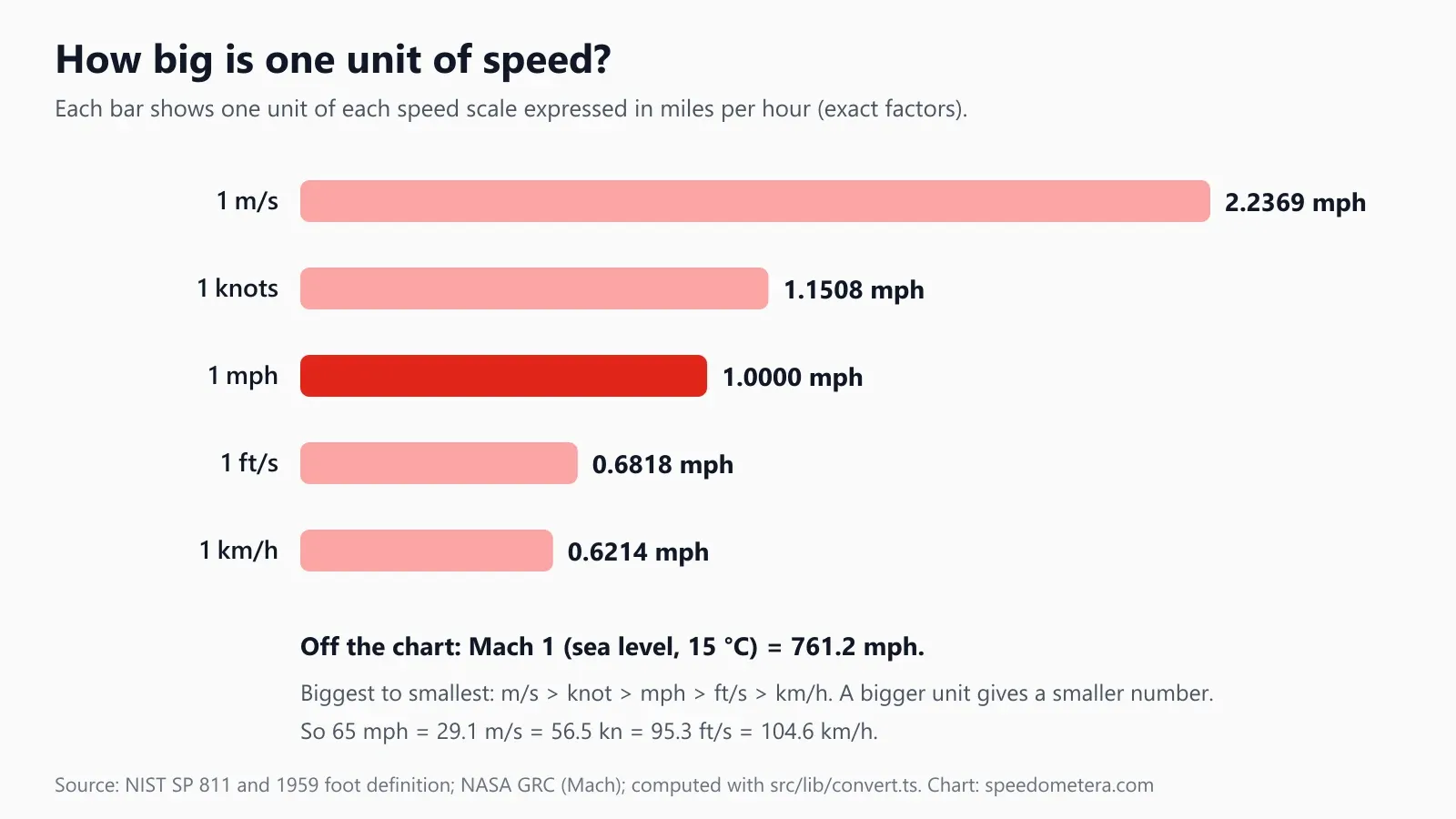
This speed converter turns any speed into mph, km/h, knots, meters per second, feet per second and Mach at once, using the exact legal definitions of each unit. Below the tool you will find the formulas, a full every-unit-to-every-unit conversion chart, a short history of where each unit came from, and US road, aviation and weather speeds already converted.
Key terms used on this page: mph (statute miles per hour; 1 mile = 5,280 ft = 1,609.344 m), km/h (kilometers per hour), knot (one nautical mile, 1,852 m, per hour), m/s (meters per second, the SI unit of speed), ft/s (feet per second) and Mach number (speed divided by the local speed of sound).
How do you use the speed converter?
Type a number in either big box at the top, or in any box of the “All units” grid, and every other unit updates as you type. There is no Convert button and nothing is sent anywhere; the math runs in your browser.
- Enter a speed in the mph box (or the km/h box). The sentence under the inputs reads it back, for example “65 mph = 104.6 km/h”.
- Tap the swap button (⇄) to flip the lead pair, so km/h is on the left and mph on the right.
- Use the “All units” grid for anything beyond the lead pair. Edit the knots, m/s, ft/s or Mach box and the other five follow.
- Copy the result with the Copy button to paste it into a message, spreadsheet or homework answer.
- Scan the quick table under the converter for common speeds from 5 to 150 mph without typing at all.
Want to know how fast you are going right now rather than convert a number? The live GPS speedometer on the homepage reads your phone’s GPS and shows mph or km/h. If you have a distance and a time instead of a speed, the speed, distance and time calculator works out the speed first.
What are the speed conversion formulas?
Every speed conversion is one multiplication, and the key factors are exact because the mile, foot and nautical mile are all defined in meters. Since July 1, 1959 the international yard has been exactly 0.9144 m and the foot exactly 0.3048 m, which makes the mile (5,280 ft) exactly 1,609.344 m. The nautical mile is exactly 1,852 m. NIST lists these in its guide to SI units (Special Publication 811).
| To convert | Multiply by | Exact? | Worked example |
|---|---|---|---|
| mph → km/h | 1.609344 | Exact | 65 mph × 1.609344 = 104.6 km/h |
| km/h → mph | 0.621371 (÷ 1.609344) | Rounded | 100 km/h ÷ 1.609344 = 62.1 mph |
| mph → m/s | 0.44704 | Exact | 70 mph × 0.44704 = 31.3 m/s |
| m/s → mph | 2.236936 (÷ 0.44704) | Rounded | 10 m/s ÷ 0.44704 = 22.4 mph |
| mph → ft/s | 22/15 (1.4667) | Exact | 60 mph × 22/15 = 88 ft/s |
| knots → mph | 1.150779 | Rounded | 20 kn × 1.150779 = 23.0 mph |
| mph → knots | 0.868976 | Rounded | 55 mph × 0.868976 = 47.8 kn |
| knots → km/h | 1.852 | Exact | 30 kn × 1.852 = 55.6 km/h |
| km/h → m/s | 1/3.6 (0.27778) | Exact | 36 km/h ÷ 3.6 = 10 m/s |
The “rounded” factors are just inverses of exact ones, so they run to endless decimals. This converter works through meters per second with the exact definitions and only rounds the number it displays, so converting 65 mph to km/h and back returns exactly 65.
target speed = speed × (m/s per source unit) ÷ (m/s per target unit)
That single formula is how the tool handles all 30 unit pairs. One mph is 0.44704 m/s, one km/h is 0.27778 m/s, one knot is 0.51444 m/s, one ft/s is 0.3048 m/s, and Mach 1 is taken as 340.294 m/s (standard sea-level air at 15 °C).
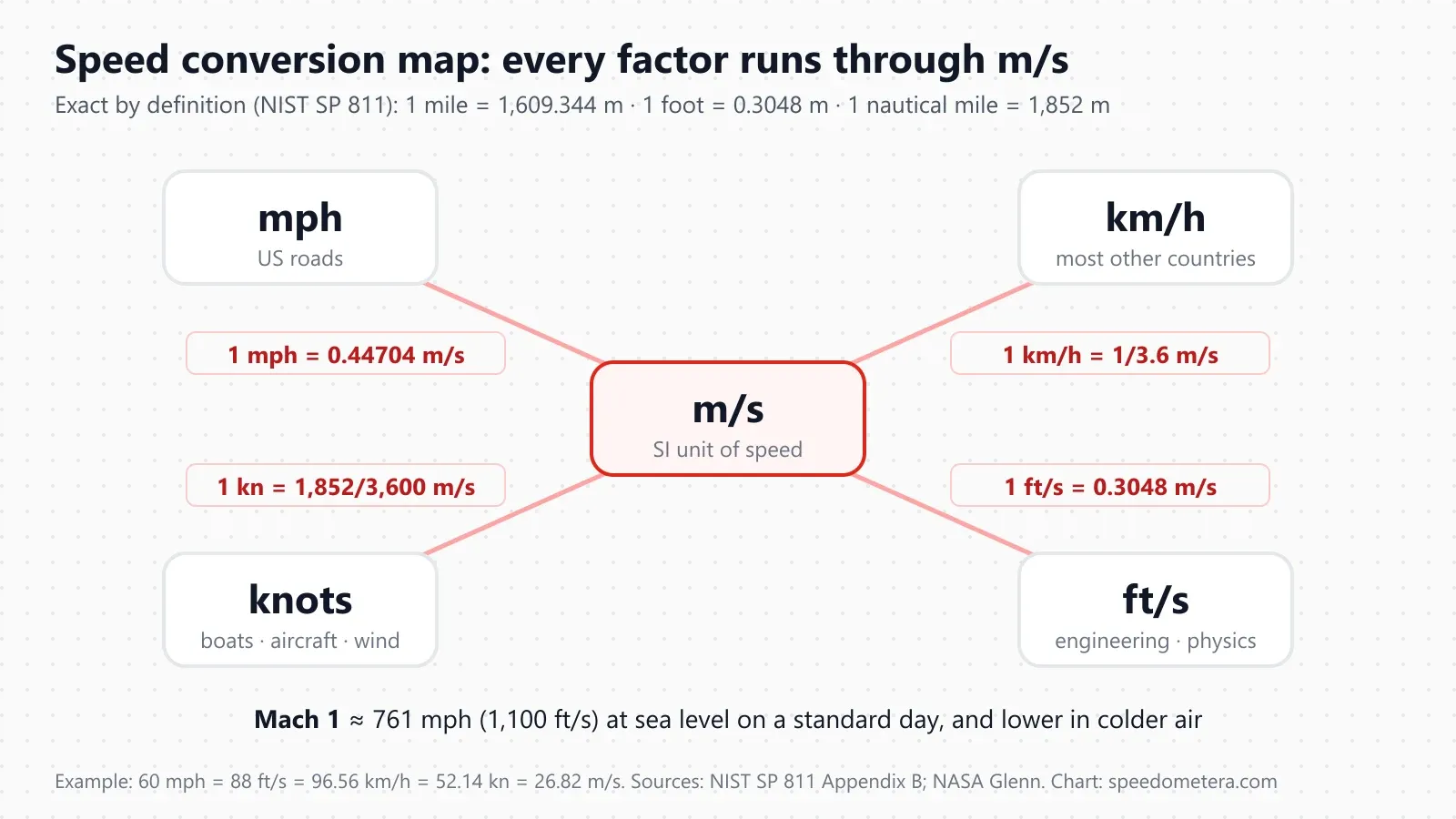
Worked example: a 75 mph speed limit in every unit
75 mph × 1.609344 = 120.7 km/h. 75 × 0.44704 = 33.5 m/s. 75 × 22/15 = 110 ft/s. 120.7 km/h ÷ 1.852 = 65.2 knots. And 33.5 m/s ÷ 340.3 m/s = Mach 0.10, so a car at highway speed is going roughly a tenth of the speed of sound.
Mental math shortcuts that are close enough
For mph to km/h, multiply by 1.6; for km/h to mph, multiply by 6 and drop the last digit. The × 1.6 rule is within about 0.6% of the exact value; the × 6 shortcut (really × 0.6) reads about 3.5% low, which errs on the safe side when you check a km/h limit.
- mph → km/h: double it, then take away a fifth of the doubled number. 50 mph → 100 → 100 − 20 = 80 (exact: 80.5 km/h).
- km/h → mph: multiply by 6 and drop a zero. 80 km/h → 480 → 48 mph (exact: 49.7 mph).
- Knots → mph: add 15%. 20 knots → 20 + 3 = 23 mph (exact: 23.0 mph).
- m/s → mph: double it and add a tenth of the doubled number. 10 m/s → 20 + 2 = 22 mph (exact: 22.4 mph).
- mph → ft/s: add half. 40 mph → 40 + 20 = 60 ft/s (exact: 58.7 ft/s). The rule overshoots slightly because the true factor is 1.467, not 1.5.
Mach depends on air temperature; the speed of sound chart shows Mach 1 from 761 mph at sea level to about 660 mph at airliner cruise altitude.
Speed conversion chart: every unit to every other unit
Read across a row: one of the unit on the left equals the number in each column. For example, the knots row shows that 1 knot = 1.15078 mph = 1.852 km/h = 0.51444 m/s. The matrix was calculated with the same code the converter uses (src/lib/convert.ts) and is shown to six significant figures.
| 1 unit equals → | mph | km/h | knots | m/s | ft/s | Mach |
|---|---|---|---|---|---|---|
| 1 mph | 1 | 1.60934 | 0.86898 | 0.44704 | 1.46667 | 0.0013137 |
| 1 km/h | 0.62137 | 1 | 0.53996 | 0.27778 | 0.91134 | 0.00081629 |
| 1 knot | 1.15078 | 1.852 | 1 | 0.51444 | 1.68781 | 0.0015118 |
| 1 m/s | 2.23694 | 3.6 | 1.94384 | 1 | 3.28084 | 0.0029386 |
| 1 ft/s | 0.68182 | 1.09728 | 0.59248 | 0.30480 | 1 | 0.00089570 |
| Mach 1 (sea level) | 761.2 | 1,225.1 | 661.5 | 340.3 | 1,116.5 | 1 |
The ordering tells you something useful: from biggest to smallest unit it runs m/s, knot, mph, ft/s, km/h. A bigger unit gives a smaller number for the same speed, which is why 65 mph shows up as just 29.1 m/s but 104.6 km/h.
The same speed in six units, at round mph values that come up often:
| mph | km/h | knots | m/s | ft/s | Mach |
|---|---|---|---|---|---|
| 10 | 16.1 | 8.7 | 4.5 | 14.7 | 0.013 |
| 20 | 32.2 | 17.4 | 8.9 | 29.3 | 0.026 |
| 50 | 80.5 | 43.4 | 22.4 | 73.3 | 0.066 |
| 100 | 160.9 | 86.9 | 44.7 | 146.7 | 0.131 |
| 200 | 321.9 | 173.8 | 89.4 | 293.3 | 0.263 |
| 300 | 482.8 | 260.7 | 134.1 | 440.0 | 0.394 |
| 550 | 885.1 | 477.9 | 245.9 | 806.7 | 0.723 |
| 761 | 1,224.7 | 661.3 | 340.2 | 1,116.1 | 1.000 |
Where do mph, km/h, knots, m/s and Mach come from?
Every common speed unit is now a distance unit defined in meters divided by an hour or a second, but each one started in a different trade. That history explains why US roads use mph, ships and planes use knots, and scientists use m/s.
- Meter and km/h. The meter was once defined by two marks on a platinum-iridium bar; NIST still holds US National Prototype Meter No. 27, one of the bars made in the late 1800s. Today the BIPM defines the meter by fixing the speed of light at exactly 299,792,458 m/s, so a meter is the distance light travels in 1/299,792,458 of a second. Kilometers per hour is simply 1,000 of those meters per 3,600 seconds.
- Foot, mile and mph. Until 1959, the American and British yards differed slightly. A 1958 meeting of English-speaking nations unified them, and Federal Register Notice 59-5442 set the yard at exactly 0.9144 m from July 1, 1959, giving the foot 0.3048 m and the mile 1,609.344 m. The older US survey foot, about 2 parts per million longer, was retired on January 1, 2023, according to NIST. Miles per hour is the unit on every US speed limit sign.
- Knot. NOAA traces the name to 17th-century sailors who threw a “common log,” a wedge of wood tied to a knotted rope, over the stern and counted how many knots ran out in a timed interval, often measured with an hourglass. The nautical mile, one minute of latitude, was set internationally at exactly 1,852 m in 1929; the US adopted that value in 1954 and the UK in 1970.
- m/s. Meters per second is the coherent SI unit of speed, built directly from two base units. It is the default in physics, engineering and most weather model output.
- Mach number. NASA’s Glenn Research Center notes the ratio of speed to the speed of sound is named after Ernst Mach, a late-19th-century physicist who studied gas dynamics. Because sound speed changes with air temperature, Mach is a ratio rather than a fixed speed.
| Unit | Defined as | Exact in m/s | Main US users |
|---|---|---|---|
| mph | 1,609.344 m per hour | 0.44704 | Drivers, road signs, sports |
| km/h | 1,000 m per hour | 0.277… (1/3.6) | Car dials (inner ring), travel abroad |
| knot | 1,852 m per hour | 0.514… (1,852/3,600) | Pilots, mariners, NOAA hurricane advisories |
| m/s | SI unit | 1 | Science, engineering, weather data |
| ft/s | 0.3048 m per second | 0.3048 | Physics classes, ballistics, crash reconstruction |
| Mach | speed ÷ speed of sound | ≈ 340.3 at sea level | Aerospace |
What do US speed limits equal in km/h, knots and ft/s?
A 65 mph interstate limit is 104.6 km/h, 56.5 knots and 95.3 ft/s. The table covers the posted limits you see across the US, calculated from the exact factors. The ft/s column is useful for stopping-distance problems: it is how far the car travels each second before you touch the brake.
| mph | km/h | knots | m/s | ft/s | Where you might see it |
|---|---|---|---|---|---|
| 15 | 24.1 | 13.0 | 6.71 | 22.0 | School zones, parking lots |
| 25 | 40.2 | 21.7 | 11.18 | 36.7 | Residential streets |
| 35 | 56.3 | 30.4 | 15.65 | 51.3 | Urban arterial roads |
| 45 | 72.4 | 39.1 | 20.12 | 66.0 | Suburban highways |
| 55 | 88.5 | 47.8 | 24.59 | 80.7 | Two-lane rural highways |
| 65 | 104.6 | 56.5 | 29.06 | 95.3 | Many interstates |
| 70 | 112.7 | 60.8 | 31.29 | 102.7 | Rural interstates |
| 75 | 120.7 | 65.2 | 33.53 | 110.0 | Western rural interstates |
| 80 | 128.7 | 69.5 | 35.76 | 117.3 | Top limits on some rural interstates |
Driving in Canada or Mexico, or renting a car with a km/h speedometer? The reverse lookup:
| km/h sign | mph | Rule of thumb (× 0.6) |
|---|---|---|
| 30 km/h | 18.6 mph | 18 mph |
| 50 km/h | 31.1 mph | 30 mph |
| 70 km/h | 43.5 mph | 42 mph |
| 80 km/h | 49.7 mph | 48 mph |
| 100 km/h | 62.1 mph | 60 mph |
| 120 km/h | 74.6 mph | 72 mph |
| 130 km/h | 80.8 mph | 78 mph |
Many US-market cars show both mph and km/h, with km/h in a smaller inner ring. If your dashboard disagrees with the GPS reading, the speedometer calibration calculator works out the percentage error, and the tire size calculator shows how much a new tire size changes it. For runners, the pace calculator turns mph into minutes per mile.
What is a knot in mph, and who uses knots?
A knot is one nautical mile per hour, about 1.15 mph or exactly 1.852 km/h. NOAA’s National Ocean Service explains that a nautical mile equals one minute of latitude, which is why it is the standard on nautical charts and in air navigation. You will meet knots in three US contexts:
| Context | Knots | mph | km/h | Source |
|---|---|---|---|---|
| Aircraft below 10,000 ft (FAA limit) | 250 kn | 288 mph | 463 km/h | 14 CFR 91.117(a) |
| Near Class C/D airports, at or below 2,500 ft | 200 kn | 230 mph | 370 km/h | 14 CFR 91.117(b) |
| Hurricane, Category 1 (lower bound) | 64 kn | 74 mph | 119 km/h | NOAA NHC |
| Hurricane, Category 3 “major” (lower bound) | 96 kn | 111 mph | 178 km/h | NOAA NHC |
| Hurricane, Category 5 (lower bound) | 137 kn | 157 mph | 252 km/h | NOAA NHC |
Hurricane mph and km/h values are the rounded thresholds NOAA publishes, so they can differ by a unit or two from a straight conversion. The FAA’s own rule text gives “250 knots (288 m.p.h.)”, matching this converter. Aircraft limits refer to indicated airspeed, which differs from speed over the ground; a GPS reading on a plane shows ground speed, wind included. See how fast planes fly for cruise speeds, or boat speed for measuring knots on the water.
How do m/s, ft/s and Mach convert to mph?
Multiply m/s by 2.237 for mph, multiply ft/s by 0.682, and multiply a Mach number by about 761 for a sea-level mph figure.
- m/s: multiply by 3.6 for km/h or by 2.237 for mph. A 10 m/s wind is 22.4 mph; a 30 m/s gust is 67.1 mph.
- ft/s: the mph × 22/15 rule comes straight from the definitions: 5,280 feet per mile divided by 3,600 seconds per hour is 22/15. That is why 60 mph is exactly 88 ft/s, and 100 ft/s is 68.2 mph.
- Mach: NASA gives the speed of sound as about 761 mph (1,100 ft/s) at sea level on a standard day. It depends only on air temperature (a = √(γRT)), so it falls with altitude: near 35,000 ft, where standard air is about −54 °C, the formula gives roughly 663 mph. NASA labels speeds below Mach 1 subsonic, near Mach 1 transonic, Mach 1 to 3 supersonic, 3 to 5 high supersonic and above 5 hypersonic. The converter’s Mach box uses the sea-level value, so treat Mach figures at altitude as approximate.
Which speed converter should you use, and what mistakes should you avoid?
Use this hub when you need several units at once; use a single-pair page when you want a long chart and context for one conversion. Each spoke has its own reference tables:
- mph to km/h: US limits and car speeds in metric.
- km/h to mph: road signs abroad and metric speedometers.
- knots to mph: boat, wind and aircraft speeds into road units.
- mph to knots: land speeds into marine and aviation units.
- How fast do trains go: measures a train live and shows both mph and km/h.
For everyday driving, a one-decimal answer is plenty; for physics homework, engineering and aviation, use the exact factors. Rounding 1.609344 to 1.6 changes a 70 mph answer by about 0.7 km/h, which no driver could notice. The errors that do matter:
- Confusing knots with mph. A boat display reading “30” is 34.5 mph if it is set to knots. 100 knots is 115 mph, a 15% gap.
- Applying 1.6 the wrong way. Dividing km/h by 1.6 gives mph; multiplying km/h by 1.6 gives a figure more than 2.5 times too high.
- Mixing ground speed and airspeed. A flight’s GPS speed can be 100+ mph higher or lower than its airspeed in a strong jet stream.
- Treating Mach as a fixed speed. It is a ratio, and its mph value depends on air temperature and so on altitude.
- Rounding before the last step. Convert with full precision, then round once at the end; rounding 0.621 to 0.6 mid-calculation adds a 3.5% error.
About this page
Conversion factors come from NIST Special Publication 811 and the 1959 international definitions of the yard, foot and mile; the meter definition is from the BIPM, the nautical mile and knot history from NOAA, and Mach values from NASA Glenn Research Center. Every number in the tables was calculated with the site’s conversion code and rounded only for display. Researched and written by Izhar Ahmad Danish; updated October 25, 2026.
FAQ
Frequently asked questions
How do I convert mph to km/h?
Multiply miles per hour by 1.609344. For example, 65 mph × 1.609344 = 104.6 km/h, and 70 mph is 112.7 km/h. For a quick estimate in your head, multiply by 1.6; the answer is within about 0.6% of the exact value.
How do I convert km/h to mph?
Divide by 1.609344, or multiply by 0.621371. 100 km/h is 62.1 mph, 120 km/h is 74.6 mph and 50 km/h is 31.1 mph. A quick mental shortcut is to multiply by 6 and drop the last digit, which reads about 3.5% low.
Is 100 km/h faster than 60 mph?
Yes, slightly. 100 km/h is 62.1 mph, so it is about 2.1 mph faster than 60 mph. Going the other way, 60 mph is 96.6 km/h. The two are close enough that many people treat them as the same in casual talk.
How do I convert knots to km/h?
Multiply knots by 1.852, exactly, because a nautical mile is 1,852 meters. 10 knots is 18.52 km/h, 30 knots is 55.56 km/h and 250 knots is 463 km/h. Divide km/h by 1.852 to go back. For knots to mph, multiply by about 1.1508.
How do I convert km/h to m/s?
Divide km/h by 3.6, because a kilometer is 1,000 m and an hour is 3,600 s. 36 km/h is 10 m/s, 90 km/h is 25 m/s and 100 km/h is 27.78 m/s. Multiply m/s by 3.6 to go back. The mph to m/s page explains the 3.6.
How many feet per second is 60 mph?
Exactly 88 feet per second, because 60 mph covers 5,280 feet in 60 seconds. The general rule is mph × 22/15 (about 1.467) = ft/s, so 30 mph is 44 ft/s and 75 mph is 110 ft/s, the distance a car covers in one second of reaction time.
How do I convert m/s to mph?
Multiply meters per second by about 2.237, or divide by exactly 0.44704. For example, 10 m/s is 22.4 mph and 30 m/s is 67.1 mph. To get km/h from m/s, multiply by 3.6, so 10 m/s is exactly 36 km/h.
How fast is Mach 1 in mph?
About 761 mph (roughly 1,100 feet per second) at sea level on a standard day, according to NASA. The speed of sound depends on air temperature, so it falls in colder air; at airliner cruise altitude near 35,000 ft the same formula gives roughly 660 mph.
What is the most accurate speed conversion factor?
The exact ones: 1 mph = 0.44704 m/s, 1 km/h = 1/3.6 m/s and 1 knot = 1,852/3,600 m/s. They are exact because the foot (0.3048 m, since 1959) and nautical mile (1,852 m) are defined in meters. Rounded factors such as 0.621 or 1.15 are only inverses.
Is 1 km/h the same as 1 mph?
No. 1 mph is exactly 1.609344 km/h, and 1 km/h is about 0.6214 mph, so a mile per hour is the faster unit. That is why 100 mph is 160.93 km/h while 100 km/h is only 62.14 mph. A knot (1.852 km/h) is faster than both.
9 Sources
- NIST SP 811, Appendix B.8: Factors for units listed alphabetically (velocity, length)
- NIST: U.S. survey foot deprecated, international foot 0.3048 m exactly (1959)
- NIST Office of Weights and Measures: SI units, length (meter history, 1959 yard of 0.9144 m)
- BIPM: SI base unit, the metre (defined by the speed of light)
- NOAA National Ocean Service: What is the difference between a nautical mile and a knot?
- NASA Glenn Research Center: Speed of sound
- NASA Glenn Research Center: Mach number (Ernst Mach, speed regimes)
- NOAA National Hurricane Center: Saffir-Simpson Hurricane Wind Scale
- 14 CFR 91.117: Aircraft speed (250 knots below 10,000 ft) (Cornell LII)
Last updated October 25, 2026 by Izhar Ahmad Danish. Found an error? Tell us.