



Key numbers
- Fastest US train: Amtrak NextGen Acela, 160 mph (257 km/h), in service since Aug 28, 2025
- Most Amtrak long-distance trains: 79 mph, because 80 mph and up requires cab signals, automatic train control or PTC (49 CFR 236.0)
- Freight trains: 60 mph on Class 4 track, 40 mph on Class 3 (49 CFR 213.9)
- Federal track classes run from 15 mph to 220 mph for passenger trains; above 125 mph needs FRA approval
- Brightline Miami–Orlando: 125 mph top, about 67 mph average over 235 miles
On this page
- How to use the How Fast Do Trains Go
- How fast do trains go in the US?
- How fast does Amtrak go?
- Why can’t US trains go faster? FRA track classes
- How fast do freight trains go?
- How do US trains compare with the fastest trains in the world?
- How long does a train trip take at each speed?
- How do I check how fast my train is going?
- How can you tell a train’s speed without GPS?
- Safety and privacy
- Frequently asked questions
How to use the How Fast Do Trains Go
- 1Get a clear view of the skySit by a window: GPS needs a view of the sky and drops out in tunnels and deep cuttings.
- 2Tap Start and allow locationYour browser asks for location permission once. The first GPS fix usually arrives in 5–30 seconds.
- 3Pick your unitChoose km/h, mph, knots or m/s. Your choice is remembered on this device.
- 4Read speed, max, average and distanceThe gauge and digital readout update about once a second. Distance and average count only while you are moving.
- 5Stop or resetTap Stop to pause, Reset to clear the trip. Nothing is stored or sent anywhere.
Works in any modern phone browser. Back to the speedometer ↑
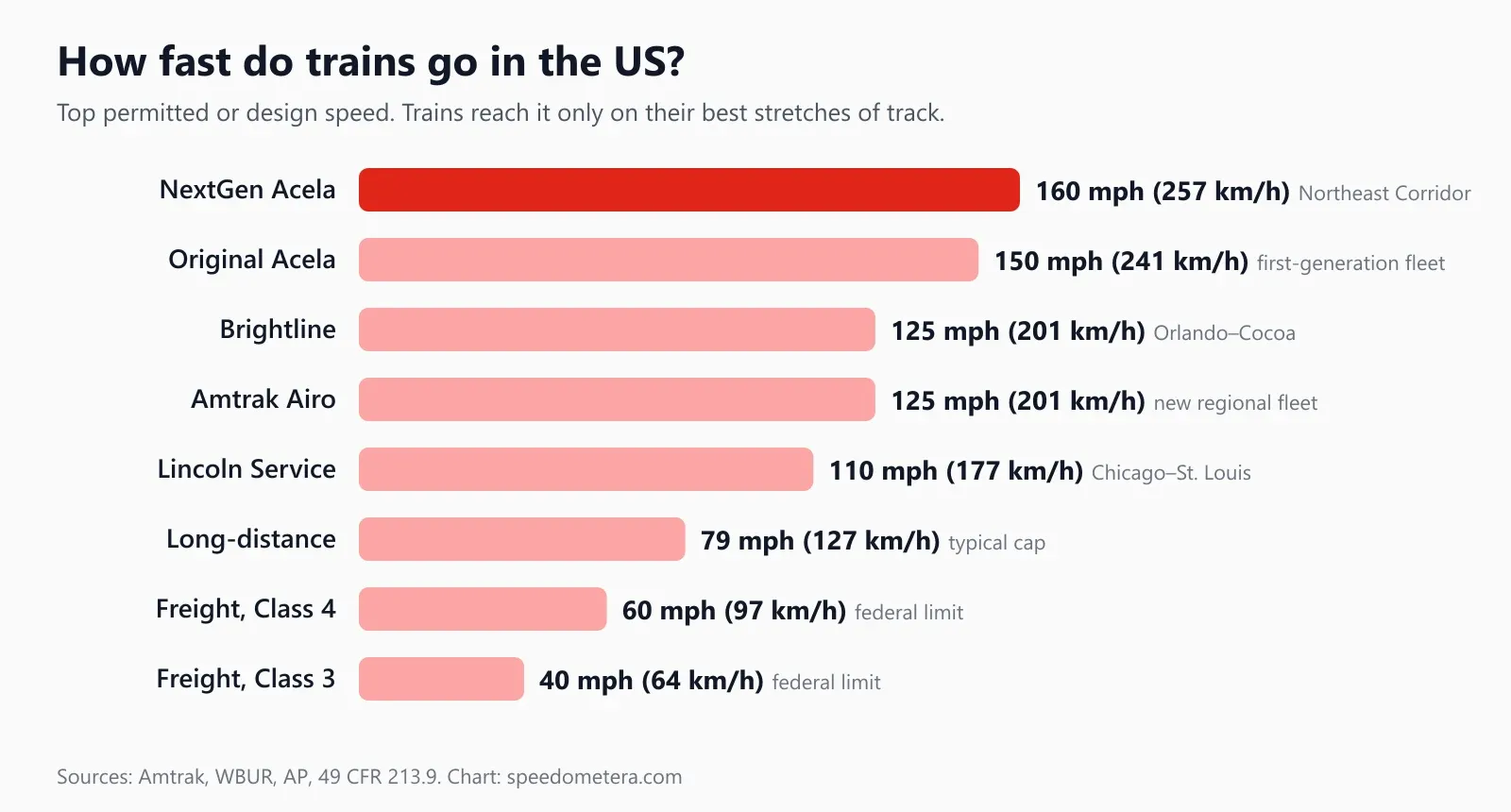
How fast do trains go? In the US, most passenger trains top out at 79 mph (127 km/h), the fastest, Amtrak’s NextGen Acela, reaches 160 mph (257 km/h), and freight trains are held to 60 mph or less. The rest of this page explains where those numbers come from, from federal track rules to the signals beside the line. The live GPS speedometer above shows how fast your own train is going right now.
Key terms on this page. FRA: the Federal Railroad Administration, the US rail safety regulator. Track class: the federal rating (Class 1 to Class 9) that sets a line’s maximum speed under 49 CFR Part 213. PTC (positive train control): an automatic system that can stop a train that is going too fast. Northeast Corridor (NEC): Amtrak’s Washington–New York–Boston main line. Speed over ground: the speed your phone’s GPS measures, the train’s true speed along the track.
How fast do trains go in the US?
US trains run from about 10 mph in yards to 160 mph on the best Northeast Corridor track, and the train type and the track decide where in that range a given train sits. Freight trains usually move at 40–60 mph, regional and long-distance passenger trains at up to 79–125 mph, and only the Acela goes faster.
| Train type | Typical top speed (mph) | km/h | What sets the limit |
|---|---|---|---|
| Amtrak NextGen Acela | 160 | 257 | Only on short upgraded NEC sections |
| Brightline (Florida) | 125 | 201 | Orlando–Cocoa section; 79 mph in urban South Florida |
| Amtrak Airo (new regional fleet) | 125 | 201 | Design speed; track limits apply |
| Amtrak Lincoln Service, Chicago–St. Louis | 110 | 177 | FRA approval for most of the route since 2023 |
| Amtrak long-distance trains | 79 | 127 | Signal rule for 80 mph and up (49 CFR 236.0) |
| Commuter rail between stations | 30–80 | 48–129 | Stop spacing and track class |
| Freight on Class 4 track | 60 | 97 | 49 CFR 213.9 |
| Freight on Class 3 track | 40 | 64 | 49 CFR 213.9 |
| Yard and excepted track | 10 | 16 | 49 CFR 213.9; no passenger trains allowed on excepted track |
The top speed is the number people quote, but you’ll only see it on short stretches. Curves, junctions, bridges, work zones, slower trains ahead and station approaches all hold a train back, so its average speed between cities is usually far below its top speed. A train that can do 160 mph may average well under 100 mph over a full trip.
How fast does Amtrak go?
Amtrak’s top speed is 160 mph on the NextGen Acela, but most Amtrak routes top out at 79 mph and a few corridors reach 110–125 mph. Which number applies depends on which train you’re on and whose track it runs on.
NextGen Acela (Washington–New York–Boston). The new Acela entered public service on August 28, 2025, with a top speed of 160 mph, 10 mph more than the first-generation Acela’s 150 mph, and 27% more seats per departure (WBUR). Amtrak calls it “the fastest train in the Western Hemisphere” (Amtrak, May 2026). By July 2026, 13 trainsets were in service and the schedule had grown to 32 weekday NextGen Acela trips, up from 26 (Amtrak, July 2026). At launch, Amtrak planned 28 NextGen trainsets in all by 2027 (WBUR).
The 160 mph figure applies only to short, upgraded sections of the Northeast Corridor. Much of the line south of New York uses older bridges and tunnels. Amtrak says the current Bush and Gunpowder River bridges in Maryland allow 125 mph today (Amtrak, Oct 2026), and trains slow sharply on the approaches to New York Penn Station, Baltimore and Washington.
Lincoln Service (Chicago–St. Louis). Amtrak and Illinois began 110 mph schedules on most of this corridor in 2023 (Amtrak, May 2023), making it one of the few places outside the Northeast where a passenger train runs faster than 79 mph.
Amtrak Airo. Amtrak’s new regional fleet is built for up to 125 mph (Amtrak, Oct 2023). As with every train, the track it runs on sets the real limit.
Long-distance trains. Routes such as the Empire Builder, Southwest Chief, California Zephyr and Coast Starlight run mostly on track owned by freight railroads. There the normal ceiling is 79 mph, and many sections are slower because of curves, grades and freight traffic. The next section explains why the number is 79 and not 80.
Brightline (not Amtrak). Florida’s private intercity line reaches 125 mph through central Florida farmland, 110 mph in less-populated areas and 79 mph in urban areas, covering 235 miles between Miami and Orlando in about 3.5 hours (AP via ClickOrlando). That works out to an average of about 67 mph (108 km/h), a good example of how far a trip’s average falls below its top speed.
Japan’s Shinkansen runs at up to 320 km/h (199 mph) every day; our bullet train speed page breaks it down by line, with the maglev record.
Why can’t US trains go faster? FRA track classes
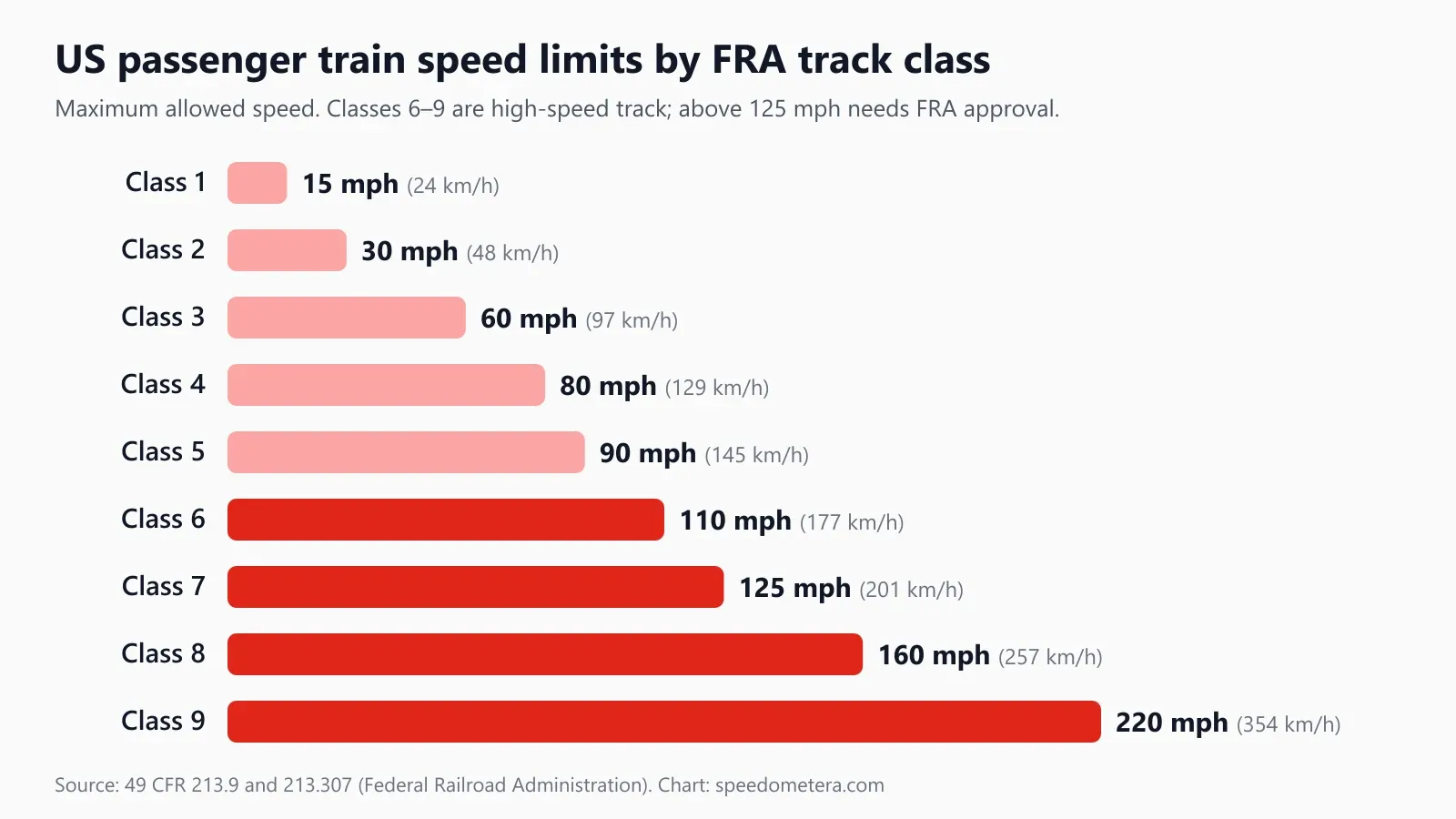
A train can never go faster than the track it’s on, and federal rules give every section of US track a class with a maximum speed. The FRA’s Track Safety Standards (49 CFR Part 213) set those classes by how the track is built, inspected and maintained: alignment, gauge, ties, surface and inspection frequency.
| FRA track class | Max freight speed (mph) | Max passenger speed (mph) | Passenger km/h | Seconds per mile at max | Minutes per 100 miles |
|---|---|---|---|---|---|
| Excepted | 10 | not allowed | — | — | — |
| Class 1 | 10 | 15 | 24 | 240 | 400 |
| Class 2 | 25 | 30 | 48 | 120 | 200 |
| Class 3 | 40 | 60 | 97 | 60 | 100 |
| Class 4 | 60 | 80 | 129 | 45 | 75 |
| Class 5 | 80 | 90 | 145 | 40 | 67 |
| Class 6 | passenger speed, with conditions | 110 | 177 | 32.7 | 55 |
| Class 7 | passenger speed, with conditions | 125 | 201 | 28.8 | 48 |
| Class 8 | passenger speed, with conditions | 160 | 257 | 22.5 | 38 |
| Class 9 | passenger speed, with conditions | 220 | 354 | 16.4 | 27 |
Classes 1–5 come from 49 CFR 213.9 and Classes 6–9 from the high-speed rules in 49 CFR 213.307. Speeds above 125 mph (Classes 8 and 9) also need specific FRA approval. Under the high-speed rules, freight may run at passenger speeds only if it meets conditions such as equal dynamic performance. The km/h, seconds-per-mile and minutes-per-100-miles columns are our calculations (1 mph = 1.609344 km/h exactly; seconds per mile = 3,600 ÷ mph). If a section of track falls short of its class, the railroad must downgrade it to the class it does meet, so poor maintenance shows up directly as slower trains.
The 79 mph rule. Track class isn’t the only limit. Under 49 CFR 236.0, any train permitted to run at 80 mph or more needed an automatic cab signal, automatic train stop or automatic train control system before December 31, 2015; since then it needs a positive train control (PTC) system, unless the FRA approves continued use of the older equipment. Passenger trains at 60 mph or more and freight trains at 50 mph or more need a block signal system or PTC. Lines without the 80 mph equipment cap passenger trains at 79 mph, which is why that odd number shows up in so many Amtrak timetables.
The other brakes on US speed. Even where track and signals allow more, trains slow down for:
- Curves. A train’s safe speed on a curve depends on its radius and banking (superelevation). Old routes laid out in the 1800s follow rivers and valleys with tight curves.
- Shared track. Most US passenger trains outside the Northeast run on freight railroads’ track, where they share space with slower, heavier trains.
- Old bridges and tunnels. The Northeast Corridor’s Baltimore tunnels, its Hudson and East River tunnels and its movable bridges all carry lower speeds.
- Grade crossings. Thousands of road crossings make very high speeds impractical on most lines; true high-speed lines are fully separated.
- Stops. A train that stops every 20 miles spends much of its time speeding up and slowing down.
You can see all of this on the speedometer: the train holds a steady number for miles (the class limit or a posted speed restriction), drops for a curve or bridge, then climbs back.
How fast do freight trains go?
US freight trains are capped at 60 mph on Class 4 track and 40 mph on Class 3, the classes most freight main lines use, and in practice many run slower. On the best Class 5 track the federal limit for freight is 80 mph, but heavy trains rarely approach it.
Federal rules set the ceiling; the train sets the rest. A long, heavy freight train needs far more distance to stop than a passenger train, climbs grades slowly, and must slow for yards, junctions and sidings when it pulls over to let other trains pass. Railroads also set their own timetable speeds below the federal maximum for some trains and loads.
The signal rule matters for freight too. Under 49 CFR 236.0, a freight train may run at 50 mph or more only where a block signal system or PTC is in place. On “dark” territory without signals, freight trains stay below 50 mph.
| Freight speed (mph) | km/h | Feet per second | Time to pass a fixed point, 1-mile-long train |
|---|---|---|---|
| 10 (yard, Class 1) | 16 | 15 | 6 min 0 s |
| 25 (Class 2) | 40 | 37 | 2 min 24 s |
| 40 (Class 3) | 64 | 59 | 1 min 30 s |
| 50 (signal threshold) | 80 | 73 | 1 min 12 s |
| 60 (Class 4) | 97 | 88 | 1 min 0 s |
The last column is a handy way to judge a freight train’s speed from a grade crossing: a one-mile train that takes a full minute to pass is doing 60 mph; one that takes six minutes is crawling at 10 mph. Values are computed from the exact definitions (1 mile = 5,280 ft, 1 mph = 1.609344 km/h).
How do US trains compare with the fastest trains in the world?
At 160 mph, the NextGen Acela is the fastest train in the Western Hemisphere, but high-speed lines in Asia and Europe run regular service considerably faster. The difference isn’t the trains so much as the track: those countries built dedicated, fenced lines with gentle curves and no road crossings, while US passenger trains mostly share old routes with freight.
Two structural differences explain most of the gap:
- Dedicated high-speed track. The fastest foreign services run on lines built only for high-speed passenger trains. In the US, Classes 8 and 9 exist in the rules (160 and 220 mph) but almost no track is built to them yet.
- Electrification. The Northeast Corridor is electrified; most other US routes are not, and the diesel trains that run there carry their own power plant.
Is high-speed rail coming to the US?
Two true high-speed lines are being planned or built, both designed for about 200–220 mph, but neither carries passengers yet. Until one opens, the 160 mph NextGen Acela stays the fastest US train.
| Project | Design top speed (mph) | km/h | Route | Status (Oct 2026) |
|---|---|---|---|---|
| Brightline West | 200 | 322 | Las Vegas–Rancho Cucamonga, 218 miles in the I-15 median | Under construction; completion scheduled for late 2029 |
| California High-Speed Rail | 220 | 354 | San Francisco–Los Angeles (first section in the Central Valley) | Under construction; no passenger service yet |
| NextGen Acela (for comparison) | 160 | 257 | Washington–New York–Boston | In service since Aug 2025 |
Brightline West says its trains will reach 200 mph and link Las Vegas with Rancho Cucamonga in about 2 hours 10 minutes, an average of roughly 100 mph over 218 miles (our calculation). In January 2026 the company told FOX5 the project is scheduled for completion by late 2029. California’s system is described in federal environmental filings as capable of up to 220 mph on dedicated, grade-separated track, the same 220 mph ceiling as FRA Class 9. Both are built on new, fenced alignments with no road crossings, which is exactly what the existing US network lacks.
For a ranked list of today’s fastest trains, from Chinese and Japanese high-speed lines to maglev, with operator-sourced speeds, see the fastest trains in the world. For how airliners compare, see how fast do planes fly.
How long does a train trip take at each speed?
Divide the distance by the average speed, not the top speed: a 225-mile trip takes about 2 h 51 min at a 79 mph average and 1 h 24 min at a 160 mph average. Real trips are slower because of stops, starts and slow zones.
| Average speed (mph) | km/h | 100 miles | 225 miles |
|---|---|---|---|
| 40 | 64 | 2 h 30 min | 5 h 38 min |
| 50 | 80 | 2 h 00 min | 4 h 30 min |
| 60 | 97 | 1 h 40 min | 3 h 45 min |
| 70 | 113 | 1 h 26 min | 3 h 13 min |
| 79 | 127 | 1 h 16 min | 2 h 51 min |
| 90 | 145 | 1 h 07 min | 2 h 30 min |
| 110 | 177 | 55 min | 2 h 03 min |
| 125 | 201 | 48 min | 1 h 48 min |
| 160 | 257 | 38 min | 1 h 24 min |
Times are computed as distance ÷ speed and rounded to the minute. 225 miles is roughly the rail distance between New York and Washington. Compare it with the actual timetable and you can work out a train’s real average speed: if a train is scheduled at 2 h 50 min for 225 miles, it averages about 79 mph even though it touches far higher numbers along the way.
The same logic explains Brightline’s 3.5-hour Miami–Orlando time despite 125 mph running: 235 miles ÷ 3.5 h is about 67 mph. To work out your own trip, use the speed, distance and time calculator; its multi-leg mode gives the true average speed when one segment is fast and another slow.
Why top speed barely changes trip time
Say a 100-mile trip has 20 miles at 160 mph and 80 miles at 79 mph. The fast part takes 7.5 minutes, the slow part 60.8 minutes: 68.3 minutes in all, an average of about 88 mph. Raising the 20 fast miles to 220 mph would save only 2 minutes. Lifting the slow 80 miles to 110 mph would save about 17. That’s why railroads spend on curves, bridges and tunnels, not just faster trains.
How do I check how fast my train is going?
Open this page, sit by a window and tap Start: your phone’s GPS shows the train’s live speed in mph or km/h, plus top speed, average and distance. Railroads rarely show speed in the cabin, so a GPS speedometer is the only real-time number most passengers have.
- Open the page in the station while you still have signal. Once it’s loaded, the speedometer keeps working with no data or Wi-Fi.
- Tap Start and allow location. Inside a coach the first fix can take 10–60 seconds. Hold the phone near the window.
- Watch the accuracy line. Once it reads “good” or better, the speed is reliable.
- Keep the tab open and the screen on. Top speed, average, distance and time keep updating.
- At the end, note your top speed or export the trip as a GPX file to see on a map where the train was fastest.
Sit by a window. Readings pause in tunnels and resume within seconds of open sky. Steel car bodies block much of the satellite signal, so a phone in a bag or deep in your lap may never get a fix. The upper level of a double-deck car and the café car’s big windows are often the best spots.
What the readings mean. Speed updates about once a second. Max is the fastest moment since you tapped Start (reset it when you change trains). Average is distance ÷ moving time, so station stops don’t drag it down. Distance counts only movement above 1.1 mph. On mountain routes such as the California Zephyr over the Rockies, the altitude view lets you watch the climb.
Is GPS accurate enough on a train? Yes. Phones measure speed from the Doppler shift of satellite signals, not from position changes alone. GPS.gov puts typical smartphone position accuracy at 4.9 m (16 ft) under open sky, and the GPS signal’s speed-error commitment is 0.006 m/s over any 3-second interval. On open track at a steady speed a phone is usually within about 1 mph; the weak link is the metal car around you.
| Where you are | What to expect |
|---|---|
| Open countryside, window seat | Steady reading within about 1 mph |
| Aisle seat or phone in a bag | Slower fix, more jumps |
| Under bridges and overpasses | Dropouts of a second or two |
| Underground stations (New York Penn, Washington Union) | No reading until you’re back outside |
| Tunnels | No reading; resumes within seconds of daylight |
| Hard braking into a station | Number lags 1–2 seconds |
For why phone GPS and a car dashboard often disagree, see GPS vs car speedometer. To switch units, tap km/h under the gauge or use the mph to km/h converter: 79 mph = 127.1 km/h, 110 mph = 177.0 km/h, 160 mph = 257.5 km/h.
How can you tell a train’s speed without GPS?
Time the mileposts: 3,600 divided by the seconds between two mileposts gives the speed in mph. Railfans used this long before smartphones, and it’s a good check on the GPS reading.
US railroads mark every mile with a small numbered sign beside the track. Start a stopwatch as one passes your window and stop it at the next.
speed (mph) = 3,600 ÷ seconds between mileposts
| Seconds between mileposts | Speed (mph) | km/h |
|---|---|---|
| 240 | 15 | 24 |
| 120 | 30 | 48 |
| 60 | 60 | 97 |
| 45.6 | 79 | 127 |
| 40 | 90 | 145 |
| 32.7 | 110 | 177 |
| 28.8 | 125 | 201 |
| 22.5 | 160 | 257 |
Rail joints. On older jointed track, rails come in 39-foot lengths and each joint makes the “clickety-clack”. Count the clicks for 26.6 seconds and the count equals your speed in mph (39 ft × 3,600 ÷ 5,280 = 26.6). Most main lines now use continuous welded rail with no joints, so on Amtrak’s busiest routes you’ll rarely hear them.
Timetable distance. Divide the distance between two stations by the scheduled time for an average speed. It’s always below the top speed because it includes acceleration and braking, but it shows how fast the trip really is.
All three methods give one number for one stretch. GPS gives a continuous reading, so you can see exactly where the train speeds up and slows down.
Safety and privacy
Using a speedometer as a passenger is safe and legal; just don’t lean out of windows or doors or stand in vestibules for a better signal. Keep the screen dim at night and the sound off in Quiet Cars. GPS plus a screen that stays on uses more battery than browsing, so plug in on long trips if your seat has an outlet.
Your location never leaves your phone. Speed and distance are calculated in your browser, kept only while the page is open, and nothing is sent to our servers. GPS speed is an estimate that depends on signal and sky view, so it can lag or jump in tunnels and stations; it’s for information, not official records. See the privacy policy, or use the main online speedometer for cars, bikes and walking.
FAQ
Frequently asked questions
How fast does Amtrak go?
Amtrak's fastest train, the NextGen Acela, reaches 160 mph on short Northeast Corridor sections. Chicago–St. Louis Lincoln Service runs up to 110 mph, the new Airo fleet is built for 125 mph, and most long-distance trains such as the Empire Builder or California Zephyr top out at 79 mph.
What is the fastest train in the United States?
Amtrak's NextGen Acela, at 160 mph (257 km/h). Amtrak calls it the fastest train in the Western Hemisphere. It entered public service on August 28, 2025 between Washington, New York and Boston, replacing the first-generation Acela, which topped out at 150 mph.
How fast do freight trains go?
Federal rules cap freight trains at 60 mph on Class 4 track and 40 mph on Class 3, the classes most main lines use. Heavy trains, grades, yards and congestion keep many well below that, and freight running at 50 mph or more needs block signals or positive train control.
Why do Amtrak trains go 79 mph?
Because of a federal signal rule. Under 49 CFR 236.0, any train running at 80 mph or more needs cab signals, automatic train stop, automatic train control or a positive train control system. Many freight-owned lines lack that equipment for passenger service, so Amtrak runs at 79 mph.
Why can't US trains go faster?
Track sets the limit. Federal track classes allow 110 mph (Class 6) or 125 mph (Class 7) at most without special approval, and anything above 125 mph needs FRA approval. Curves, shared freight track, old bridges and tunnels, and frequent stops slow US trains further.
How fast does the Acela go between New York and Washington?
The NextGen Acela can reach 160 mph, but only on short upgraded stretches. Much of the route south of New York runs on older track, bridges and tunnels at lower speeds. Amtrak says the current Bush and Gunpowder River bridges in Maryland allow 125 mph.
How fast does Brightline go?
Brightline reaches 125 mph on the central Florida section between Orlando and Cocoa, 110 mph through less-populated areas and 79 mph in urban South Florida. The 235-mile Miami–Orlando trip takes about 3.5 hours, an average of roughly 67 mph.
How can I check how fast my train is going?
Open this page, sit by a window and tap Start. Your phone's GPS shows the train's live speed in mph or km/h within 10–60 seconds, plus top speed and distance. On open track it is usually within about 1 mph. Readings pause in tunnels and resume within seconds.
How fast is 160 mph in km/h?
160 mph is 257.5 km/h (160 × 1.609344). At that speed a train covers a mile every 22.5 seconds, or 235 feet every second. 125 mph is 201 km/h and 79 mph is 127 km/h.
How fast can trains legally go in the US?
Up to 220 mph (354 km/h). Federal track rules (49 CFR 213.307) define Class 9 track for passenger trains at 220 mph, but anything above 125 mph needs specific FRA approval, and no US line is built to Class 9 yet. Freight is capped at 80 mph even on the best conventional track.
Is there a train that goes 300 mph?
Not in passenger service. The fastest train you can ride, China's CR400 Fuxing, runs at 217 mph (350 km/h). Only test runs have passed 300 mph: Japan's L0 maglev hit 375 mph (603 km/h) in 2015 and France's TGV V150 357 mph (574.8 km/h) in 2007.
Is high-speed rail coming to the US?
Yes, slowly. Brightline West is building a 218-mile line from Las Vegas to Southern California for trains up to 200 mph (322 km/h), now scheduled for late 2029. California High-Speed Rail is designed for 220 mph (354 km/h). Today the 160 mph Acela is the only US train faster than 125 mph.
14 Sources
- Amtrak Media: Freedom250 train announcement, NextGen Acela top speed 160 mph, fastest in the Western Hemisphere (May 2026)
- Amtrak Media: NextGen Acela fleet continues to grow, 13 trainsets, 32 weekday trips (July 2026)
- WBUR: Amtrak launches NextGen Acela, 160 mph vs 150 mph, 27% more seats (Aug 28, 2025)
- Amtrak Media: 110 mph schedules for Chicago–St. Louis corridor (May 2023)
- Amtrak Media: Bush and Gunpowder River bridge replacement, 125 mph today (Oct 2026)
- Amtrak Media: Airo production, trains up to 125 mph (Oct 2023)
- AP via ClickOrlando: Brightline Miami–Orlando, 79/110/125 mph, 235 miles, about 3.5 hours (Sept 2023)
- 49 CFR 213.9: Classes of track, operating speed limits (Cornell LII)
- 49 CFR 213.307: Classes of track, high-speed (Cornell LII)
- 49 CFR 236.0: Signal and train control requirements by speed (Cornell LII)
- Brightline West: project overview, trains up to 200 mph, Las Vegas–Rancho Cucamonga about 2 h 10 min
- FOX5 Las Vegas: Brightline West now scheduled for completion by late 2029, 218 miles in the I-15 median (Jan 14, 2026)
- Federal Register (FRA), Aug 12, 2011: California high-speed train system capable of up to 220 mph
- GPS.gov: GPS accuracy (smartphones and speed accuracy)
Last updated October 25, 2026 by Izhar Ahmad Danish. Found an error? Tell us.