



Key numbers
- Healthy adults aged 20–59 walk at 3.0–3.2 mph (4.8–5.1 km/h) on average
- At 3 mph a mile takes 20:00; the CDC counts 2.5 mph or faster as brisk, moderate-intensity walking
- Each 0.1 m/s (0.22 mph) faster gait speed is linked to a 12% lower death risk in adults 65+
- US crosswalk signals are timed for 3.5 ft/s (2.4 mph), per MUTCD Section 4E.06
- Gauge on this page: 0–10 mph with a live pace line in min/mi or min/km
On this page
- How to use the Average Walking Speed
- What is the average walking speed?
- What is the average walking speed by age and sex?
- Is 3 mph a fast walking speed?
- How long does it take to walk a mile, a 5K or a 10K?
- Why is walking speed called the “sixth vital sign”?
- How fast do crosswalk signals assume you walk?
- How do you measure your walking speed with this page?
- What changes how fast you walk?
- Sources
- Frequently asked questions
How to use the Average Walking Speed
- 1Get a clear view of the skyKeep the phone in your hand or pocket; the page keeps tracking while it stays open.
- 2Tap Start and allow locationYour browser asks for location permission once. The first GPS fix usually arrives in 5–30 seconds.
- 3Pick your unitChoose km/h, mph, knots or m/s. Your choice is remembered on this device.
- 4Read speed, max, average and distanceThe gauge and digital readout update about once a second. Distance and average count only while you are moving.
- 5Stop or resetTap Stop to pause, Reset to clear the trip. Nothing is stored or sent anywhere.
Works in any modern phone browser. Back to the speedometer ↑
What is the average walking speed?
The average walking speed for a healthy adult is about 3 mph (4.8 km/h, 1.34 m/s), which is a 20-minute mile. That figure comes from the largest pooled data set on everyday walking: Richard Bohannon and A. Williams Andrews’ 2011 meta-analysis in Physiotherapy, which combined 41 studies and 23,111 apparently healthy adults walking at their normal, comfortable pace.
Two things make “average walking speed” slippery. First, it depends heavily on age: the averages hold nearly flat from your 20s to your 50s and then drop, slowly in your 60s and sharply after 80. Second, the number changes with how it is measured. The studies Bohannon and Andrews pooled timed people over straight walkways of 3 to 30 metres at a self-chosen “normal” pace. A commute with traffic lights, a hike with a backpack or a stroll window-shopping will all come out slower.
Key terms used on this page: walking speed or gait speed is distance divided by time (mph, km/h or m/s). Pace is the inverse, time per distance (minutes per mile or per km). Comfortable or self-selected speed is the pace you choose without being told to hurry; brisk walking is the CDC’s moderate-intensity example, 2.5 mph or faster. A meta-analysis pools results from many separate studies. The MUTCD is the Federal Highway Administration’s Manual on Uniform Traffic Control Devices, the rulebook for US traffic signals.
If you want your own number rather than the population’s, the tracker above measures it live. The rest of this page gives the age and sex tables, explains what counts as fast or slow, and shows why doctors and traffic engineers both care about how fast you walk.
What is the average walking speed by age and sex?
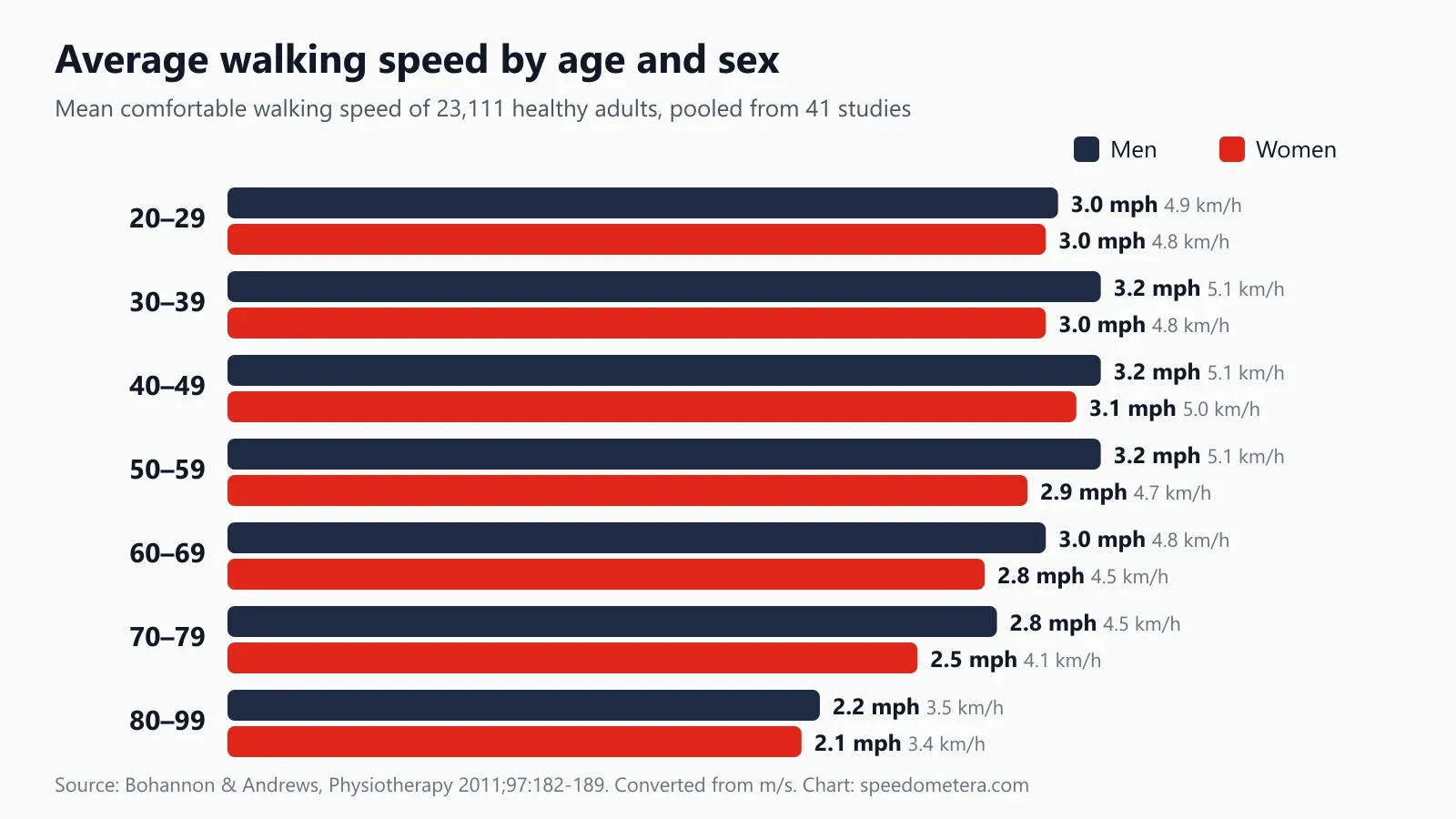
Adults aged 20 to 59 average 3.0–3.2 mph (men) and 2.9–3.1 mph (women); speed falls to about 2.8 mph in the 60s, 2.5–2.8 mph in the 70s and 2.1–2.2 mph after 80. The table below converts Bohannon and Andrews’ published means from metres per second into mph, km/h and minutes per mile, using the site’s exact unit constants (1 mile = 1,609.344 m).
| Age | Men (mph) | Men (km/h) | Men (min/mile) | Women (mph) | Women (km/h) | Women (min/mile) |
|---|---|---|---|---|---|---|
| 20–29 | 3.0 | 4.9 | 19:43 | 3.0 | 4.8 | 20:01 |
| 30–39 | 3.2 | 5.1 | 18:45 | 3.0 | 4.8 | 20:01 |
| 40–49 | 3.2 | 5.1 | 18:45 | 3.1 | 5.0 | 19:18 |
| 50–59 | 3.2 | 5.1 | 18:45 | 2.9 | 4.7 | 20:29 |
| 60–69 | 3.0 | 4.8 | 20:01 | 2.8 | 4.5 | 21:38 |
| 70–79 | 2.8 | 4.5 | 21:17 | 2.5 | 4.1 | 23:44 |
| 80–99 | 2.2 | 3.5 | 27:39 | 2.1 | 3.4 | 28:32 |
Original m/s means (Bohannon and Andrews, 2011): men 1.36, 1.43, 1.43, 1.43, 1.34, 1.26 and 0.97; women 1.34, 1.34, 1.39, 1.31, 1.24, 1.13 and 0.94, for the same age bands. Each age-and-sex group had between 83 and 8,591 participants. The fastest group was men aged 40 to 49 at 1.434 m/s, the slowest women aged 80 to 99 at 0.943 m/s.
What the numbers show:
- The plateau is long. Men’s averages barely move between 30 and 59. Women peak in their 40s at 3.1 mph. If you are under 60 and walk a mile in about 19–20 minutes on a flat path, you are right on the average.
- The drop is late but steep. Between the 70s and the 80-plus group, average speed falls by about 0.6 mph for men, the biggest step in the table. That is roughly 6 extra minutes for every mile.
- The sex gap is small. Men are faster in every band, but by only 0.0–0.3 mph. Height and leg length explain part of it; the meta-analysis did not adjust for either.
One caution from the authors themselves: their values are for walking over a set course at a steady pace. They warned that the averages may not be a fair standard if speed is timed over a short distance from a standing start on “go,” or if a turn is involved, as in some clinic tests.
Is 3 mph a fast walking speed?
No. 3 mph is the average walking speed, a 20-minute mile; a fast walk for most adults is 3.5 to 4 mph, or a 15- to 17-minute mile. The CDC’s physical activity guidance lists “walking briskly (2.5 miles per hour or faster)” as a moderate-intensity activity, so the average 3 mph walk already counts as moderate exercise, with half a mile per hour to spare.
A practical way to place your own speed:
| Speed | Pace per mile | What it feels like | Where it sits |
|---|---|---|---|
| Under 2 mph (3.2 km/h) | Over 30:00 | Strolling, sightseeing, shopping | Below the average of every age group in the meta-analysis |
| 2.0–2.5 mph | 24:00–30:00 | Relaxed; easy conversation | Typical of healthy adults over 80; CDC “brisk” starts at 2.5 mph |
| 2.5–3.0 mph | 20:00–24:00 | Comfortable, purposeful; moderate intensity | Average for adults in their 60s and 70s |
| 3.0–3.5 mph | 17:09–20:00 | Brisk; you can talk but not sing | Average for ages 20–59 |
| 3.5–4.5 mph | 13:20–17:09 | Fast, arms swinging, slightly out of breath | Above average at every age |
| 4.5–5 mph (7.2–8 km/h) | 12:00–13:20 | Power walking; very fast | Most people switch to a jog here |
| 5–6 mph (8–9.7 km/h) | 10:00–12:00 | Race walking technique needed | Same speed as an easy jog: the Compendium’s running codes start at 4–5 mph |
The CDC’s own “talk test” is a good self-check: at moderate intensity you can talk but not sing; at vigorous intensity you can say only a few words without pausing for breath. CDC lists jogging or running among its vigorous-intensity examples.
If you are aiming for a pace target, the pace calculator converts any finish time into minutes per mile, and the speed, distance and time calculator works out how long a planned route will take.
How long does it take to walk a mile, a 5K or a 10K?
At the average walking speed of 3 mph, a mile takes 20 minutes, a 5K about 1 hour 2 minutes and a 10K about 2 hours 4 minutes. Every row below is computed from the speed with the site’s tested pace library, so the minutes per mile and the race times agree exactly.
| Speed (mph) | km/h | m/s | ft/s | Pace (min/mile) | Pace (min/km) | 5K time | 10K time |
|---|---|---|---|---|---|---|---|
| 2.0 | 3.2 | 0.89 | 2.9 | 30:00 | 18:38 | 1:33:12 | 3:06:25 |
| 2.5 | 4.0 | 1.12 | 3.7 | 24:00 | 14:55 | 1:14:34 | 2:29:08 |
| 3.0 | 4.8 | 1.34 | 4.4 | 20:00 | 12:26 | 1:02:08 | 2:04:16 |
| 3.5 | 5.6 | 1.56 | 5.1 | 17:09 | 10:39 | 53:16 | 1:46:31 |
| 4.0 | 6.4 | 1.79 | 5.9 | 15:00 | 9:19 | 46:36 | 1:33:12 |
| 4.5 | 7.2 | 2.01 | 6.6 | 13:20 | 8:17 | 41:25 | 1:22:51 |
Pace (min per mile) = 60 ÷ speed (mph) · Time = distance ÷ speed
Worked example: a 2.5-mile walk to work at 3 mph takes 2.5 ÷ 3 = 0.83 hours, or 50 minutes. Speed up to 3.5 mph and it drops to about 43 minutes, a saving of 7 minutes each way. Real routes add time for crossings and lights, so budget a few minutes per mile in a city.
Want the same numbers in metric? 3 mph is 4.83 km/h exactly to two decimals; the mph to km/h converter handles any other value, and km/h to mph goes the other way for treadmills and fitness watches set to metric.
Why is walking speed called the “sixth vital sign”?
Because comfortable walking speed tracks overall health so closely that physical therapists Stacy Fritz and Michelle Lusardi argued in a 2009 white paper that it should be checked alongside pulse, blood pressure, breathing, temperature and pain. Walking at speed draws on the heart, lungs, muscles, joints, balance and nervous system at once, so a slowdown is often an early sign that one of them is struggling.
The strongest evidence is from older adults. In a 2011 JAMA study, Stephanie Studenski and colleagues pooled individual data on 34,485 community-dwelling adults aged 65 and over from nine cohort studies. Their findings, converted to US units:
| Gait speed | mph | ft/s | What the JAMA 2011 study found (adults 65+) |
|---|---|---|---|
| Each +0.1 m/s | +0.22 mph | +0.33 ft/s | Pooled hazard ratio for death 0.88 (about 12% lower risk) |
| About 0.8 m/s | 1.79 mph | 2.62 ft/s | Matched median life expectancy for age and sex at most ages |
| 1.0 m/s or faster | 2.24 mph or faster | 3.28 ft/s | Survival consistently longer than expected by age and sex alone |
| Above 1.2 m/s | Above 2.68 mph | 3.94 ft/s | Authors’ tentative marker of “exceptional” life expectancy |
Two cautions matter. The study shows association, not cause: walking faster on purpose does not automatically add years, although regular walking has its own well-documented benefits. And the authors described the 1.0 and 1.2 m/s cut points as tentative, needing more research.
The 2015 follow-up review by Middleton, Fritz and Lusardi, “Walking speed: the functional vital sign,” adds a figure that ties health to the street: it notes that in the United States walking speeds of 1.32 m/s (2.95 mph) or greater are needed to cross streets safely. That is almost exactly the 3 mph average, and it is faster than many healthy adults over 70 walk, which is where traffic engineering comes in.
If your walking speed has dropped noticeably over months, or you have started to avoid crossing wide roads, mention it to your doctor or a physical therapist. A home measurement is a prompt for a conversation, not a diagnosis.
How fast do crosswalk signals assume you walk?
US pedestrian signals are timed for a walking speed of 3.5 ft/s (2.4 mph), with 3 ft/s (2.0 mph) used to check that slower walkers have enough total time. The rule is in the Federal Highway Administration’s 2009 MUTCD, Section 4E.06. Paragraph 07 sets the flashing “Don’t Walk” clearance time so a pedestrian walking 3.5 feet per second can reach at least the far side of the traveled way. Paragraph 10 says a speed slower than 3.5 ft/s should be considered where older or disabled people often cross; paragraph 14 checks the whole Walk plus clearance time against 3 ft/s, measured from the pushbutton.
The “Walk” interval itself should be at least 7 seconds (paragraph 11), and can be as short as 4 seconds where pedestrian volume is low (paragraph 12). Paragraph 08 also allows a walking speed of up to 4 ft/s, but only to evaluate whether the pedestrian clearance time is sufficient, not as the basic design speed.
How long it takes to cross common street widths, computed from the speeds above:
| Walker | ft/s | mph | 24 ft street | 48 ft street | 72 ft street | 96 ft street |
|---|---|---|---|---|---|---|
| Average man 40–49 | 4.7 | 3.2 | 5.1 s | 10.2 s | 15.3 s | 20.5 s |
| MUTCD evaluation speed | 4.0 | 2.7 | 6.0 s | 12.0 s | 18.0 s | 24.0 s |
| MUTCD clearance design speed | 3.5 | 2.4 | 6.9 s | 13.7 s | 20.6 s | 27.4 s |
| Average woman 80–99 | 3.1 | 2.1 | 7.8 s | 15.6 s | 23.3 s | 31.1 s |
| MUTCD slower-walker check | 3.0 | 2.0 | 8.0 s | 16.0 s | 24.0 s | 32.0 s |
The takeaway: the 3.5 ft/s design speed sits comfortably below the average of every age group under 80, but the average healthy adult over 80 walks at about 3.1 ft/s, below the design speed. On a 72-foot crossing that means needing about 2.7 seconds more than the clearance interval alone allows, which is why the 3 ft/s whole-cycle check, extended pushbutton presses and pedestrian refuge islands matter.
How do you measure your walking speed with this page?
Tap Start on the tracker at the top of this page, allow location, and walk outdoors for at least a minute; the gauge shows your speed in mph or km/h and the pace line shows minutes per mile or per kilometre. It uses your phone’s GPS, works in any modern browser and needs no app or sign-up.
- Open the page outdoors. GPS needs a view of the sky. Wait for the accuracy line under the gauge to settle before you start.
- Tap Start and allow location. The first fix can take a few seconds to a minute, especially after a phone restart.
- Walk at your natural pace. Hold the phone or keep it in a pocket; the page keeps tracking while it stays open and the screen stays on.
- Read average, not instant, speed. GPS speed jitters at walking pace. After a few minutes, the average speed and the distance are far steadier than the needle.
- Note your pace. The “Pace … min/mi” line updates live. Compare it with the age table above.
- Tap Reset between walks so the top speed and distance start from zero.
Accuracy: GPS.gov says smartphones are typically accurate to within 4.9 m (16 ft) under open sky, and less near buildings, bridges and trees. At 3 mph you cover only about 4.4 feet per second, so a few feet of position error is a large share of each second’s movement. That is why the instant reading can wobble by half a mile per hour or more while the average over a quarter-mile is reliable. Treat the result as an estimate, not a clinical test.
A clinic-style check you can do at home: mark out 10 metres (32.8 ft) on a flat path, start walking a few steps before the first mark, and time yourself between the marks. Divide 10 by the seconds for m/s, then multiply by 2.237 for mph. 8.3 seconds over 10 m is 1.2 m/s, or 2.7 mph. Walking through a flying start avoids the standing-start problem Bohannon and Andrews warned about.
What changes how fast you walk?
Age is the biggest factor in the data, but height, fitness, load, terrain, footwear and even the purpose of the walk can shift your speed by a mile per hour or more. A few practical notes:
- Leg length and stride. Taller people take longer steps at the same cadence, which is one reason men’s averages are a little higher.
- Fitness and health. Heart, lung and joint problems usually show up as a slower comfortable pace before they show up anywhere else, which is the whole basis of the vital-sign idea.
- Terrain. Uphill grades, sand, snow and rough trails all cut speed; a steady downhill can raise it. If you walk a hilly route, compare it only with itself week to week.
- Load. A backpack, a toddler or groceries slow almost everyone.
- Setting. City walking includes crossings, lights and crowds, so the trip average from door to door is lower than your moving speed. This is the same moving-time versus total-time gap cyclists see; the average cycling speed page explains it in more detail.
- Intent. People walk faster when late, commuting or exercising, and slower when sightseeing. Studies ask for “normal” pace precisely to strip this out.
How walking compares with other human speeds: above roughly 4.5 mph most people find it easier to break into a jog than to keep race-walking, and sprinting is several times faster again; see how fast can a human run for sourced running and sprint speeds. For every speed this site measures, from walking to driving, the main online speedometer uses the same GPS engine.
About this page: researched and written by Izhar Ahmad Danish. All conversions use exact constants (1 mile = 1,609.344 m, 1 ft = 0.3048 m) and round only for display. Study figures are quoted as published; nothing here is medical advice.
Sources
- Bohannon RW, Andrews AW. Normal walking speed: a descriptive meta-analysis. Physiotherapy 2011;97(3):182–189. Values as tabulated in the University of Toronto iWalk Guide.
- Studenski S, et al. Gait speed and survival in older adults. JAMA 2011;305(1):50–58.
- Middleton A, Fritz SL, Lusardi M. Walking speed: the functional vital sign. J Aging Phys Act 2015;23(2):314–322.
- Fritz S, Lusardi M. White paper: Walking speed: the sixth vital sign. J Geriatr Phys Ther 2009;32(2).
- Federal Highway Administration. MUTCD 2009 Edition, Chapter 4E, Section 4E.06.
- CDC. Measuring physical activity intensity.
- GPS.gov. GPS accuracy.
FAQ
Frequently asked questions
What is a good walking speed by age?
A good walking speed is at or above the average for your age: about 3.0 mph in your 20s, 3.0–3.2 mph from 30 to 59, 2.8–3.0 mph in your 60s, 2.5–2.8 mph in your 70s and 2.1–2.2 mph after 80, based on Bohannon and Andrews' 2011 meta-analysis of 23,111 adults.
Is 3 mph a fast walk?
No, 3 mph is an average walk, not a fast one. It equals a 20-minute mile, comfortably above the 2.5 mph the CDC uses as its threshold for brisk, moderate-intensity walking. A fast walk for most adults is 3.5–4 mph, which is a 15- to 17-minute mile.
How long does it take to walk a mile?
At the average walking speed of 3 mph, a mile takes 20 minutes. At 2.5 mph it takes 24 minutes, at 3.5 mph about 17 minutes and at 4 mph 15 minutes. Hills, traffic lights and crowded sidewalks usually add one to three minutes.
Is walking 2 mph too slow?
For most adults, yes. 2 mph (3.2 km/h, a 30-minute mile) is below the 2.5 mph CDC threshold for brisk walking and slower than the average of every age group under 80. In adults 65 and over, a JAMA study linked speeds of 2.24 mph (1.0 m/s) or faster with longer-than-expected survival.
Is walking 4 mph good?
Yes. 4 mph (6.4 km/h, a 15-minute mile) is well above the 3.0–3.2 mph average for adults of any age group, and well past the 2.5 mph the CDC sets as the floor for brisk walking. Above about 4.5 mph most people start jogging instead.
Is walking 5 mph fast?
Yes, very fast. 5 mph (8 km/h) is a 12-minute mile, the same speed as an easy jog, and well above the 3.0–3.2 mph average for adults. Most people break into a run somewhere above 4.5 mph; holding 5 to 6 mph as a walk takes race-walking technique.
How long does it take to walk 10,000 steps at 3 mph?
About 1 hour 40 minutes. The CADENCE-Adults study found that about 100 steps per minute marks moderate-intensity walking, so 10,000 steps takes roughly 100 minutes. At 3 mph that is about 5 miles (8 km). Taller people with longer strides cover more ground per 10,000 steps.
How fast do older adults walk?
Healthy adults in their 70s average 2.8 mph (men) and 2.5 mph (women); those over 80 average 2.2 and 2.1 mph. In adults 65 and over, gait speeds of 1.0 m/s (2.2 mph) or faster were linked to longer-than-expected survival in a JAMA study of 34,485 people.
How far can you walk in an hour?
At the average walking speed of 3 mph you cover 3 miles (4.8 km) in an hour. A brisk 3.5 mph walker covers 3.5 miles and a 4 mph walker 4 miles. A 5K at 3 mph takes about 1 hour 2 minutes.
Do men walk faster than women?
Slightly. In the 2011 meta-analysis men averaged 1.36–1.43 m/s (3.0–3.2 mph) before 60 and women 1.31–1.39 m/s (2.9–3.1 mph). The gap is small in the 20s and widest from 50 to 79, at about 0.2–0.3 mph.
Can my phone measure my walking speed?
Yes. Tap Start above and your phone's GPS shows walking speed in mph or km/h plus your pace per mile. Outdoors under open sky, smartphones are typically accurate to about 16 ft (4.9 m), so walk for at least a minute and read the average, not the first few seconds.
10 Sources
- Bohannon RW, Andrews AW. Normal walking speed: a descriptive meta-analysis. Physiotherapy 2011;97(3):182–189
- University of Toronto iWalk Guide: Walking speed age- and sex-specific normative values (table from Bohannon & Andrews 2011)
- Studenski S, et al. Gait speed and survival in older adults. JAMA 2011;305(1):50–58 (PMC full text)
- Middleton A, Fritz SL, Lusardi M. Walking speed: the functional vital sign. J Aging Phys Act 2015;23(2):314–322 (PMC)
- Fritz S, Lusardi M. White paper: Walking speed: the sixth vital sign. J Geriatr Phys Ther 2009;32(2) (University of Missouri Geriatric Toolkit)
- FHWA MUTCD 2009 Edition, Chapter 4E, Section 4E.06: Pedestrian intervals and signal phases
- CDC: Measuring physical activity intensity (brisk walking, 2.5 mph or faster)
- ScienceDaily (Feb 2019): Tudor-Locke C. et al., CADENCE-Adults, 100 steps/min marks moderate-intensity walking (IJBNPA)
- Compendium of Physical Activities (Arizona State University et al.): running speeds and MET values
- GPS.gov: GPS accuracy (smartphones within 4.9 m under open sky)
Last updated October 25, 2026 by Izhar Ahmad Danish. Found an error? Tell us.