



Key numbers
- Mach 1 at sea level = 761 mph (1,225 km/h, 661 knots, 340.3 m/s) at 15 °C
- Mach 1 above 36,089 ft = 660 mph (1,062 km/h), because the air is −56.5 °C
- Formula: a = √(γRT), so only temperature changes it, not pressure
- Each 1 °C of warming adds about 0.6 m/s (1.3 mph)
- NASA's X-59 is designed to cruise at Mach 1.4 (925 mph) at 55,000 ft
On this page
- How to use the Speed of Sound (Mach to mph) Converter
- How fast is the speed of sound in mph?
- Why does the speed of sound change with temperature?
- What is the speed of sound at altitude?
- How do you convert Mach to mph?
- What happens when a plane breaks the sound barrier?
- How far does sound travel in a second?
- How to use the Mach to mph converter
- Frequently asked questions
How to use the Speed of Sound (Mach to mph) Converter
- 1Type a speed in any boxEnter a number in mph, km/h, knots, m/s, ft/s or Mach. Every other box updates as you type.
- 2Read the other unitsResults use exact definitions: 1 mile = 1,609.344 m, 1 nautical mile = 1,852 m, 1 foot = 0.3048 m.
- 3Swap or copyUse Swap to flip the main pair and Copy to copy a result. The quick table below lists common speeds.
Works in any modern phone browser. Back to the tool ↑
How fast is the speed of sound in mph?
The speed of sound is 761 mph (1,225 km/h) at sea level on a standard 15 °C (59 °F) day. NASA’s Glenn Research Center gives the same figure, 761 mph, for “standard day, sea level static conditions”. In metric that is 340.3 meters per second, 661 knots, or about 1,116 feet per second.
The converter above starts at Mach 1 and shows the sea-level value in mph. Type any Mach number to see it in mph, or tap Swap to turn an mph speed into a Mach number. The converter uses the ICAO and US Standard Atmosphere sea-level value of 340.294 m/s for Mach 1, the same constant our speed converter uses, and rounds only for display.
The catch: Mach 1 is not one speed. It is the local speed of sound, and that changes with the temperature of the air. A jet flying at Mach 0.85 at 39,000 ft is going about 561 mph, not the 647 mph you would get with the sea-level number.
Why does the speed of sound change with temperature?
Sound is a pressure wave carried by colliding air molecules, and warmer molecules move faster, so the wave travels faster. NASA writes the relationship as one formula:
a = √(γ × R × T)
- a is the speed of sound in m/s.
- γ (gamma) is the ratio of specific heats, 1.4 for air.
- R is the gas constant for air, 287.05 J/(kg·K).
- T is the absolute temperature in kelvin (°C + 273.15).
Check it at sea level: √(1.4 × 287.05287 × 288.15) = 340.294 m/s, exactly the standard value. Pressure and density do not appear: they cancel out for an ideal gas, so thin air at the same temperature carries sound just as fast as dense air.
Because speed goes with the square root of temperature, the effect is modest but real. Near room temperature, each 1 °C adds about 0.59 m/s (1.3 mph):
| Air temperature (°C / °F) | Speed of sound (mph) | Speed of sound (km/h) | Speed of sound (m/s) | Speed of sound (ft/s) |
|---|---|---|---|---|
| −40 °C / −40 °F | 684.7 mph | 1,102.0 km/h | 306.1 m/s | 1,004 ft/s |
| −20 °C / −4 °F | 713.5 mph | 1,148.2 km/h | 319.0 m/s | 1,046 ft/s |
| 0 °C / 32 °F | 741.1 mph | 1,192.7 km/h | 331.3 m/s | 1,087 ft/s |
| 10 °C / 50 °F | 754.6 mph | 1,214.4 km/h | 337.3 m/s | 1,107 ft/s |
| 15 °C / 59 °F (standard) | 761.2 mph | 1,225.1 km/h | 340.3 m/s | 1,116 ft/s |
| 20 °C / 68 °F | 767.8 mph | 1,235.6 km/h | 343.2 m/s | 1,126 ft/s |
| 30 °C / 86 °F | 780.8 mph | 1,256.5 km/h | 349.0 m/s | 1,145 ft/s |
| 40 °C / 104 °F | 793.6 mph | 1,277.1 km/h | 354.7 m/s | 1,164 ft/s |
Computed with a = √(γRT), γ = 1.4, R = 287.05287 J/(kg·K), dry air. Humidity raises the value slightly (a fraction of a percent), which this table ignores.
What is the speed of sound at altitude?
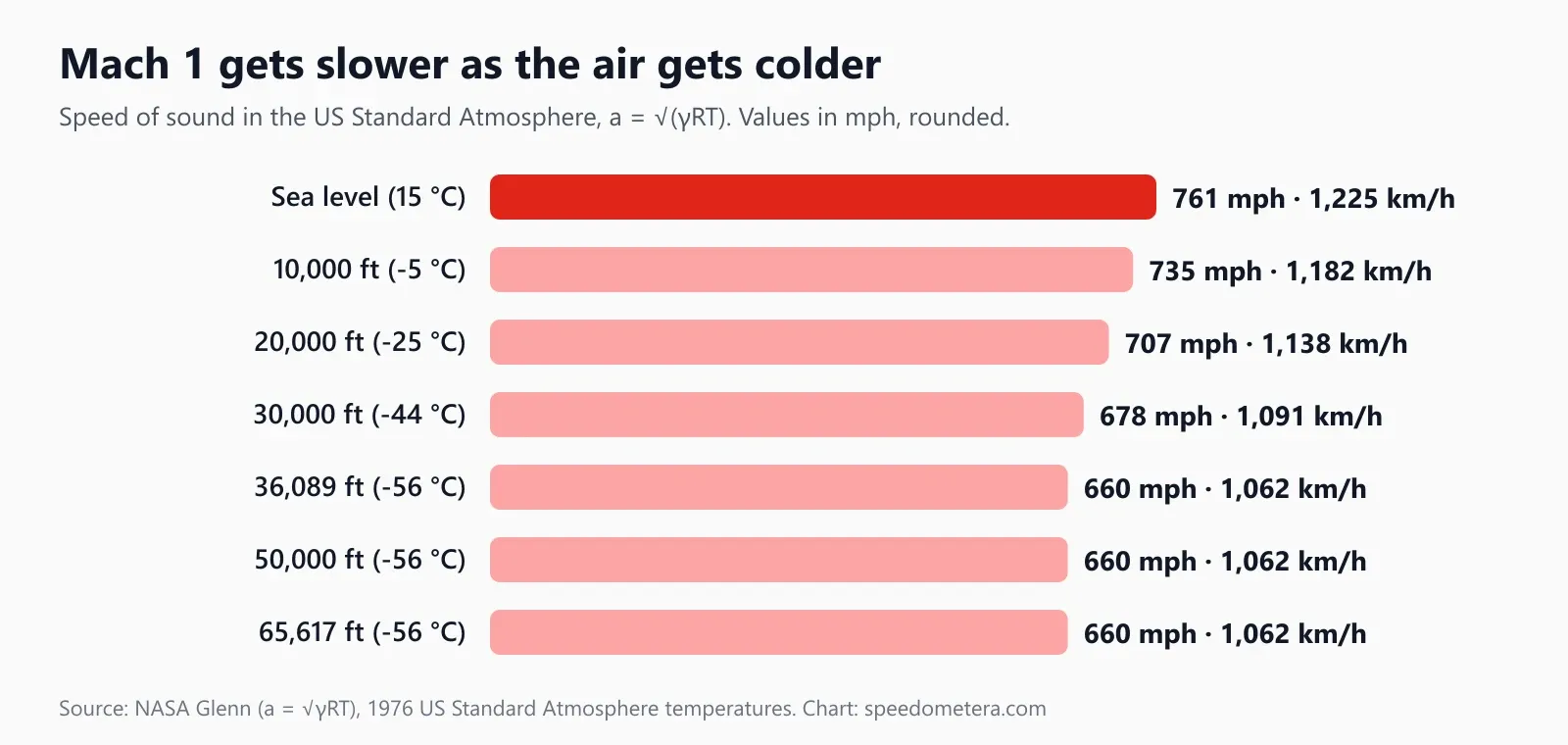
In the standard atmosphere the speed of sound falls from 761 mph at sea level to 660 mph (1,062 km/h) at 36,089 ft, then stays at 660 mph up to 65,617 ft. The reason is the temperature profile: the 1976 US Standard Atmosphere cools air by 6.5 °C per kilometer up to 11 km (36,089 ft), holds it at −56.5 °C to 20 km, then warms it slowly.
| Altitude (ft) | Altitude (km) | Standard temperature (°C / °F) | Mach 1 (mph) | Mach 1 (km/h) | Mach 1 (knots) | Mach 1 (m/s) |
|---|---|---|---|---|---|---|
| 0 ft (sea level) | 0.0 km | 15.0 °C / 59.0 °F | 761 mph | 1,225 km/h | 661 kn | 340.3 m/s |
| 5,000 ft | 1.5 km | 5.1 °C / 41.2 °F | 748 mph | 1,204 km/h | 650 kn | 334.4 m/s |
| 10,000 ft | 3.0 km | −4.8 °C / 23.3 °F | 735 mph | 1,182 km/h | 638 kn | 328.4 m/s |
| 20,000 ft | 6.1 km | −24.6 °C / −12.3 °F | 707 mph | 1,138 km/h | 614 kn | 316.0 m/s |
| 30,000 ft | 9.1 km | −44.4 °C / −48.0 °F | 678 mph | 1,091 km/h | 589 kn | 303.2 m/s |
| 35,000 ft | 10.7 km | −54.3 °C / −65.8 °F | 663 mph | 1,068 km/h | 576 kn | 296.5 m/s |
| 36,089 ft (tropopause) | 11.0 km | −56.5 °C / −69.7 °F | 660 mph | 1,062 km/h | 574 kn | 295.1 m/s |
| 40,000–65,617 ft | 12.2–20.0 km | −56.5 °C / −69.7 °F | 660 mph | 1,062 km/h | 574 kn | 295.1 m/s |
| 80,000 ft | 24.4 km | −52.1 °C / −61.8 °F | 667 mph | 1,073 km/h | 579 kn | 298.0 m/s |
| 100,000 ft | 30.5 km | −46.0 °C / −50.8 °F | 676 mph | 1,088 km/h | 587 kn | 302.1 m/s |
Altitudes are geopotential; values are for the standard day. Real air on a given day can be 10 to 20 °C warmer or colder, which shifts Mach 1 by roughly 13 to 26 mph. This is why pilots read Mach from instruments that measure the air around them, and why the ground speed your phone shows on a plane is a different number again (see how fast do planes fly).
How do you convert Mach to mph?
Multiply the Mach number by the local speed of sound: at sea level, mph = Mach × 761.2; above 36,089 ft, mph = Mach × 660.1. The converter above uses the sea-level constant; use the altitude column for cruise conditions.
| Mach number | Flight regime (NASA) | At sea level, 15 °C (mph / km/h) | At 36,089–65,617 ft, −56.5 °C (mph / km/h) |
|---|---|---|---|
| Mach 0.5 | Subsonic | 381 mph / 613 km/h | 330 mph / 531 km/h |
| Mach 0.85 | Subsonic (airliner cruise range) | 647 mph / 1,041 km/h | 561 mph / 903 km/h |
| Mach 1 | Transonic, the “sound barrier” | 761 mph / 1,225 km/h | 660 mph / 1,062 km/h |
| Mach 1.4 | Supersonic (X-59 design cruise) | 1,066 mph / 1,715 km/h | 924 mph / 1,487 km/h |
| Mach 2 | Supersonic | 1,522 mph / 2,450 km/h | 1,320 mph / 2,125 km/h |
| Mach 3 | Supersonic | 2,284 mph / 3,675 km/h | 1,980 mph / 3,187 km/h |
| Mach 5 | Hypersonic begins | 3,806 mph / 6,125 km/h | 3,300 mph / 5,311 km/h |
| Mach 10 | Hypersonic | 7,612 mph / 12,251 km/h | 6,601 mph / 10,623 km/h |
NASA defines the regimes by Mach number: subsonic below 1, transonic near 1, supersonic above 1, and hypersonic “typically greater than Mach 5.0”. Note that the X-59 row agrees with NASA’s own figure: Mach 1.4 at 55,000 ft is 924 to 925 mph, because at that height Mach 1 is 660 mph. To turn any of these into knots for aviation use, see the knots to mph converter.
What happens when a plane breaks the sound barrier?
Above Mach 1 an aircraft outruns its own pressure waves; they merge into shock waves that trail behind it in a cone, and when that cone sweeps the ground people hear a sonic boom. The boom is not a one-off event at the moment of “breaking” the barrier: it follows the aircraft along its whole supersonic track.
That boom is why supersonic travel over land is still restricted. Under 14 CFR 91.817, civil aircraft may not fly faster than Mach 1 over the United States without an FAA authorization, and NASA notes the FAA “currently prohibits supersonic flight over land due to the loud boom”.
NASA’s answer is the X-59 of the Quesst mission, a 99.7-ft, single-pilot jet shaped to turn the boom into a quiet “thump”. NASA’s design target is cruise at Mach 1.4 (925 mph) at 55,000 ft. The aircraft first went supersonic on 5 June 2026, according to AIAA’s report of NASA’s announcement; flights over communities to measure how people perceive the thump are meant to feed new noise standards.
How far does sound travel in a second?
At 15 °C sound covers 340 m (1,116 ft) per second, so it takes about 4.7 seconds to travel one mile and 2.9 seconds to travel one kilometer. That gives the classic thunderstorm rule: count the seconds between lightning and thunder, divide by 5 for miles or by 3 for kilometers.
Some other useful numbers:
- Echo distance: a clap that returns in 1 second came off a wall about 170 m (558 ft) away, half the round trip.
- Stadium delay: from the far end of a 100 m field, a starter’s pistol arrives about 0.29 s late, a big gap in a race timed to 0.01 s.
- Sound vs. speed: to convert any measured speed of sound in m/s into mph, use the m/s and mph converter.
How to use the Mach to mph converter
Enter a Mach number in the first box and read mph next to it; the sea-level standard (Mach 1 = 761.2 mph) is used.
- Type a Mach number, for example 0.85 or 2.
- Read mph, or tap All units for km/h, knots, m/s and ft/s at once.
- Adjust for altitude with the tables above: multiply by 660.1 instead of 761.2 for anything flying above 36,089 ft.
- Swap to turn an mph speed into a Mach number, such as a car at 300 mph (Mach 0.39 at sea level).
A phone cannot show your Mach number
A GPS speedometer measures ground speed, not airspeed, and does not know the outside air temperature, so it cannot compute a true Mach number. On a plane, our GPS speedometer shows ground speed, which includes the wind; a 100-knot tailwind can push ground speed well above the plane’s airspeed. GPS speed is an estimate that depends on signal and device.
FAQ
Frequently asked questions
What is Mach 1 in mph?
Mach 1 is 761 mph (1,225 km/h) at sea level in standard 15 °C air. At 36,089 ft and above, where standard air is −56.5 °C, Mach 1 is about 660 mph (1,062 km/h). Mach is a ratio to the local speed of sound, so its mph value changes with temperature.
How fast is the speed of sound in km/h?
The speed of sound is 1,225 km/h (340.3 m/s) at sea level at 15 °C. It is about 1,193 km/h at 0 °C, 1,236 km/h at 20 °C and 1,062 km/h in the −56.5 °C air of the lower stratosphere, where airliners cruise.
Why is the speed of sound slower at high altitude?
Because the air is colder, not because it is thinner. The speed of sound in air is a = √(γRT), which depends only on absolute temperature. Standard air cools from 15 °C at sea level to −56.5 °C at 36,089 ft, cutting Mach 1 from 761 mph to 660 mph.
How fast is Mach 2 in mph?
Mach 2 is 1,522 mph (2,450 km/h) at sea level and about 1,320 mph (2,125 km/h) at 36,089 ft and above, where most supersonic aircraft fly. Mach 3 is 2,284 mph at sea level and about 1,980 mph at altitude.
Does the speed of sound change with air pressure?
Not for an ideal gas such as dry air. Pressure and density cancel out in the formula, leaving a = √(γRT). That is why the speed of sound stays at 660 mph from 36,089 ft to 65,617 ft, where the standard atmosphere's temperature is constant.
How long does sound take to travel a mile?
About 4.7 seconds at 15 °C (1,609.344 m ÷ 340.3 m/s). That is the basis of the thunder rule: count the seconds from flash to bang and divide by 5 for miles or by 3 for kilometers (2.9 s per km).
What causes a sonic boom?
An aircraft flying faster than Mach 1 outruns its own pressure waves, which pile up into shock waves that spread behind it as a cone. When the cone sweeps over the ground, people hear a boom, and it lasts the whole time the aircraft is supersonic, not just at the moment it passes Mach 1.
Is the speed of sound faster in water?
Yes, much faster. Sound travels through seawater at about 1,500 m/s on average (about 3,355 mph), more than four times its speed in air, according to NASA JPL. This page covers sound in air, which is what Mach numbers for aircraft use.
Is the speed of sound 1,000 mph?
No. At sea level on a standard 15 °C day it is 761 mph (1,225 km/h), and about 768 mph in 20 °C air. 1,000 mph is Mach 1.31 at sea level and about Mach 1.52 in the −56.5 °C air above 36,089 ft, where Mach 1 is 660 mph.
Can a human go the speed of sound?
Yes, in an aircraft. Chuck Yeager first flew faster than sound on October 14, 1947, reaching Mach 1.06, about 700 mph, at 43,000 feet in the Bell X-1, according to the Smithsonian National Air and Space Museum. At that altitude Mach 1 is only about 660 mph.
9 Sources
- NASA Glenn Research Center: Speed of sound (a = √(γRT); 761 mph on a standard sea-level day)
- NASA Glenn Research Center: Mach number (subsonic, transonic, supersonic, hypersonic above about Mach 5)
- NOAA / NASA / USAF: U.S. Standard Atmosphere, 1976 (temperature profile, sea-level speed of sound 340.294 m/s)
- NASA: Quesst mission and the X-59 (Mach 1.4, 925 mph, 55,000 ft; FAA overland supersonic prohibition)
- AIAA (9 June 2026): NASA's X-59 exceeds Mach 1 on 5 June 2026
- 14 CFR 91.817: Civil aircraft sonic boom (Mach 1 limit over the US), Cornell LII
- NASA JPL classroom activity: sound travels through seawater at about 1,500 m/s
- NIST SP 811 Appendix B.9: speed conversion factors (mph = 0.44704 m/s exact)
- Smithsonian National Air and Space Museum: Bell X-1 Glamorous Glennis (Mach 1.06, 700 mph, 43,000 ft, 14 Oct 1947)
Last updated October 25, 2026 by Izhar Ahmad Danish. Found an error? Tell us.