



Key numbers
- Cheetah, timed run: 64.2 mph (103.3 km/h), a captive female over 201 m, timed by Craig Sharp in 1965
- Wild cheetah, GPS collar: 57.9 mph (93.2 km/h), fastest of 367 runs in Botswana (Wilson et al., Nature 2013)
- Fastest racehorse: 43.7 mph (70.35 km/h), Winning Brew, 2 furlongs in 20.57 s, 2008
- Racing greyhound: 42.5 mph (68.4 km/h, 19 m/s), Royal Veterinary College study, 2012
- Fastest human: 27.8 mph (44.7 km/h), Usain Bolt's peak, under half a cheetah's speed
On this page
How to use the How Fast Do Animals Run?
- 1Get a clear view of the skyHold the phone or keep it in an arm band; open the page before you start running.
- 2Tap Start and allow locationYour browser asks for location permission once. The first GPS fix usually arrives in 5–30 seconds.
- 3Pick your unitChoose km/h, mph, knots or m/s. Your choice is remembered on this device.
- 4Read speed, max, average and distanceThe gauge and digital readout update about once a second. Distance and average count only while you are moving.
- 5Stop or resetTap Stop to pause, Reset to clear the trip. Nothing is stored or sent anywhere.
Works in any modern phone browser. Back to the speedometer ↑
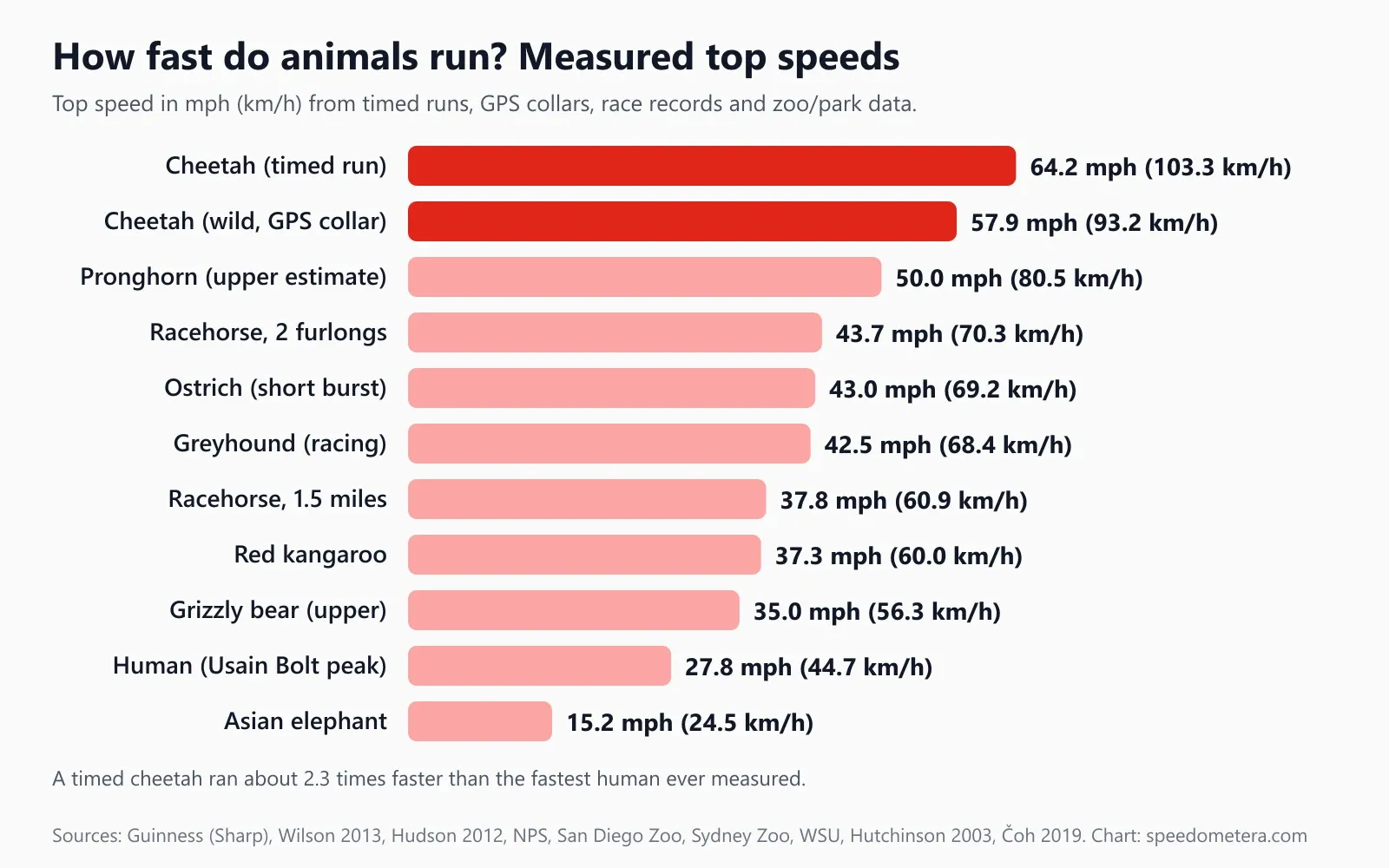
How fast does a cheetah run? The best timed run is 64.2 mph (103.3 km/h), and wild cheetahs wearing GPS collars peaked at 57.9 mph (93.2 km/h). No other land animal comes close. This page is a hub for animal running speeds: the cheetah, the horse and the dog get their own sections, and a sourced table compares them with the pronghorn, ostrich, kangaroo, bear, elephant and the fastest human. Every figure comes from a timed record, a peer-reviewed study or a zoo or national park page, and every mph to km/h conversion is calculated with the site’s own unit code.
Two kinds of numbers get mixed up online. A timed speed comes from a stopwatch, video or sensor over a measured distance. A quoted speed is an estimate repeated from book to book. Where the two disagree, this page says so.
How fast does a cheetah run?
A cheetah’s best timed speed is 28.7 m/s, which is 64.2 mph or 103.3 km/h (Guinness rounds it to 64.3 mph). Professor Craig Sharp timed a 35 kg captive female named Pritchelou in 1965. She started 18 m behind a 201.2 m (220-yard) course, chased a lure pulled by a Land Rover, and the speed is the average of three runs. Sharp published the result in the Journal of Zoology only in 1997, after learning that earlier records were unreliable.
The famous “70 mph” or “71 mph” cheetah (about 113 to 114 km/h) comes from older claims; Sharp’s paper notes that the earlier published records were unreliable, which is why he published his 1965 timings. The Smithsonian’s National Zoo still gives a range of 60 to 70 mph, so the honest answer is “about 60 to 64 mph, measured”.
What do wild cheetahs actually run? In 2013 Alan Wilson’s team at the Royal Veterinary College fitted five wild cheetahs in Botswana’s Okavango Delta with GPS and motion-sensor collars and recorded 367 runs over 17 months. The fastest reached 25.9 m/s (57.9 mph, 93.2 km/h), but the average top speed per hunt was only 14.9 m/s, or 33.3 mph (53.6 km/h). The study found that cheetahs win hunts with acceleration, braking and sharp turns, not with flat-out speed.
Acceleration beats top speed
The National Zoo says a cheetah goes from a standstill to 45 mph (72.4 km/h) in about 2.5 seconds, and can hold its top speed for only about 300 yards (274 m). After that it has to stop and recover.
How fast can a horse run?
The fastest racehorse speed on record is 70.35 km/h (43.7 mph), set by the two-year-old filly Winning Brew, who covered 2 furlongs (402 m) in 20.57 seconds at Penn National Race Course, Pennsylvania, on 14 May 2008. That is the figure on the current Guinness World Records page. Many sites quote 70.76 km/h (43.97 mph) for the same run; the Guinness record page we checked on 25 Oct 2026 gives 70.35 km/h, and 402 m in 20.57 s works out to the lower figure.
Speed falls as races get longer. The Guinness record over 1.5 miles (2,414 m) is 60.86 km/h (37.8 mph), set by Hawkster at Santa Anita Park in 1989 in 2:22.8. A racehorse can hold close to 38 mph for well over two minutes, something no cheetah can do.
Horse speed by gait. Riding horses move much slower than racing Thoroughbreds. The Montana State University Extension gives these typical ranges:
| Gait | Typical speed (mph) | Typical speed (km/h) |
|---|---|---|
| Walk | 3.5–5 | 5.6–8.0 |
| Canter | 6–10 | 9.7–16.1 |
| Trot | 7–10 | 11.3–16.1 |
| Gallop | 12–20 | 19.3–32.2 |
| Racehorse, 1.5 miles (record) | 37.8 | 60.9 |
| Racehorse, 2 furlongs (record) | 43.7 | 70.35 |
A rider can check these numbers directly: start the GPS speedometer at the top of this page, put the phone in a zipped pocket, and read the max speed after the ride. GPS updates about once a second, so a short burst reads lower than the true peak.
How fast can a dog run?
The racing greyhound is the fastest dog with a published measurement: 19 m/s, which is 42.5 mph or 68.4 km/h. Penny Hudson, Sandra Corr and Alan Wilson of the Royal Veterinary College filmed trained racing greyhounds and captive cheetahs on the same straight track and reported the result in the Journal of Experimental Biology in 2012 (ScienceDaily summary). In that test the greyhounds were actually faster than the captive cheetahs, which topped out at 17.8 m/s (39.8 mph). Pet cheetahs that chase a lure for fun are not wild hunters.
The 45 mph greyhound figure on many dog sites has no traceable measurement behind it. The same is true of the long breed lists (Saluki, Vizsla, Dalmatian and so on) that give each breed a precise mph. We found no peer-reviewed speeds for them, so we do not repeat them. Most pet dogs run well below greyhound speed, and size, age, fitness and surface matter more than breed labels.
Animal speed comparison table
The cheetah is fastest, the pronghorn second, and racehorses, ostriches and greyhounds form a close group at 42 to 44 mph. The table lists each animal’s best published top speed, converted with the site’s speed converter code (1 mph = 1.609344 km/h exactly).
| Animal | Top speed (mph) | Top speed (km/h) | Source |
|---|---|---|---|
| Cheetah, timed run | 64.2 | 103.3 | Guinness (Sharp, 1965) |
| Cheetah, wild (GPS collar) | 57.9 | 93.2 | Wilson et al., Nature 2013 |
| Pronghorn (sustained sprint) | 45–50 | 72.4–80.5 | NPS Yellowstone |
| Thoroughbred racehorse (2 furlongs) | 43.7 | 70.35 | Guinness |
| Ostrich (short burst) | 43 | 69.2 | San Diego Zoo |
| Greyhound (racing) | 42.5 | 68.4 | Hudson et al., J Exp Biol 2012 |
| Red kangaroo | 37.3 | 60 | Sydney Zoo |
| Grizzly bear | 30–35 | 48.3–56.3 | Washington State Univ. |
| Human (Usain Bolt peak) | 27.8 | 44.7 | Human running speed |
| Asian elephant | 15+ | 24+ | Univ. of Colorado (Hutchinson, Kram et al., 2003) |
| Lion | not reliably measured | — | Widely quoted 50 mph (80 km/h) has no timed source we could verify |
A few notes on the table. The ostrich can also hold a steady 31 mph (49.9 km/h), per San Diego Zoo. The elephant figure comes from video of 42 Asian elephants in Thailand; three topped 15 mph, about 50 percent faster than any earlier reliable record. And we left the lion without a number on purpose: the popular “50 mph” lion appears everywhere but traces back to no published timing.
What about the fastest animal of all? The table covers running animals. In the air the record belongs to the peregrine falcon: the National Park Service says a stooping peregrine may reach about 200 mph (322 km/h), but most dives are closer to 100 mph, because the bird uses only as much speed as it needs to catch its prey.
Why are cheetahs so fast?
Cheetahs combine a long, flexible spine, long legs and a light body (Sharp’s record cheetah weighed 35 kg), so each stride covers a lot of ground. Hudson’s 2012 study found that at the same speed a cheetah uses longer, slower strides than a greyhound, and at high speed it carries about 70 percent of its weight on its hind legs (62 percent for a greyhound), which helps it push off and accelerate. The 2013 Wilson study adds the other half of the story: hunts are short, tight-turning chases, so grip, braking and acceleration decide success more than top speed.
The price is endurance. A cheetah overheats and tires after a few hundred yards, while a pronghorn or a horse can keep running fast for minutes.
How to measure an animal’s speed with your phone
You can get a rough top speed for a horse ride or a dog run with any phone GPS: open this page, tap Start, allow location, and read the max speed afterwards.
- Use open ground with a clear sky view; trees and buildings make GPS jump.
- Wait until the speed reads 0 while standing still before starting.
- For a horse, keep the phone in a zipped pocket or a saddle bag. For a dog, use a secure harness pouch and a safe, enclosed area.
- Read the max speed and distance at the end, and export the GPX track if you want to see the speed graph.
GPS speed is an estimate. GPS.gov notes that smartphone accuracy depends on signal, sky view and device, and a 1-second update rate smooths out short bursts. Treat the reading as a guide, not a race timing. For people, see how fast a human can run, the average walking speed and average cycling speed, or convert any figure with km/h to mph.
FAQ
Frequently asked questions
How fast does a cheetah run in mph?
The best measured cheetah speed is 64.2 mph (103.3 km/h), averaged over three timed runs by a captive female in 1965. Wild cheetahs wearing GPS collars in Botswana peaked at 57.9 mph (93.2 km/h), and most of their hunts were much slower.
How long can a cheetah run at top speed?
Only briefly. The Smithsonian's National Zoo says cheetahs can hold top speed for about 300 yards (274 m). They reach 45 mph (72.4 km/h) from a standstill in about 2.5 seconds, so the chase is decided in seconds, not minutes.
How fast can a horse run?
The fastest racehorse speed in Guinness records is 43.7 mph (70.35 km/h), set by the filly Winning Brew over 2 furlongs in 2008. Over 1.5 miles the record is 37.8 mph (60.86 km/h). An ordinary riding horse gallops at about 12 to 20 mph (19 to 32 km/h).
How fast can a dog run?
The racing greyhound is the fastest dog measured in a peer-reviewed study, at 19 m/s, which is 42.5 mph (68.4 km/h). Most pet breeds are far slower and have no published, measured top speed, so treat breed-by-breed mph lists online with caution.
Can a horse outrun a cheetah?
Not in a sprint. A cheetah's timed 64.2 mph is about 20 mph faster than the fastest racehorse at 43.7 mph. Over longer distances the horse wins, because a cheetah can only hold top speed for about 300 yards while a racehorse averages 37.8 mph over 1.5 miles.
What is the fastest land animal after the cheetah?
The pronghorn of North America. Yellowstone National Park says pronghorn sustain sprints of 45 to 50 mph (72 to 80 km/h), and they can keep running fast for far longer than a cheetah, which makes them the best long-distance sprinters on land.
Can a human outrun a bear?
No. Washington State University says grizzly bears have been clocked at 30 to 35 mph (48 to 56 km/h) in the wild, while the fastest human ever measured, Usain Bolt, peaked at 27.8 mph for about 20 meters. Never run from a bear.
What is the fastest animal in the world?
The peregrine falcon. The US National Park Service says a peregrine diving on prey can reach about 200 mph (322 km/h), though most dives are closer to 100 mph. On land the fastest animal is the cheetah, timed at 64.2 mph (103.3 km/h) over a short sprint.
Can a cheetah run 100 mph?
No. The fastest timed cheetah ran 64.2 mph (103.3 km/h), and wild cheetahs fitted with GPS collars peaked at 57.9 mph (93.2 km/h). 100 mph would be over 50% faster than any measured run; even the Smithsonian's National Zoo gives an upper figure of 70 mph.
Could a human outrun a cheetah?
Not in a sprint. Usain Bolt's peak of 27.8 mph is less than half a wild cheetah's measured 57.9 mph. A cheetah reaches 45 mph in about 2.5 seconds and, at top speed, covers 100 m in under 4 seconds. It can only hold that pace for about 300 yards, though.
Do cheetahs overheat when they run?
Not during a hunt, according to a 2013 Biology Letters study by Robyn Hetem and colleagues. Body temperatures of four wild cheetahs in Namibia stayed stable through chases and rose only afterwards, about twice as much after a kill. The overheating idea came from a 1973 study of captive cheetahs on a treadmill.
Can I measure how fast my dog or horse runs?
Yes, roughly. Tap Start on the GPS speedometer above and carry the phone while riding your horse, or attach it securely to a harness for a dog. GPS reads speed every second or so, so short bursts read lower than the true peak.
15 Sources
- Guinness World Records: fastest mammal on land over short distances, cheetah 64.3 mph (28.7 m/s), timed by Prof. Craig Sharp, 1965
- ScienceDaily (14 Jun 2013): Wilson A.M. et al., Locomotion dynamics of hunting in wild cheetahs, Nature 498:185, 367 runs, top speed 58 mph
- BioEd Online / Nature News (12 Jun 2013): wild cheetah top speed 25.9 m/s, average hunt top speed 14.9 m/s
- Smithsonian's National Zoo: cheetah, 60–70 mph, 0–45 mph in 2.5 s, held for about 300 yards
- ScienceDaily (21 Jun 2012): Hudson, Corr & Wilson, High speed galloping in the cheetah and the racing greyhound, J Exp Biol 215:2425
- Guinness World Records: fastest speed for a racehorse, Winning Brew 70.35 km/h (2008); Hawkster 60.86 km/h over 1.5 miles (1989)
- Montana State University Extension: horse locomotion, gait speeds
- National Park Service, Yellowstone: pronghorn sustained sprints of 45–50 mph
- San Diego Zoo Wildlife Alliance: ostrich, bursts to 43 mph, steady 31 mph
- Sydney Zoo: red kangaroo, top speed 60 km/h
- Washington State University CAHNRS (24 Jun 2016): grizzlies clocked at 30–35 mph in the wild
- University of Colorado Boulder (2003): Hutchinson, Kram et al., Nature, elephants clocked above 15 mph
- National Park Service, Mississippi National River: peregrine falcon stoops up to 200 mph, most dives closer to 100 mph
- National Geographic (23 Jul 2013): Hetem R.S. et al., Biology Letters, cheetahs do not abandon hunts because they overheat
- GPS.gov: GPS accuracy (smartphones and speed accuracy)
Last updated October 25, 2026 by Izhar Ahmad Danish. Found an error? Tell us.