



Key numbers
- Phone GPS speed comes from the location chip in metres per second; 1 m/s = 3.6 km/h = 2.237 mph
- UN R39 dashboards may never read low, and may read up to 10% + 4 km/h high
- India: every new motor vehicle must have a speedometer meeting IS 11827-2008 (CMVR rule 117)
- US trucks and buses: within ±5 mph at 50 mph (49 CFR 393.82); no federal limit for cars
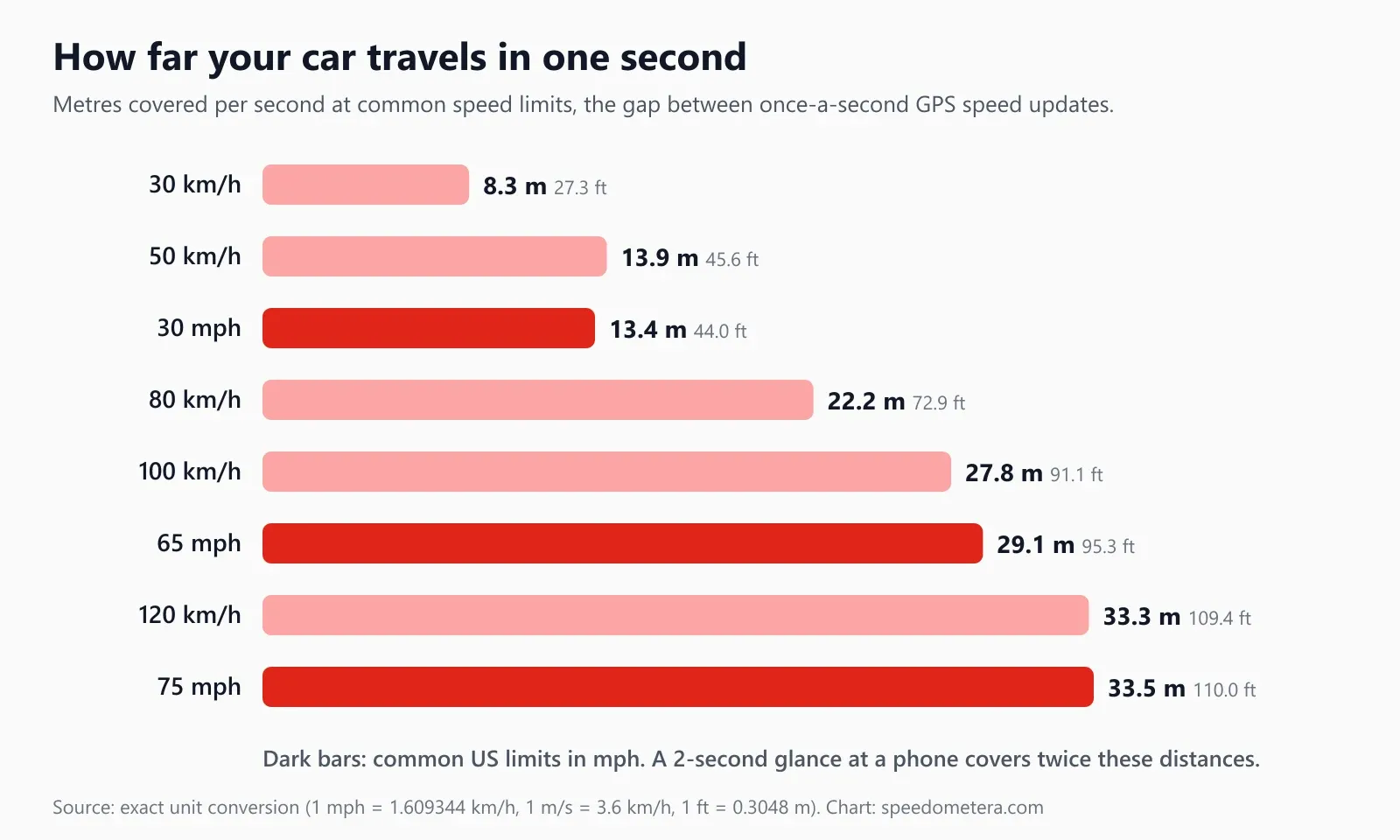
- At 100 km/h a car covers 27.8 m every second; at 65 mph, 95 ft
On this page
- How to use the Car Speedometer
- How do I use my phone as a car speedometer?
- When does a phone car speedometer help?
- How does a car speedometer work?
- How does a GPS speedometer for a car work?
- Why does my car speedometer read higher than GPS?
- How do I test my car speedometer online?
- Car speedometer in km/h and mph: quick reference
- What are the car speed limits in India?
- GPS app, OBD-II display or HUD: which digital speedometer for a car?
- What this car speedometer does not claim
- Frequently asked questions
How to use the Car Speedometer
- 1Get a clear view of the skyMount your phone in a holder with a clear view of the sky before you set off.
- 2Tap Start and allow locationYour browser asks for location permission once. The first GPS fix usually arrives in 5–30 seconds.
- 3Pick your unitChoose km/h, mph, knots or m/s. Your choice is remembered on this device.
- 4Read speed, max, average and distanceThe gauge and digital readout update about once a second. Distance and average count only while you are moving.
- 5Stop or resetTap Stop to pause, Reset to clear the trip. Nothing is stored or sent anywhere.
Works in any modern phone browser. Back to the speedometer ↑
How do I use my phone as a car speedometer?
Mount the phone, open this page, tap Start and allow location access. The car speedometer above then shows your true speed from GPS in km/h or mph. Nothing to install, no account, and it keeps working without mobile data once the page has loaded.
- Mount it first. Put the phone in a dashboard or windscreen holder where it has a clear view of the sky through the glass. A phone lying in a cup holder or a door pocket sees less sky and gives jumpier readings.
- Tap Start and allow location. The browser asks once. On Android choose “precise” location; on iPhone keep “Precise Location” on. Without precise location the phone may fall back to Wi-Fi or mobile-network positions, which cannot measure driving speed.
- Wait for a fix. The accuracy line under the gauge shows how sure the phone is about its position. Give it 10–30 seconds parked or rolling slowly before trusting the number.
- Pick your unit. “Auto” uses km/h or mph from your region; tap the unit pill to switch. Drivers in India and Indonesia usually want km/h, in the US and UK mph.
- Set a speed alert. Enter a limit and the speedometer beeps (and vibrates, where the phone supports it) when you pass it, so you don’t need to look at the screen.
- Night driving? Use HUD mode. The HUD speedometer mirrors the digits so they reflect in the windscreen. It works best on a dark dashboard at night.
The screen stays on while the speedometer runs (where the browser supports it). Plug the phone into the car charger for long trips, because GPS and a bright screen together use a lot of battery.
The driver must not handle the phone
Mount the phone before you set off and let a passenger change settings. Reading or tapping a phone while driving is dangerous and illegal in many countries and US states. Follow your local law and the posted limits.
When does a phone car speedometer help?
A GPS speedometer for your car is most useful when the dash can’t be trusted or can’t be read: a broken gauge, new tyres, a rental car in unfamiliar units, or a speedometer you simply want to check. Here are the common cases and what to do in each.
| Situation | Why the dash falls short | What to do with the GPS speedometer |
|---|---|---|
| Speedometer stopped working or the needle jumps | Failed speed sensor, wiring, fuse or cluster fault | Use GPS as a stand-in until it is repaired |
| Bigger or smaller tyres fitted | The car still assumes the old tyre size | Compare at a steady speed, then use the calibration calculator |
| Rental car abroad in km/h (or mph) | Unfamiliar main scale | Set the unit you think in; check the km/h to mph converter |
| Classic or imported car | Old cable speedometer, worn parts or a different gear ratio | Read true speed from GPS; keep it mounted as a second gauge |
| “Is my speedometer right?” | Dashboards read high by design | Run the 2-minute test below |
| Long night drive | Glancing down at the cluster | HUD mode on the windscreen |
| Trip and fuel planning | Odometer shares the tyre error | Track distance with the trip odometer |
A GPS speedometer is not a replacement for a working dashboard. It loses the signal in tunnels and multi-storey car parks, lags by a second or two when you brake, and depends on your phone’s battery. Treat it as a check and a backup, and get a broken speedometer fixed: in India, CMVR rule 117 requires every motor vehicle to carry one, and a car with a dead speed sensor often has trouble with cruise control and other systems too.
How does a car speedometer work?
A car speedometer doesn’t measure speed directly. It counts how fast the wheels (or the gearbox output) turn and multiplies by the distance one tyre revolution is assumed to cover. That one assumption explains almost every speedometer error.
Mechanical (cable) speedometers
Older cars, including many still on Indian roads, use a flexible cable driven by a gear on the gearbox. The cable spins a magnet inside the instrument. The rotating magnet drags a metal cup (the “speed cup”) around through eddy currents, and a fine hairspring holds the cup back. The faster the magnet spins, the further the cup and its needle turn against the spring. A second gear train drives the odometer digits.
Cable speedometers wear: a dry or kinked cable makes the needle flutter or stick, and a broken cable drops it to zero while the odometer stops counting. The search “car speedometer cable” is mostly owners of these cars.
Electronic speedometers
Modern cars replace the cable with magnetic sensors. A toothed ring on the gearbox output or on each wheel hub passes a sensor that sends a pulse per tooth. The engine or ABS computer counts pulses per second, converts that to speed using a programmed pulses-per-kilometre figure, and sends the result to the instrument cluster over the car’s data network. The cluster draws either a needle (analog) or digits (digital). Both read the same number, which is why a digital dash is not inherently more accurate than an analog one; it is only easier to read precisely.
The same signal feeds cruise control, the ABS and stability systems, automatic gear changes and the OBD-II diagnostic port. That is why a failed vehicle speed sensor often brings warning lights and erratic gear changes with it, and why an OBD-II plug-in display shows exactly the same speed, error included, as the dash.
What all of them assume
Every wheel-based speedometer assumes a fixed tyre circumference. If the tyre is larger, each turn covers more road than the car thinks, and the speedometer reads low; smaller or worn tyres make it read high. Our tire size calculator shows the exact change for any size swap, and GPS vs car speedometer covers how much tread wear moves the reading.
How does a GPS speedometer for a car work?
A GPS car speedometer reads the speed your phone’s location chip calculates from satellite signals, not from the wheels, so tyre size, wear and gear ratios don’t affect it. The browser hands that speed to the page in metres per second, and the page converts it to km/h or mph.
All three platforms say the same thing about the unit. The W3C Geolocation API that every browser uses defines speed as the horizontal speed “in meters per second, or null if not available”. Android’s Location.getSpeed() returns “speed in meters per second” and notes it “may be more accurate than would be obtained simply by calculating distance / time for sequential positions, such as if the Doppler measurements from GNSS satellites are taken into account.” Apple’s Core Location gives “the instantaneous speed of the device, measured in meters per second”, with a negative value meaning invalid.
That Doppler point matters. The receiver measures the tiny frequency shift in each satellite’s signal caused by your motion, which gives velocity directly instead of by subtracting two noisy positions. GPS.gov puts the GPS signal’s range-rate error at no more than 0.006 m/s over any 3-second interval (95% probability), while smartphone position accuracy is typically about 4.9 m (16 ft) under open sky and worse near buildings, bridges and trees. Speed from a phone is therefore usually much better than its position, as long as it can see the sky.
Converting the reading
km/h = m/s × 3.6 · mph = km/h ÷ 1.609344
Worked example: the phone reports 27.78 m/s. × 3.6 = 100.0 km/h, ÷ 1.609344 = 62.1 mph. The page does this with exact constants and rounds only for display.
The chart shows two things. GPS speed lags a little because each reading describes the last second, so during hard braking the phone can briefly show a higher number than the dash. And a glance at a phone is never “just a second”: at 100 km/h that second is 27.8 m of road, which is why the phone belongs in a mount with a speed alert, not in your hand.
Why does my car speedometer read higher than GPS?
Because it is designed to. Speedometers built to UN Regulation No. 39 may never show less than true speed, and may show up to 10% plus 4 km/h more. Car makers aim slightly high so that tolerances and tyre wear never push the reading below true speed.
0 ≤ (indicated − true) ≤ 0.1 × true + 4 km/h
At a true 100 km/h the dash may legally show anything from 100 to 114 km/h. In mph, at a true 60 mph (96.6 km/h) the limit is 1.1 × 96.6 + 4 = 110.2 km/h, or 68.5 mph. Real cars use only a small part of that window, typically reading a few percent high. India requires a speedometer meeting the Bureau of Indian Standards’ IS 11827-2008 under CMVR rule 117. In the US, FMVSS No. 101 governs how the speedometer is labelled and lit but sets no accuracy figure for cars; only buses and trucks have one, ±5 mph at 50 mph under 49 CFR 393.82.
For the full tolerance tables, tyre-wear figures and the ticket question, read GPS vs car speedometer. If your gap is outside normal, the speedometer calibration tool turns one GPS reading into a correction factor.
How do I test my car speedometer online?
Hold a steady indicated speed on a straight, level road and have a passenger compare the dash with the GPS reading above for 10–20 seconds. Error % = (dash − GPS) ÷ GPS × 100.
- Set tyre pressures to the door-jamb placard.
- Mount the phone, tap Start and wait for a good accuracy reading before you drive.
- On an expressway or open highway, hold 80 km/h or 50 mph on the dash, ideally with cruise control.
- Let the passenger read GPS several times, then repeat at 100 km/h or 60–65 mph.
- Drive the same stretch the other way and average, to cancel slope and wind.
| Dash shows | GPS shows | Error | What it means |
|---|---|---|---|
| 100 km/h | 96 km/h | +4.2% | Normal: reads high |
| 60 mph | 58 mph | +3.4% | Normal: reads high |
| 80 km/h | 80 km/h | 0.0% | Unusually exact; fine |
| 65 mph | 68 mph | −4.4% | Reads low: you’re faster than the dash. Check tyre size |
Error computed as (dash − GPS) ÷ GPS × 100, rounded to 0.1%. A negative number is the one to act on, because a low-reading speedometer can earn you a speeding ticket at an indicated limit.
Car speedometer in km/h and mph: quick reference
Most cars sold in India show km/h; US cars show mph on the main scale with km/h on a smaller inner ring. Renting abroad, the numbers you know are on the wrong scale. Here are the common limits converted exactly.
| km/h on the dash | = mph | Distance per second |
|---|---|---|
| 30 km/h | 18.6 mph | 8.3 m (27.3 ft) |
| 50 km/h | 31.1 mph | 13.9 m (45.6 ft) |
| 60 km/h | 37.3 mph | 16.7 m (54.7 ft) |
| 80 km/h | 49.7 mph | 22.2 m (72.9 ft) |
| 100 km/h | 62.1 mph | 27.8 m (91.1 ft) |
| 120 km/h | 74.6 mph | 33.3 m (109.4 ft) |
| mph on the dash | = km/h | Distance per second |
|---|---|---|
| 25 mph | 40.2 km/h | 11.2 m (36.7 ft) |
| 35 mph | 56.3 km/h | 15.6 m (51.3 ft) |
| 45 mph | 72.4 km/h | 20.1 m (66.0 ft) |
| 55 mph | 88.5 km/h | 24.6 m (80.7 ft) |
| 65 mph | 104.6 km/h | 29.1 m (95.3 ft) |
| 75 mph | 120.7 km/h | 33.5 m (110.0 ft) |
Computed with exact constants (1 mph = 1.609344 km/h, 1 m/s = 3.6 km/h), rounded to 0.1. Speed limits vary by state and road; follow the posted sign. For any other value, use the speed converter.
What are the car speed limits in India?
India’s national maximums come from Ministry of Road Transport and Highways notification S.O. 1522(E) of 6 April 2018: 120 km/h for cars on access-controlled expressways, 100 km/h on four-lane divided highways and 70 km/h elsewhere. These are ceilings. State governments and police post lower limits on many stretches, and the posted sign is the one that applies.
| Vehicle class (km/h) | Expressway with access control | 4-lane+ divided carriageway | Road within municipal limits | Other roads |
|---|---|---|---|---|
| Cars and passenger vehicles up to 8 seats (M1) | 120 | 100 | 70 | 70 |
| Buses, 9+ seats (M2, M3) | 100 | 90 | 60 | 60 |
| Goods vehicles (all N) | 80 | 80 | 60 | 60 |
| Motorcycles | 80* | 80 | 60 | 60 |
| Quadricycles | — | 60 | 50 | 50 |
| Three-wheelers | — | 50 | 50 | 50 |
* Only where motorcycles are allowed on the expressway. Source: the table in the Gazette notification, transcribed from the official scan. Paragraph 2 of the same notification says no speeding case is taken up under section 183 of the Motor Vehicles Act if the detected speed is within 5% of the maximum, so 120 km/h becomes 126 km/h on the camera. Do not plan around that margin: your dash already reads a few percent high, and posted limits are often lower than the table.
Legal status. In August 2021 the Madras High Court quashed this notification and told the government to bring speeds down. The Supreme Court set that order aside in November 2024, holding that speed limits are for experts and the government to fix, not courts, as reported by LawChakra. We have not been able to locate the judgment itself, so treat the table as the national ceiling and the posted sign as the law on your road.
GPS app, OBD-II display or HUD: which digital speedometer for a car?
For checking true speed, a GPS speedometer wins; for a permanent second display that never loses signal, an OBD-II gauge; for keeping your eyes up, a HUD. Each has a different source and a different weakness.
| Option | Speed source | Affected by tyre size? | Works in tunnels? | Cost |
|---|---|---|---|---|
| This web speedometer | Phone GPS | No | No | Free |
| Native speedometer app | Phone GPS | No | No | Free to paid |
| OBD-II plug-in gauge or HUD | Car’s own speed signal | Yes, same as dash | Yes | Paid hardware |
| Stand-alone GPS HUD unit | Its own GPS receiver | No | No | Paid hardware |
| Factory digital dash | Wheel/gearbox sensors | Yes | Yes | Comes with the car |
A web page needs the screen on and the tab open; native apps can track in the background. If you only need the number now, the free speedometer above is enough. If you drive mostly at night, try the HUD speedometer first before buying a projector.
What this car speedometer does not claim
GPS speed from a phone is an estimate. It depends on the satellite signal, the phone’s antenna and chip, and its view of the sky, and it can lag or jump in tunnels, city centres and the first seconds after start-up. Neither this page nor your car’s dashboard is legal evidence or a calibration certificate; for that, use a calibrated test facility. Never drive faster than the limit to test a reading.
FAQ
Frequently asked questions
Can I use my phone as a speedometer in my car?
Yes. Open this page, tap Start and allow location; the phone's GPS shows speed in km/h or mph with no app needed. Mount it in a holder with a view of the sky, keep the screen on, and let a passenger handle it. It works offline once the page has loaded.
Is a GPS speedometer more accurate than a car speedometer?
At a steady speed on an open road, usually yes. Car speedometers are designed to read a few percent high, while GPS.gov puts the satellite signal's speed error at no more than 0.006 m/s. GPS lags 1–2 seconds when you brake or accelerate and drops out in tunnels, so compare at constant speed.
How does a car speedometer measure speed?
It counts how fast the wheels or gearbox output shaft turn and multiplies by the distance one tyre revolution covers. Old cars used a spinning cable and a magnet; modern cars use magnetic sensors that send pulses to a computer. Because it assumes a tyre size, a different or worn tyre changes the reading.
Why does my car speedometer show more than my actual speed?
Because the rules allow over-reading but never under-reading. UN Regulation No. 39 lets a speedometer show up to 10% plus 4 km/h above true speed, so a true 100 km/h may legally show up to 114 km/h. Most cars use only a small part of that, reading a few percent high; worn tyres add a little more.
Is a car speedometer accurate?
Accurate enough for driving, but biased high. Most cars read a few percent fast, so a dash 100 km/h often means about 95–98 km/h. R39 forbids any reading below true speed. Test yours with GPS at a steady speed; if it reads below GPS, check tyre size and pressure.
Can I drive my car if the speedometer is not working?
Only to get it repaired, and carefully. In India, CMVR rule 117 requires every motor vehicle to be fitted with a speedometer meeting IS 11827-2008, so a dead one leaves the car non-compliant, and you cannot prove your speed to yourself or anyone else. A GPS speedometer is a stand-in for the drive to the garage, not a fix.
What is the maximum speed limit for cars in India?
Under MoRTH notification S.O. 1522(E) of 6 April 2018, cars with up to eight passenger seats (M1) may do 120 km/h on access-controlled expressways, 100 km/h on four-lane divided highways and 70 km/h on other roads and inside municipal limits. States and cities often post lower limits; the sign always wins.
What should I do if my car speedometer is not working?
Use a GPS speedometer such as this page as a temporary readout and get the car checked. Common causes are a failed vehicle speed sensor, a wiring or fuse fault, or an instrument cluster fault; a broken cable on older cars. ABS and cruise control may also misbehave, so repair it soon.
What is the best speedometer app for a car?
One that shows large digits, works hands-free and offline, and lets you switch km/h and mph. This web speedometer does that without an install, and adds a HUD mirror mode, speed alert and trip distance. Native apps can run in the background; a web page needs the screen on.
Is a digital speedometer more accurate than an analog one?
Not by itself. Both read the same wheel-speed signal and follow the same over-read rules, so the error is the same; a digital display only makes the number easier to read precisely. A GPS speedometer is different, because it measures speed from satellites rather than from the tyres.
Can I add a digital speedometer to any car?
Yes, three ways: a phone or tablet running a GPS speedometer, a plug-in OBD-II display that reads the car's own speed signal, or a stand-alone GPS head-up unit. GPS units ignore tyre-size errors; OBD-II units copy whatever the dash says, error included.
How do I read a car speedometer in km/h and mph?
Most cars show one main scale and a smaller second scale. In India the large numbers are km/h; in the US they are mph with km/h on an inner ring. To convert, 100 km/h = 62.1 mph and 60 mph = 96.6 km/h; tap the unit under the gauge above to switch.
11 Sources
- W3C Geolocation API (Recommendation): coords.speed in metres per second, null if unavailable; accuracy at 95% confidence
- Android developers: Location.getSpeed(), speed in metres per second, may use GNSS Doppler measurements
- Apple developer documentation: CLLocation.speed, instantaneous speed in metres per second, negative when invalid
- GPS.gov: GPS accuracy (smartphones about 4.9 m under open sky; range-rate error ≤0.006 m/s over 3 s)
- UN Regulation No. 39, Revision 2 (E/ECE/324/Rev.1/Add.38/Rev.2): para. 5.4 speedometer accuracy formula (copy hosted by a forum; original issued by UNECE)
- 49 CFR 393.82 (FMCSA): speedometer accuracy ±5 mph at 50 mph for buses, trucks and truck-tractors (Cornell LII)
- 49 CFR 571.101: FMVSS No. 101, Controls and displays (NHTSA; Cornell LII)
- Gazette of India, Extraordinary, Part II Sec. 3(i), G.S.R. 291(E), 24 April 2014: Central Motor Vehicles (5th Amendment) Rules, 2014, rule 9 substituting CMVR rule 117(2)–(3), speedometer to IS 11827-2008 (official Gazette scan, Internet Archive)
- Gazette of India, Extraordinary, Part II Sec. 3(ii), S.O. 1522(E), 6 April 2018 (MoRTH): maximum speed by vehicle class and road type; 5% detection margin (official Gazette scan, Internet Archive)
- PIB, 19 July 2018: Speed limit on National Highways (Lok Sabha written reply on S.O. 1522(E))
- LawChakra, 30 Nov 2024: Supreme Court (Surya Kant and Ujjal Bhuyan JJ.) sets aside Madras High Court order on 2018 speed limits (secondary report; judgment text not located)
Last updated October 25, 2026 by Izhar Ahmad Danish. Found an error? Tell us.