



Key numbers
- 1 mph = 0.44704 m/s exactly (NIST SP 811)
- 1 m/s = 2.23694 mph = 3.6 km/h
- Mental shortcut: halve the mph, then subtract 10% (60 mph → 27 m/s; exact 26.82)
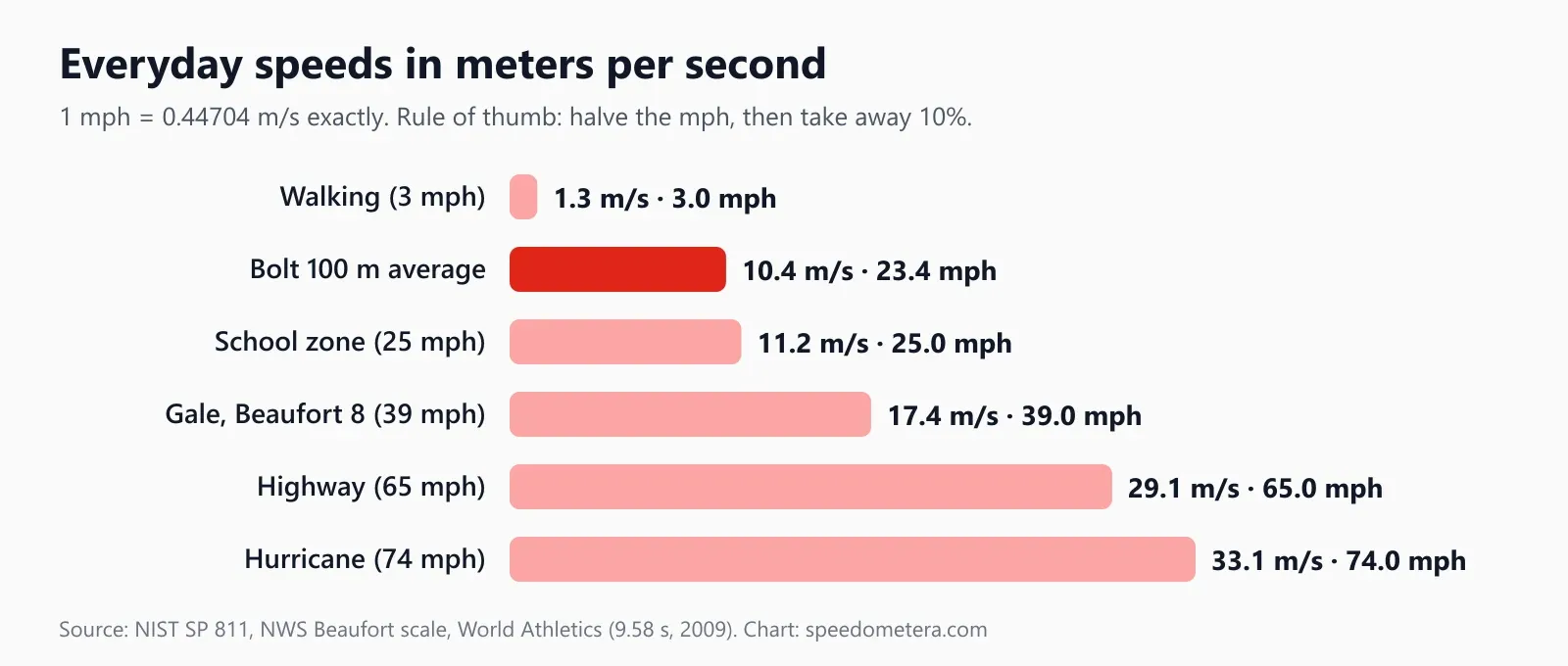
- Usain Bolt's 9.58 s world-record 100 m averaged 10.44 m/s (23.35 mph)
- Hurricane-force wind starts at 64 knots = 32.9 m/s (73.6 mph)
On this page
- How to use the mph to m/s Converter
- How do you convert mph to m/s?
- mph to m/s conversion chart
- How do you convert mph to m/s in your head?
- What is m/s used for: physics, wind and sport
- Why do you divide by 3.6 to convert km/h to m/s?
- How do you convert m/s to mph?
- How to use the mph to m/s converter
- Frequently asked questions
How to use the mph to m/s Converter
- 1Type a speed in any boxEnter a number in mph, km/h, knots, m/s, ft/s or Mach. Every other box updates as you type.
- 2Read the other unitsResults use exact definitions: 1 mile = 1,609.344 m, 1 nautical mile = 1,852 m, 1 foot = 0.3048 m.
- 3Swap or copyUse Swap to flip the main pair and Copy to copy a result. The quick table below lists common speeds.
Works in any modern phone browser. Back to the tool ↑
How do you convert mph to m/s?
Multiply the speed in miles per hour by 0.44704 to get meters per second. The converter above starts at 10 mph (4.47 m/s); type any number and the result updates as you type, or tap Swap to convert m/s to mph.
m/s = mph × 0.44704 · mph = m/s × 2.23694
The factor is exact, not rounded. It comes from two definitions:
- 1 international mile = 1,609.344 m (exact).
- 1 hour = 3,600 s.
So 1 mph = 1,609.344 ÷ 3,600 = 0.44704 m/s, and NIST’s SI guide prints this factor in bold as exact. Going the other way, 1 m/s = 3,600 ÷ 1,609.344 = 2.236936… mph. Our converter stores every unit as meters per second internally, so mph to m/s involves a single exact multiplication.
Three worked examples:
- A 25 mph school zone: 25 × 0.44704 = 11.18 m/s.
- A 65 mph highway: 65 × 0.44704 = 29.06 m/s, so you cover about 29 meters, more than six car lengths, every second.
- A 100 mph fastball: 100 × 0.44704 = 44.70 m/s.
mph to m/s conversion chart
The table gives common speeds in mph with their exact m/s value (rounded to 0.01) and km/h and ft/s alongside. All rows are computed from the site’s conversion library.
| Miles per hour (mph) | Meters per second (m/s) | Kilometers per hour (km/h) | Feet per second (ft/s) |
|---|---|---|---|
| 1 mph | 0.45 m/s | 1.6 km/h | 1.5 ft/s |
| 2 mph | 0.89 m/s | 3.2 km/h | 2.9 ft/s |
| 3 mph | 1.34 m/s | 4.8 km/h | 4.4 ft/s |
| 5 mph | 2.24 m/s | 8.0 km/h | 7.3 ft/s |
| 10 mph | 4.47 m/s | 16.1 km/h | 14.7 ft/s |
| 15 mph | 6.71 m/s | 24.1 km/h | 22.0 ft/s |
| 20 mph | 8.94 m/s | 32.2 km/h | 29.3 ft/s |
| 25 mph | 11.18 m/s | 40.2 km/h | 36.7 ft/s |
| 30 mph | 13.41 m/s | 48.3 km/h | 44.0 ft/s |
| 35 mph | 15.65 m/s | 56.3 km/h | 51.3 ft/s |
| 40 mph | 17.88 m/s | 64.4 km/h | 58.7 ft/s |
| 45 mph | 20.12 m/s | 72.4 km/h | 66.0 ft/s |
| 50 mph | 22.35 m/s | 80.5 km/h | 73.3 ft/s |
| 55 mph | 24.59 m/s | 88.5 km/h | 80.7 ft/s |
| 60 mph | 26.82 m/s | 96.6 km/h | 88.0 ft/s |
| 65 mph | 29.06 m/s | 104.6 km/h | 95.3 ft/s |
| 70 mph | 31.29 m/s | 112.7 km/h | 102.7 ft/s |
| 75 mph | 33.53 m/s | 120.7 km/h | 110.0 ft/s |
| 80 mph | 35.76 m/s | 128.7 km/h | 117.3 ft/s |
| 90 mph | 40.23 m/s | 144.8 km/h | 132.0 ft/s |
| 100 mph | 44.70 m/s | 160.9 km/h | 146.7 ft/s |
| 120 mph | 53.64 m/s | 193.1 km/h | 176.0 ft/s |
| 150 mph | 67.06 m/s | 241.4 km/h | 220.0 ft/s |
| 200 mph | 89.41 m/s | 321.9 km/h | 293.3 ft/s |
| 250 mph | 111.76 m/s | 402.3 km/h | 366.7 ft/s |
| 500 mph | 223.52 m/s | 804.7 km/h | 733.3 ft/s |
| 761 mph (speed of sound, sea level) | 340.20 m/s | 1,224.7 km/h | 1,116.1 ft/s |
A pattern worth spotting: 30 mph is exactly 44 ft/s and 60 mph exactly 88 ft/s, because a mile is 5,280 ft. For other units, including knots and Mach, use the all-units speed converter; for km/h only, the mph to km/h converter.
How do you convert mph to m/s in your head?
Halve the mph, then take away 10% of that half. For 60 mph: half is 30, minus 3 is 27 m/s. The exact answer is 26.82 m/s.
The trick works because halving and removing a tenth multiplies by 0.45, just above the true 0.44704. It always reads about 0.7% high:
| Speed (mph) | Exact (m/s) | Just halve (m/s) | Halve minus 10% (m/s) |
|---|---|---|---|
| 10 mph | 4.47 m/s | 5 m/s | 4.50 m/s |
| 30 mph | 13.41 m/s | 15 m/s | 13.50 m/s |
| 60 mph | 26.82 m/s | 30 m/s | 27.00 m/s |
| 100 mph | 44.70 m/s | 50 m/s | 45.00 m/s |
“Just halve it” is fine for a rough sense of scale but is 12% too high. For the reverse, double the m/s and add 10%: 15 m/s → 30 + 3 = 33 mph (exact 33.6).
What is m/s used for: physics, wind and sport
Meters per second is the SI unit of speed, so it is the unit for physics problems, wind measurements in most of the world, and sprint analysis.
Physics. Every SI formula expects m/s. Kinetic energy (½mv²), momentum (mv) and acceleration (Δv/Δt) only give joules, kg·m/s and m/s² if speed is in m/s. A car going from 0 to 60 mph in 3 seconds gains 26.82 m/s, an average of 8.94 m/s², or about 0.91 g (standard gravity is 9.80665 m/s²). Our speed, distance and time calculator handles the companion maths.
Wind. The US National Weather Service gives the Beaufort scale in knots and mph; many weather services worldwide report wind in m/s. Here is the NWS table converted from its knot ranges:
| Beaufort force | Description | Wind (knots) | Wind (mph, NWS) | Wind (m/s, computed) |
|---|---|---|---|---|
| 0 | Calm | 0–1 kn | 0–1 mph | 0.0–0.5 m/s |
| 2 | Light breeze | 4–6 kn | 4–7 mph | 2.1–3.1 m/s |
| 4 | Moderate breeze | 11–16 kn | 13–18 mph | 5.7–8.2 m/s |
| 5 | Fresh breeze | 17–21 kn | 19–24 mph | 8.7–10.8 m/s |
| 6 | Strong breeze | 22–27 kn | 25–31 mph | 11.3–13.9 m/s |
| 8 | Gale | 34–40 kn | 39–46 mph | 17.5–20.6 m/s |
| 10 | Storm | 48–55 kn | 55–63 mph | 24.7–28.3 m/s |
| 12 | Hurricane force | 64–71 kn | 72–83 mph | 32.9–36.5 m/s |
The National Hurricane Center starts Category 1 at 74 mph, which is 33.1 m/s.
Sport. Usain Bolt’s world record of 9.58 s for 100 m, set in Berlin on 16 August 2009 (World Athletics), averages 100 ÷ 9.58 = 10.44 m/s, or 23.35 mph. His top speed mid-race was higher than this average, because the first few meters are run from a standing start. See how fast can a human run for more.
Why do you divide by 3.6 to convert km/h to m/s?
Because 1 km/h is 1,000 meters in 3,600 seconds, and 1,000 ÷ 3,600 = 1/3.6. So any km/h figure divided by 3.6 gives m/s, and m/s × 3.6 gives km/h. Both are exact. mph has no such tidy number: 1 mph is 1,609.344 m in 3,600 s, which is 0.44704 m/s.
m/s = km/h ÷ 3.6 · m/s = mph × 0.44704
| km/h | m/s (exact ÷ 3.6) | mph |
|---|---|---|
| 18 km/h | 5.00 m/s | 11.2 mph |
| 27 km/h | 7.50 m/s | 16.8 mph |
| 36 km/h | 10.00 m/s | 22.4 mph |
| 54 km/h | 15.00 m/s | 33.6 mph |
| 72 km/h | 20.00 m/s | 44.7 mph |
| 90 km/h | 25.00 m/s | 55.9 mph |
| 100 km/h | 27.78 m/s | 62.1 mph |
| 108 km/h | 30.00 m/s | 67.1 mph |
| 120 km/h | 33.33 m/s | 74.6 mph |
Multiples of 18 km/h give whole m/s values (18 km/h = 5 m/s), which is why physics problems often use 36, 54, 72 or 108 km/h. A common slip is to divide mph by 3.6: 60 mph ÷ 3.6 = 16.7, but the right answer is 26.82 m/s. Convert mph to km/h first on the mph to km/h converter, or use 0.44704 directly.
How do you convert m/s to mph?
Multiply meters per second by 2.23694. 1 m/s is 2.24 mph, 5 m/s is 11.2 mph, 10 m/s is 22.4 mph, 20 m/s is 44.7 mph, 30 m/s is 67.1 mph and 100 m/s is 223.7 mph.
To do it in the converter, tap Swap so m/s is on the left. To convert m/s to km/h, multiply by exactly 3.6. The speed of sound at sea level, 340.3 m/s, is 761 mph; at airliner cruise height it is lower, which the speed of sound page explains.
How to use the mph to m/s converter
Type mph in the first box; m/s appears instantly, computed with the exact 0.44704 factor and rounded only for display.
- Enter mph, decimals allowed (for example 17.5).
- Read m/s in the second box. The quick table under the tool lists nearby values.
- Swap to convert m/s to mph.
- Copy result to paste it into homework, a lab report or a spreadsheet.
- All units opens km/h, knots, ft/s and Mach together.
Want a live reading instead? Our GPS speedometer can display your current speed, and you can convert it here. GPS speed is an estimate that depends on signal, sky view and device; it is not a calibrated instrument, and drivers should never operate a phone while driving.
FAQ
Frequently asked questions
How many m/s is 1 mph?
One mph is exactly 0.44704 m/s. A mile is 1,609.344 meters and an hour is 3,600 seconds, and 1,609.344 ÷ 3,600 = 0.44704 with no rounding. NIST lists this factor as exact.
How do you convert mph to m/s?
Multiply the speed in mph by 0.44704. For example, 30 mph × 0.44704 = 13.41 m/s, and 70 mph × 0.44704 = 31.29 m/s. Dividing by 2.237 gives the same answer.
How do you convert m/s to mph?
Multiply m/s by 2.23694. 10 m/s is 22.4 mph, 20 m/s is 44.7 mph, and 30 m/s is 67.1 mph. A quick estimate is to double the m/s and add 10%: 20 m/s → 40 + 4 = 44 mph.
What is 60 mph in meters per second?
60 mph is 26.82 m/s (96.6 km/h). A car that reaches 60 mph from a stop in 3 seconds therefore averages 8.94 m/s² of acceleration, about 0.91 g.
Is 10 m/s fast?
10 m/s is 22.4 mph (36 km/h), about the average speed of a world-class 100 m sprinter: Usain Bolt's 9.58 s record works out to 10.44 m/s. For a cyclist it is a brisk pace; as a wind it is Beaufort force 5, a fresh breeze.
Why do scientists use m/s instead of mph?
Meters per second is the SI unit of speed, so it plugs straight into physics formulas with meters, seconds, kilograms and newtons. Using mph would need a conversion inside every equation, for example in kinetic energy ½mv² or acceleration in m/s².
What is a quick way to convert mph to m/s in your head?
Halve the mph and take away 10%. For 40 mph: half is 20, minus 2 is 18 m/s, against an exact 17.88 m/s. The shortcut multiplies by 0.45, so it reads about 0.7% high at any speed.
How fast is 100 mph in m/s?
100 mph is 44.70 m/s, exactly 44.704 m/s, because each mph is 0.44704 m/s. 20 mph is 8.94 m/s and 50 mph is 22.35 m/s. A car at 100 mph covers almost 45 meters every second, so even a one-second glance away from the road is half a football field.
Are m/s and mph the same?
No. 1 m/s is 2.237 mph, so a meter per second is a bit more than twice as fast as a mile per hour. The same speed shows a smaller number in m/s: 60 mph is 26.82 m/s. m/s is the SI unit of speed; mph is a US customary unit.
How do I convert mph per second to m/s²?
Multiply by the same factor, 0.44704. A car gaining 10 mph every second accelerates at 4.47 m/s², which is 0.46 g after dividing by standard gravity (9.80665 m/s²). m/s² is acceleration, not speed, so the starting figure must be a speed change per second.
5 Sources
- NIST SP 811 Appendix B.9: conversion factors (mile per hour = 0.44704 m/s exact)
- National Weather Service Miami: Beaufort wind scale in knots and mph
- NOAA National Hurricane Center: Saffir-Simpson Hurricane Wind Scale
- World Athletics (16 Aug 2009): Bolt runs 9.58 100 m world record in Berlin
- NASA Glenn Research Center: Speed of sound (761 mph on a standard sea-level day)
Last updated October 25, 2026 by Izhar Ahmad Danish. Found an error? Tell us.