



Key numbers
- 1 mph = 1.609344 km/h exactly (1 mile = 1,609.344 m since 1959)
- 60 mph = 96.6 km/h; 70 mph = 112.7 km/h; 100 mph = 160.9 km/h
- Shortcut: mph × 1.6 reads 0.58% low at every speed
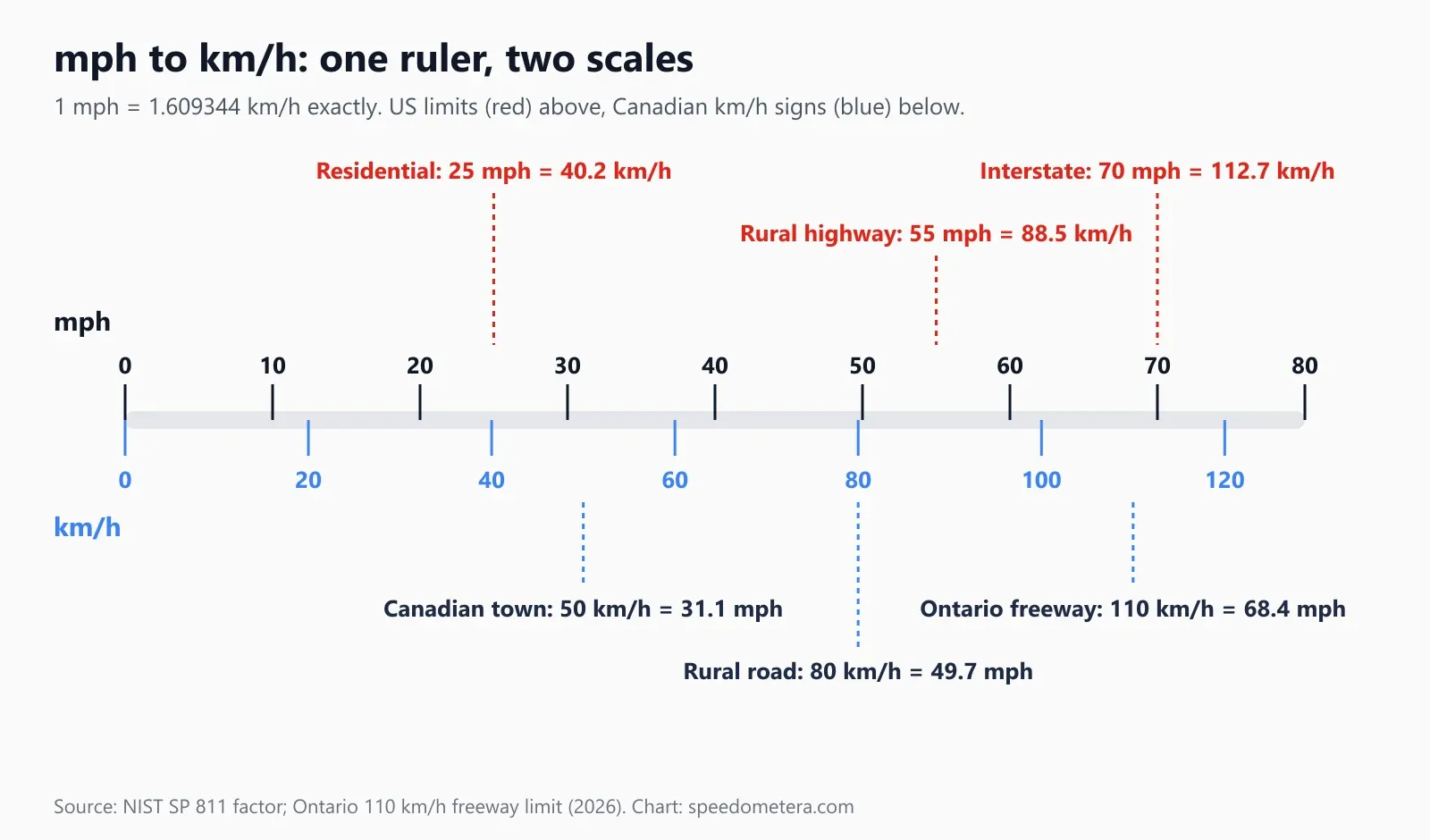
- Canada posts every limit in km/h (since September 1977); Ontario freeways are mostly 110 km/h = 68.4 mph
- The UK still posts mph: its 70 mph motorway limit is 112.7 km/h
On this page
- How to use the mph to km/h Converter
- How do I convert mph to km/h?
- Why is 1 mph exactly 1.609344 km/h?
- mph to km/h conversion table
- Which is faster, 50 mph or 50 km/h?
- What is the easiest way to convert mph to km/h in your head?
- What is 65 mph in km/h, and what do US speed limits equal in km/h?
- Driving in Canada: what do US speeds equal on km/h signs?
- Where else do Americans need mph in km/h?
- What is a treadmill speed in mph in km/h?
- Why does the US use mph instead of km/h?
- About this page
- Frequently asked questions
How to use the mph to km/h Converter
- 1Type a speed in any boxEnter a number in mph, km/h, knots, m/s, ft/s or Mach. Every other box updates as you type.
- 2Read the other unitsResults use exact definitions: 1 mile = 1,609.344 m, 1 nautical mile = 1,852 m, 1 foot = 0.3048 m.
- 3Swap or copyUse Swap to flip the main pair and Copy to copy a result. The quick table below lists common speeds.
Works in any modern phone browser. Back to the tool ↑
How do I convert mph to km/h?
Multiply the speed in miles per hour by 1.609344 and you have kilometers per hour. That factor is exact, not rounded: the mile is defined as exactly 1,609.344 meters, so one mile per hour is exactly 1.609344 kilometers per hour. Every mph to km/h conversion on this page, in the converter above and in the tables below, is that one multiplication.
Key terms. mph (miles per hour) is the speed unit on US and UK road signs. km/h (kilometers per hour, also written kph or kmh) is the unit used on road signs in Canada, Mexico and most of the world. The international mile is 5,280 international feet of 0.3048 m each, which is where 1,609.344 m comes from. NIST, the US National Institute of Standards and Technology, publishes the official conversion factors.
Three worked examples:
- 25 mph (a typical US residential street): 25 × 1.609344 = 40.2 km/h
- 65 mph (many US interstates): 65 × 1.609344 = 104.6 km/h
- 80 mph (the top posted limit on some rural interstates): 80 × 1.609344 = 128.7 km/h
To use the converter at the top of the page, type a number in the Miles per hour box and the Kilometers per hour box fills in as you type. There is no Convert button. Tap the swap button (⇄) to go the other way, or use Copy to paste the answer into a text or spreadsheet. The “All units” grid shows the same speed in knots, meters per second, feet per second and Mach, and the mph to km/h quick table lists common speeds without typing at all.
Need the reverse? If you are reading a km/h sign and want to know the mph, our km/h to mph converter is built for that direction, with a full table of metric speed-limit signs. This page is for the opposite job: you know a speed in mph (your own car, a US limit, a pitch or a storm) and need to say it in km/h.
Popular conversions: 20 mph (32.19 km/h), 30 mph (48.28 km/h), 60 mph (96.56 km/h) and 100 mph to km/h (160.93 km/h), with UK limits and stopping distances. To convert a trip distance, see miles to km; for physics units, the mph to m/s converter (1 mph = 0.44704 m/s exactly).
Why is 1 mph exactly 1.609344 km/h?
Because since 1959 the foot has been defined as exactly 0.3048 meters, and a mile is 5,280 feet: 5,280 × 0.3048 = 1,609.344 meters. Divide by 1,000 meters per kilometer and the hours cancel, so 1 mph = 1.609344 km/h with no rounding anywhere.
NIST explains that “in 1959, the relationship of the foot to the meter was officially refined as 1 foot = 0.3048 meter exactly,” a change made to support US industry and trade with other countries. For decades a slightly different US survey foot survived in land surveying, but NIST declared it obsolete from January 1, 2023, so there is now just one foot and one mile in the US. NIST’s Special Publication 811 lists the resulting velocity factor, mile per hour to kilometer per hour, as 1.609344 exactly.
That matters for two practical reasons:
- Round trips are clean. Because the converter uses the exact factor and only rounds what it displays, 65 mph converts to 104.6 km/h and back to exactly 65 mph. Converters that use a rounded factor such as 1.61 drift: 65 × 1.61 = 104.65, which converts back to 65.03 mph.
- The reverse factor is the one that is rounded. 1 km/h = 1 ÷ 1.609344 = 0.621371192… mph, a never-ending decimal. That is why you see “0.621371” in km/h to mph formulas, but a clean 1.609344 in this direction.
Many top-ranking converters quote the factor as 1.60934, which drops the last digit. The error is tiny (about 0.00025%), but there is no reason to round when the exact value is only seven digits long.
mph to km/h conversion table
The table below converts the speeds people search for most, from 1 to 300 mph, using the exact factor and rounding to one decimal. The third column is what the mental shortcut (× 1.6) gives, so you can see how close it gets.
| mph | km/h (exact factor) | × 1.6 estimate | Example |
|---|---|---|---|
| 1 mph | 1.6 km/h | 1.6 | A very slow stroll |
| 5 mph | 8.0 km/h | 8.0 | Parking-lot speed |
| 10 mph | 16.1 km/h | 16.0 | Easy bike ride |
| 15 mph | 24.1 km/h | 24.0 | US school zone |
| 20 mph | 32.2 km/h | 32.0 | Neighborhood limit; Welsh towns |
| 25 mph | 40.2 km/h | 40.0 | US residential street |
| 30 mph | 48.3 km/h | 48.0 | UK built-up areas |
| 35 mph | 56.3 km/h | 56.0 | US city arterial |
| 40 mph | 64.4 km/h | 64.0 | Suburban road |
| 45 mph | 72.4 km/h | 72.0 | Divided suburban highway |
| 50 mph | 80.5 km/h | 80.0 | Rural two-lane road |
| 55 mph | 88.5 km/h | 88.0 | Rural highway |
| 60 mph | 96.6 km/h | 96.0 | UK single carriageway |
| 65 mph | 104.6 km/h | 104.0 | Many US interstates |
| 70 mph | 112.7 km/h | 112.0 | UK motorway; US rural interstate |
| 75 mph | 120.7 km/h | 120.0 | Western rural interstates |
| 80 mph | 128.7 km/h | 128.0 | Highest limits in a few states |
| 85 mph | 136.8 km/h | 136.0 | For comparison |
| 90 mph | 144.8 km/h | 144.0 | Fast fastball |
| 100 mph | 160.9 km/h | 160.0 | Elite fastball |
| 110 mph | 177.0 km/h | 176.0 | Fast passenger train |
| 120 mph | 193.1 km/h | 192.0 | Fast passenger train |
| 130 mph | 209.2 km/h | 208.0 | Sports-car top speeds |
| 150 mph | 241.4 km/h | 240.0 | High-speed rail |
| 200 mph | 321.9 km/h | 320.0 | Top-tier high-speed rail |
| 250 mph | 402.3 km/h | 400.0 | For comparison |
| 300 mph | 482.8 km/h | 480.0 | For comparison |
The example column is there to give each number a sense of scale; the speeds attached to trains, storms and sports are covered with their own sources on pages such as how fast trains go and how fast planes fly. The conversions themselves come straight from the factor.
Which is faster, 50 mph or 50 km/h?
50 mph is faster: it is 80.5 km/h, while 50 km/h is only 31.1 mph. For the same number, mph is always about 1.61 times faster than km/h, because a mile (1,609.344 m) is longer than a kilometer (1,000 m). The gap grows with the number, as the table shows.
| Same number | That many mph, in km/h | That many km/h, in mph | Gap (in km/h) |
|---|---|---|---|
| 20 | 32.2 km/h | 12.4 mph | 12.2 km/h |
| 30 | 48.3 km/h | 18.6 mph | 18.3 km/h |
| 50 | 80.5 km/h | 31.1 mph | 30.5 km/h |
| 60 | 96.6 km/h | 37.3 mph | 36.6 km/h |
| 70 | 112.7 km/h | 43.5 mph | 42.7 km/h |
| 100 | 160.9 km/h | 62.1 mph | 60.9 km/h |
So “is kph faster than mph?” has a simple answer: no, one km/h is the slower unit (0.621 mph). A car doing 60 on a km/h dial is moving at 37.3 mph, a town speed; the same 60 on an mph dial is 96.6 km/h, a highway speed. To go from km/h to mph, use the km/h to mph converter.
What is the easiest way to convert mph to km/h in your head?
Multiply by 1.6. It reads exactly 0.58% low at every speed, which is less error than most car speedometers already have. If multiplying by 1.6 is awkward, use one of the three tricks below.
The calculation behind that claim: 1.6 ÷ 1.609344 = 0.99419, so the shortcut is always 0.58% under the true value, whether you convert 5 mph or 500 mph. At 60 mph that is 96 km/h instead of 96.6; at 100 mph it is 160 instead of 160.9.
Trick 1: double it, then take off a fifth. Doubling gives × 2, and removing a fifth of the result gives × 1.6.
- 45 mph → 90 → 90 − 18 = 72 km/h (exact 72.4)
- 70 mph → 140 → 140 − 28 = 112 km/h (exact 112.7)
Trick 2: add half, then a tenth. 1 + 0.5 + 0.1 = 1.6.
- 50 mph → 50 + 25 + 5 = 80 km/h (exact 80.5)
- 35 mph → 35 + 17.5 + 3.5 = 56 km/h (exact 56.3)
Trick 3: the Fibonacci pairs. Consecutive Fibonacci numbers grow by a ratio close to 1.618, which happens to be near 1.609. So each number in the sequence, read as mph, is roughly the next one in km/h. We checked each pair against the exact factor:
| mph (Fibonacci) | Next Fibonacci (estimate) | Exact km/h | Estimate error |
|---|---|---|---|
| 3 mph | 5 km/h | 4.8 km/h | +3.6% |
| 5 mph | 8 km/h | 8.0 km/h | −0.6% |
| 8 mph | 13 km/h | 12.9 km/h | +1.0% |
| 13 mph | 21 km/h | 20.9 km/h | +0.4% |
| 21 mph | 34 km/h | 33.8 km/h | +0.6% |
| 34 mph | 55 km/h | 54.7 km/h | +0.5% |
| 55 mph | 89 km/h | 88.5 km/h | +0.6% |
From 5 mph upward the pairs are within about 1%, so “55 is about 89” is a handy anchor for a rural highway.
Worked example: setting cruise control in a rented car abroad
You usually drive at 70 mph at home and pick up a rental car whose speedometer shows only km/h. Double-and-take-a-fifth: 70 → 140 → 140 − 28 = 112 km/h. The exact figure is 112.7 km/h. If the local motorway limit is 110 km/h, set the cruise control to 110, which is 68.4 mph, slightly under your habit.
What is 65 mph in km/h, and what do US speed limits equal in km/h?
65 mph is 104.6 km/h. In general, US limits convert to awkward metric numbers: 25 mph is 40.2, 55 is 88.5 and 75 is 120.7 km/h. That is why US limits never line up neatly with Canadian or European ones.
US limits are set by each state and posted in mph. The table below takes the common posted values and adds the nearest “round” metric limit a driver might see abroad, to show how far apart they are.
| US posted limit | Exact km/h | Nearest common metric limit | Difference |
|---|---|---|---|
| 25 mph | 40.2 km/h | 40 km/h (24.9 mph) | +0.2 km/h |
| 30 mph | 48.3 km/h | 50 km/h (31.1 mph) | −1.7 km/h |
| 35 mph | 56.3 km/h | 60 km/h (37.3 mph) | −3.7 km/h |
| 45 mph | 72.4 km/h | 70 km/h (43.5 mph) | +2.4 km/h |
| 50 mph | 80.5 km/h | 80 km/h (49.7 mph) | +0.5 km/h |
| 55 mph | 88.5 km/h | 90 km/h (55.9 mph) | −1.5 km/h |
| 60 mph | 96.6 km/h | 100 km/h (62.1 mph) | −3.4 km/h |
| 65 mph | 104.6 km/h | 100 km/h (62.1 mph) | +4.6 km/h |
| 70 mph | 112.7 km/h | 110 km/h (68.4 mph) | +2.7 km/h |
| 75 mph | 120.7 km/h | 120 km/h (74.6 mph) | +0.7 km/h |
Two patterns stand out. First, 50 mph ≈ 80 km/h and 75 mph ≈ 120 km/h are almost exact matches (within 1 km/h), which makes them easy anchors. Second, the common US interstate limit of 65 mph sits between the two typical metric freeway limits: faster than 100 km/h, slower than 110 km/h.
The same speeds in feet per second are useful for thinking about reaction distance: 60 mph is exactly 88 ft/s (26.8 m/s), and 70 mph is 102.7 ft/s (31.3 m/s). Our speed, distance and time calculator works out how far you travel at any of these speeds.
Driving in Canada: what do US speeds equal on km/h signs?
Every Canadian speed limit has been posted in km/h since September 1977, so a US driver needs to think in km/h the moment they cross the border. The usual limits are 50 km/h in towns (31.1 mph), 80 to 90 km/h on rural roads (49.7 to 55.9 mph) and 100 to 110 km/h on freeways (62.1 to 68.4 mph).
The Canadian Encyclopedia records that September 1977 brought “road signs showing distances in kilometres and speed limits in kilometres per hour,” and that, at the same time, cars with metric speedometers and odometers went on sale. Canada has stayed metric on its roads ever since, while the US and the UK kept miles.
Ontario, the province most US drivers enter through Detroit, Buffalo or the Thousand Islands, has been raising freeway limits from 100 to 110 km/h. Its June 2026 announcement added another 938 km of 110 km/h highway, rolling out through September 30, 2026, so that nearly 89% of the provincial highway network is posted at 110 km/h, up from 43%. Signs on a given stretch can still differ, so always go by what is posted.
Here is how your US habits translate on the Canadian side:
| If you usually drive | That is | Typical Canadian limit | Gap |
|---|---|---|---|
| 30 mph in town | 48.3 km/h | 50 km/h | 1.7 km/h under |
| 45 mph on a suburban road | 72.4 km/h | 70 km/h | 2.4 km/h over |
| 55 mph on a two-lane road | 88.5 km/h | 80 km/h | 8.5 km/h over |
| 65 mph on the interstate | 104.6 km/h | 100 km/h | 4.6 km/h over |
| 70 mph on the interstate | 112.7 km/h | 110 km/h (most Ontario freeways) | 2.7 km/h over |
The row to watch is the rural two-lane road: a US driver comfortable at 55 mph is 8.5 km/h over an 80 km/h limit. The easy fix is to read the km/h scale on your speedometer directly rather than converting in your head.
Does my US car show km/h?
Many cars sold in the US show km/h as well as mph, usually as a smaller inner ring or a second number on a digital display. Many digital dashboards and infotainment screens let you switch the main readout to km/h in the settings menu, which is the simplest option for a Canada trip. If your car shows only mph, keep the converter on this page or the GPS speedometer open on a phone in a mount and switch it to km/h, with a passenger handling the phone.
If the dashboard and GPS disagree by more than a mile or two per hour, the GPS vs car speedometer guide explains why, and the speedometer calibration calculator works out your car’s exact error.
Where else do Americans need mph in km/h?
Beyond driving abroad, you convert mph to km/h whenever you talk to an audience outside the US and UK: travel, science homework, sports, weather and car specs. Most of the world, and all scientific writing, uses metric units.
- Renting a car in Europe, Mexico or Australia. Rental speedometers usually lead with km/h. Knowing that your usual 70 mph is about 113 km/h tells you where your comfort zone sits on the dial.
- Driving in the UK and Ireland. This one catches people out: the UK still posts limits in mph. GOV.UK lists the national limits for cars as 30 mph (48 km/h) in built-up areas, 60 mph (96 km/h) on single carriageways and 70 mph (112 km/h) on dual carriageways and motorways, with 20 mph (32 km/h) the default in Welsh built-up areas. Cross into the Republic of Ireland and the signs switch to km/h.
- School and college physics. Problems often give a car’s speed in mph and expect an answer in SI units. Convert to km/h with × 1.609344, or straight to meters per second with × 0.44704 (exact). The speed converter shows all units at once.
- Sports. International coverage of baseball pitches, tennis serves and running records quotes km/h. A 100 mph fastball is 160.9 km/h. Human sprinting speeds are covered on the how fast can a human run page, in both units.
- Weather. US forecasts give wind in mph, while many international agencies use km/h or knots. A 74 mph wind, the threshold of a Category 1 hurricane, is 119.1 km/h; for knots, the mph to knots converter does the same job.
- Car specifications. A US brochure’s “top speed 155 mph” is 249.4 km/h, which is how European reviews would describe the same car.
What is a treadmill speed in mph in km/h?
Multiply the treadmill’s mph by 1.609344: 3 mph walking is 4.83 km/h and 6 mph jogging is 9.66 km/h. US treadmills usually show mph and minutes per mile; gyms and apps elsewhere use km/h and minutes per km. This table converts both the speed and the pace, computed exactly.
| Treadmill (mph) | km/h | Pace per mile | Pace per km |
|---|---|---|---|
| 2 mph | 3.22 km/h | 30:00 min/mile | 18:38 min/km |
| 3 mph | 4.83 km/h | 20:00 min/mile | 12:26 min/km |
| 3.5 mph | 5.63 km/h | 17:09 min/mile | 10:39 min/km |
| 4 mph | 6.44 km/h | 15:00 min/mile | 9:19 min/km |
| 5 mph | 8.05 km/h | 12:00 min/mile | 7:27 min/km |
| 6 mph | 9.66 km/h | 10:00 min/mile | 6:13 min/km |
| 7 mph | 11.27 km/h | 8:34 min/mile | 5:20 min/km |
| 8 mph | 12.87 km/h | 7:30 min/mile | 4:40 min/km |
| 10 mph | 16.09 km/h | 6:00 min/mile | 3:44 min/km |
| 12 mph | 19.31 km/h | 5:00 min/mile | 3:06 min/km |
Pace is 60 divided by the speed, so it is a different number in each unit system. For any pace not in the table, use the pace calculator.
Why does the US use mph instead of km/h?
Because US road signs, laws and speedometers were built around the mile, and the country never completed a switch to metric road signs the way Canada did in 1977. The mile itself is defined in metric terms (exactly 1,609.344 m), so the two systems are tied together precisely even though signs differ.
The practical upshot for anyone converting:
- Canada, Mexico and nearly all of Europe, Asia, South America, Africa and Oceania post limits in km/h.
- The US and the UK are the best-known countries still posting limits in miles per hour.
- Ships and aircraft everywhere use neither: they use knots, nautical miles per hour. One knot is 1.852 km/h exactly, about 1.15 mph. The knots to mph page covers that conversion, and boat speed explains why sailors kept it.
So even in the US, you will meet km/h on imported-car dashboards, in international news and in any science class, which is why a reliable mph to km/h converter is still worth having on your phone.
mph to km/h or km/h to mph? Pick the right page
Search engines show both directions for both queries, but the jobs are different. Use this page when the number you start with is in mph (your speedometer, a US limit, a US forecast). Use km/h to mph when you are reading a metric number (a Canadian sign, a European car spec). Both use the same exact definition, so the answers always agree.
About this page
Every conversion on this page is calculated with the site’s tested conversion code (src/lib/convert.ts), which uses the exact definitions from NIST Special Publication 811: 1 international mile = 1,609.344 m, 1 foot = 0.3048 m. Numbers are rounded only for display. Speed-limit facts come from GOV.UK, The Canadian Encyclopedia and coverage of Ontario’s June 2026 provincial announcement, all linked in the sources below. Researched and written by Izhar Ahmad Danish; last updated October 25, 2026.
FAQ
Frequently asked questions
How do you convert mph to km/h?
Multiply miles per hour by 1.609344. For example, 50 mph × 1.609344 = 80.5 km/h and 75 mph × 1.609344 = 120.7 km/h. If you only need a rough figure, multiply by 1.6, which lands within 0.6% of the exact answer at any speed.
What is 60 mph in km/h?
60 mph is 96.6 km/h (96.56 km/h before rounding). That is a little under the 100 km/h limit common on Canadian highways, which works out to 62.1 mph. The quick × 1.6 method gives 96 km/h, close enough for everyday use.
What is 100 mph in km/h?
100 mph is 160.9 km/h, or exactly 160.9344 km/h. A neat way to remember it: 100 miles is 160.9 km, so the same digits work for distance and speed. In the other direction, 100 km/h is only 62.1 mph.
What is 20 mph in km/h?
20 mph is 32.2 km/h. It is the default limit in built-up areas of Wales, where the UK government lists it as 20 mph (32 km/h), and a common US school-zone or neighborhood limit. Multiplying 20 by 1.6 gives a quick estimate of 32 km/h.
What is 30 mph in km/h?
30 mph is 48.3 km/h. It is the standard built-up-area limit in England, Scotland and Northern Ireland, which GOV.UK lists as 48 km/h. A Canadian 50 km/h town limit is slightly faster, at 31.1 mph.
Is 1 mph faster than 1 km/h?
Yes. 1 mph is about 1.61 times faster than 1 km/h, because a mile (1,609.344 m) is longer than a kilometer (1,000 m). So a number in mph always converts to a bigger number in km/h: 1 mph is 1.609 km/h, and 1 km/h is only 0.621 mph.
What is 70 mph in km/h?
70 mph is 112.7 km/h. It is the top speed limit on UK motorways and a common rural interstate limit in the US. It is about 2.7 km/h above the 110 km/h limit on most Ontario freeways, so a US driver keeping their usual 70 will be just over the limit there.
Is km/h the same as kph?
Yes. km/h, kph, km/hr and kmh all mean kilometers per hour. km/h is the SI-style symbol used on Canadian signs and in NIST's guide; kph is an informal abbreviation. The conversion is the same: 1 mph = 1.609344 km/h, whichever spelling you use.
What is the easiest way to convert mph to km/h in your head?
Multiply by 1.6, or double the mph and subtract one-fifth of the result. For 45 mph: 45 × 2 = 90, 90 − 18 = 72 km/h (exact: 72.4). Both tricks read about 0.6% low, which is smaller than most speedometer errors.
Does the UK use mph or km/h?
Mph. The Highway Code for Great Britain gives every national speed limit in miles per hour, with km/h only in brackets: 30 mph (48 km/h) in built-up areas of England and Scotland, 60 mph (96 km/h) on single carriageways and 70 mph (112 km/h) on dual carriageways and motorways.
7 Sources
- NIST SP 811, Appendix B.8: Factors for units listed alphabetically (length, velocity)
- NIST: U.S. survey foot (international foot = 0.3048 m exactly since 1959; survey foot obsolete from January 1, 2023)
- The Canadian Encyclopedia: Metric conversion (km/h speed limit signs, September 1977)
- GOV.UK: Speed limits (national limits in mph and km/h)
- Today's Northumberland (June 24, 2026): Ontario raising speed limits on most provincial highways to 110 km/h
- NOAA National Hurricane Center: Saffir-Simpson Hurricane Wind Scale (Category 1 from 74 mph)
- GOV.UK: The Highway Code, rule 124 speed limits table (mph with km/h in brackets)
Last updated October 25, 2026 by Izhar Ahmad Danish. Found an error? Tell us.