



Key numbers
- 20 mph = 32.187 km/h = 17.38 knots = 8.94 m/s = 29.33 ft/s
- At 20 mph you cover 1 mile in 3 minutes and 1 km in 1 min 52 s
- Wales: default limit on restricted roads cut from 30 to 20 mph in September 2023
- Highway Code typical stopping distance at 20 mph: 12 m, vs 23 m at 30 mph
- 20 mph ≈ 30 km/h zone in km/h countries (30 km/h is 18.64 mph)
On this page
- How to use the 20 mph to km/h
- What is 20 mph in other units?
- 20 mph to km/h chart (5–40 mph)
- Where is 20 mph the speed limit?
- How much safer is 20 mph than 30 mph?
- Does 20 mph make journeys much longer?
- Is 20 mph fast for a bike or a runner?
- How do I convert 20 mph to km/h in my head?
- Related conversions
- Frequently asked questions
How to use the 20 mph to km/h
- 1Type a speed in any boxEnter a number in mph, km/h, knots, m/s, ft/s or Mach. Every other box updates as you type.
- 2Read the other unitsResults use exact definitions: 1 mile = 1,609.344 m, 1 nautical mile = 1,852 m, 1 foot = 0.3048 m.
- 3Swap or copyUse Swap to flip the main pair and Copy to copy a result. The quick table below lists common speeds.
Works in any modern phone browser. Back to the tool ↑
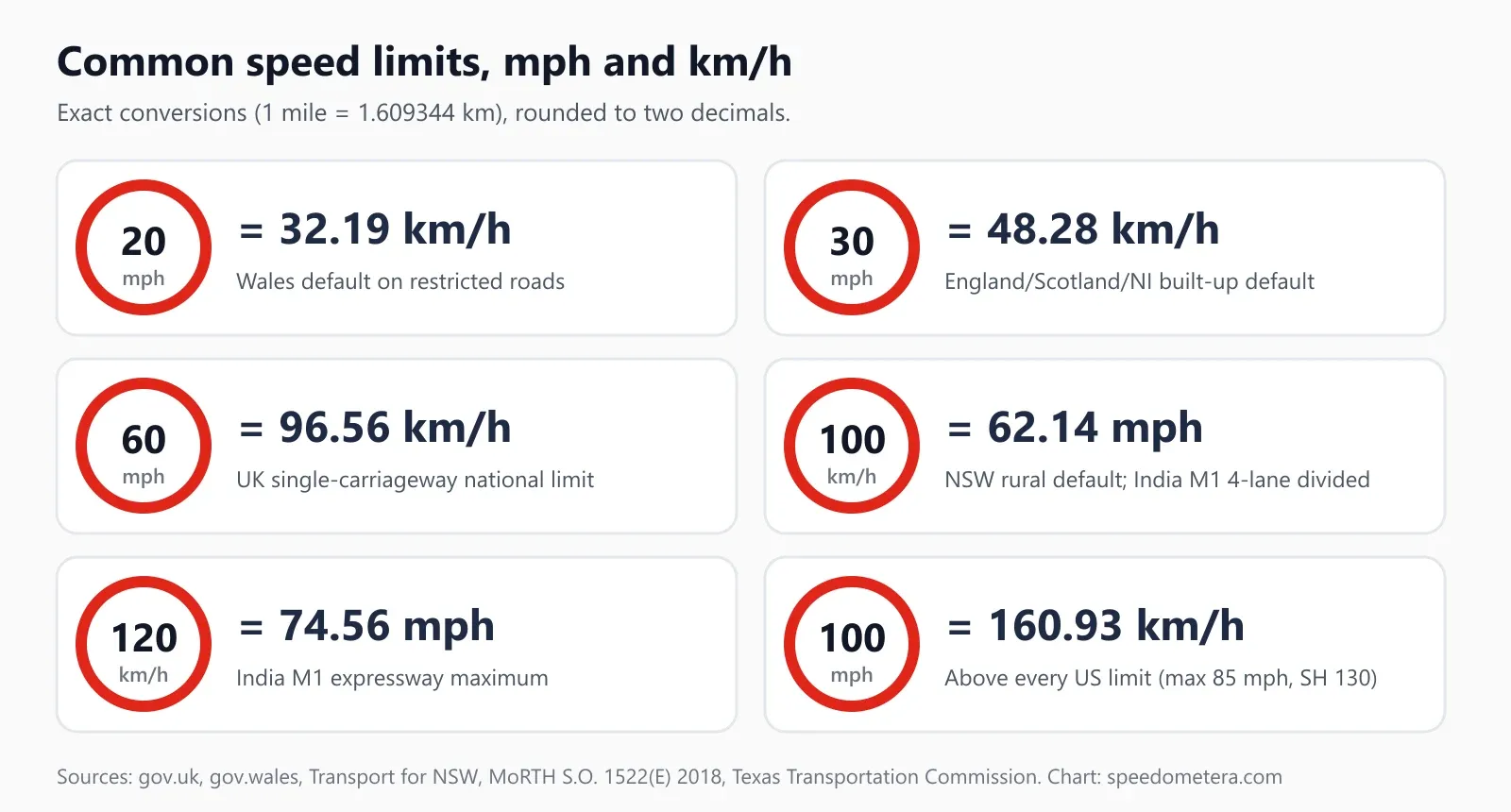
20 mph is 32.19 km/h. The exact figure is 32.187 km/h: 20 × 1.609344 = 32.187. The converter above starts at 20 mph; type another value to convert it, or open the full mph to km/h converter.
What is 20 mph in other units?
| Unit | 20 mph equals |
|---|---|
| Kilometers per hour | 32.187 km/h |
| Knots | 17.38 kn |
| Meters per second | 8.94 m/s |
| Feet per second | 29.33 ft/s |
| Miles per minute | 0.333 mi/min |
| Time per mile | 3 min |
| Time per kilometer | 1 min 52 s |
8.94 meters per second is a useful figure for anyone near a road: a car at 20 mph covers about two car lengths every second.
20 mph to km/h chart (5–40 mph)
| mph | km/h |
|---|---|
| 5 | 8.05 |
| 10 | 16.09 |
| 15 | 24.14 |
| 20 | 32.19 |
| 25 | 40.23 |
| 30 | 48.28 |
| 35 | 56.33 |
| 40 | 64.37 |
Each row is mph × 1.609344, rounded to two decimals by the same code that runs the converter.
Where is 20 mph the speed limit?
Wales is the first UK nation where 20 mph is the default limit on restricted roads. The Welsh Government lowered it from 30 mph to 20 mph in September 2023. Restricted roads are mostly residential streets and busy pedestrian areas with street lighting. The government gave four reasons: fewer collisions and serious injuries (and less pressure on the NHS), more walking and cycling, better health and well-being, and safer streets for communities. A trial in eight communities before the change found that average speeds fell.
GOV.UK now lists the built-up-area limit for cars as 20 mph (32 km/h) in Wales and 30 mph (48 km/h) in England, Scotland and Northern Ireland. Outside Wales, councils sign individual 20 mph zones and limits, often around schools and town centres.
| Place | Built-up default | Exact km/h |
|---|---|---|
| Wales | 20 mph | 32.19 |
| England, Scotland, Northern Ireland | 30 mph | 48.28 |
| Typical km/h-country residential zone | 30 km/h | (18.64 mph) |
In the US, 20 mph and lower limits are mostly set by states and cities for school zones and residential streets; the posted sign always applies.
How much safer is 20 mph than 30 mph?
The UK Highway Code’s typical stopping distance at 20 mph is 12 m, about half the 23 m needed at 30 mph. Rule 126 of the Highway Code breaks it down:
| Speed | Thinking | Braking | Total |
|---|---|---|---|
| 20 mph (32.19 km/h) | 6 m | 6 m | 12 m |
| 30 mph (48.28 km/h) | 9 m | 14 m | 23 m |
In other words, a driver doing 30 mph is still travelling after the point where a 20 mph driver has already stopped. That gap, 11 m, is the length of about three cars.
Does 20 mph make journeys much longer?
Less than it sounds: a mile takes 3 minutes at 20 mph and 2 minutes at 30 mph. On a typical 5-mile urban trip, the maximum difference is 15 minutes versus 10, and real journeys lose far less because junctions, traffic lights and queues already hold average speeds well below the limit. Check any trip with the speed, distance and time calculator.
Is 20 mph fast for a bike or a runner?
For a bicycle, 20 mph is quick; for a human runner, it is near the very top. Most people who ask “is 20 mph fast?” are thinking about running, cycling or an e-bike rather than a car, so here are the benchmarks side by side:
| Who or what | Speed | km/h | vs 20 mph |
|---|---|---|---|
| Recreational runner, easy to steady pace | 6–7.5 mph | 9.7–12.1 | 30–38% |
| Everyday cyclist, average | 10–12 mph | 16.1–19.3 | 50–60% |
| Fit road cyclist on the flat | 15–18 mph | 24.1–29.0 | 75–90% |
| 20 mph | 20 mph | 32.19 | 100% |
| Class 1 and 2 e-bike: motor stops assisting | 20 mph | 32.19 | 100% |
| Men’s 400 m world record (43.03 s), average | 20.8 mph | 33.5 | 104% |
| Usain Bolt, 100 m world record (9.58 s), average | 23.4 mph | 37.6 | 117% |
| Usain Bolt, peak (60–80 m, Berlin 2009) | 27.8 mph | 44.72 | 139% |
| Class 3 e-bike: motor stops assisting | 28 mph | 45.06 | 140% |
The e-bike limits are California’s three-class definitions as summarized by the California Highway Patrol: Class 1 (pedal-assist) and Class 2 (throttle) stop assisting at 20 mph, Class 3 (pedal-assist, speedometer required) at 28 mph. Many other states use the same three classes, but check your own state’s rules. The running figures are averages of World Athletics records; the cycling and recreational figures come from our average cycling speed and how fast can a human run guides, which cite their sources.
So 20 mph on foot is a sprinter’s speed held for seconds, on a pedal bike it is a strong rider’s pace, and on an e-bike it is where the motor usually lets go. In a 20 mph zone a fit cyclist can be moving at the same speed as the traffic.
How do I convert 20 mph to km/h in my head?
- × 1.6: 20 × 1.6 = 32 km/h, about 0.6% low.
- Double, then add 60%: 20 + 12 = 32 km/h.
- Exact: 32.187 km/h.
Need your real speed? Our GPS speedometer shows mph or km/h on a phone. GPS speed is an estimate that depends on signal and sky view and can jump in narrow streets; drivers must not handle the phone, so mount it hands-free or let a passenger use it.
Related conversions
- 30 mph to km/h: 48.28 km/h, the England, Scotland and NI built-up limit
- 60 mph to km/h: 96.56 km/h
- Speed converter: every speed unit at once
FAQ
Frequently asked questions
How fast is 20 mph in km/h?
20 mph is 32.19 km/h. Multiply 20 by 1.609344, the exact number of kilometers in a mile, to get 32.187 km/h. It is slightly faster than a 30 km/h zone sign in Europe.
What is 20 mph in kph?
20 mph is 32.19 kph. kph and km/h are the same unit, kilometers per hour.
Is 20 mph the same as 30 km/h?
Close but not equal. 20 mph is 32.19 km/h and 30 km/h is 18.64 mph. Countries that sign in km/h usually use 30 km/h for the same kind of residential zone the UK signs at 20 mph.
When did Wales change to 20 mph?
In September 2023. The Welsh Government lowered the default limit on restricted roads, mostly residential and busy pedestrian streets, from 30 mph to 20 mph, citing fewer collisions and injuries and more walking and cycling.
How long does it take to travel a mile at 20 mph?
Exactly 3 minutes. At 30 mph the same mile takes 2 minutes, so on a 1-mile stretch the lower limit costs about one minute at most, less once junctions and traffic are counted.
Can a bicycle go 20 mph?
Yes. Fit road cyclists can hold 20 mph on the flat for short spells, everyday riders average about 10–12 mph, and US Class 1 and 2 e-bikes stop assisting at 20 mph. See our average cycling speed guide for the data.
Is 20 mph fast?
For a car it is slow: it is the default limit on restricted roads in Wales. For a bicycle it is brisk, well above the 10–12 mph most everyday riders average. On foot it is a sprint: Usain Bolt's peak was about 27.8 mph, so few people can run 20 mph at all.
How fast is 25 mph in km/h?
25 mph is 40.23 km/h (25 × 1.609344). The converter above works for any value: type 25 and it shows km/h, knots and m/s at once.
Is 20 mph fast for an e-bike?
It is the usual assistance cut-off. Under California's three-class system, summarized by the California Highway Patrol, Class 1 (pedal-assist) and Class 2 (throttle) e-bikes stop helping at 20 mph (32.19 km/h), and Class 3 pedal-assist bikes at 28 mph (45.06 km/h). Above that, only the rider's legs add speed.
Can a person run 20 mph?
Only trained sprinters, and only for a few seconds. The men's 400 m world record averages about 20.8 mph and Usain Bolt's 100 m record 23.4 mph, with a 27.8 mph peak. A fit recreational runner cruises at 6–7.5 mph, about a third of 20 mph.
7 Sources
- NIST SP 811, Appendix B.8: conversion factors (mile = 1,609.344 m exactly)
- Welsh Government: Introducing default 20mph speed limits
- GOV.UK: Speed limits (national limits in mph and km/h)
- GOV.UK: The Highway Code, rules 103–158 (rule 126, typical stopping distances)
- California Highway Patrol: Motorcycles and similar vehicles (Class 1, 2 and 3 electric bicycles: 20 and 28 mph assistance limits)
- World Athletics: Usain Bolt athlete profile, 100 m 9.58 world record (Berlin 2009)
- World Athletics: Wayde van Niekerk profile, 400 m 43.03 world record (Rio 2016)
Last updated October 25, 2026 by Izhar Ahmad Danish. Found an error? Tell us.