



Key numbers
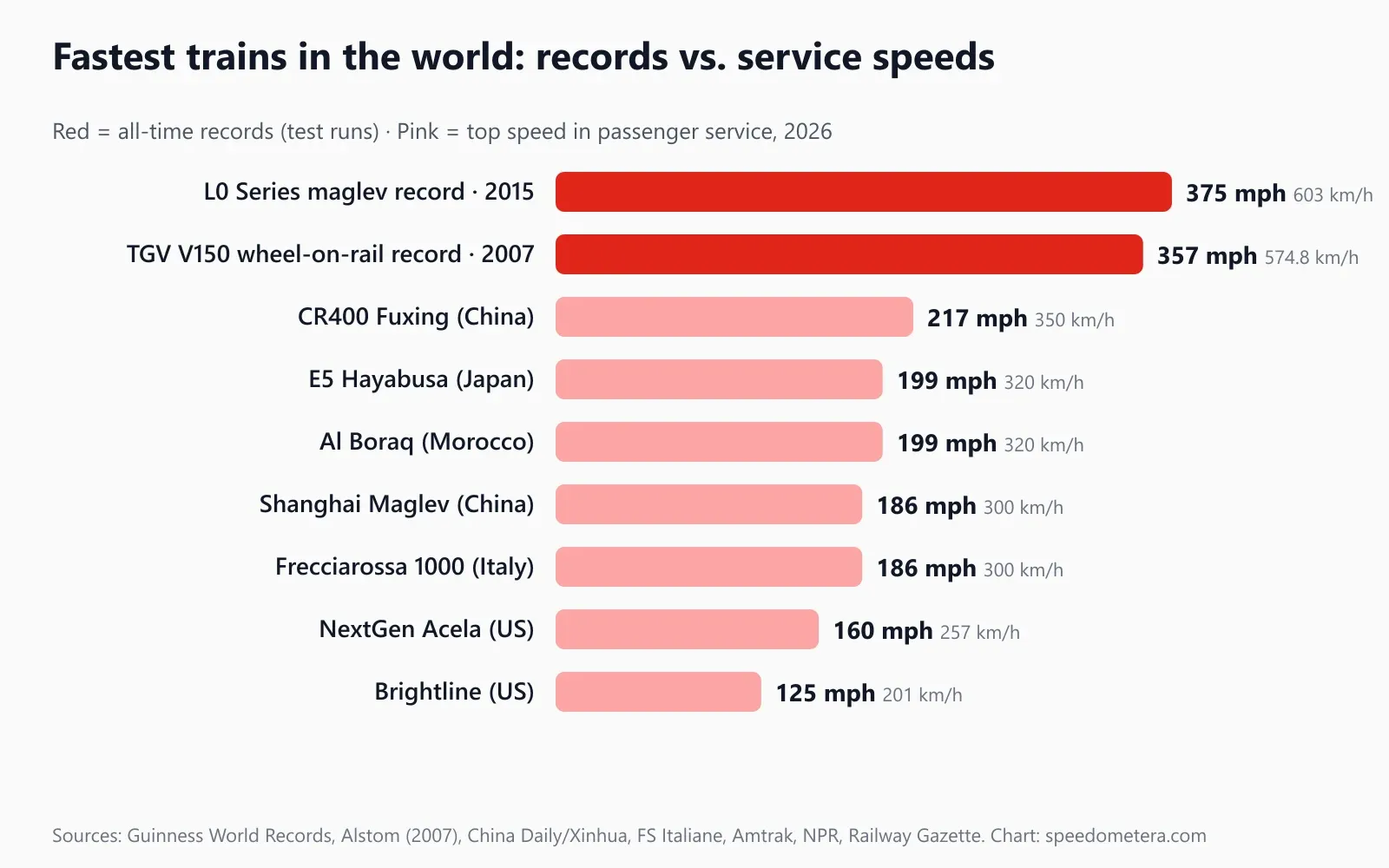
- Fastest in daily service: CR400 Fuxing, 350 km/h (217 mph), China
- All-time record: L0 Series maglev, 603 km/h (375 mph), Japan, 21 April 2015
- Wheel-on-rail record: TGV V150, 574.8 km/h (357 mph), France, 3 April 2007
- Next up: CR450, built for 400 km/h (249 mph) service; hit 453 km/h in 2025 trials
- Fastest in the US: NextGen Acela, 160 mph (257 km/h)
On this page
- How to use the Fastest Trains in the World
- What is the fastest train in the world right now?
- What is the fastest train ever recorded?
- Is the Shanghai Maglev still the fastest commercial train?
- What will be the fastest train next?
- Is there a 400, 600 or 1,000 mph train?
- Which country has the most high-speed rail?
- What is the fastest train in the United States?
- Maglev vs. bullet train: which is faster?
- How long would the fastest trains take to go 100 miles?
- How to measure your own train’s top speed
- Frequently asked questions
How to use the Fastest Trains in the World
- 1Get a clear view of the skySit by a window: GPS needs a view of the sky and drops out in tunnels and deep cuttings.
- 2Tap Start and allow locationYour browser asks for location permission once. The first GPS fix usually arrives in 5–30 seconds.
- 3Pick your unitChoose km/h, mph, knots or m/s. Your choice is remembered on this device.
- 4Read speed, max, average and distanceThe gauge and digital readout update about once a second. Distance and average count only while you are moving.
- 5Stop or resetTap Stop to pause, Reset to clear the trip. Nothing is stored or sent anywhere.
Works in any modern phone browser. Back to the speedometer ↑
What is the fastest train in the world right now?
The fastest train in the world in regular passenger service is China’s CR400 Fuxing, at 350 km/h (217 mph). It has held that title since the Beijing–Shanghai high-speed line raised its top speed to 350 km/h in September 2017, and China Daily (citing Xinhua) still described the CR400 fleet as operating at 350 km/h in October 2025.
Many lists still put the Shanghai Maglev at the top with 431 km/h (268 mph). That was true from 2004 until May 2021, when the line’s cruising speed was cut to 300 km/h (more on that below). So if the question is “which train can I ride today that goes fastest?”, the answer is a steel-wheel bullet train, not a maglev.
Key terms used on this page. Top service speed is the highest speed a train reaches with paying passengers on a normal timetable. Record speed is a one-off test run with a modified train and no passengers. Maglev (magnetic levitation) trains float above a guideway on magnetic fields instead of rolling on rails. Wheel-on-rail or bullet train means conventional high-speed rail: steel wheels on steel rails, such as China’s Fuxing, Japan’s Shinkansen and France’s TGV.
The fastest trains in passenger service, as of October 2026:
| Rank | Train | Country | Top service speed (mph) | km/h | Operator source |
|---|---|---|---|---|---|
| 1 | CR400 Fuxing | China | 217 | 350 | China State Railway via Xinhua / CGTN |
| 2 | E5 Hayabusa (Tohoku Shinkansen) | Japan | 199 | 320 | JR East (via Wikipedia) |
| 2 | Al Boraq (TGV 2N2) | Morocco | 199 | 320 | ONCF via Railway Gazette |
| 4 | Shanghai Maglev | China | 186 | 300 | Reported since May 2021 |
| 4 | Frecciarossa 1000 | Italy | 186 | 300 | FS Italiane |
| — | NextGen Acela | United States | 160 | 257 | Amtrak |
| — | Brightline | United States | 125 | 201 | Brightline via NPR |
The mph column is converted with the site’s exact factor (1 mph = 1.609344 km/h) and rounded to the nearest whole number. Top service speed is a ceiling, not a cruising speed for the whole trip: every train on this list spends much of its journey slower, on curves, through stations and on older track. The ranking is only for the train’s top speed in regular service, which is what most people searching “fastest train in the world” want to know. It does not rank trains by average speed between cities, which depends as much on the route and the number of stops as on the train.
Several famous trains are not on the list because their service speed is lower than 300 km/h, or because I could not find an operator figure to check. The ranking will change once China’s CR450 enters service (see the section on what’s next).
What is the fastest train ever recorded?
The fastest train ever is Japan’s L0 Series superconducting maglev, which reached 603 km/h (374.68 mph) on 21 April 2015 on the Yamanashi Maglev Line. Guinness World Records lists the run by train A07 of the Central Japan Railway Company (JR Central), and JR Central’s own annual report calls it the world speed record for a manned rail vehicle.
The fastest train on conventional rails is France’s TGV V150. According to Alstom’s press release, it hit 574.8 km/h (357 mph) at 13:13 on 3 April 2007 on the LGV Est line. The V150 was a special trainset: two TGV POS power cars, three double-deck TGV Duplex coaches and two motorized AGV bogies, producing 19.6 MW (about 25,000 hp). It beat the previous record, 515.3 km/h set by TGV Atlantique no. 325 on 18 May 1990.
| Record or milestone | Train | Year | km/h | mph | m/s | × Acela top speed |
|---|---|---|---|---|---|---|
| Absolute rail speed record (maglev) | L0 Series, Japan | 2015 | 603 | 374.7 | 167.5 | 2.34 |
| Wheel-on-rail record | TGV V150, France | 2007 | 574.8 | 357.2 | 159.7 | 2.23 |
| Shanghai Maglev test run | Transrapid, China | 2003 | 501 | 311.3 | 139.2 | 1.95 |
| Planned maglev service speed | Chuo Shinkansen, Japan | future | 500 | 310.7 | 138.9 | 1.94 |
| Fastest bullet-train trial in China | CR450, China | 2025 | 453 | 281.5 | 125.8 | 1.76 |
| Shanghai Maglev service speed, 2004–2021 | Transrapid, China | 2004 | 431 | 267.8 | 119.7 | 1.67 |
| Planned CR450 service speed | CR450, China | future | 400 | 248.5 | 111.1 | 1.55 |
The mph, m/s and “× Acela” columns are calculated from the km/h figures with src/lib/convert.ts (exact factors, rounded to one decimal). The last column compares each speed with the 160 mph top speed of Amtrak’s NextGen Acela, the fastest US train.
To put 603 km/h in context: at 167.5 meters per second, the L0 covered the length of a football field (100 yards, 91.44 m) in about 0.55 seconds. To compare with aircraft, see how fast planes fly.
Record runs are not service speeds. Test trains are often shortened, specially tuned and run on track prepared for the attempt, with no passengers and no timetable. That’s why the gap between the record (603 km/h) and the fastest train you can buy a ticket for (350 km/h) is so large.
For line-by-line Shinkansen speeds, the Tokyo–Osaka timetable and India’s Mumbai–Ahmedabad project, see our guide to bullet train speed.
Is the Shanghai Maglev still the fastest commercial train?
No. The Shanghai Maglev ran at 431 km/h (268 mph) from 2004, but since May 2021 its cruising speed has been reported at 300 km/h (186 mph), which puts it behind China’s 350 km/h CR400 Fuxing. This is the single most common mistake in “fastest train” lists, many of which still quote 431 km/h or even 460 km/h as today’s speed.
The line links Longyang Road station in Shanghai with Pudong International Airport over about 30 km (18.6 miles), using German Transrapid technology. Guinness still lists it as the fastest maglev in regular public service at 431 km/h, and during a test on 12 November 2003 a train reached 501 km/h (311 mph). The lower 300 km/h cruising speed after May 2021, and the 8 minutes 10 seconds journey time, come from the Wikipedia article on the line. I could not reach the operator’s own site to confirm them, so treat the 300 km/h figure as reported, not official. The reason for the cut has not been published by the operator either; travel guides give different explanations, so I don’t repeat them here.
What the published numbers do let us calculate:
- Average speed: 30 km in 8 minutes 10 seconds is 220.4 km/h, or 137 mph. That’s a fast average for an 18-mile trip, but well below the top speed, because the train spends a large share of the run accelerating and braking.
- Why short lines can’t show off: a maglev needs several minutes to reach and leave its top speed. On a 30 km line, a higher top speed saves only seconds.
The Shanghai Maglev opened as the world’s first commercial high-speed maglev and is still a remarkable ride. It’s just no longer the fastest train.
What will be the fastest train next?
China’s CR450 is next in line: it is built for 400 km/h (249 mph) in service, reached 453 km/h (281 mph) in pre-service trials in October 2025, and finished a 600,000 km operational test in August 2026. Japan’s Chuo Shinkansen maglev, planned for 500 km/h (311 mph), would beat it but has no opening date.
CR450 (China). China Daily, citing Xinhua, reported on 21 October 2025 that the CR450 was engineered for a top test speed of 450 km/h and a commercial service speed of 400 km/h, that it was undergoing qualification trials on the Shanghai–Chengdu high-speed line, that it can go from a standstill to 350 km/h in 4 minutes 40 seconds, and that two CR450s passed each other at a combined 896 km/h (557 mph). Caixin reported in August 2026 that the prototypes had completed a 600,000 km operational test, clearing the way for final inspection and certification, and that new models must also pass a one-year operational assessment. No date for passenger service had been announced as of 25 October 2026. When it opens, it will be the fastest wheel-on-rail train in service by 50 km/h (31 mph).
Chuo Shinkansen (Japan). JR Central’s 2025 annual report gives the superconducting maglev an operating speed of 500 km/h and a maximum design speed of 505 km/h. It plans about 40 minutes from Tokyo (Shinagawa) to Nagoya over 285.6 km and about 67 minutes to Osaka. 285.6 km in 40 minutes works out to an average of 428 km/h (266 mph), close to the old Shanghai Maglev’s top speed. The same report says the planned 2027 opening of the Shinagawa–Nagoya section is no longer possible because of delays to the construction work in Shizuoka Prefecture, and that a new date can’t yet be predicted.
| Future train | Planned service speed (mph) | km/h | Status (Oct 2026) |
|---|---|---|---|
| Chuo Shinkansen maglev | 311 | 500 | Under construction; 2027 opening not possible, no new date |
| CR450 | 249 | 400 | Testing and certification; no service date announced |
| CR400 Fuxing (today’s leader) | 217 | 350 | In service |
Is there a 400, 600 or 1,000 mph train?
No train carries passengers at 400 mph or more. The fastest any train has ever gone is 375 mph (603 km/h), and the fastest you can ride is 217 mph (350 km/h). Higher numbers in headlines are design targets, prototypes or concepts.
| Headline speed | mph | km/h | What actually exists | Status (Oct 2026) |
|---|---|---|---|---|
| “300 mph train” | 300 | 483 | Only record runs: L0 maglev 375 mph (2015), TGV V150 357 mph (2007); Chuo Shinkansen planned at 311 mph | No service; Chuo opening date unknown |
| “400 mph train” | 400 | 644 | Nothing has reached it; the absolute record is 375 mph | Not achieved |
| “600 km/h train” | 373 | 600 | CRRC maglev rolled out in Qingdao, July 2021, designed for 600 km/h | Not yet tested at 600 km/h when unveiled; not in service |
| “600 mph train” | 600 | 966 | Hyperloop concepts only | Hyperloop One shut down in Dec 2023 |
| “1,000 mph train” | 1,000 | 1,609 | No vehicle; concept papers only | Not achieved |
China’s 600 km/h maglev is real hardware: Caixin reported that CRRC rolled it off the line in Qingdao in July 2021, but also that “high-speed tests at 600 kph are yet to be conducted”, and it carries no passengers. The fastest anyone has ridden a hyperloop pod is about 107 mph, in Virgin Hyperloop’s 500-meter test near Las Vegas in November 2020 (Carscoops); the company, by then renamed Hyperloop One, announced it was shutting down in December 2023 (SiliconANGLE). So a “1,000 mph train” remains an idea, not a machine. For comparison, a jet airliner cruises at about 560 mph (how fast planes fly).
Which country has the most high-speed rail?
China, by far: its high-speed network passed 50,000 route-km (31,000 miles) at the end of 2025, more than 70% of the roughly 65,000 km of high-speed line in the world, according to Railway Gazette. A further 10,000 km is planned for the 2026–30 five-year plan, which would take it to about 60,000 km.
| Measure | Figure | Miles | Source |
|---|---|---|---|
| China high-speed network, end of 2025 | 50,000+ route-km | 31,000+ | Railway Gazette |
| China network at start of 2021 | about 37,900 route-km | about 23,550 | Railway Gazette |
| High-speed line worldwide | about 65,000 route-km | about 40,400 | Railway Gazette, citing China |
| China plan to 2030 (+10,000 km) | about 60,000 route-km | about 37,300 | Railway Gazette |
Miles are our conversions (1 km = 0.621371 mi). Speed and size are different questions: Japan’s Shinkansen is older and famous for punctuality (see bullet train speed), but China has both the fastest trains in service and the largest network.
What is the fastest train in the United States?
The fastest train in the US is Amtrak’s NextGen Acela, with a top speed of 160 mph (257 km/h), which Amtrak calls the fastest train in the Western Hemisphere. Florida’s Brightline is second, with trains that can reach 125 mph (201 km/h) between Miami and Orlando.
- NextGen Acela. In its May 2026 announcement, Amtrak describes the train as “the fastest train in the Western Hemisphere, with a top speed of 160 mph”. By July 2026, 13 NextGen Acela trainsets were in service between Washington, New York and Boston, and Amtrak was running 32 weekday NextGen Acela trips, up from 26 weekday Acela trips before the new fleet. The 160 mph is reached only on short upgraded parts of the Northeast Corridor; most of the route is far slower.
- Brightline. NPR reported at the September 2023 opening of the Miami–Orlando extension that trains can reach 125 mph. It is privately owned, which makes it unusual in the US.
Why are US trains slower than the world’s fastest? The trains are not the main limit; the track is. Federal Track Safety Standards set a top speed for every class of track. Under 49 CFR 213.307, Class 7 track allows 125 mph, Class 8 allows 160 mph and Class 9 allows 220 mph, and running above 125 mph needs specific FRA approval. Most Amtrak trains also share track with freight and commuter railroads, run through old tunnels and bridges, and cross roads at grade. China and Japan built new, dedicated high-speed lines with gentle curves and no level crossings. The full US breakdown by track class is on how fast do trains go.
How the US compares with the leaders:
| Comparison | mph | km/h | Gap to CR400 (mph) |
|---|---|---|---|
| CR400 Fuxing top service speed | 217 | 350 | — |
| NextGen Acela top speed | 160 | 257 | 57 |
| Brightline top speed | 125 | 201 | 92 |
| FRA Class 9 track ceiling (no US service yet) | 220 | 354 | +3 |
The last row is the interesting one: US federal rules already have a track class fast enough for a CR400. What’s missing is a line built to Class 9 standards.
Maglev vs. bullet train: which is faster?
Maglev is faster at the very top: it holds the absolute record of 603 km/h (375 mph), 28 km/h (18 mph) more than the best wheel-on-rail run. In everyday service, though, steel-wheel bullet trains are currently faster. China’s CR400 runs at 350 km/h, while the world’s only high-speed maglev in service, in Shanghai, runs at 300 km/h.
| Maglev | Wheel-on-rail (bullet train) | |
|---|---|---|
| How it moves | Floats above a guideway on magnetic fields, no wheel contact at speed | Steel wheels roll on steel rails |
| Record speed | 603 km/h (374.7 mph), L0 Series, 2015 | 574.8 km/h (357.2 mph), TGV V150, 2007 |
| Fastest in service, 2026 | 300 km/h (186 mph), Shanghai (reported) | 350 km/h (217 mph), CR400 Fuxing |
| Planned | 500 km/h (311 mph), Chuo Shinkansen | 400 km/h (249 mph), CR450 |
| Where you can ride it at high speed | Shanghai’s 30 km airport line | National networks in China, Japan, Europe, Morocco and more |
| Can use existing stations and track | No, needs its own guideway | Yes, can run onto older lines at lower speed |
The trade-off explains why maglev is rare. A bullet train can leave its high-speed line and continue on ordinary track into a city-center station. A maglev cannot, so every mile of its route has to be new guideway. That is one reason the world’s fastest train in service in 2026 is still a wheel-on-rail train.
How long would the fastest trains take to go 100 miles?
At top speed, China’s CR400 Fuxing covers 100 miles in 27.6 minutes, the NextGen Acela in 37.5 minutes and Brightline in 48 minutes. Real trips take longer because no train holds top speed from station to station.
| Train | Top speed (mph) | km/h | Meters per second | Seconds per mile | Minutes for 100 miles at top speed |
|---|---|---|---|---|---|
| CR400 Fuxing | 217.5 | 350 | 97.2 | 16.6 | 27.6 |
| E5 Hayabusa / Al Boraq | 198.8 | 320 | 88.9 | 18.1 | 30.2 |
| Shanghai Maglev / Frecciarossa 1000 | 186.4 | 300 | 83.3 | 19.3 | 32.2 |
| NextGen Acela | 160.0 | 257 | 71.5 | 22.5 | 37.5 |
| Brightline | 125.0 | 201 | 55.9 | 28.8 | 48.0 |
Calculated with src/lib/convert.ts: seconds per mile = 3,600 ÷ mph, and minutes for 100 miles = 100 ÷ mph × 60. The “seconds per mile” column is handy on a train: US railroads post a milepost every mile, so if they flash past every 22.5 seconds you’re at 160 mph.
time (minutes) = distance (miles) ÷ speed (mph) × 60
Acceleration matters as much as top speed on short hops. The CR450’s 0–350 km/h in 4 minutes 40 seconds works out to an average of 0.35 m/s², and the Frecciarossa 1000’s 0–300 km/h in 4 minutes (FS Italiane) gives the same 0.35 m/s². At that rate a train needs several minutes, and several miles, just to reach top speed, which is why lines with stations close together never see it. To try your own route, use the speed, distance and time calculator; to convert any figure here, use km/h to mph.
How to measure your own train’s top speed
Open this page on your phone before the train leaves, sit by a window, tap Start and allow location; the GPS speedometer above shows the live speed and keeps your top speed for the whole trip. It works on Amtrak, Brightline, the Shinkansen, a TGV or a Chinese bullet train, with no app and no data connection once the page has loaded.
- Load the page in the station. That way it works even where the train has no signal or Wi-Fi.
- Tap Start and allow location. The first fix can take 10–60 seconds inside a steel car. Hold the phone near the window.
- Pick your unit. mph is the default in the US; tap km/h to compare with the operator’s figure on a Japanese, Chinese or European train.
- Watch the accuracy line. Once it reads good or better, the number is reliable. The gauge on this page reaches about 310 mph (500 km/h), enough for any train in passenger service.
- Read the Max figure at the end. That’s your top speed. Compare it with the table above: on the NextGen Acela, a Max close to 160 mph means you rode one of the fast stretches.
Tunnels are the main gap
Chinese and Japanese high-speed lines run through long tunnels, and GPS cannot reach the phone there. The reading pauses rather than guessing and returns within seconds of daylight. Your Max is kept through the gap.
Is GPS accurate at 200 mph? Yes. Phones measure speed from the Doppler shift of satellite signals, which doesn’t get less accurate as you go faster. GPS.gov puts the signal’s speed-error commitment at 0.006 m/s over any 3 seconds; the real limit is the train’s metal body and coated windows, so a window seat matters more than the train’s speed. For how GPS speed compares with other speed readings, see GPS vs. car speedometer, and for everyday driving, use the main online speedometer.
Using the speedometer as a passenger is safe and legal. Don’t lean out of doors or windows, or stand in vestibules, to get a better signal. Your location stays on your phone: speed is calculated in the browser and nothing is sent to our servers.
FAQ
Frequently asked questions
What is the fastest train in the world in 2026?
China's CR400 Fuxing, at 350 km/h (217 mph) in regular service. The newer CR450, built for 400 km/h (249 mph), reached 453 km/h in pre-service trials in 2025 but was still in testing and certification as of October 2026, so it does not yet carry paying passengers.
What is the fastest train ever recorded?
Japan's L0 Series superconducting maglev reached 603 km/h (374.68 mph) with people on board on 21 April 2015 on the Yamanashi test line, according to Guinness World Records. The fastest train on conventional steel rails is France's TGV V150 at 574.8 km/h (357 mph) in 2007.
Is the Shanghai Maglev still the fastest train?
No. It ran at 431 km/h (268 mph) from 2004, but its cruising speed has been reported at 300 km/h (186 mph) since May 2021. That puts it behind China's 350 km/h CR400 Fuxing. Its 30 km airport run takes about 8 minutes, an average of 137 mph.
How fast is the fastest bullet train in mph?
217 mph. China's CR400 Fuxing runs at 350 km/h, which is 217.5 mph. Japan's fastest Shinkansen, the E5 Hayabusa, runs at 320 km/h (199 mph), and Italy's Frecciarossa 1000 at 300 km/h (186 mph), although it is designed for 400 km/h.
What is the fastest train in the United States?
Amtrak's NextGen Acela, with a top speed of 160 mph (257 km/h), which Amtrak calls the fastest train in the Western Hemisphere. It reaches that speed only on short upgraded parts of the Northeast Corridor. Florida's Brightline is second, at up to 125 mph.
Why are US trains so slow compared to China and Japan?
Mostly track, not trains. Federal track classes allow 125 mph unless the FRA approves more, and most Amtrak routes share curvy freight or commuter lines. China and Japan built dedicated lines with gentle curves and no level crossings, where 300–350 km/h (186–217 mph) is routine.
Is maglev faster than a bullet train?
Yes, at the top end. Maglev holds the absolute record of 603 km/h (375 mph), about 28 km/h more than the best wheel-on-rail run. In service the gap is smaller: Shanghai's maglev runs at 300 km/h today, below China's 350 km/h steel-wheel trains.
When will the 500 km/h Chuo Shinkansen maglev open?
There is no date yet. JR Central plans a 500 km/h (311 mph) service linking Shinagawa and Nagoya in about 40 minutes, but it has said the planned 2027 opening is not possible because of delays to tunnel work in Shizuoka Prefecture.
Can I measure the speed of a high-speed train with my phone?
Yes. Open this page, sit by a window and tap Start; your phone's GPS shows live speed and records your top speed. GPS works fine at 200 mph, but readings pause in tunnels, which are common on Japanese and Chinese high-speed lines.
Is China's bullet train faster than Japan's?
Yes, in service. China's CR400 Fuxing runs at 350 km/h (217 mph), while Japan's fastest Shinkansen, the E5 Hayabusa, tops out at 320 km/h (199 mph). Japan still holds the absolute record: its L0 maglev reached 603 km/h (375 mph) on a test line in 2015.
Is there a 600 km/h or 1,000 mph train?
No train runs at either speed with passengers. China's CRRC rolled out a maglev designed for 600 km/h (373 mph) in July 2021, but had not yet tested it at that speed. No 1,000 mph (1,609 km/h) train exists; the only hyperloop passenger test, in 2020, reached about 107 mph.
20 Sources
- Guinness World Records: Fastest maglev train, 603 km/h, L0 Series, 21 April 2015
- Guinness World Records: Fastest maglev train in regular public service (Shanghai, 431 km/h)
- Alstom press release: 574.8 km/h world rail speed record, 3 April 2007
- JR Central Annual Report 2025: Chuo Shinkansen, 500 km/h, Shinagawa–Nagoya 40 min (PDF)
- China Daily / Xinhua: CR450 reaches 453 km/h in pre-service trials; CR400 runs at 350 km/h (21 Oct 2025)
- CGTN: Beijing–Shanghai Fuxing officially runs at 350 km/h (Sept 2017)
- Caixin: CR450 completes 600,000 km operational test (10 Aug 2026)
- FS Italiane: Frecciarossa 1000, designed for 400 km/h, certified for 300 km/h
- Railway Gazette: Al Boraq reaches a maximum of 320 km/h (ONCF)
- Amtrak Media: NextGen Acela, fastest train in the Western Hemisphere at 160 mph (May 2026)
- Amtrak Media: NextGen Acela fleet continues to grow, 13 trainsets (July 2026)
- NPR: Brightline Miami–Orlando opens, trains up to 125 mph (Sept 2023)
- 49 CFR 213.307: High-speed track classes 6–9 (Cornell LII)
- Caixin: CRRC rolls out 600 km/h maglev in Qingdao; high-speed tests at 600 km/h yet to be conducted (21 July 2021)
- Carscoops: Virgin Hyperloop completes first passenger test, 107 mph (Nov 2020)
- SiliconANGLE: Hyperloop One to shut down (22 Dec 2023)
- Railway Gazette: China passes 50,000 route-km of high-speed line; over 70% of 65,000 km worldwide (7 Mar 2026)
- Wikipedia (secondary): Shanghai maglev train, operating speed after May 2021
- Wikipedia (secondary): E5 Series Shinkansen, maximum speed 320 km/h
- GPS.gov: GPS accuracy (smartphones and speed accuracy)
Last updated October 25, 2026 by Izhar Ahmad Danish. Found an error? Tell us.