



Key numbers
- 1 km/h = 0.621371 mph; 1 mph = 1.609344 km/h exactly
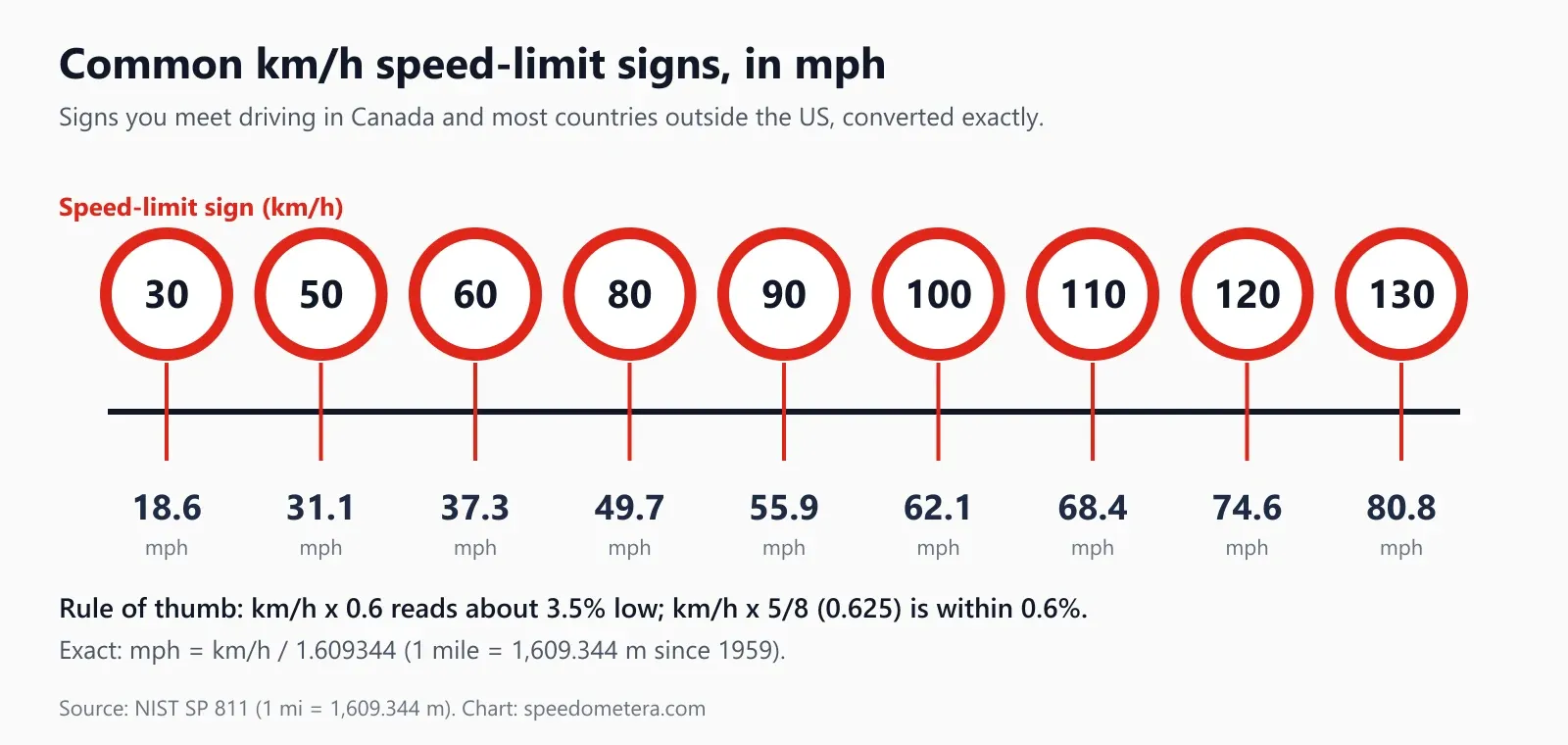
- 100 km/h = 62.1 mph, 120 km/h = 74.6 mph, 130 km/h = 80.8 mph
- Quick rule: km/h × 0.6 (multiply by 6, drop a zero), about 3.5% low
- Closer rule: km/h × 5/8 (halve, halve, halve, then × 5), about 0.6% high
- Canada switched road signs to km/h in September 1977
On this page
- How to use the km/h to mph Converter
- How do you use the km/h to mph converter?
- What is the formula to convert km/h to mph?
- km/h to mph conversion table (5 to 300 km/h)
- What are 100, 120 and 130 km/h in mph?
- How can you convert km/h to mph in your head?
- Where will US drivers see km/h?
- Is km/h the same as kph and kmh?
- Why does the US use mph when most of the world uses km/h?
- About this page
- Frequently asked questions
How to use the km/h to mph Converter
- 1Type a speed in any boxEnter a number in mph, km/h, knots, m/s, ft/s or Mach. Every other box updates as you type.
- 2Read the other unitsResults use exact definitions: 1 mile = 1,609.344 m, 1 nautical mile = 1,852 m, 1 foot = 0.3048 m.
- 3Swap or copyUse Swap to flip the main pair and Copy to copy a result. The quick table below lists common speeds.
Works in any modern phone browser. Back to the tool ↑
How do you use the km/h to mph converter?
Type a speed in the Kilometers per hour box and the Miles per hour box updates as you type; the sentence underneath reads it back, for example “60 km/h = 37.282 mph”. There is no Convert button, and the page works offline once loaded. Step by step:
- Enter the km/h value in the left box. It starts at 60, so you can see the format before you type.
- Read the mph result in the right box and in the sentence under the inputs, shown to three decimals.
- Tap the swap button (⇄) if you need the reverse, mph to km/h. The same tool on mph to km/h leads with mph.
- Copy the result with the Copy result button to paste it into a text, a spreadsheet or homework.
- Open “All units” to see the same speed in knots, meters per second, feet per second and Mach at once, and edit any of them.
- Scan the km/h to mph quick table under the card for common speeds from 5 to 150 km/h without typing.
Want your live speed instead of a conversion? The GPS speedometer on the homepage reads your phone’s GPS and lets you switch between mph and km/h with one tap, which is handy in a rental car whose dashboard only shows one unit clearly.
Key terms on this page. km/h (also written kph or kmh) is kilometers per hour, the speed unit used on road signs in Canada, Mexico and most of the world. mph is miles per hour, used on US and UK roads. A kilometer is 1,000 meters; a mile is exactly 1,609.344 meters. The conversion factor is the number you divide or multiply by: 1.609344 or its inverse, 0.621371.
Popular conversions: 100 km/h to mph (62.14 mph) and 120 km/h to mph (74.56 mph), each with the speed limits where that value applies. For distances rather than speeds, use the km to miles converter: 100 km is 62.14 miles.
What is the formula to convert km/h to mph?
mph = km/h ÷ 1.609344, which is the same as km/h × 0.621371. The divisor is exact, because since 1959 the international foot has been defined as 0.3048 m, which makes the mile (5,280 ft) exactly 1,609.344 m. NIST lists the mile and the kilometer per hour in Appendix B of its SI guide, Special Publication 811, and the older US survey foot, which differed by two parts per million, was retired on January 1, 2023.
Why it works: a speed in km/h tells you how many 1,000-meter units you cover in an hour. A mile is 1.609344 of those units, so you cover fewer miles in the same hour, and the number gets smaller by that factor. The hour cancels out entirely, which is why you never need to touch the “per hour” part.
| Method | Calculation | Result for 90 km/h | Error vs exact |
|---|---|---|---|
| Exact divide | 90 ÷ 1.609344 | 55.923 mph | 0 |
| Multiply (6 decimals) | 90 × 0.621371 | 55.923 mph | under 0.0001% |
| Multiply by 0.62 | 90 × 0.62 | 55.8 mph | 0.2% low |
| Multiply by 5/8 (0.625) | 90 ÷ 8 × 5 | 56.25 mph | 0.6% high |
| Multiply by 0.6 | 90 × 6, drop a zero | 54 mph | 3.4% low |
| Divide by 1.6 | 90 ÷ 1.6 | 56.25 mph | 0.6% high |
Note that dividing by 1.6 and multiplying by 5/8 are the same thing (1 ÷ 1.6 = 0.625), so pick whichever feels easier.
Worked example: a 110 km/h sign in Ontario
110 ÷ 1.609344 = 68.35 mph. The quick rule says 110 × 0.6 = 66 mph, so if you hold 66 on a mph-only speedometer you are about 2 mph under. The closer rule says 110 ÷ 8 × 5 = 68.75 mph, which is less than half a mph high.
km/h to mph conversion table (5 to 300 km/h)
Every value from 5 to 300 km/h in steps of 5, converted with the exact factor and rounded to one decimal. Read down each pair of columns; the middle pair covers typical highway and motorway speeds, and the right pair covers sports cars, racing and high-speed trains.
| km/h | mph | km/h | mph | km/h | mph |
|---|---|---|---|---|---|
| 5 | 3.1 | 105 | 65.2 | 205 | 127.4 |
| 10 | 6.2 | 110 | 68.4 | 210 | 130.5 |
| 15 | 9.3 | 115 | 71.5 | 215 | 133.6 |
| 20 | 12.4 | 120 | 74.6 | 220 | 136.7 |
| 25 | 15.5 | 125 | 77.7 | 225 | 139.8 |
| 30 | 18.6 | 130 | 80.8 | 230 | 142.9 |
| 35 | 21.7 | 135 | 83.9 | 235 | 146.0 |
| 40 | 24.9 | 140 | 87.0 | 240 | 149.1 |
| 45 | 28.0 | 145 | 90.1 | 245 | 152.2 |
| 50 | 31.1 | 150 | 93.2 | 250 | 155.3 |
| 55 | 34.2 | 155 | 96.3 | 255 | 158.4 |
| 60 | 37.3 | 160 | 99.4 | 260 | 161.6 |
| 65 | 40.4 | 165 | 102.5 | 265 | 164.7 |
| 70 | 43.5 | 170 | 105.6 | 270 | 167.8 |
| 75 | 46.6 | 175 | 108.7 | 275 | 170.9 |
| 80 | 49.7 | 180 | 111.8 | 280 | 174.0 |
| 85 | 52.8 | 185 | 115.0 | 285 | 177.1 |
| 90 | 55.9 | 190 | 118.1 | 290 | 180.2 |
| 95 | 59.0 | 195 | 121.2 | 295 | 183.3 |
| 100 | 62.1 | 200 | 124.3 | 300 | 186.4 |
Need a value between the steps, say 1 to 4 km/h? Each single km/h adds 0.621 mph: 1 km/h = 0.621, 2 = 1.243, 3 = 1.864, 4 = 2.485 mph. Add that to the nearest row: 87 km/h is 85 km/h (52.8) plus 2 km/h (1.24), or 54.1 mph. The converter above does it exactly for any number, including decimals like 87.5.
Two landmarks are worth remembering because they line up almost perfectly: 160 km/h is 99.4 mph, so “160 is about 100 mph”, and 80 km/h is 49.7 mph, so “80 is about 50”. Every other value can be found by scaling from those two.
What are 100, 120 and 130 km/h in mph?
100 km/h is 62.1 mph, 120 km/h is 74.6 mph and 130 km/h is 80.8 mph. These are the three most searched values because they are the most common highway and motorway limits on km/h signs. The table below puts the popular answers next to the nearest US speed limit, so you can feel what each one means on a road you know.
| km/h | Exact mph | × 0.6 shortcut | Nearest familiar US limit | How it compares |
|---|---|---|---|---|
| 30 | 18.6 | 18 | 20 mph school zone | about 1 mph slower |
| 40 | 24.9 | 24 | 25 mph residential | essentially the same |
| 50 | 31.1 | 30 | 30 mph city street | about 1 mph faster |
| 60 | 37.3 | 36 | 35 mph arterial | about 2 mph faster |
| 70 | 43.5 | 42 | 45 mph suburban road | about 1.5 mph slower |
| 80 | 49.7 | 48 | 50 mph rural road | essentially the same |
| 90 | 55.9 | 54 | 55 mph two-lane highway | about 1 mph faster |
| 100 | 62.1 | 60 | 60/65 mph highway | between the two |
| 110 | 68.4 | 66 | 70 mph interstate | about 1.6 mph slower |
| 120 | 74.6 | 72 | 75 mph rural interstate | essentially the same |
| 130 | 80.8 | 78 | 80 mph top interstate limit | about 1 mph faster |
| 140 | 87.0 | 84 | above any US limit | |
| 150 | 93.2 | 90 | above any US limit |
A few more single-value answers people look for: 60 km/h is 37.3 mph, 70 km/h is 43.5 mph, 90 km/h is 55.9 mph, 150 km/h is 93.2 mph, 200 km/h is 124.3 mph, 250 km/h is 155.3 mph and 300 km/h is 186.4 mph. At the high end, 320 km/h is 198.8 mph, so “about 200 mph” is a fair description of 320 km/h, and 350 km/h is 217.5 mph. For context on those speeds, see how fast trains go, where 300 km/h is a normal cruising speed for high-speed rail.
How can you convert km/h to mph in your head?
Multiply by 6 and drop the last digit: 100 km/h becomes 600, then 60 mph. It is the easiest trick and it reads about 3.5% low, which is the safe direction when you are trying to stay under a km/h limit with a mph speedometer. If you want something closer, use one of the three tricks below.
- The × 0.6 rule (easy, safe). 80 km/h × 6 = 480, drop the zero: 48 mph. Exact: 49.7. Error is always about 3.4% low, so the gap grows with speed: 1.7 mph at 80 km/h, 2.6 mph at 120 km/h.
- The halve-three-times rule (close). Halve the number three times, then multiply by 5. That is × 5/8. 120 → 60 → 30 → 15, × 5 = 75 mph. Exact: 74.6. It reads about 0.6% high, under half a mph at highway speeds.
- The half-plus-a-tenth rule (very close). Take half, add a tenth of the original, and add a fiftieth if you want more. 100 km/h → 50 + 10 = 60, + 2 = 62 mph. Exact: 62.1. Half plus a tenth is the same as the × 0.6 rule; adding the fiftieth gives × 0.62, which is within 0.2%.
- The Fibonacci pairs (fun, surprisingly good). Consecutive Fibonacci numbers have a ratio near 1.618, close to 1.609. So 5 mph ≈ 8 km/h, 8 ≈ 13, 13 ≈ 21, 21 ≈ 34, 34 ≈ 55, 55 ≈ 89. Read the pair backward to go from km/h to mph: 89 km/h ≈ 55 mph (exact: 55.3).
Which trick should you use? When driving, the × 0.6 rule wins because it is fast and errs on the safe side. When you are checking a spec sheet, a race result or a train speed, use the halve-three-times rule or simply the converter, because 3.5% of 300 km/h is a 6.5 mph mistake.
The reverse trick, mph to km/h
Going the other way, multiply mph by 1.6 (or add 60%). 65 mph → 65 + 39 = 104 km/h; exact is 104.6. Do not multiply km/h by 1.6 by accident: that turns 100 km/h into “160 mph”, which is the most common conversion slip. More on the reverse on the mph to km/h page.
Where will US drivers see km/h?
Mostly in Canada and Mexico, in rental cars abroad, and in the small inner ring of a US-market speedometer. In each case the trick is to know which number is the big one on your display and convert the sign, not the dial.
Driving into Canada. Canada moved its road signs to kilometers and kilometers per hour in September 1977, according to The Canadian Encyclopedia, and cars built for the Canadian market around then got metric speedometers and odometers. Every sign you see after the border is in km/h. Common values are 50 km/h in towns (31.1 mph), 80 km/h on many rural two-lane roads (49.7 mph) and 100 km/h on freeways (62.1 mph). Ontario has gone further: it made 110 km/h (68.4 mph) permanent on six highway sections in 2022 and began raising ten more sections from 100 to 110 km/h on July 12, 2024, so that 110 km/h covers about 860 km, or 36%, of its provincial highway network, as Truck News reported. On those raised sections, stunt-driving penalties start at 40 km/h over the limit, or 150 km/h (93.2 mph).
Driving into Mexico. Mexican road signs are also posted in km/h, so the same table applies: a 60 km/h sign is 37.3 mph and a 110 km/h sign is 68.4 mph.
Rental cars abroad. A car rented in Canada, Mexico or Europe will usually show km/h as the main, large number and may not show mph at all. Many modern digital clusters let you switch units in the settings menu, but if you cannot find it, set your phone’s GPS speedometer to mph and mount it where you can see it at a glance before you start driving, never while moving.
Your own car. Most US-market analog speedometers print mph in large numbers on the outer ring and km/h in small numbers on an inner ring. On a 0–160 mph dial, the inner ring runs to about 260 km/h. That inner ring is a built-in conversion chart: drive into Canada and read the small numbers. If your speedometer and a GPS reading disagree, see GPS vs car speedometer for why, and the speedometer calibration calculator to measure the percentage error.
Do the conversion before you need it
Before a cross-border trip, write down the three or four limits you will meet (50, 80, 100, 110 km/h) and their mph values. Converting a sign while driving takes your attention off the road; the table and chart on this page are meant to be read before you set off.
Is km/h the same as kph and kmh?
Yes. km/h, kph, kmh and km/hr all mean kilometers per hour, and all convert to mph the same way (× 0.621371). The difference is only spelling. NIST’s SI guide treats km/h as the correct symbol, because the slash shows “per”. kph is common in British and Australian writing and in casual speech; kmh, without the slash, is what most people type into a search box or see on a phone keyboard.
Watch out for two look-alikes that are not speeds:
- km alone is a distance. “100 km to miles” is 62.1 miles, the same number, but it describes how far, not how fast. To combine the two, use the speed, distance and time calculator.
- kn or kt is knots, nautical miles per hour, used by boats and aircraft. One knot is 1.852 km/h, or about 1.151 mph, so a boat doing 20 knots is going 23.0 mph, not 12.4. See knots to mph if a marine or aviation display is the source of your number.
Meters per second (m/s) is the scientific unit. To get km/h from m/s, multiply by 3.6; to get mph, multiply m/s by about 2.237. A sprinter at 10 m/s is doing 36 km/h, or 22.4 mph. The All units panel on the converter shows these alongside km/h and mph.
Why does the US use mph when most of the world uses km/h?
Because US law, signs and vehicles kept customary units, even though the mile itself has been defined in meters since 1959. The US mile is exactly 1,609.344 m, so the conversion is fixed by definition, not by measurement. What stayed customary is the roadside: federal and state speed limits, highway mileposts and dashboard speedometers are all in miles.
Canada shows what a full switch looks like. It converted road signs in one go in September 1977, which is why everything from its city limits to its trucking rules is written in km/h; Truck News notes that trucks in Ontario and Quebec have been electronically limited to 105 km/h (65.2 mph) since 2008. The UK went the other way and kept mph on its roads even after adopting metric units elsewhere, which is why a UK rental car also shows mph.
For US drivers, the practical effect is that you will always meet km/h at the border, in a rental, and in car and train specs written for a global audience. A European car magazine quoting “0–100 km/h in 6 seconds” is talking about 0–62.1 mph, not 0–60 mph, which makes the European figure very slightly slower than an American 0–60 time for the same car. Top speeds are the same story: an electronically limited 250 km/h is 155.3 mph, which is why so many German cars are quoted at “155 mph”.
Common km/h to mph mistakes to avoid
The biggest mistake is multiplying by 1.6 instead of dividing, which turns 100 km/h into a bogus 160 mph. Remember that mph is always the smaller number for the same speed. If your answer is bigger than what you started with, you went the wrong way.
- Mixing up direction. km/h → mph makes the number smaller (÷ 1.609). mph → km/h makes it bigger (× 1.609).
- Using 1.6 for precise work. It is fine on the road, but over a 300 km/h figure the shortcut × 0.6 is 6.4 mph off. Use the exact factor for anything you publish or submit.
- Rounding too early. Convert first, then round. Rounding 0.621371 to 0.6 before multiplying 250 km/h gives 150 mph instead of 155.3. The converter keeps full precision and rounds only for display.
- Confusing knots with km/h. A boat display reading 30 is 34.5 mph in knots but 18.6 mph in km/h. Check the unit label.
- Reading the wrong ring. On a dual-scale speedometer, make sure you are reading the large mph numbers at home and the small km/h numbers in Canada.
For running and cycling speeds, the same factor applies: a 10 km/h jog is 6.2 mph, and a 25 km/h bike ride is 15.5 mph. The pace calculator turns those speeds into minutes per mile, which is how most US runners think about effort.
About this page
Every number on this page was calculated from the exact definition of the mile (1,609.344 m) used in the site’s converter code, and rounded only for display. Road-sign facts come from the sources listed below. Written by Izhar Ahmad Danish. For every unit at once, use the full speed converter.
FAQ
Frequently asked questions
What is 100 km/h in mph?
100 km/h is 62.1 mph (62.137 to three decimals). It is the most common highway limit in Canada and much of the world, and it sits just above the 60 mph mark. In your head, 100 × 0.6 = 60 mph gives a safe, slightly low estimate.
How do you convert km/h to mph?
Divide the km/h figure by 1.609344, or multiply by 0.621371. For example, 80 km/h ÷ 1.609344 = 49.7 mph and 110 km/h ÷ 1.609344 = 68.4 mph. The factor comes from the mile being exactly 1,609.344 meters, set by international agreement in 1959.
Is 120 km/h fast?
120 km/h is 74.6 mph, about the same as a 75 mph US rural interstate limit. On roads signed in km/h, 120 km/h is a typical motorway maximum in many countries. It is fast for a city street, where 50 km/h (31.1 mph) is a common limit.
What is 130 km/h in mph?
130 km/h is 80.8 mph. That is roughly the top posted limit on the fastest US interstates (80 mph), and 130 km/h is a common motorway limit abroad. The quick rule 130 × 0.6 gives 78 mph, about 3 mph under the exact value.
Is 1 km/h the same as 1 mph?
No. 1 km/h is only 0.621 mph, because a kilometer (1,000 m) is shorter than a mile (1,609.344 m). So any speed shows a bigger number in km/h than in mph: 60 mph reads as 96.6 km/h, and 60 km/h is just 37.3 mph.
What is 50 km/h in mph?
50 km/h is 31.1 mph. It is the typical urban speed limit in Canada and many other km/h countries, so treat it like a 30 mph zone at home. Quick check: 50 × 0.6 = 30 mph, which keeps you about 1 mph under the limit.
How fast is 200 km/h in mph?
200 km/h is 124.3 mph. That is well above any US road limit and is closer to the cruising speed of a fast intercity train. 300 km/h, a typical high-speed rail speed, converts to 186.4 mph.
Why does the US use mph instead of km/h?
Because US road law and signage stayed in customary units. The mile is still defined in metric terms (exactly 1,609.344 m since 1959), but signs, speedometers and laws use mph. Canada, by contrast, converted its road signs to km/h in September 1977.
What is the difference between km/h, kph and kmh?
None: all three mean kilometers per hour. km/h is the official SI-style symbol that NIST recommends; kph and kmh are informal spellings you see on car displays and in search boxes. 1 of any of them equals 0.621371 mph.
Is 120 km/h the same as 80 mph?
No. 120 km/h is 74.6 mph, about 5 mph under 80, and 80 mph is 128.7 km/h. The quick × 0.6 rule gives 72 mph for 120 km/h. Anyone who reckons 120 km/h is about 80 mph has multiplied by two-thirds, which overstates the mph by about 7%.
How do I convert a treadmill speed from km/h to mph?
Divide by 1.609344, as for any speed. A treadmill at 10 km/h is 6.2 mph, a 9:40 minute-per-mile pace; 8 km/h is 5.0 mph (12:04 per mile) and 12 km/h is 7.5 mph (8:03 per mile). For a full table in the other direction, see the mph to km/h page.
4 Sources
- NIST SP 811, Appendix B.8: Factors for units listed alphabetically (mile, kilometer per hour)
- NIST: U.S. survey foot deprecated, international foot 0.3048 m exactly (1959)
- The Canadian Encyclopedia: Metric conversion in Canada (road signs to km/h, September 1977)
- Truck News: Ontario raising speed limit to 110 km/h on 10 more highway sections (2024)
Last updated October 25, 2026 by Izhar Ahmad Danish. Found an error? Tell us.