



Key numbers
- Speed = distance ÷ time: 120 mi in 2:00:00 = 60 mph (96.56 km/h)
- Distance = speed × time: 65 mph for 3.5 h = 227.5 miles
- Time = distance ÷ speed: 225 mi at 62 mph = 3:37:45
- Round trip 30 mph out, 60 mph back: average is 40 mph, not 45
- 1 mph = 1.609344 km/h = 0.44704 m/s exactly (NIST)
On this page
- How to use the Speed Distance Time Calculator
- How do you calculate speed, distance and time?
- How to use the speed calculator
- MPH calculator: how do you work out miles per hour?
- What is the formula for average speed?
- Why is the average of 30 mph and 60 mph not 45?
- How long does it take to drive 100 miles?
- How do you handle units: mph, km/h, knots, m/s and ft/s?
- More worked examples: running, cycling, boating and travel
- Common mistakes in speed, distance and time problems
- How accurate is the calculator, and when should you measure instead?
- Frequently asked questions
How to use the Speed Distance Time Calculator
- 1Choose what to solve forPick Speed, Distance or Time, or Average speed for a trip with several legs.
- 2Enter the two values you knowType a distance (miles, km, meters, feet or nautical miles), a time as h:mm:ss, or a speed in mph, km/h, m/s, knots or ft/s.
- 3Read the answer and the formulaThe result shows in your unit plus mph and km/h, with the formula used. For average speed, add one row per leg.
Works in any modern phone browser. Back to the tool ↑
How do you calculate speed, distance and time?
Speed is distance divided by time; distance is speed multiplied by time; time is distance divided by speed. This speed calculator solves whichever of the three you leave out. The default above, 120 miles in 2 hours, gives 60 mph (96.56 km/h), and the calculator prints the formula it used so you can check the work.
The three formulas are one relationship written three ways:
speed = distance ÷ time · distance = speed × time · time = distance ÷ speed
A memory aid from school is the “DST triangle”: distance on top, speed and time side by side underneath. Cover the value you want and the triangle shows the operation. Cover distance and you see speed × time; cover speed and you see distance over time; cover time and you see distance over speed.
Key terms used on this page. Speed is how fast something moves, a number with units (mph, km/h, m/s, knots, ft/s). Distance is the length of the path actually traveled. Time is elapsed time, written here as h:mm:ss. Average speed is total distance ÷ total elapsed time (OpenStax University Physics uses exactly this definition). Velocity is speed with a direction; average velocity uses displacement (straight-line change of position), so a round trip has zero average velocity but a real average speed. Harmonic mean is the averaging rule for speeds held over equal distances.
The only trap in the formulas themselves is units. Miles and hours give mph; kilometers and hours give km/h; meters and seconds give m/s; nautical miles and hours give knots. Mix them (miles with minutes, say) and the answer is off by a factor of 60. The calculator handles this for you by converting everything to meters and seconds internally and back to the units you picked.
How to use the speed calculator
Pick what you want to solve, type the two values you know, and read the result plus the formula. The field being solved is greyed out so you never type into it by mistake.
- Choose a mode. Tap Speed, Distance or Time at the top of the card. Average speed opens the multi-leg trip mode (next section).
- Enter distance with a unit. Miles, km, meters, feet or nautical miles. Decimals are fine: 13.1 miles, 0.25 miles, 400 meters.
- Enter time as h:mm:ss. 2:00:00 is two hours, 0:45:00 is 45 minutes, 0:00:30 is 30 seconds. You can also type minutes and seconds as 45:00.
- Or enter a speed with a unit. mph, km/h, m/s, knots or ft/s.
- Read the answer. The result shows in your unit with mph and km/h alongside, for example “Speed: 60 mph (60 mph · 96.56 km/h)”, and the line underneath shows the formula, “120 miles ÷ 2:00:00 = 60 mph”.
Three worked examples (US road trips)
Speed: 150 miles in 2:30:00 → 150 ÷ 2.5 = 60 mph (96.56 km/h).
Distance: 65 mph for 3:30:00 → 65 × 3.5 = 227.5 miles.
Time: 225 miles at an average 62 mph → 225 ÷ 62 = 3.629 h = 3:37:45.
The calculator does the maths in exact base units (meters, seconds, m/s) using the definitions in NIST SP 811, and rounds only for display. It works offline once loaded, stores nothing and sends nothing.
Driving faster also costs fuel: fueleconomy.gov says mileage usually drops rapidly above 50 mph, so use the fuel cost calculator to price the trip as well as time it.
MPH calculator: how do you work out miles per hour?
Miles per hour = miles ÷ hours, or miles × 60 ÷ minutes. 30 miles in 25 minutes is 30 × 60 ÷ 25 = 72 mph. Set the calculator to Speed, enter the distance in miles and the time as h:mm:ss, and it returns mph with km/h alongside, so it doubles as an mph calculator for driving, running, cycling or timing anything over a known distance.
The fastest way to get mph from a short timed run is seconds: mph = miles × 3,600 ÷ seconds. For feet, multiply feet per second by 0.6818 (3,600 ÷ 5,280). Examples, each checked with the site’s speed library:
| What you timed | Working | Speed (mph) | Speed (km/h) |
|---|---|---|---|
| 1 mile in 4:00 | 1 × 3,600 ÷ 240 | 15.00 | 24.14 |
| 5 miles in 45:00 | 5 × 60 ÷ 45 | 6.67 | 10.73 |
| 10 miles in 15:00 | 10 × 60 ÷ 15 | 40.00 | 64.37 |
| 30 miles in 25:00 | 30 × 60 ÷ 25 | 72.00 | 115.87 |
| Marathon (26.22 mi) in 4:00:00 | 26.22 ÷ 4 | 6.55 | 10.55 |
| ¼ mile in 12 s | 0.25 × 3,600 ÷ 12 | 75.00 | 120.70 |
| 100 ft in 1 s | 100 × 0.6818 | 68.18 | 109.73 |
| Highway markers: 1 mile in 52 s | 3,600 ÷ 52 | 69.23 | 111.42 |
The last row is the old road-trip check of your car’s speedometer: time the gap between two mile markers and divide 3,600 by the seconds. Anything under 60 seconds means you are above 60 mph. The ¼-mile row is an average over the run, not the trap speed at the end, which is always higher because the car is still accelerating. If you need live mph rather than an average, the GPS speedometer on the homepage reads it directly from your phone.
What is the formula for average speed?
Average speed = total distance ÷ total time. Add up every leg’s distance, add up every leg’s time (including stops, if you want an honest door-to-door figure), and divide. Do not average the speeds of the legs unless each leg lasted exactly the same amount of time.
Switch the calculator to Average speed to do this automatically. Each row is one leg with a Distance and a Time (h:mm:ss); tap + Add leg for more rows and ✕ to remove one. The output boxes show Average speed, Total distance and Total time. The default is two 60-mile legs, one taking 2:00:00 and one taking 1:00:00, which gives 40 mph over 120 miles in 3:00:00.
A realistic three-leg example, computed with the site’s own maths library:
| Leg | Distance | Speed held | Time on leg |
|---|---|---|---|
| City streets to the interstate | 40 mi | 30 mph | 1:20:00 |
| Interstate | 150 mi | 70 mph | 2:08:34 |
| Final town traffic | 10 mi | 20 mph | 0:30:00 |
| Whole trip (no stops) | 200 mi | 50.3 mph average | 3:58:34 |
| Same trip plus one 30-minute stop | 200 mi | 44.7 mph average | 4:28:34 |
Two things stand out. First, 70 mph on the interstate does not make this a “70 mph trip”: the slow 50 miles at either end take almost as long as the 150 fast ones, and the true average is just over 50 mph. Second, a single half-hour stop costs more average speed (50.3 → 44.7 mph) than driving the whole interstate leg 5 mph slower would. That is why navigation apps’ arrival estimates rarely match “distance ÷ speed limit”.
Whether to include stops depends on the question. “How long will the drive take door to door?” includes them. “How fast was I moving?” excludes them, and that is what a GPS trip computer usually calls moving average. Our GPS odometer counts distance only while you move for the same reason.
Why is the average of 30 mph and 60 mph not 45?
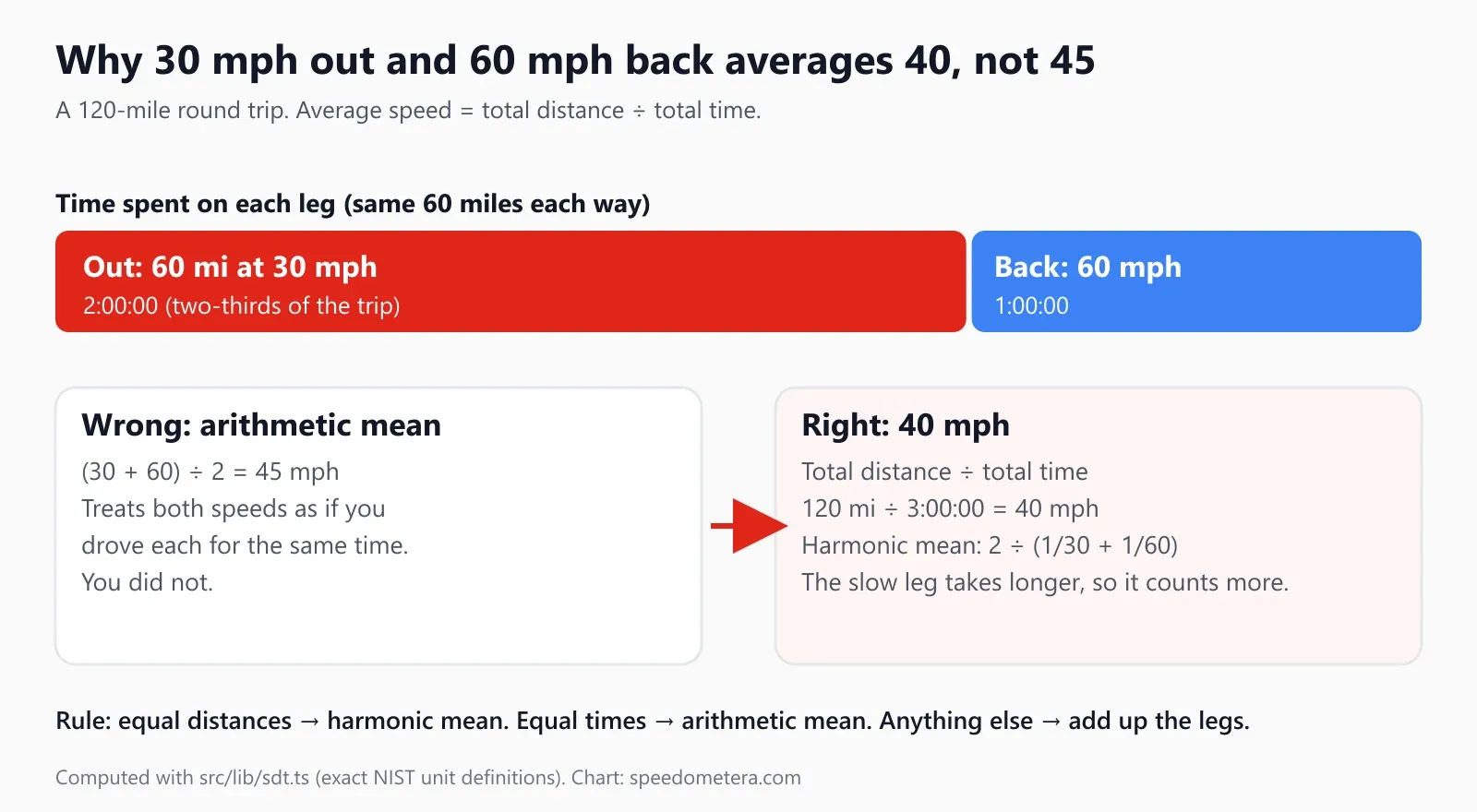
Because you spend more time at the slower speed. Over 60 miles each way, the 30 mph leg takes 2 hours and the 60 mph leg takes 1 hour, so you cover 120 miles in 3 hours: 40 mph. The simple average, 45 mph, would only be right if you drove each speed for the same length of time.
When each speed covers the same distance, the correct average is the harmonic mean: the number of legs divided by the sum of the reciprocals of the speeds. For two legs, that is 2 ÷ (1/a + 1/b). When each speed lasts the same time, the ordinary arithmetic mean is correct. The calculator’s Same distance at different speeds? panel does both: type the speeds into “Speeds, comma-separated” and it shows the harmonic mean (your true average) next to the arithmetic mean (the tempting wrong answer).
equal distances: average = n ÷ (1/v₁ + 1/v₂ + … + 1/vₙ) · equal times: average = (v₁ + v₂ + … + vₙ) ÷ n
How big the error gets depends on how different the two speeds are. Each row below is a 120-mile round trip, 60 miles each way:
| Out / back speed | Simple average (wrong) | True average (harmonic) | Total time |
|---|---|---|---|
| 60 / 60 mph | 60 mph | 60 mph | 2:00:00 |
| 60 / 70 mph | 65 mph | 64.6 mph | 1:51:26 |
| 50 / 70 mph | 60 mph | 58.3 mph | 2:03:26 |
| 40 / 60 mph | 50 mph | 48 mph | 2:30:00 |
| 30 / 60 mph | 45 mph | 40 mph | 3:00:00 |
| 20 / 80 mph | 50 mph | 32 mph | 3:45:00 |
| 10 / 90 mph | 50 mph | 18 mph | 6:40:00 |
With similar speeds the shortcut is close (65 vs 64.6 mph). With very different speeds it is badly wrong: 10 mph up a mountain trail and 90 mph down would average 18 mph, not 50. The same applies to three or more legs: 55, 65 and 75 mph over equal distances average 63.97 mph, not 65.
The classic puzzle: can you still average 60 mph?
You drive the first 60 miles of a 120-mile round trip at 30 mph. How fast must you drive back to average 60 mph? To average 60 mph over 120 miles you have exactly 2 hours, and the first leg already used 2:00:00. No speed is fast enough, not even an infinite one. This is the harmonic mean in action: a slow leg locks in time you can never win back.
How long does it take to drive 100 miles?
At 60 mph, 100 miles takes exactly 1 hour 40 minutes; at 70 mph it takes 1:25:43; at 55 mph, 1:49:05. Because time = distance ÷ speed, each extra 5 mph saves less time than the one before. Use the Time mode for your own numbers. This table uses the same maths:
| Steady speed | In km/h | Time for 100 miles | Time for 300 miles | 300 mi compared with 55 mph |
|---|---|---|---|---|
| 25 mph | 40.2 km/h | 4:00:00 | 12:00:00 | 393 min longer |
| 35 mph | 56.3 km/h | 2:51:26 | 8:34:17 | 187 min longer |
| 45 mph | 72.4 km/h | 2:13:20 | 6:40:00 | 73 min longer |
| 55 mph | 88.5 km/h | 1:49:05 | 5:27:16 | baseline |
| 60 mph | 96.6 km/h | 1:40:00 | 5:00:00 | 27 min saved |
| 65 mph | 104.6 km/h | 1:32:18 | 4:36:55 | 50 min saved |
| 70 mph | 112.7 km/h | 1:25:43 | 4:17:09 | 70 min saved |
| 75 mph | 120.7 km/h | 1:20:00 | 4:00:00 | 87 min saved |
| 80 mph | 128.7 km/h | 1:15:00 | 3:45:00 | 102 min saved |
Read across the “saved” column and the diminishing return is plain. Going from 55 to 60 mph on a 300-mile drive saves 27 minutes; going from 75 to 80 mph saves only 15 more. Over a single 100-mile stretch, 70 instead of 65 mph saves under 7 minutes, and that assumes you can hold the higher speed the whole way, which traffic, fuel stops and lower posted limits rarely allow. Check posted limits for your route; they vary by state and road.
The table also explains why real trips run long: the time column assumes a steady speed with no stops. Use the Average speed mode with your actual legs (including slow city miles) for a realistic estimate.
How do you handle units: mph, km/h, knots, m/s and ft/s?
Use matching units, or let the calculator convert: 1 mph = 1.609344 km/h = 0.44704 m/s exactly, and 1 knot = 1.852 km/h exactly. Both mile definitions are exact by international agreement and published by NIST, so the conversions below involve no measurement error, only rounding.
| One unit of speed | mph | km/h | m/s | knots | ft/s |
|---|---|---|---|---|---|
| 1 mph | 1 | 1.6093 | 0.44704 | 0.869 | 1.4667 |
| 1 km/h | 0.6214 | 1 | 0.27778 | 0.54 | 0.9113 |
| 1 m/s | 2.2369 | 3.6 | 1 | 1.9438 | 3.2808 |
| 1 knot | 1.1508 | 1.852 | 0.51444 | 1 | 1.6878 |
| 1 ft/s | 0.6818 | 1.0973 | 0.3048 | 0.5925 | 1 |
The definitions behind every number on this page, from NIST SP 811 Appendix B.9: 1 statute mile = 1,609.344 m, 1 nautical mile = 1,852 m, 1 foot = 0.3048 m. Since 2023 the “foot” means the international foot for all purposes; NIST retired the U.S. survey foot (1200/3937 m, about 0.3048006 m), which only ever mattered for land surveying.
Useful mental shortcuts that fall out of these numbers:
- 60 mph = 88 ft/s. Handy for reaction-distance estimates: in one second at 60 mph a car travels 88 feet.
- 1 mile per minute = 60 mph. So mph = 3,600 ÷ seconds per mile, the rule for timing mile markers from the passenger seat.
- km/h ÷ 1.609 ≈ mph, or roughly “multiply by 0.62”. Full tables on km/h to mph and mph to km/h.
- knots × 1.15 ≈ mph. Boats and aircraft use knots; see knots to mph.
- m/s × 3.6 = km/h exactly, and m/s × 2.237 ≈ mph. A sprinter covering 100 m in 10 s is moving 10 m/s, or about 22.4 mph.
Time is the other unit that trips people up. Calculators that want decimal hours need 45 minutes typed as 0.75, not 0.45. Ours takes h:mm:ss directly, so 1:45:00 is 1 hour 45 minutes. For anything else, use the speed converter, which converts any speed into all six units at once.
More worked examples: running, cycling, boating and travel
The same three formulas cover every kind of motion; only the units change. These examples were run through the calculator’s own maths library.
- Running a 5K. 5 km in 25:00 → 5,000 m ÷ 1,500 s = 3.33 m/s = 7.46 mph. Runners usually think in pace (minutes per mile) rather than speed; the pace calculator converts between the two and gives splits.
- Walking. 2 miles in 0:40:00 → 2 ÷ 0.667 h = 3 mph. Compare with published figures on average walking speed.
- Cycling. 30 miles at 15 mph → 30 ÷ 15 = 2:00:00 of riding time. To include a 20-minute break, add its time to the last leg in Average speed mode: 30 miles in 2:20:00 averages 12.86 mph.
- Boating. 18 nautical miles at 12 knots → 1:30:00. Pick nautical miles and knots so the units match; see boat speed for typical hull speeds.
- Interstate drive. 65 mph for 3:30:00 → 227.5 miles, the Distance-mode answer to “how far will I get by lunch?”
- Flight leg. Distance mode with a speed in knots and time in hours gives nautical miles directly, the unit used on aviation charts.
Common mistakes in speed, distance and time problems
Most wrong answers come from four errors: averaging speeds, mixing units, writing minutes as decimals, and forgetting stops. Each is easy to spot once you know it.
- Averaging the speeds instead of the trip. Covered above: equal distances need the harmonic mean, and anything irregular needs total distance ÷ total time. If you only remember one rule, remember that one.
- Mixing units. Miles with minutes gives miles per minute, not mph. Kilometers with mph gives nonsense. Convert first or choose units in the calculator.
- Writing 1 h 30 min as 1.30. It is 1.5 hours. 150 miles ÷ 1.30 would give 115 mph instead of the true 100 mph.
- Ignoring stops and slow sections. A route planned at “70 mph” with fuel, food and city miles typically averages far less. Plan with real legs.
- Confusing speed with velocity. In physics class, average velocity uses straight-line displacement; a lap that ends where it started has an average velocity of zero but an average speed equal to the lap distance ÷ lap time (OpenStax §3.1).
- Trusting the dashboard as “speed”. A car speedometer can differ from true speed, so a trip calculated from indicated speed can misstate the distance covered. A GPS reading is a better input; see GPS vs car speedometer.
How accurate is the calculator, and when should you measure instead?
The maths is exact; the answer is only as good as the numbers you put in. Conversions use exact definitions and are rounded only for display (2 decimal places for speeds, nearest second for times), and the code is covered by unit tests.
Real-world inputs carry real errors. A distance from a map app may be a few percent off the route you actually drive. A time measured by hand can be off by a second or more, which matters a lot over short distances: timing a quarter-mile at 60 mph (15 seconds) with a 1-second error gives anywhere from about 56 to 64 mph. For live speed, use the online speedometer, which reads your phone’s GPS; GPS speed is itself an estimate that depends on signal, sky view and device and can lag or jump in tunnels and cities. Neither tool is legal evidence or a calibration certificate.
If you are behind the wheel, do not operate the phone: let a passenger enter numbers, or do the calculation before you leave.
FAQ
Frequently asked questions
How do you calculate speed?
Divide the distance by the time. 150 miles in 2.5 hours is 150 ÷ 2.5 = 60 mph. Keep units consistent: miles with hours gives mph, kilometers with hours gives km/h, and meters with seconds gives m/s. Convert minutes to hours first: 45 minutes is 0.75 hours.
What is the formula for average speed?
Average speed = total distance ÷ total time, including stops if you count them. A 200-mile trip that takes 4 hours averages 50 mph. Never average the speeds of legs directly unless each leg lasted the same time; 30 and 60 mph over equal distances average 40 mph.
If you drive 30 mph one way and 60 mph back, what is your average speed?
40 mph, not 45. Over 60 miles each way, the 30 mph leg takes 2 hours and the 60 mph leg takes 1 hour, so you cover 120 miles in 3 hours. Equal distances call for the harmonic mean, 2 ÷ (1/30 + 1/60) = 40.
How long does it take to drive 100 miles at 60 mph?
Exactly 1 hour 40 minutes. Time = distance ÷ speed, so 100 ÷ 60 = 1.667 hours, and 0.667 × 60 = 40 minutes. At 70 mph the same 100 miles takes 1:25:43, and at 55 mph it takes 1:49:05.
How do you calculate distance from speed and time?
Multiply speed by time. Driving 65 mph for 3 hours 30 minutes covers 65 × 3.5 = 227.5 miles. Write the time as decimal hours first (30 minutes = 0.5 h, 15 minutes = 0.25 h), or enter h:mm:ss in the calculator and it converts for you.
How do you convert minutes to hours for a speed calculation?
Divide minutes by 60. 45 minutes is 0.75 hours, 20 minutes is 0.333 hours and 90 minutes is 1.5 hours. So 30 miles in 45 minutes is 30 ÷ 0.75 = 40 mph. A shortcut: 1 mile per minute is exactly 60 mph.
How fast is 1 mile in 1 minute?
60 mph (96.56 km/h). One mile per minute is 60 miles per hour, so a mile in 30 seconds is 120 mph and a mile in 2 minutes is 30 mph. In general, mph = 3,600 ÷ seconds per mile, the same rule used for timing mile markers.
Can I average 60 mph if I drove the first half at 30 mph?
No, not on a fixed distance. To average 60 mph over a 120-mile round trip you have 2 hours in total, but driving the first 60 miles at 30 mph already used all 2 hours. No speed on the way back, however high, can bring the average up to 60.
What speed is 1.5 km in 5 minutes?
18 km/h, or 11.2 mph. Convert the time to hours (5 ÷ 60 = 0.0833 h), then divide: 1.5 ÷ 0.0833 = 18 km/h. Faster: km per minute × 60, so 0.3 × 60 = 18. By the same method, 2.5 km in 10 minutes is 15 km/h (9.3 mph), and 1.5 km is 0.932 miles.
What units does the speed calculator use?
Distance in miles, kilometers, meters, feet or nautical miles; speed in mph, km/h, m/s, knots or ft/s; time as h:mm:ss. Results also show mph and km/h. Conversions use exact definitions: 1 mile = 1,609.344 m, 1 nautical mile = 1,852 m, 1 foot = 0.3048 m.
How do I calculate mph from miles and minutes?
Multiply the miles by 60 and divide by the minutes. 30 miles in 25 minutes is 30 × 60 ÷ 25 = 72 mph, and 5 miles in 45 minutes is 6.67 mph. For a timed mile, divide 3,600 by the seconds: a mile in 52 seconds is 69.2 mph.
4 Sources
- NIST SP 811, Appendix B.9: conversion factors (mile 1,609.344 m, nautical mile 1,852 m, foot 0.3048 m, mph 0.44704 m/s)
- NIST: U.S. survey foot deprecated, international foot = 0.3048 m for all uses (from Jan 1, 2023)
- OpenStax University Physics Vol. 1, §3.2: average speed = total distance ÷ elapsed time
- OpenStax University Physics Vol. 1, §3.1: displacement vs distance traveled, average velocity
Last updated October 25, 2026 by Izhar Ahmad Danish. Found an error? Tell us.