


Key numbers
- Works for bicycles, e-bikes, scooters and motorcycles: the gauge runs to 120 km/h (75 mph)
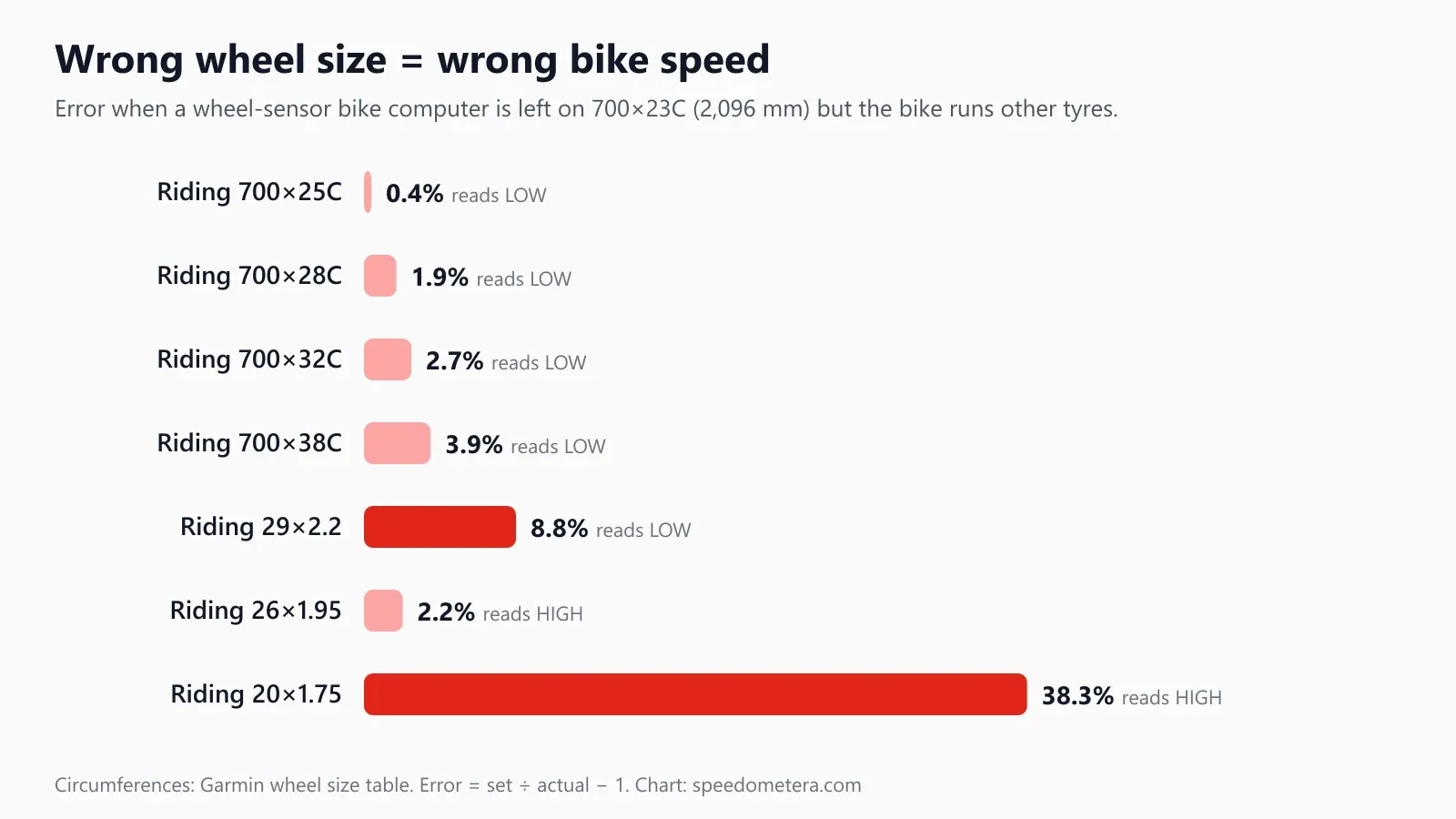
- A wheel-sensor computer set to 700×23C on a 29×2.2 MTB reads 8.8% low: a true 15 mph shows 13.7 mph
- Wheel circumference = π × (rim bead seat + 2 × tyre width): a 700×25C tyre is about 2,105 mm
- UN R39: a motorcycle speedometer may never read low, and at most 10% + 4 km/h high
- Apple advises a vibration-dampening mount for phones on mopeds and scooters, and none on high-power motorcycles
On this page
- How to use the Bike Speedometer
- What is a bike speedometer?
- How do I use my phone as a bike speedometer?
- Phone GPS vs wheel sensor vs bike computer: which should you use?
- How does a wheel-sensor bike speedometer work?
- Bicycle wheel size chart for bike computers
- How to set up and fix a bicycle speedometer
- Motorcycle and scooter speedometers: why they read high
- How should I mount my phone on a bike or motorcycle?
- Battery tips for long rides
- Bike speed in mph and km/h: quick reference
- Frequently asked questions
How to use the Bike Speedometer
- 1Get a clear view of the skyClip your phone to the handlebar or keep it in a chest or arm pocket.
- 2Tap Start and allow locationYour browser asks for location permission once. The first GPS fix usually arrives in 5–30 seconds.
- 3Pick your unitChoose km/h, mph, knots or m/s. Your choice is remembered on this device.
- 4Read speed, max, average and distanceThe gauge and digital readout update about once a second. Distance and average count only while you are moving.
- 5Stop or resetTap Stop to pause, Reset to clear the trip. Nothing is stored or sent anywhere.
Works in any modern phone browser. Back to the speedometer ↑
What is a bike speedometer?
A bike speedometer shows how fast you are riding, usually with your top speed, average and distance. It comes in three forms: a phone GPS speedometer like the one above, a wheel-sensor bike computer (CatEye, Bontrager and similar), or a GPS bike computer (Garmin Edge, Wahoo, iGPSport). On a motorcycle or scooter the speedometer is part of the dashboard and is required by law in most countries.
The word “bike” means different things to different readers. In the US and UK it usually means a bicycle. In India it usually means a motorcycle, and “cycle” means a bicycle. This page covers both. The live tool works the same way on either: it reads your speed from satellites, not from the wheel, so it needs no wiring, no magnet and no wheel-size setting. The gauge scale on this page runs to 120 km/h (75 mph), which covers a road bike descent as well as a 125 cc commuter motorcycle on a highway.
Key terms on this page. Wheel circumference is the distance the bike rolls in one full wheel turn, in millimetres. ETRTO is the European tyre and rim sizing system printed on most sidewalls as width-diameter, such as 25-622. Bead seat diameter (BSD) is the rim diameter the tyre sits on: 622 mm for 700C and 29-inch wheels, 559 mm for 26-inch. Indicated speed is what a dashboard or computer shows; true speed is your real speed over the ground.
How do I use my phone as a bike speedometer?
Mount the phone on the handlebar, tap Start, allow location and ride: speed updates about once a second in mph or km/h. No app, account or sensor is needed, and nothing is uploaded.
- Mount first, then start. Clip the phone into a handlebar or stem mount before you set off, screen facing you. For a motorcycle, use a mount made for motorcycles with vibration damping (see below).
- Tap Start and allow location. The first satellite fix takes from a few seconds to about half a minute. Wait until the speed reads 0 before rolling, so the first reading isn’t a jump.
- Pick the unit. The tool picks mph or km/h from your region and remembers your choice; tap the unit pill to change it.
- Ride and glance. The big number is current speed. Max, average and distance sit beneath it; average counts only while you are moving, so traffic lights don’t drag it down.
- Stop, reset or export. At the end, note your top and average speed, or export the ride as a GPX file for Strava or any mapping app.
The screen stays awake while the speedometer runs (where the browser supports the Wake Lock API). For a cleaner view on the bar, switch to the digital view or full screen. If you’d like a distance-only log, the GPS odometer records trip distance with less on screen.
Eyes on the road
Set everything up before you ride. Don’t tap or hold the phone while moving on a bicycle, scooter or motorcycle: glance only when the road is clear, and follow local law on phone use.
Phone GPS vs wheel sensor vs bike computer: which should you use?
For most riders a phone GPS speedometer is accurate enough and costs nothing; a wheel sensor wins on instant response and under tree cover; a GPS bike computer wins on battery life and sunlight readability. The right choice depends on where and how often you ride.
| Phone GPS (this page) | Wheel-magnet sensor computer | GPS bike computer | |
|---|---|---|---|
| How it measures speed | Satellite signals (Doppler shift) | Counts wheel turns × wheel circumference | Satellites, plus an optional wheel sensor |
| Setup | None | Fit magnet and sensor, enter wheel size in mm | Pair sensors, set profiles |
| Accuracy at steady speed | Good under open sky | About as good as the wheel size you enter | Good; best with a speed sensor |
| Response to braking and sprints | Lags 1–2 s | Instant (one pulse per wheel turn) | Instant with sensor, else lags like GPS |
| Under trees, in tunnels, indoors | Drifts or drops out | Unaffected; works on indoor trainers | Needs sensor for indoors |
| Changing tyres or wheels | Unaffected | Must re-enter circumference | Must re-enter if using a sensor |
| Battery | Uses the phone’s battery | Coin cell, typically lasts months | Rechargeable, days of riding |
| Works on a motorcycle | Yes, up to 120 km/h on this gauge | Check model’s speed and wheel-size range | Yes with a motorcycle mount |
| Cost | Free | Low | Moderate to high |
The table’s accuracy rows come from how each method works. GPS.gov states that GPS-enabled smartphones are typically accurate to within 4.9 m (16 ft) under open sky, and that the GPS signal itself contributes a speed error of no more than 0.006 m/s. The receiver, the sky view and the phone’s own filtering add more, which is why a phone reads best at a steady pace on an open road. The browser receives that speed through the W3C Geolocation API, which reports it in metres per second, or null when the device has no speed estimate; the tool then converts to mph or km/h with exact constants.
A wheel sensor has the opposite strengths. It knows nothing about satellites: every time the spoke magnet passes the fork sensor, the wheel has rolled exactly one circumference. That makes it instant and immune to trees, but it turns any error in the circumference you typed straight into a speed error.
How does a wheel-sensor bike speedometer work?
A magnet on a spoke passes a sensor on the fork once per wheel turn; the computer multiplies turns per second by the wheel circumference to get speed. Modern sensors that strap to the hub use an accelerometer instead of a magnet, but the maths is the same.
speed (km/h) = circumference (mm) × wheel turns per second × 0.0036 · e.g. 2,105 mm × 3 turns/s × 0.0036 = 22.7 km/h (14.1 mph)
That formula is also why the wheel-size setting matters so much. If you tell the computer your wheel is 2,096 mm around (the usual 700×23C default) but you actually ride 700×32C tyres that measure 2,155 mm, every wheel turn is counted 59 mm short, and every speed and distance reads 2.7% low. Garmin’s speed sensors try to detect wheel size automatically by comparing with GPS, and let you enter it by hand if that fails. Simpler magnet computers rely on the number you type.
Small mismatches between road tyres barely matter: 0.4% is 0.06 mph at 15 mph. Big ones do. A 29er mountain bike left on a road setting shows a true 15 mph as 13.7 mph, and a computer moved to a child’s 20-inch bike without changing the setting turns 15 mph into 20.8 mph. GPS has none of this problem, which is one reason riders who swap wheels often prefer it.
Bicycle wheel size chart for bike computers
Enter the circumference in millimetres from your tyre’s sidewall size: 700×25C is about 2,105 mm, 26×1.95 about 2,050 mm and 29×2.2 about 2,298 mm. The table gives Garmin’s published values next to our own calculation from the ETRTO numbers, so you can see how closely the two agree.
circumference (mm) = π × (bead seat diameter + 2 × tyre width) · e.g. 700×25C (25-622): π × (622 + 50) = 2,111 mm
| Tyre size (sidewall) | ETRTO | Formula circumference (mm) | Garmin table (mm) | Difference | Wheel turns per km | Wheel turns per mile |
|---|---|---|---|---|---|---|
| 20 × 1.75 (kids, folding) | 47-406 | 1,571 | 1,515 | −3.6% | 660 | 1,062 |
| 24 × 1.75 (junior MTB) | 47-507 | 1,888 | 1,890 | +0.1% | 529 | 852 |
| 26 × 1.95 (MTB, geared city cycles) | 50-559 | 2,070 | 2,050 | −1.0% | 488 | 785 |
| 26 × 2.10 (MTB) | 54-559 | 2,095 | 2,068 | −1.3% | 484 | 778 |
| 29 × 2.2 (29er MTB) | 56-622 | 2,306 | 2,298 | −0.3% | 435 | 700 |
| 700 × 23C (road) | 23-622 | 2,099 | 2,096 | −0.1% | 477 | 768 |
| 700 × 25C (road) | 25-622 | 2,111 | 2,105 | −0.3% | 475 | 765 |
| 700 × 28C (endurance road) | 28-622 | 2,130 | 2,136 | +0.3% | 468 | 753 |
| 700 × 32C (gravel, hybrid) | 32-622 | 2,155 | 2,155 | 0.0% | 464 | 747 |
| 700 × 38C (hybrid, touring) | 38-622 | 2,193 | 2,180 | −0.6% | 459 | 738 |
Wheel turns per km and per mile use the Garmin value and the exact mile (1,609.344 m). The formula assumes the tyre’s height equals its nominal width, which is close for most road and mountain tyres; real tyres differ with brand, rim width, pressure and your weight, and small wheels like the 20-inch show the biggest gap. Neither number is exact for your bike, which is why manufacturers recommend measuring.
The roll-out test (most accurate). Pump the tyre to your normal pressure. Mark the tyre and the floor where the tyre touches the ground, with the valve straight down. Sit on the bike (or lean your weight on it) and roll forward one full turn until the mark is at the bottom again. Measure between the floor marks in millimetres and enter that number. Repeating it two or three times and averaging takes five minutes and beats any chart.
Check your setting against GPS
Ride a straight, open road at a steady pace with the bike computer and this page’s GPS speedometer side by side. If the computer is consistently 3% low, increase the circumference by 3% (2,096 mm becomes about 2,159 mm) and test again.
How to set up and fix a bicycle speedometer
Most “bike speedometer not working” problems are a misaligned magnet, too wide a sensor gap, a flat battery or a lost pairing. Work through them in this order before buying a new unit.
- Magnet alignment. The spoke magnet must pass the centre mark of the sensor every turn. Magnets slip along the spoke over bumps; slide it back and tighten it.
- Sensor gap. The gap between magnet and sensor must be small; check your manual for the exact maximum, since it varies by model. Bring the sensor closer to the spokes.
- Batteries. Wired and wireless computers use coin cells in both the head unit and sensor. A weak sensor battery causes dropouts before it dies completely.
- Pairing and interference. Bluetooth and ANT+ sensors need re-pairing after battery changes on some models. Older analogue wireless sensors can be upset by nearby lights or other riders’ sensors.
- Wrong numbers but no dropouts. That is the wheel-size setting. Re-enter the circumference from the table above or a roll-out test, and check the unit is set to km/h or mph as you expect.
- Front or rear wheel. Either works as long as the magnet and sensor are on the same wheel and the circumference matches that wheel. Rear-wheel sensors are common on indoor trainers.
For a phone GPS speedometer, the checklist is shorter: location permission on for the browser, precise location allowed, and a clear view of the sky. Speed shows “–” until the first fix arrives.
Motorcycle and scooter speedometers: why they read high
Motorcycle and scooter speedometers are designed to read higher than true speed, never lower. UN Regulation No. 39, whose scope covers vehicles of categories L, M and N (L being two- and three-wheelers), lets the shown speed exceed true speed by up to 10% plus 4 km/h for type approval. For motorcycles coming off the production line (categories L3–L5), the conformity-of-production check allows 10% plus 8 km/h; for mopeds (L1 and L2) it stays at 10% plus 4 km/h.
| Dash reading | True speed allowed under R39 type approval | In mph |
|---|---|---|
| 40 km/h | 32.7–40 km/h | 20.3–24.9 mph |
| 60 km/h | 50.9–60 km/h | 31.6–37.3 mph |
| 80 km/h | 69.1–80 km/h | 42.9–49.7 mph |
True-speed ranges are solved from 0 ≤ shown − true ≤ 0.1 × true + 4 km/h. In practice most bikes are much closer than the limit, often a few km/h high, but your own bike is easy to measure: ride a steady 50 or 60 km/h on the dash on a straight, open road while a pillion or a fixed mount shows the GPS speed above, and compare. A bigger rear tyre, a different sprocket or a worn tyre all shift the reading, the same way they do on a car; the speedometer calibration guide and GPS vs car speedometer page explain the method and maths in detail.
R39 also caps the dial on mopeds: speedometers for L1 and L2 vehicles may not display readings above 80 km/h (49.7 mph).
India. Under the Central Motor Vehicles (5th Amendment) Rules, 2014, published as G.S.R. 291(E) in the Gazette of India on 24 April 2014, rule 117 requires every motor vehicle to carry a speedometer conforming to IS 11827-2008, from 1 April 2015 for new models and 1 April 2016 for existing ones. A motorcycle or scooter with a broken speedometer is therefore not just inconvenient; it falls short of the rule. A phone GPS speedometer is a useful stand-in to check speed until it is repaired, not a legal replacement. The national ceilings for motorcycles, set by S.O. 1522(E) of 6 April 2018, are 80 km/h on four-lane divided highways (and on expressways where bikes are allowed) and 60 km/h on other roads and inside city limits; posted signs are often lower. See the car speedometer page for the full table and its legal status.
United States. Ordinary bicycles need no speedometer. California’s three-class e-bike law, described in the AB 1096 committee analysis, requires one on Class 3 e-bikes, which assist up to 28 mph (45 km/h). Federal consumer law defines a low-speed electric bicycle as one with a motor under 750 W whose top speed on motor power alone is under 20 mph (32.2 km/h). For how fast people actually ride bicycles and e-bikes, see average cycling speed.
How should I mount my phone on a bike or motorcycle?
Use a mount that grips the phone on all sides and clamps to the handlebar or stem; on motorcycles and scooters, use one with vibration damping. A phone that rattles loose at speed is a hazard to you and to traffic behind.
- Bicycles: a silicone strap or quad-lock style mount on the stem keeps the phone close to your line of sight. Test it by shaking the bars hard before you ride.
- Scooters and mopeds: Apple’s support note on vibration says attaching an iPhone to vehicles with small-volume or electric engines such as mopeds and scooters calls for a vibration-dampening mount or a gimbal to lessen the risk of damage.
- High-power motorcycles: the same note says Apple does not recommend attaching an iPhone to motorcycles with high-power or high-volume engines, because prolonged high-amplitude vibration can degrade the camera’s image stabilization and autofocus. If you ride one, put the phone in a tank bag or jacket pocket and let a pillion read it, or use a dedicated GPS unit.
- Rain and heat: a weatherproof case protects the phone, but direct summer sun on a black mount can make phones dim the screen or pause charging. Angle it away from the sun when you can.
Battery tips for long rides
GPS with the screen on is one of the heaviest loads on a phone battery, so plan for it on rides longer than an hour or two. How long a charge lasts depends on the phone, its age and the screen brightness, so test on a short ride and watch the percentage.
- Lower screen brightness to the lowest level you can read in daylight, or use the digital view, which has less to draw.
- Close navigation and music apps you don’t need; each one may also be using GPS.
- Carry a small power bank in a frame bag, or use a USB charger on a motorcycle that has one.
- On very long rides, start the speedometer, check the first few kilometres, then lock the screen; the trip keeps counting while the page stays open in the browser (behaviour varies by phone), and you can glance at the summary at stops.
- Cold weather drains batteries faster; keep the phone in an inside pocket between uses in winter.
Bike speed in mph and km/h: quick reference
Common bike speeds: 25 km/h is 15.5 mph, 32 km/h is 19.9 mph, 45 km/h is 28.0 mph, 80 km/h is 49.7 mph and 120 km/h is 74.6 mph. Convert any other figure with the km/h to mph converter, or work out ride times with the speed, distance and time calculator.
| Speed (km/h) | Speed (mph) | Where you see it |
|---|---|---|
| 17 | 10.6 | Average US trail cyclist (FHWA, see average cycling speed) |
| 25 | 15.5 | Fast commuter on a regular bicycle |
| 32.2 | 20 | US Class 1 and 2 e-bike assist cutoff |
| 45.1 | 28 | US Class 3 e-bike assist cutoff (speedometer required in California) |
| 80 | 49.7 | Highest reading allowed on a moped speedometer under UN R39 |
| 120 | 74.6 | Top of this page’s bike gauge |
All conversions use 1 mph = 1.609344 km/h exactly and are rounded to 0.1. Back to the main online speedometer for driving, or see the full list of vehicle speedometers.
FAQ
Frequently asked questions
Can I use my phone as a bike speedometer?
Yes. Open this page, tap Start and allow location: the phone's GPS shows live speed, maximum, average and distance in mph or km/h. Put the phone in a handlebar mount so you only glance at it. GPS.gov says smartphones are typically accurate to 4.9 m (16 ft) under open sky.
Is a bike speedometer accurate?
A wheel-sensor speedometer is accurate to about 1% when its wheel circumference is set correctly, and wrong by several percent when it is not: a computer left on 700×23C reads 2.7% low on 700×32C tyres. GPS needs no setup but lags 1–2 seconds and drifts under trees and tall buildings.
How does a bike speedometer work?
A classic bike computer counts wheel turns: a magnet on a spoke passes a sensor on the fork once per revolution, and the computer multiplies turns by the wheel circumference you entered. At 2,105 mm per turn, 3 turns a second is 22.7 km/h (14.1 mph). A GPS speedometer measures satellite signals instead.
How do I set the wheel size on a bicycle speedometer?
Read the tyre size on the sidewall (for example 700×25C or 26×1.95), find its circumference in the computer's manual or the table on this page (2,105 mm and 2,050 mm in Garmin's chart), and enter it in millimetres. For best accuracy, roll the wheel one full turn and measure.
Why is my bike speedometer not working?
On a wheel-sensor computer the usual causes are a magnet that has slid out of line with the sensor, too big a gap between them, a flat sensor or head battery, or a lost pairing. For a GPS speedometer, check that location permission is on and that you are outdoors with a clear view of the sky.
Is GPS or a wheel sensor better for cycling speed?
For most riders GPS is enough and free; a wheel sensor is better for instant response, indoor trainers, tree-covered trails and tunnels. Many riders use both: GPS for distance and route, the sensor for speed. A sensor is only as good as its wheel-size setting.
Can I use a bicycle speedometer on a motorcycle?
Not reliably. Bicycle computers are built for bicycle wheel sizes and speeds, so check the model's maximum speed and circumference range before trying. A phone GPS speedometer works on any vehicle; this page's gauge runs to 120 km/h (75 mph). Mount it firmly and never handle it while riding.
Why is my motorcycle speedometer showing more than GPS?
Because speedometers are designed to read high. Under UN Regulation No. 39, which also covers motorcycles, a speedometer may never show less than true speed but may show up to 10% plus 4 km/h more. A dash 80 km/h can legally mean a true speed between 69.1 and 80 km/h.
Do I need a speedometer on a bicycle or e-bike?
In the US an ordinary bicycle needs none. California's three-class e-bike law requires a speedometer on Class 3 e-bikes, which assist to 28 mph (45 km/h). In India every motor vehicle, including motorcycles and scooters, must have a speedometer meeting IS 11827 under CMVR rule 117.
Is there a free bike speedometer app?
Yes: this page works as one. It runs in the phone browser on Android and iPhone, needs no download or account, and can be added to the home screen to open like an app. It shows speed, max, average, distance and altitude, and exports the ride as GPX.
10 Sources
- Garmin: Wheel Size and Circumference table (MARQ Captain owner's manual)
- GPS.gov: GPS accuracy (smartphones 4.9 m, range-rate error ≤0.006 m/s)
- W3C Geolocation specification: speed attribute in metres per second
- Apple Support 102175: vibrations from high-power motorcycle engines may impact iPhone cameras (1 Nov 2023)
- UN Regulation No. 39, Revision 2: scope (categories L, M, N), mopeds display limit, accuracy formula (copy hosted by a forum; original issued by UNECE)
- UN Treaty Collection C.N.154.2002: R39 conformity of production, +8 km/h for L3–L5 motorcycles
- Gazette of India, Extraordinary, G.S.R. 291(E), 24 April 2014: Central Motor Vehicles (5th Amendment) Rules, 2014, rule 9 substituting CMVR rule 117(2)–(3), speedometer to IS 11827-2008 (official Gazette scan, Internet Archive)
- Gazette of India, Extraordinary, S.O. 1522(E), 6 April 2018 (MoRTH): maximum speeds by vehicle class, motorcycles 80/80/60/60 km/h (official Gazette scan, Internet Archive)
- 15 U.S.C. 2085: Low-speed electric bicycles (under 750 W, under 20 mph) (Cornell LII)
- California Assembly Transportation Committee: AB 1096 bill analysis, three e-bike classes (2015)
Last updated October 25, 2026 by Izhar Ahmad Danish. Found an error? Tell us.