



Key numbers
- 100 km/h = 62.137 mph = 54.0 knots = 27.78 m/s
- At 100 km/h you cover 1 km every 36 seconds and 1 mile every 57.9 seconds
- NSW, Australia: 100 km/h is the default limit outside built-up areas
- India (MoRTH S.O. 1522(E), 2018): cars 100 km/h on 4-lane divided highways, 120 km/h on expressways
- 0–100 km/h (0–62.14 mph) takes a little longer than 0–60 mph (0–96.56 km/h)
On this page
- How to use the 100 km/h to mph
- What is 100 km/h in other units?
- 100 km/h to mph chart (80–120 km/h)
- Where is 100 km/h the speed limit?
- Is 0–100 km/h the same as 0–60 mph?
- How long does it take to travel at 100 km/h?
- How do I convert 100 km/h to mph in my head?
- Why does my car show 100 km/h when GPS says less?
- Related conversions
- Frequently asked questions
How to use the 100 km/h to mph
- 1Type a speed in any boxEnter a number in mph, km/h, knots, m/s, ft/s or Mach. Every other box updates as you type.
- 2Read the other unitsResults use exact definitions: 1 mile = 1,609.344 m, 1 nautical mile = 1,852 m, 1 foot = 0.3048 m.
- 3Swap or copyUse Swap to flip the main pair and Copy to copy a result. The quick table below lists common speeds.
Works in any modern phone browser. Back to the tool ↑
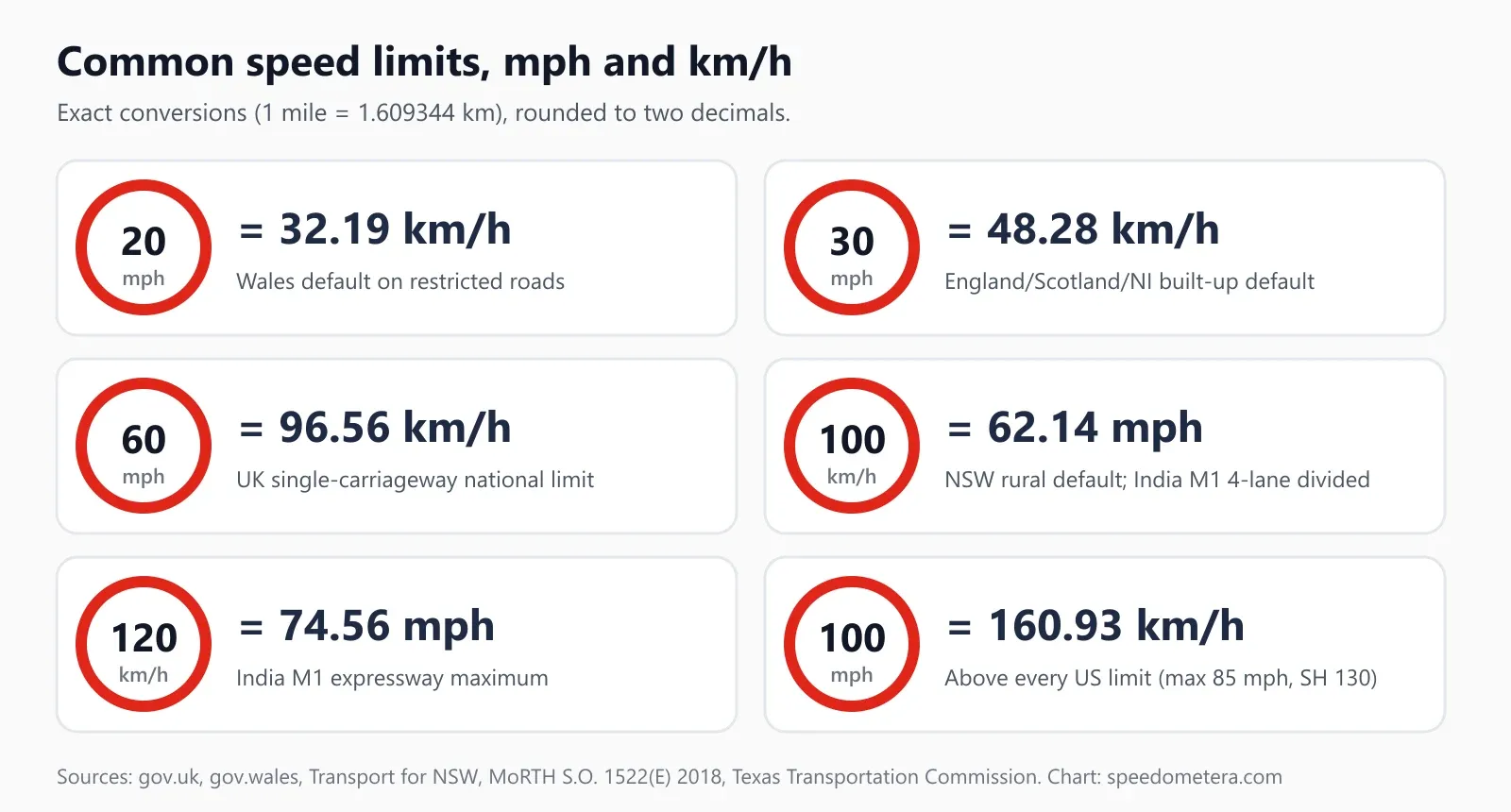
100 km/h is 62.14 mph. The exact figure is 62.137 mph, because a mile is exactly 1.609344 km and 100 ÷ 1.609344 = 62.137. The converter above starts at 100 km/h; change the number to convert any other speed, or open the full km/h to mph converter for a chart up to 300 km/h.
What is 100 km/h in other units?
Here is the same speed in every unit you are likely to meet, computed with the exact factors in our methodology:
| Unit | 100 km/h equals |
|---|---|
| Miles per hour | 62.137 mph |
| Knots | 54.00 kn |
| Meters per second | 27.78 m/s |
| Feet per second | 91.13 ft/s |
| Kilometers per minute | 1.667 km/min |
| Miles per minute | 1.036 mi/min |
| Time per kilometer | 36 s |
| Time per mile | 57.9 s |
The meters-per-second figure is the useful one for safety: at 100 km/h a car travels 27.8 meters every second, roughly the length of six family cars, before the driver has even moved a foot to the brake.
100 km/h to mph chart (80–120 km/h)
Every row is computed with the same function the converter uses, rounded to two decimals:
| km/h | mph |
|---|---|
| 80 | 49.71 |
| 85 | 52.82 |
| 90 | 55.92 |
| 95 | 59.03 |
| 100 | 62.14 |
| 105 | 65.24 |
| 110 | 68.35 |
| 115 | 71.46 |
| 120 | 74.56 |
Two rows matter most to drivers from the US or UK: 90 km/h is just under a 56 mph pace, and 110 km/h (68.35 mph) is close to a 70 mph motorway cruise.
Other km/h speeds people look up
People who search for 100 km/h also ask about town speeds and train and race speeds. Same formula, mph = km/h ÷ 1.609344:
| km/h | mph | Where you meet it |
|---|---|---|
| 40 | 24.85 | Slow urban streets and school areas |
| 50 | 31.07 | Typical town limit in km/h countries (≈ 30 mph) |
| 60 | 37.28 | Urban arterial roads |
| 70 | 43.50 | Many rural and municipal roads |
| 80 | 49.71 | Rural roads, trucks on highways |
| 200 | 124.27 | Faster than any US road limit |
| 300 | 186.41 | Italy’s Frecciarossa 1000, Shanghai maglev in service |
| 350 | 217.48 | China’s CR400 Fuxing, fastest regular service |
| 400 | 248.55 | Above any scheduled train service |
For the rail figures, see the fastest trains in the world.
Where is 100 km/h the speed limit?
100 km/h is one of the most widely posted open-road limits in the world. Three examples, each checked against the official source:
- New South Wales, Australia. On a road with no speed sign, the default limit is 50 km/h in a built-up area and 100 km/h on all other roads, according to the NSW Government. A built-up area is one with street lights or buildings next to the road less than 100 m apart.
- India. The Ministry of Road Transport and Highways notification S.O. 1522(E) of 6 April 2018 sets the maximum for cars (category M1, up to eight passenger seats) at 100 km/h on four-lane-and-above divided highways and 120 km/h on access-controlled expressways. States and road authorities can and do post lower limits on individual roads, so the sign always wins.
- The Netherlands. Since March 2020 the daytime limit (06:00–19:00) on most Dutch national motorways has been 100 km/h. Rijkswaterstaat’s traffic decree RWS-2019/45657 (19 December 2019) set it to cut nitrogen emissions, and the signs went up from 12 to 16 March 2020; the higher limit applies in the evening and at night. A few sections have since been raised back, so check the signs.
Driving one of these roads in a US-market rental car? Its speedometer’s large numbers are in mph, so hold the needle just over 62 mph. Our GPS speedometer can show km/h directly; set it up before you set off and let a passenger read it, because the driver must not handle a phone.
Is 0–100 km/h the same as 0–60 mph?
No: 0–100 km/h ends at 62.14 mph, so it is a slightly longer test than 0–60 mph, which ends at 96.56 km/h. Car makers in Europe, Australia and India quote 0–100 km/h; US magazines quote 0–60 mph. The gap is only 2.14 mph (3.44 km/h), but at the top of the run a car is accelerating at its slowest, so the 0–100 km/h figure usually reads a few tenths of a second longer. When you compare a European road test with an American one, compare like with like, or treat the km/h number as the stricter benchmark.
You can watch a run build up on the speed graph of our GPS speedometer, but GPS updates about once a second, so it is not a timing instrument; test acceleration only on a closed course, never on a public road.
How long does it take to travel at 100 km/h?
At a steady 100 km/h, time and distance line up neatly in metric:
| Distance | Time at 100 km/h |
|---|---|
| 1 km | 36 seconds |
| 1 mile (1.609 km) | 57.9 seconds |
| 10 km | 6 minutes |
| 100 km (62.14 mi) | 1 hour |
| 100 miles | 1 hour 36.6 minutes |
That is why 100 km/h feels “round” to metric drivers: one kilometer every 36 seconds, one hour per 100 km. Use the speed, distance and time calculator for other trips.
How do I convert 100 km/h to mph in my head?
Multiply by 0.6 for a safe estimate (60 mph), or by 5/8 for a close one (62.5 mph).
- × 0.6: 100 × 0.6 = 60 mph. It reads about 3.5% low, which is handy when you want to stay under a limit.
- × 5/8: halve three times (100 → 50 → 25 → 12.5) and multiply by 5 = 62.5 mph, only 0.6% high.
- Exact: 100 ÷ 1.609344 = 62.137 mph.
The reverse is on the mph to km/h page; 62 mph comes back as 99.78 km/h.
Why does my car show 100 km/h when GPS says less?
Car speedometers are allowed to over-read, and most do by a few percent, so a GPS reading of about 96–98 km/h with 100 km/h on the dial is normal. Tyre wear and tyre size change the reading too. Our GPS vs car speedometer guide explains the rules, and the speedometer calibration tool works out your car’s exact error from one GPS reading. GPS speed itself is an estimate that depends on signal and sky view, and it can lag in tunnels and cities.
Related conversions
- 120 km/h to mph: 74.56 mph, the Indian expressway limit for cars
- 60 mph to km/h: 96.56 km/h, the UK single-carriageway limit
- Speed converter: km/h, mph, knots, m/s and Mach at once
FAQ
Frequently asked questions
How fast is 100 km/h in mph?
100 km/h is 62.14 mph. Divide by 1.609344 (the exact number of kilometers in a mile) to get 62.137 mph. On a US road that is a little above a 60 mph limit and well under 65 mph.
Is 100 km/h fast?
It is a normal open-road speed. 100 km/h is the default rural limit in New South Wales and the car limit on India's four-lane divided highways, and the daytime limit on most Dutch motorways. In a town, where 50 km/h (31 mph) is typical, it would be twice the limit.
What is 100 kph in mph?
100 kph is the same as 100 km/h, so it is 62.14 mph. kph, kmh and km/h are just different spellings of kilometers per hour.
Is 0–100 km/h the same as 0–60 mph?
No. 0–100 km/h is 0–62.14 mph, while 0–60 mph is 0–96.56 km/h. A 0–100 km/h time is therefore slightly longer than the same car's 0–60 mph time, because the car has to gain about 3.4 km/h more.
How long does it take to drive 100 km at 100 km/h?
Exactly one hour, if you hold 100 km/h the whole way. 100 km is 62.14 miles, so 100 km/h is also 1.036 miles per minute, or one mile every 57.9 seconds.
Is 100 km/h 60 mph?
Roughly, not exactly. 100 km/h is 62.14 mph. Multiplying by 0.6 gives 60 mph (about 3.5% low, so it keeps you under a limit); multiplying by 5/8 gives 62.5 mph (about 0.6% high). The exact figure is 62.137 mph.
Which is faster, 100 km/h or 100 mph?
100 mph is faster. One mile is exactly 1.609344 km, so 100 mph is 160.93 km/h, about 61% faster than 100 km/h (62.14 mph). Whenever the number is the same, the mph speed is the higher one.
How fast is 200 km/h in mph?
200 km/h is 124.27 mph (200 ÷ 1.609344). It is twice 100 km/h, so it is also twice 62.14 mph. 300 km/h is 186.41 mph and 400 km/h is 248.55 mph; the table on this page lists more values from 40 to 400 km/h.
Is 1 km half a mile?
No, it is a bit more than half: 1 km is 0.6214 miles, and 1 mile is exactly 1.609344 km. So 1 km/h is slower than 1 mph, and 100 km/h (62.14 mph) is slower than 100 mph (160.93 km/h).
4 Sources
- NIST SP 811, Appendix B.8: conversion factors (mile = 1,609.344 m exactly)
- NSW Government: Speed limits (default 50 km/h built-up, 100 km/h elsewhere)
- Gazette of India, MoRTH notification S.O. 1522(E), 6 April 2018: maximum speeds by vehicle class and road type; M1 cars 120 / 100 / 70 / 70 km/h (gazette copy hosted by ACMA)
- Rijkswaterstaat: Verkeersbesluit RWS-2019/45657 (19 Dec 2019), 100 km/h between 06:00 and 19:00 on national motorways, signs placed 12–16 March 2020
Last updated October 25, 2026 by Izhar Ahmad Danish. Found an error? Tell us.