


Key numbers
- Mach 0.85 at 35,000 ft = 564 mph (908 km/h, 490 knots) in the standard atmosphere
- Below 10,000 ft, US rules cap planes at 250 knots (288 mph) indicated airspeed
- The Boeing 787's certified limit is Mach 0.90; the A320 family's is Mach 0.82
- Jet stream winds can exceed 275 mph, which is why eastbound flights land early
- A Cessna 172 tops out at 124 knots (143 mph) in cruise
On this page
- How to use the How Fast Do Planes Fly?
- How fast does a plane fly at cruising altitude?
- How fast do different planes fly? Speeds by aircraft
- What is the difference between airspeed, ground speed and Mach?
- Why are flights faster eastbound? The jet stream effect
- How fast does a plane go at takeoff and landing?
- How do I check my plane’s speed with my phone?
- Is it legal to use GPS on a plane? FAA and FCC rules
- Do planes fly 300, 400, 700 or 1,000 mph?
- How fast do the fastest planes fly?
- Frequently asked questions
How to use the How Fast Do Planes Fly?
- 1Get a clear view of the skyUse a window seat and turn on airplane mode (GPS still works); fixes take longer at altitude.
- 2Tap Start and allow locationYour browser asks for location permission once. The first GPS fix usually arrives in 5–30 seconds.
- 3Pick your unitChoose km/h, mph, knots or m/s. Your choice is remembered on this device.
- 4Read speed, max, average and distanceThe gauge and digital readout update about once a second. Distance and average count only while you are moving.
- 5Stop or resetTap Stop to pause, Reset to clear the trip. Nothing is stored or sent anywhere.
Works in any modern phone browser. Back to the speedometer ↑
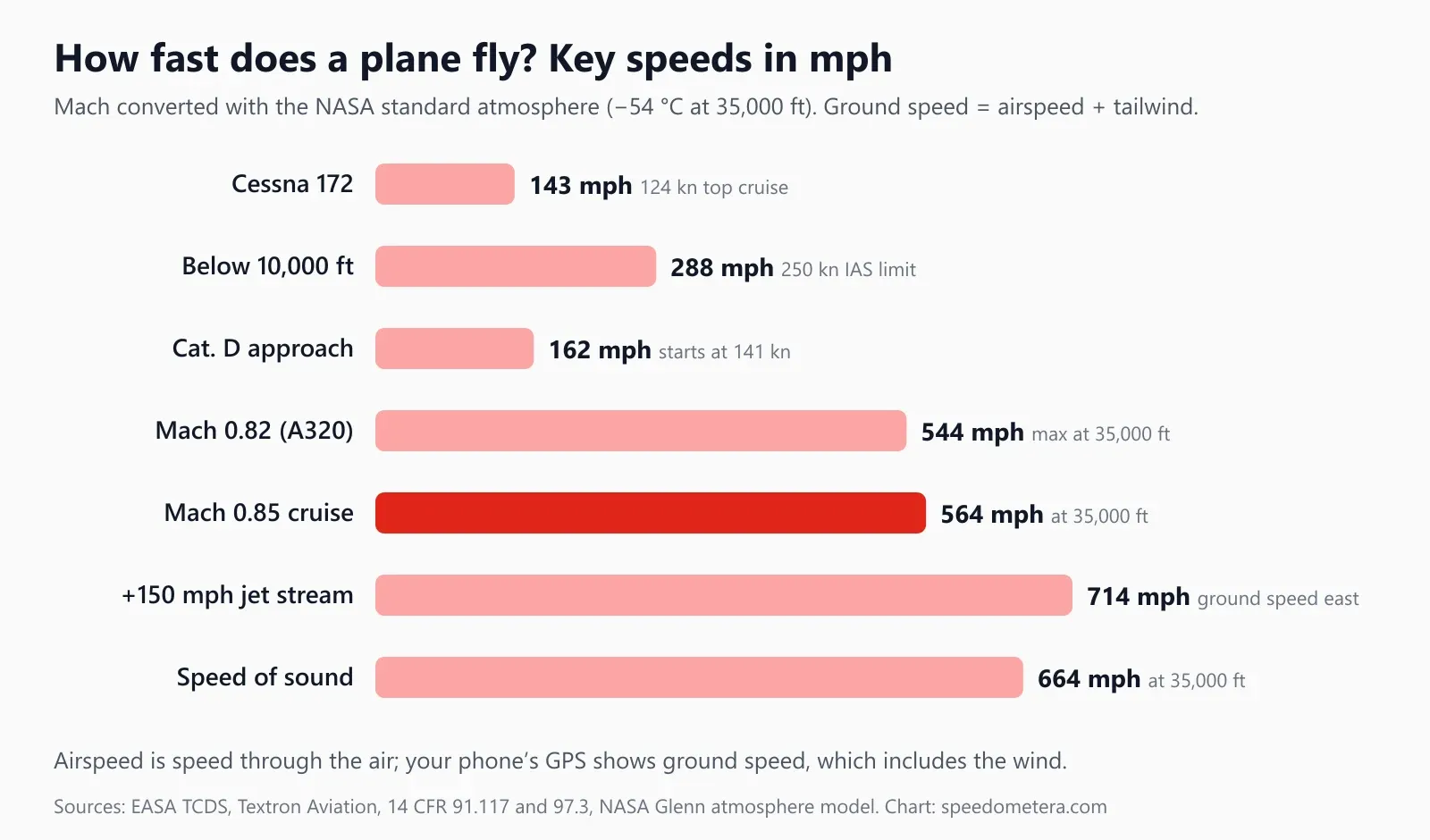
How fast does a plane fly at cruising altitude?
A jet airliner at cruising altitude flies at roughly 550 mph (885 km/h) through the air. Pilots fly to a Mach number rather than a fixed mph, and at 35,000 feet Mach 0.85 is 564 mph. That is the answer to “how fast does a plane fly” for most passenger flights, and it is the number you will usually see if you run the GPS speedometer above at a window seat in still air.
Why Mach instead of miles per hour? An airliner’s speed limit at altitude comes from the way air behaves as it approaches the speed of sound, and the speed of sound itself drops as the air gets colder. In the standard atmosphere that NASA uses, the air at 35,000 feet is about −54 °C, and sound travels at 664 mph there instead of 761 mph at sea level. So Mach 0.85 would be 647 mph at sea level, but only 564 mph at cruise height. That is one reason articles on this topic disagree: some quote speeds at sea level, some at altitude, and some quote ground speed with the wind included.
The certified data sheets set the ceiling. Europe’s aviation regulator, EASA, lists the maximum operating Mach (MMO) for every type it validates: 0.82 for the Airbus A320 family and 0.90 for the Boeing 787. Airlines cruise a little below those limits to leave a margin for turbulence and to save fuel. Boeing’s own airport planning document gives the 747-8 Intercontinental a cruise speed of Mach 0.855 and the 747-8 Freighter Mach 0.845.
Definitions used on this page. Indicated airspeed (IAS): speed shown on the cockpit airspeed indicator. True airspeed (TAS): speed relative to the undisturbed air. Ground speed (GS): speed across the ground, which is what GPS measures. Mach number: true airspeed divided by the local speed of sound (all per 14 CFR 1.1). Knot (kn): one nautical mile (1,852 m) per hour, 1.15 mph. MMO/VMO: the maximum operating Mach and airspeed a type is certified for.
How fast do different planes fly? Speeds by aircraft
Speeds range from about 143 mph for a Cessna 172 to around 620 mph for the fastest business jets, with airliners in between, certified to 544–597 mph at 35,000 feet. The table converts each manufacturer or regulator figure into mph, km/h and knots so you can compare like with like.
| Aircraft | Official figure | Type of figure | mph at 35,000 ft | km/h | knots |
|---|---|---|---|---|---|
| Cessna 172 Skyhawk | 124 knots TAS | Top cruise (Textron) | 143 mph* | 230 | 124 |
| Airbus A320 / A321neo | Mach 0.82 | Certified maximum (EASA, Airbus) | 544 mph | 876 | 473 |
| Boeing 747-8 Freighter | Mach 0.845 | Cruise (Boeing) | 561 mph | 902 | 487 |
| Gulfstream G700 | Mach 0.85 | Long-range cruise (Gulfstream) | 564 mph | 908 | 490 |
| Boeing 747-8 Intercontinental | Mach 0.855 | Cruise (Boeing) | 567 mph | 913 | 493 |
| Boeing 787-8/-9/-10 | Mach 0.90 | Certified maximum (EASA) | 597 mph | 961 | 519 |
| Gulfstream G700 | Mach 0.90 | High-speed cruise (Gulfstream) | 597 mph | 961 | 519 |
| Gulfstream G650 | Mach 0.925 | Certified maximum (EASA) | 614 mph | 988 | 533 |
| Gulfstream G700 / G800 | Mach 0.935 | Certified maximum (EASA) | 620 mph | 998 | 539 |
*The Cessna’s figure is a true airspeed at its own much lower cruise altitude (it is certified to 14,000 ft), so it doesn’t need a Mach conversion. All other mph values are computed in the NASA standard atmosphere at 35,000 ft, where sound travels at 664 mph. Conversion constants are exact: 1 knot = 1.852 km/h and 1 mph = 1.609344 km/h.
Two things stand out. First, “maximum” and “cruise” are different numbers. An A320 is not allowed past Mach 0.82, so in practice it cruises slightly slower than that. A 787 is allowed to Mach 0.90 but normally cruises well below its limit because fuel burn rises steeply near it. Second, the spread among jets is small. The fastest Gulfstream at its legal limit is only about 14% faster than an A320 at its limit, which is why a business jet saves time mostly by flying direct and skipping the hub, not by raw speed.
Range matters as much as speed for long trips. Boeing lists the 787-9 at up to 8,300 nautical miles (9,551 miles). A plane that can fly nonstop beats a faster plane that has to stop for fuel.
Airliners cruise below Mach 1, which is only about 660 mph at 36,000 ft; see the speed of sound in mph by altitude.
What is the difference between airspeed, ground speed and Mach?
Airspeed is how fast the plane moves through the air; ground speed is how fast it moves over the Earth. Your phone’s GPS measures ground speed, so it includes the wind. Pilots work with four different speeds, and each answers a different question.
| Speed | What it measures | Who uses it | Example at cruise |
|---|---|---|---|
| Indicated airspeed (IAS) | Air pressure in the pitot tube, shown on the airspeed indicator | Pilots, for lift and structural limits | Far below true airspeed in thin air |
| True airspeed (TAS) | Real speed through the air mass | Navigation and flight planning | Mach 0.85 = 490 knots (564 mph) |
| Mach number | TAS ÷ local speed of sound | Pilots and autopilot above about 30,000 ft | 0.85 |
| Ground speed (GS) | Speed across the ground = TAS ± wind | Arrival times, flight trackers, your GPS | 564 mph + 150 mph tailwind = 714 mph |
Why indicated airspeed falls as a plane climbs. The airspeed indicator senses how hard air molecules push into a forward-facing tube. In thin air at 35,000 feet, fewer molecules hit it, so the dial reads far lower than the true speed. The FAA defines true airspeed as equivalent airspeed scaled by the square root of the density ratio, which is the formal version of the same idea. The wing feels the indicated number, which is why rules about structural limits and approach speeds are written in indicated knots.
Why Mach matters at altitude. As a wing approaches the speed of sound, parts of the airflow over it go supersonic and form shock waves. That is the reason each airliner has a certified MMO. In the standard atmosphere, the speed of sound depends only on temperature, so it shrinks as you climb through the troposphere and stays constant above about 36,000 feet:
| Altitude | Standard temp | Speed of sound (mph) | km/h | knots | Mach 0.85 in mph |
|---|---|---|---|---|---|
| Sea level | 15.0 °C | 761 | 1,225 | 662 | 647 |
| 10,000 ft | −4.7 °C | 735 | 1,182 | 638 | 625 |
| 20,000 ft | −24.5 °C | 707 | 1,138 | 614 | 601 |
| 30,000 ft | −44.3 °C | 678 | 1,092 | 589 | 577 |
| 35,000 ft | −54.2 °C | 664 | 1,068 | 577 | 564 |
| 39,000 ft and above | −56.5 °C | 660 | 1,062 | 574 | 561 |
speed of sound a = √(γ × R × T), with γ = 1.4, R = 287.05 J/(kg·K), T in kelvin
The formula is from NASA Glenn’s speed of sound page, and the temperatures come from NASA’s atmosphere model (T = 15.04 − 0.00649 h °C up to 11,000 m, −56.46 °C above). Real days are warmer or colder than standard, so the true mph for a given Mach moves by a few percent. Our sea-level figure (761 mph) matches NASA’s.
If you want to convert any of these yourself, the knots to mph converter and mph to knots converter use the same exact constants.
Why are flights faster eastbound? The jet stream effect
Flights heading east ride the jet stream, a band of west-to-east wind near 30,000 feet that NOAA says can blow faster than 275 mph. A tailwind adds directly to ground speed, so the same plane can cover the ground 100–200 mph faster going east than going west.
The plane’s speed through the air doesn’t change. It holds the same Mach number in both directions. What changes is the air mass it flies in, which is moving over the ground. Take a jet holding Mach 0.85 at 35,000 feet (564 mph true airspeed) on a 2,500-mile trip, about the distance of a coast-to-coast US flight, and add a straight headwind or tailwind:
| Jet stream wind | Ground speed eastbound | Cruise time east | Ground speed westbound | Cruise time west | Difference |
|---|---|---|---|---|---|
| Calm | 564 mph | 4 h 26 min | 564 mph | 4 h 26 min | 0 min |
| 50 mph | 614 mph | 4 h 04 min | 514 mph | 4 h 52 min | 48 min |
| 100 mph | 664 mph | 3 h 46 min | 464 mph | 5 h 23 min | 97 min |
| 150 mph | 714 mph | 3 h 30 min | 414 mph | 6 h 02 min | 152 min |
| 200 mph | 764 mph | 3 h 16 min | 364 mph | 6 h 52 min | 216 min |
The times cover the cruise at a constant wind only. Taxi, climb and descent add real time, and no route has a pure headwind or tailwind from end to end. The math is the same as any speed, distance and time calculation: time = distance ÷ ground speed.
This is why a reading of 700+ mph on your phone doesn’t mean the plane broke any rule. Its airspeed is still around Mach 0.85; the wind is doing the rest. Notice that a 764 mph ground speed is above the 664 mph speed of sound at altitude, yet the plane is not supersonic, because Mach is measured against the air around it, not the ground.
Dispatchers use the wind too. Westbound flights often take routes that dodge the strongest part of the jet stream, and eastbound ones go looking for it. NOAA notes the jet stream sits four to eight miles up and can be hundreds of miles wide, so where a flight crosses it changes how much time it saves. Because the jet stream blows mostly west to east, it matters most on east-west routes such as US coast-to-coast and transatlantic flights, and far less on north-south ones.
How fast does a plane go at takeoff and landing?
A jet airliner typically lands at about 139–190 mph (121–165 knots, FAA approach categories C and D) and takes off at a speed calculated for each flight, usually higher than its landing speed because it is heavier at departure. The FAA sorts planes by landing reference speed, from under 91 knots (Category A) to 166 knots and above (Category E).
Takeoff speeds are not fixed numbers. Before every flight the crew calculates three “V-speeds” from the plane’s weight, flap setting, runway length, temperature and wind. The FAA’s abbreviations list defines them:
- V1, decision speed: the fastest point at which the crew can still abort and stop on the runway.
- VR, rotation speed: the speed at which the pilot lifts the nose.
- V2, takeoff safety speed: the speed the plane holds while it climbs away, high enough to stay controllable if an engine fails.
A heavy long-haul jet bound for Asia needs a much higher VR than the same jet flying a light domestic leg. Hot days and high-altitude airports such as Denver push speeds up too, because thinner air gives less lift at a given ground speed.
For landing, the key number is VREF, the reference landing speed. The FAA uses it to sort aircraft into approach categories that set the size of the protected airspace around each instrument approach:
| FAA approach category | VREF (knots) | mph | km/h |
|---|---|---|---|
| A | under 91 | under 104.7 | under 168.5 |
| B | 91 to under 121 | 104.7–139.2 | 168.5–224.1 |
| C | 121 to under 141 | 139.2–162.3 | 224.1–261.1 |
| D | 141 to under 166 | 162.3–191.0 | 261.1–307.4 |
| E | 166 and above | 191.0 and above | 307.4 and above |
Category thresholds are from 14 CFR 97.3, based on VREF (or 1.3 times the landing-configuration stall speed) at maximum certificated landing weight. The mph and km/h columns are calculated. Lift grows with the square of airspeed, so a plane that weighs more needs more speed to fly; that is why a jet leaving full of fuel rotates faster than the same jet lands at the end of a long trip.
There are also hard speed limits on the way down. Under 14 CFR 91.117, no aircraft may exceed 250 knots indicated (288 mph) below 10,000 feet unless the FAA authorizes it, and near the main airport of Class C or D airspace the limit is 200 knots (230 mph) at or below 2,500 feet above the ground. If you watch the GPS reading on descent, you can often see the plane slow and level off around 10,000 feet as it obeys the first rule.
How do I check my plane’s speed with my phone?
Turn on airplane mode, keep location on, open this page at a window seat and tap Start. GPS works without a cellular signal, so your phone shows the plane’s ground speed, altitude and heading once it gets a fix.
- Load the page before boarding. Open this page on the ground while you still have data or Wi-Fi so the speedometer is ready; it keeps working offline.
- Turn on airplane mode, and leave Location Services on. Airplane mode switches off the cellular radio, as federal rules require, but on most phones it leaves the GPS receiver working.
- Hold the phone flat against the window. The fuselage blocks most satellite signals, so an aisle seat or a phone in your lap may never get a fix. A window seat on the side facing more open sky works best.
- Tap Start and wait. The first fix at altitude can take one to two minutes, longer than on the ground, because the receiver has to find satellites through a small window.
- Watch the accuracy line. Once it says “good”, the speed is reliable. Switch the unit to knots if you want to compare with a flight tracker, or to km/h.
- Read the extras. The altitude line shows height above sea level (see the altitude tool for how phones measure it), and the max field keeps your top ground speed for the flight.
Why your number beats the seatback map
Your phone reads Doppler shift from GPS satellites about once a second. GPS.gov says the signal itself has a range-rate error of no more than 0.006 m/s over any 3 seconds (95% probability), so on a steady cruise your reading is limited by the phone and the window, not by GPS itself.
What the readings mean in the air. The big number is ground speed, so it already includes the wind. Expect the number to climb quickly on the takeoff roll, then a long climb with speed held near 288 mph until 10,000 feet, then a steady rise to cruise. If the reading tops 650 mph, you are almost certainly riding the jet stream. The gauge on this page runs to 650 mph, enough for any airliner in normal winds.
When the reading drops out. Banking turns, a cabin full of passengers leaning against the window, or a window shade pulled down can all break the fix. Readings pause rather than guess, and they come back within seconds once the phone sees enough sky again. GPS.gov notes that typical smartphones locate themselves to about 16 feet under open sky; through an aircraft window, accuracy is worse but still good enough for a stable speed reading at cruise.
Is it legal to use GPS on a plane? FAA and FCC rules
Yes, on US airlines you can generally use your phone in airplane mode during flight, including its GPS, if your airline allows it. The FCC bans cellular phone use in the air, and the FAA leaves the decision on other devices to each airline.
Two federal rules work together:
- FAA rule, 14 CFR 121.306. No one may operate a portable electronic device on a US airline flight unless it is on a short list of exceptions or the airline (the “part 119 certificate holder”) has determined it won’t interfere with the plane’s navigation or communication systems. In other words, the airline decides, and its flight attendants’ instructions are what you follow.
- FCC rule, 47 CFR 22.925. Cellular phones “must not be operated while such aircraft are airborne.” That is why airlines ask you to switch to airplane mode before takeoff: it turns off the cellular radio.
Since GPS is a receive-only signal, using the GPS receiver doesn’t transmit anything. Airlines publish their own device policies, and rules can differ by carrier, aircraft and phase of flight, and the crew can tell you to stow devices at any time, such as during takeoff and landing. Foreign carriers follow their own regulators. When in doubt, ask a flight attendant.
Follow crew instructions
Never ignore a crew instruction to stow or switch off a device, and don’t block an emergency exit row or lean on a window to get a better signal during taxi, takeoff or landing. The speedometer is for curiosity only; it is not a navigation instrument.
Do planes fly 300, 400, 700 or 1,000 mph?
Yes to all four, but not the same planes: turboprops cruise near 300 mph, jet airliners at 540–600 mph through the air (and over 700 mph across the ground with a jet-stream tailwind), and only supersonic aircraft pass 1,000 mph. The table puts each benchmark next to a real aircraft.
| Benchmark | Aircraft | Official figure | mph | km/h |
|---|---|---|---|---|
| ~150 mph | Cessna 172 Skyhawk | 124 kt top cruise (Textron) | 143 | 230 |
| ~150 mph | Bell 407 helicopter | 133 kt max cruise (Bell) | 153 | 246 |
| ~300 mph | ATR 72-600 turboprop | 275 kt maximum cruise (ATR) | 316 | 509 |
| 400 mph | No airliner cruises here; jets pass through it climbing and descending | 250 kt limit below 10,000 ft (14 CFR 91.117) | 288 | 463 |
| ~550–600 mph | Airbus A320 to Boeing 787 | Mach 0.82–0.90 at 35,000 ft (EASA) | 544–597 | 876–961 |
| 700+ mph | Any airliner with a 150 mph jet-stream tailwind | Ground speed, not airspeed | 714 | 1,149 |
| 1,000+ mph | Concorde (retired 2003) | 1,350 mph cruise (British Airways) | 1,350 | 2,173 |
| 2,000+ mph | Lockheed SR-71 Blackbird | 2,193.167 mph record, 1976 (USAF museum) | 2,193 | 3,530 |
| 4,000+ mph | North American X-15 | Mach 6.7 (NASA) | 4,520 | 7,274 |
Knots are converted with 1 kt = 1.150779 mph and mph with 1 mph = 1.609344 km/h; the 714 mph row is Mach 0.85 at 35,000 ft plus a 150 mph tailwind, as in the jet-stream section above. Two lessons stand out. First, a “700 mph” reading on your phone’s GPS is normal on an eastbound flight: it is ground speed with the wind added, not the plane going faster through the air. Second, 1,000 mph has been reached only by aircraft built to go supersonic. British Airways gives Concorde’s cruise as 1,350 mph at up to 60,000 ft, with London–New York in a little under 3.5 hours, and the National Museum of the US Air Force lists the SR-71’s July 1976 records of 2,193.167 mph and 85,069 ft. No passenger plane has flown supersonic since Concorde retired.
How fast do the fastest planes fly?
The fastest flight by a crewed, powered aircraft is the X-15 rocket plane’s Mach 6.7, or 4,520 mph (7,274 km/h), flown by Air Force pilot Pete Knight on October 3, 1967, according to NASA. No airliner flying today comes close: they are certified to Mach 0.82–0.90.
| Aircraft | Top or certified speed | mph | km/h | Notes |
|---|---|---|---|---|
| North American X-15 | Mach 6.7 | 4,520 | 7,274 | Rocket research plane, NASA and US Air Force |
| Gulfstream G700 / G800 | Mach 0.935 | 620 at 35,000 ft | 998 | Certified MMO, among the fastest civil jets |
| Boeing 787 | Mach 0.90 | 597 at 35,000 ft | 961 | Certified MMO |
| Boeing 747-8 Intercontinental | Mach 0.855 | 567 at 35,000 ft | 913 | Cruise speed |
| Airbus A320 family | Mach 0.82 | 544 at 35,000 ft | 876 | Certified MMO |
Why don’t airliners go faster? Above about Mach 0.9, drag rises sharply as shock waves form on the wings, and fuel burn rises with it. Supersonic flight also creates a sonic boom. For an airline, a few percent more speed rarely earns back the extra fuel, which is why every airliner in the table above is certified for a narrow band between Mach 0.82 and 0.90.
If you’re comparing travel options, the same pattern holds on the ground. The fastest trains in the world top out around a third of an airliner’s cruise speed, and US trains are slower still (see how fast do trains go). For your own speed on the road, use the online speedometer on the homepage.
FAQ
Frequently asked questions
How fast does a 747 fly?
The Boeing 747-8 Intercontinental cruises at Mach 0.855 and the 747-8 Freighter at Mach 0.845, according to Boeing's airport planning document. At 35,000 feet that is about 567 mph and 561 mph (913 and 902 km/h). With a strong tailwind its ground speed can top 700 mph.
How fast does a plane go when it takes off?
There is no single number: the crew calculates rotation speed (VR) for every flight from weight, flaps, runway and temperature. As a guide, jet airliners land at about 139–190 mph (FAA approach categories C and D) and take off faster than that when heavy with fuel. Light planes in Category A land under 105 mph.
How fast does a plane land?
A jet airliner typically crosses the runway threshold at about 140–190 mph (120–165 knots). FAA approach categories C and D, which cover most airliners, span 121 to 165 knots, or 139 to 190 mph. Heavier, faster jets land faster; small piston planes land under 104 mph (Category A).
Why are flights faster going east?
Because the jet stream blows from west to east at 30,000 feet and can exceed 275 mph. A jet cruising at 564 mph through the air gains that wind as ground speed flying east and loses it flying west. A 100 mph wind makes a 2,500-mile trip about 97 minutes shorter eastbound than westbound.
Can a plane fly faster than the speed of sound?
Airliners cannot: their certified limits are Mach 0.82 to 0.90, so 1.0 is off-limits. Military jets and research aircraft can. The X-15 rocket plane reached Mach 6.7 (4,520 mph) in October 1967, the fastest flight by a crewed, powered aircraft, according to NASA.
Does GPS work on a plane in airplane mode?
On most phones, yes. GPS only receives satellite signals, so it keeps working with airplane mode on, which FCC rules require for cellular radios once you are airborne. Sit at a window, allow location and expect the first fix to take one to two minutes at 35,000 feet.
What is the average speed of a commercial plane?
Gate to gate, much less than its 560 mph cruise. Taxiing, climbing, the 250-knot (288 mph) limit below 10,000 feet and descent drag the average down. On a 2,500-mile trip, cruise alone at 564 mph would take 4 hours 26 minutes before any climb, descent or wind.
How high and how fast do planes fly?
Jet airliners usually cruise in the mid-30,000s of feet, where the air is thin, cold and efficient. The A320 is certified up to 39,100–41,000 ft and the 787-8 and 787-9 to 43,100 ft. At 35,000 ft, sound travels at 664 mph, so Mach 0.85 equals about 564 mph.
How fast does a small private plane fly?
A four-seat Cessna 172 Skyhawk cruises at up to 124 knots (143 mph, 230 km/h), according to Textron Aviation. Business jets are much faster: the Gulfstream G700 cruises at Mach 0.85 to 0.90, about 564 to 597 mph at 35,000 feet.
How fast do helicopters fly?
Much slower than planes. A Bell 407, a common police and medical helicopter, has a maximum cruise speed of 133 knots (153 mph, 246 km/h), according to Bell. The record for a conventional helicopter is 400.87 km/h (249 mph), set by a modified Westland Lynx on August 11, 1986.
Can a plane fly at 70,000 feet?
A few special aircraft can, but no airliner. Airliners are certified to about 39,000–43,100 ft, Concorde cruised up to 60,000 ft, and the SR-71 Blackbird set an altitude record of 85,069 ft in July 1976. Above about 40,000 ft the thin air makes subsonic airliner wings and engines inefficient.
24 Sources
- Boeing: 747-8 Airplane Characteristics for Airport Planning (D6-58326-1, Rev E), cruise Mach 0.845 / 0.855
- EASA TCDS IM.A.115, Boeing 787 (Issue 30, Dec 2025): VMO/MMO 350 KEAS / 0.90M, max altitude 43,100 ft
- EASA TCDS A.064, Airbus A318–A321 (Issue 60): MMO 0.82, VMO 350 kt, max altitude 39,100–41,000 ft
- Airbus: A321neo key figures (Mmo 0.82)
- EASA TCDS IM.A.169, Gulfstream G650/G700/G800 (Issue 17, Jul 2026): MMO 0.925 / 0.935
- Gulfstream: G700 speeds (long-range cruise Mach 0.85, high-speed cruise Mach 0.90)
- Textron Aviation: Cessna Skyhawk (top cruise 124 ktas)
- Boeing: 787 Dreamliner range and seating
- 14 CFR 91.117: Aircraft speed (250 knots below 10,000 ft, 200 knots near Class C/D airports)
- 14 CFR 97.3: Aircraft approach categories A–E
- 14 CFR 1.1: Definitions of indicated, calibrated, equivalent and true airspeed and Mach number
- 14 CFR 1.2: Abbreviations (V1, VR, V2, VREF, VMO/MMO)
- 14 CFR 121.306: Portable electronic devices on airline flights
- 47 CFR 22.925: Cellular telephones prohibited on airborne aircraft (FCC)
- NOAA JetStream: The jet stream (speeds above 275 mph, around 30,000 ft)
- NASA Glenn: Speed of sound (a = √γRT; 761 mph at sea level)
- NASA Glenn: Earth atmosphere model (metric)
- NASA: X-15 (4,520 mph, Mach 6.7, October 3, 1967)
- ATR: ATR 72-600 factsheet (maximum cruise speed 275 KTAS) (PDF)
- British Airways: Celebrating Concorde (cruise 1,350 mph, ceiling 60,000 ft, London–New York under 3.5 hours)
- National Museum of the US Air Force: Lockheed SR-71A (2,193.167 mph and 85,069 ft records, July 1976)
- Leonardo: G-Lynx, 35 years of an unrivalled helicopter speed record (400.87 km/h, 11 Aug 1986)
- Bell: Bell 407 specifications (max cruise 133 kts, 246 km/h)
- GPS.gov: GPS accuracy (smartphones and speed accuracy)
Last updated October 25, 2026 by Izhar Ahmad Danish. Found an error? Tell us.