



Key numbers
- A 10:00 mile is exactly 6.0 mph (6:13 per km)
- A 4:00:00 marathon needs 9:09 per mile (5:41 per km)
- A marathon is 26.22 miles (42,195 m), not 26.2, so a 9:09 pace reaches mile 26.2 at 3:59:50
- To turn pace per mile into pace per km, divide by 1.609344
- Kelvin Kiptum's 2:00:35 marathon record averaged 4:36 per mile (13.05 mph)
On this page
- How to use the Pace Calculator
- What does a pace calculator do?
- How do you calculate running pace?
- Running pace chart: what finish time does each pace give?
- What pace do I need for my goal time?
- Marathon pace chart: what pace do I need for every finish time?
- 5K pace chart: what pace is my 5K time?
- How do I convert treadmill speed to pace?
- How do I use pace splits in a race?
- Why does my GPS watch show a different pace?
- Pace per mile vs pace per km: how do you convert?
- How accurate is this pace calculator?
- Frequently asked questions
How to use the Pace Calculator
- 1Choose what to calculatePick Pace, Finish time or Distance. The box you are solving for is filled in for you.
- 2Enter the other two valuesPick a race (5K, 10K, half marathon, marathon) or type a distance in miles or km, then a time as h:mm:ss or a pace as min:sec.
- 3Read pace, speed and splitsSee pace per mile and per km, speed in mph, even-pace splits and finish times for common races at the same pace.
Works in any modern phone browser. Back to the tool ↑
What does a pace calculator do?
A pace calculator solves the running triangle: give it any two of distance, time and pace, and it returns the third, plus speed in mph and even-pace splits. The tool above starts on a 5K in 25:00, which works out to 8:03 per mile, 5:00 per kilometer and 7.46 mph.
Pace is the runner’s version of speed turned upside down. A car speedometer tells you how far you go per hour (miles per hour); a running pace tells you how long one unit of distance takes (minutes per mile or minutes per kilometer). Both describe the same movement, which is why this page shows pace and mph side by side, and why the same maths powers our speed, distance and time calculator and the live online speedometer on the homepage.
Key terms on this page. Pace = time per mile or per km (min:sec). Speed = distance per hour (mph or km/h). Split = the time for one segment of a race, such as one mile. Elapsed = total time from the start to that point. Even pace = every split the same. Negative split = the second half faster than the first. Chip time (net time) = time from crossing the start mat to the finish mat, the time the Boston Athletic Association uses for qualifying.
The three modes work like this:
- Pace: you know the distance and your time (a race result, a training run). The calculator returns your average pace per mile and per km.
- Finish time: you know the distance and the pace you can hold. It returns your projected finish time and the elapsed time at every mile or kilometer.
- Distance: you know how long you ran and at what pace (a treadmill session, a timed run). It returns how far you went.
Every result also lists the finish time at that same pace for a mile, 5K, 10K, 15K, 10 miles, half marathon and marathon, so one number gives you a full race chart.
Not sure how far a 5K or 10K is in your units? A 5K is 3.11 miles and a 10K is 6.21 miles; see the km to miles converter for every race distance.
How do you calculate running pace?
Divide your time by your distance: pace = time ÷ distance. A 30-minute run over 3 miles is 30 ÷ 3 = 10:00 per mile, which is 6.0 mph. Convert the time to seconds (or decimal minutes) first so the division is clean.
pace (min per mile) = time (min) ÷ distance (miles) · speed (mph) = 60 ÷ pace (min per mile)
Worked examples, all computed with the same code as the tool:
- A 25:00 5K. A 5K is 5,000 m, which is 3.107 miles (1 mile is exactly 1,609.344 m, per NIST). 1,500 seconds ÷ 3.107 miles = 483 seconds = 8:03 per mile. Per km: 1,500 ÷ 5 = 300 seconds = 5:00 per km. Speed: 3.107 miles in 0.4167 hours = 7.46 mph.
- A 1:00:00 10K. 3,600 seconds ÷ 6.214 miles = 9:39 per mile, 6:00 per km, 6.21 mph.
- A 2:00:00 half marathon. The half is 21,097.5 m, or 13.11 miles. 7,200 ÷ 13.11 = 9:09 per mile (5:41 per km), 6.55 mph. That is the same pace as a 4:00:00 full marathon, which is why “sub-2 half, sub-4 full” is a common pairing.
- Finish time from pace. Running a 10K at 8:30 per mile: 6.214 miles × 8.5 minutes = 52.8 minutes = 52:49.
- Distance from pace. 45 minutes on the treadmill at a 9:00 pace: 45 ÷ 9 = 5.0 miles (8.05 km).
The most common mistake when doing this by hand is mixing decimal minutes with seconds. 8.5 minutes is 8:30, not 8:50; 9.15 minutes is 9:09, not 9:15. The calculator accepts times as h:mm:ss, mm:ss, or plain text such as 1h5m and 25min, so you never have to convert.
Running pace chart: what finish time does each pace give?
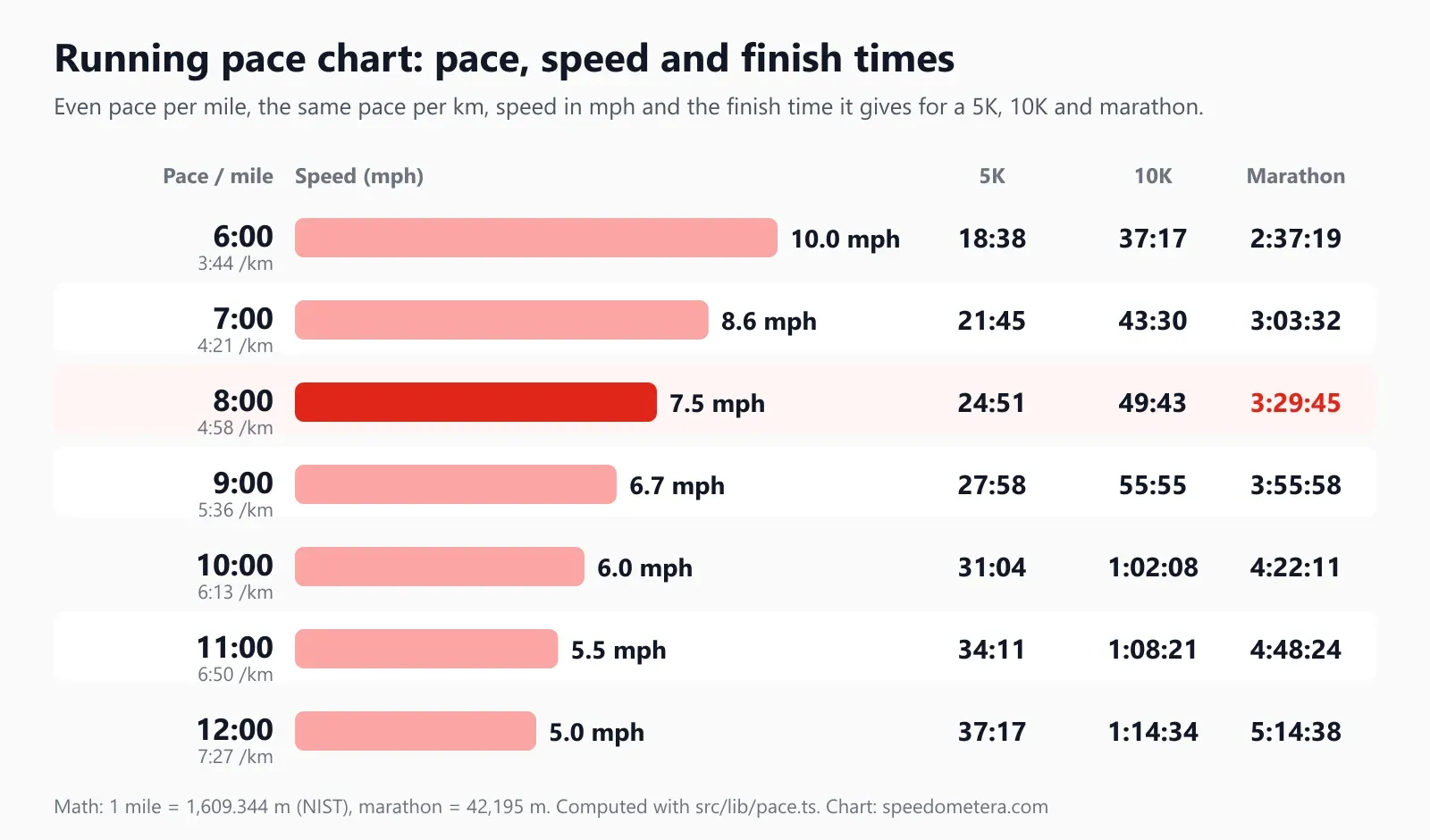
At an even 8:00 per mile you run a 5K in 24:51, a 10K in 49:43, a half marathon in 1:44:53 and a marathon in 3:29:45. The chart below lists every half-minute pace from 6:00 to 13:00 per mile, with the matching pace per km and speed in mph.
| Pace per mile | Pace per km | Speed (mph) | 5K | 10K | Half marathon | Marathon |
|---|---|---|---|---|---|---|
| 6:00 | 3:44 | 10.00 | 18:38 | 37:17 | 1:18:39 | 2:37:19 |
| 6:30 | 4:02 | 9.23 | 20:12 | 40:23 | 1:25:13 | 2:50:25 |
| 7:00 | 4:21 | 8.57 | 21:45 | 43:30 | 1:31:46 | 3:03:32 |
| 7:30 | 4:40 | 8.00 | 23:18 | 46:36 | 1:38:19 | 3:16:38 |
| 8:00 | 4:58 | 7.50 | 24:51 | 49:43 | 1:44:53 | 3:29:45 |
| 8:30 | 5:17 | 7.06 | 26:24 | 52:49 | 1:51:26 | 3:42:52 |
| 9:00 | 5:36 | 6.67 | 27:58 | 55:55 | 1:57:59 | 3:55:58 |
| 9:30 | 5:54 | 6.32 | 29:31 | 59:02 | 2:04:32 | 4:09:05 |
| 10:00 | 6:13 | 6.00 | 31:04 | 1:02:08 | 2:11:06 | 4:22:11 |
| 10:30 | 6:31 | 5.71 | 32:37 | 1:05:15 | 2:17:39 | 4:35:18 |
| 11:00 | 6:50 | 5.45 | 34:11 | 1:08:21 | 2:24:12 | 4:48:24 |
| 11:30 | 7:09 | 5.22 | 35:44 | 1:11:27 | 2:30:45 | 5:01:31 |
| 12:00 | 7:27 | 5.00 | 37:17 | 1:14:34 | 2:37:19 | 5:14:38 |
| 12:30 | 7:46 | 4.80 | 38:50 | 1:17:40 | 2:43:52 | 5:27:44 |
| 13:00 | 8:05 | 4.62 | 40:23 | 1:20:47 | 2:50:25 | 5:40:51 |
Two patterns stand out once the numbers are side by side:
- Every 30 seconds per mile is worth about 13 minutes in a marathon. Going from 9:00 to 9:30 per mile adds 13:07 to a marathon but only 1:33 to a 5K. Small pacing errors early in a long race are expensive.
- The mph column is not linear. Dropping from 13:00 to 12:00 per mile gains 0.38 mph; dropping from 7:00 to 6:00 gains 1.43 mph. Each minute off your pace is a bigger jump in speed the faster you already are, which is why it feels so much harder.
These are even-pace times. They tell you what a pace produces, not what a particular runner can hold for a particular distance. Most people slow as the distance grows, so a pace you can run for a 5K is usually well faster than your marathon pace.
What pace do I need for my goal time?
Divide the goal time by the race distance: a 30:00 5K needs 9:39 per mile, a 2:00:00 half needs 9:09, and a 4:00:00 marathon needs 9:09 per mile (5:41 per km). Use the Pace mode above for any other target; the table covers the goals runners search for most, plus US qualifying and record benchmarks.
| Goal time | Race | Pace per mile | Pace per km | Speed (mph) |
|---|---|---|---|---|
| 20:00 | 5K | 6:26 | 4:00 | 9.32 |
| 25:00 | 5K | 8:03 | 5:00 | 7.46 |
| 30:00 | 5K | 9:39 | 6:00 | 6.21 |
| 50:00 | 10K | 8:03 | 5:00 | 7.46 |
| 1:00:00 | 10K | 9:39 | 6:00 | 6.21 |
| 1:45:00 | Half marathon | 8:01 | 4:59 | 7.49 |
| 2:00:00 | Half marathon | 9:09 | 5:41 | 6.55 |
| 2:30:00 | Half marathon | 11:27 | 7:07 | 5.24 |
| 2:55:00 (Boston, men 18–34) | Marathon | 6:40 | 4:09 | 8.99 |
| 3:00:00 (Boston, men 35–39) | Marathon | 6:52 | 4:16 | 8.74 |
| 3:25:00 (Boston, women 18–34) | Marathon | 7:49 | 4:52 | 7.67 |
| 3:30:00 (Boston, women 35–39) | Marathon | 8:01 | 4:59 | 7.49 |
| 4:00:00 | Marathon | 9:09 | 5:41 | 6.55 |
| 4:30:00 | Marathon | 10:18 | 6:24 | 5.83 |
| 5:00:00 | Marathon | 11:27 | 7:07 | 5.24 |
| 6:00:00 | Marathon | 13:44 | 8:32 | 4.37 |
| 2:00:35 (world record) | Marathon | 4:36 | 2:51 | 13.05 |
The Boston rows use the 2027 Boston Marathon qualifying standards published by the Boston Athletic Association, which are chip (net) times by age on race day. Hitting the standard does not guarantee entry: the B.A.A. accepts qualifiers fastest-first when the field is full, so many runners aim a few minutes under. For the 2027 race the B.A.A. reported that the acceptance cut-off was 5 minutes, 17 seconds: a woman aged 18–34 needed 3:19:43 or faster, about 7:37 per mile, not 3:25:00. Starting with 2027 registration, times from courses with 1,500 feet or more of net downhill are also adjusted before they count. A two-minute cushion on a 3:25:00 target means 3:23:00, or 7:45 per mile, four seconds per mile faster.
For scale, Kelvin Kiptum’s 2:00:35 at the Chicago Marathon on October 8, 2023, the ratified marathon world record, averaged 4:36 per mile, or 13.05 mph for 26.2 miles. For how that compares with sprinters and everyday runners, see how fast can a human run.
A simple rule of thumb
A half marathon at the same pace takes almost exactly half the marathon time, because the distance is exactly half (21,097.5 m). A 2:00:00 half at even pace equals a 4:00:00 marathon pace. Holding half-marathon pace for twice the distance is much harder, so treat your half time as a ceiling for marathon pace, not a prediction.
Marathon pace chart: what pace do I need for every finish time?
A 3:00:00 marathon needs 6:52 per mile (4:16 per km), a 4:00:00 marathon needs 9:09 per mile (5:41 per km) and a 5:00:00 marathon needs 11:27 per mile (7:07 per km). The marathon pace chart below covers every 10-minute finish time from 2:30 to 6:00, with the even-pace halfway and 20-mile splits so you can check yourself mid-race.
| Marathon finish | Pace per mile | Pace per km | Speed (mph) | Halfway (13.1 mi) | 20 miles |
|---|---|---|---|---|---|
| 2:30:00 | 5:43 | 3:33 | 10.49 | 1:15:00 | 1:54:25 |
| 2:40:00 | 6:06 | 3:48 | 9.83 | 1:20:00 | 2:02:03 |
| 2:50:00 | 6:29 | 4:02 | 9.25 | 1:25:00 | 2:09:41 |
| 3:00:00 | 6:52 | 4:16 | 8.74 | 1:30:00 | 2:17:18 |
| 3:10:00 | 7:15 | 4:30 | 8.28 | 1:35:00 | 2:24:56 |
| 3:20:00 | 7:38 | 4:44 | 7.87 | 1:40:00 | 2:32:34 |
| 3:30:00 | 8:01 | 4:59 | 7.49 | 1:45:00 | 2:40:11 |
| 3:40:00 | 8:23 | 5:13 | 7.15 | 1:50:00 | 2:47:49 |
| 3:50:00 | 8:46 | 5:27 | 6.84 | 1:55:00 | 2:55:27 |
| 4:00:00 | 9:09 | 5:41 | 6.55 | 2:00:00 | 3:03:05 |
| 4:10:00 | 9:32 | 5:55 | 6.29 | 2:05:00 | 3:10:42 |
| 4:20:00 | 9:55 | 6:10 | 6.05 | 2:10:00 | 3:18:20 |
| 4:30:00 | 10:18 | 6:24 | 5.83 | 2:15:00 | 3:25:58 |
| 4:40:00 | 10:41 | 6:38 | 5.62 | 2:20:00 | 3:33:35 |
| 4:50:00 | 11:04 | 6:52 | 5.42 | 2:25:00 | 3:41:13 |
| 5:00:00 | 11:27 | 7:07 | 5.24 | 2:30:00 | 3:48:51 |
| 5:10:00 | 11:49 | 7:21 | 5.07 | 2:35:00 | 3:56:28 |
| 5:20:00 | 12:12 | 7:35 | 4.92 | 2:40:00 | 4:04:06 |
| 5:30:00 | 12:35 | 7:49 | 4.77 | 2:45:00 | 4:11:44 |
| 5:40:00 | 12:58 | 8:03 | 4.63 | 2:50:00 | 4:19:21 |
| 5:50:00 | 13:21 | 8:18 | 4.49 | 2:55:00 | 4:26:59 |
| 6:00:00 | 13:44 | 8:32 | 4.37 | 3:00:00 | 4:34:37 |
Every row is computed with this page’s pace code on the official 42,195 m distance (26.219 miles), so the per-mile paces are about a second faster than charts that divide by a flat 26.2. Each 10 minutes of finish time is worth roughly 23 seconds per mile, or 14 seconds per km.
How to use the marathon pace chart on race day:
- Write down two checkpoints, not 26. The halfway and 20-mile columns are the useful ones. If you pass halfway more than a minute or two ahead of the chart, you started too fast, and the last 6.2 miles usually charge that back with interest.
- Pick the row from a recent race, not a wish. A half-marathon result doubled is a ceiling for marathon pace (see the rule of thumb above); most runners finish the full distance noticeably slower than that.
- Expect your watch to read long. Run 26.4 or 26.5 miles by GPS and your watch pace will look faster than the chart’s for the same finish. Pace off the course’s mile markers when you can.
For any finish time not in the chart, type it into the calculator above in Pace mode with the Marathon preset.
5K pace chart: what pace is my 5K time?
A 20:00 5K is 6:26 per mile (4:00 per km), a 25:00 5K is 8:03 per mile (5:00 per km) and a 30:00 5K is 9:39 per mile (6:00 per km). A 5K is exactly 5,000 m, or 3.107 miles, so divide your finish time by 3.107 for pace per mile, or by 5 for pace per km.
| 5K finish | Pace per mile | Pace per km | Speed (mph) | Per 400 m lap |
|---|---|---|---|---|
| 15:00 | 4:50 | 3:00 | 12.43 | 1:12 |
| 16:00 | 5:09 | 3:12 | 11.65 | 1:17 |
| 17:00 | 5:28 | 3:24 | 10.97 | 1:22 |
| 18:00 | 5:48 | 3:36 | 10.36 | 1:26 |
| 19:00 | 6:07 | 3:48 | 9.81 | 1:31 |
| 20:00 | 6:26 | 4:00 | 9.32 | 1:36 |
| 21:00 | 6:46 | 4:12 | 8.88 | 1:41 |
| 22:00 | 7:05 | 4:24 | 8.47 | 1:46 |
| 23:00 | 7:24 | 4:36 | 8.10 | 1:50 |
| 24:00 | 7:43 | 4:48 | 7.77 | 1:55 |
| 25:00 | 8:03 | 5:00 | 7.46 | 2:00 |
| 26:00 | 8:22 | 5:12 | 7.17 | 2:05 |
| 27:00 | 8:41 | 5:24 | 6.90 | 2:10 |
| 28:00 | 9:01 | 5:36 | 6.66 | 2:14 |
| 30:00 | 9:39 | 6:00 | 6.21 | 2:24 |
| 32:00 | 10:18 | 6:24 | 5.83 | 2:34 |
| 35:00 | 11:16 | 7:00 | 5.33 | 2:48 |
| 40:00 | 12:52 | 8:00 | 4.66 | 3:12 |
| 45:00 | 14:29 | 9:00 | 4.14 | 3:36 |
The lap column is the time for one 400 m lap of a standard outdoor track (12.5 laps make a 5K), handy for interval sessions at goal 5K pace. Per-km paces come out as round numbers because 5 km divides evenly: every extra minute on your 5K adds exactly 12 seconds per km, or about 19 seconds per mile.
Is a 30 or 40 minute 5K good?
Yes. A 30-minute 5K (9:39 per mile) beats the whole-field average at almost every big US race, and a 40-minute 5K (12:52 per mile) is a normal finish for a run-walk or a first race. In Running USA’s report on the top US races of late 2024, only two of the top 100 races had an average 5K finish time under 30 minutes. Large 5Ks include walkers, families and charity runners, so their averages are slow, and finishing is what most entrants are there for.
Is 5, 7.5 or 12 mph a jog or a run?
5 mph (12:00 per mile) is a slow jog, 7.5 mph (8:00 per mile) is a steady run and 12 mph (5:00 per mile) is fast running that few people can hold for a mile. The Compendium of Physical Activities, which exercise scientists use to rate effort, starts its running codes at 4 to 4.2 mph and lists 14 mph (a 4:17 mile) at the top.
| Speed (mph) | Pace per mile | Pace per km | What it usually means |
|---|---|---|---|
| 3.5 | 17:09 | 10:39 | Brisk walk (7 miles in 2 hours) |
| 5 | 12:00 | 7:27 | Slow jog |
| 6 | 10:00 | 6:13 | Easy run |
| 7.5 | 8:00 | 4:58 | Steady run |
| 8 | 7:30 | 4:40 | Strong amateur race pace |
| 10 | 6:00 | 3:44 | Fast club runner |
| 12 | 5:00 | 3:06 | Very fast; a 5-minute mile |
The labels are our descriptive guide, not an official scale; what counts as a jog depends on your fitness. Use the calculator above for any speed in between.
How do I convert treadmill speed to pace?
Divide 60 by the treadmill speed in mph to get minutes per mile: 6.0 mph is a 10:00 mile, 7.5 mph is 8:00, and 8.0 mph is 7:30. US treadmills display mph, while most running plans are written in pace, so this is the conversion most people need at the gym.
pace (min per mile) = 60 ÷ speed (mph) · speed (mph) = 60 ÷ pace (min per mile)
| Treadmill speed (mph) | km/h | Pace per mile | Pace per km | 5K time at this speed |
|---|---|---|---|---|
| 3.0 | 4.8 | 20:00 | 12:26 | 1:02:08 |
| 3.5 | 5.6 | 17:09 | 10:39 | 53:16 |
| 4.0 | 6.4 | 15:00 | 9:19 | 46:36 |
| 4.5 | 7.2 | 13:20 | 8:17 | 41:25 |
| 5.0 | 8.0 | 12:00 | 7:27 | 37:17 |
| 5.5 | 8.9 | 10:55 | 6:47 | 33:54 |
| 6.0 | 9.7 | 10:00 | 6:13 | 31:04 |
| 6.5 | 10.5 | 9:14 | 5:44 | 28:41 |
| 7.0 | 11.3 | 8:34 | 5:20 | 26:38 |
| 7.5 | 12.1 | 8:00 | 4:58 | 24:51 |
| 8.0 | 12.9 | 7:30 | 4:40 | 23:18 |
| 8.5 | 13.7 | 7:04 | 4:23 | 21:56 |
| 9.0 | 14.5 | 6:40 | 4:09 | 20:43 |
| 9.5 | 15.3 | 6:19 | 3:55 | 19:37 |
| 10.0 | 16.1 | 6:00 | 3:44 | 18:38 |
| 11.0 | 17.7 | 5:27 | 3:23 | 16:57 |
| 12.0 | 19.3 | 5:00 | 3:06 | 15:32 |
The low end of the table is walking territory. The CDC lists walking briskly at 2.5 mph or faster as moderate-intensity activity and jogging or running as vigorous, so 3.0–4.0 mph on the belt (a 20:00 to 15:00 mile) is a brisk walk for most adults. Our guide to average walking speed covers typical walking paces by age.
Treadmill tips that change the numbers:
- Speeds step in 0.1 mph. A 9:00 mile is 6.67 mph, so the nearest settings are 6.6 mph (9:05) and 6.7 mph (8:57). Over a 30-minute run the gap between those two settings is 0.05 miles.
- Belt displays are not lab-calibrated. If your treadmill and outdoor pace disagree, trust a measured outdoor distance or a track; a 400 m lap (inside lane) is a fixed reference.
- Incline is not in this table. The pace shown is horizontal speed only. Running uphill at the same belt speed is harder but the pace number does not change.
Need km/h for a treadmill abroad? Multiply mph by 1.609344, or use the mph to km/h converter; going the other way, the km/h to mph converter does the reverse.
How do I use pace splits in a race?
Splits are your checkpoints: at an even 9:09 per mile (a 4:00:00 marathon) you should pass 5 miles at 45:46, mile 13.1 at 1:59:55 (the true halfway point, 21.1 km, at 2:00:00), mile 20 at 3:03:05 and mile 26.2 at 3:59:50. The calculator builds this table automatically for any race, per mile or per km.
Here are the even-pace checkpoints for a 4:00:00 marathon, straight from the tool’s split table:
| Checkpoint | Elapsed time (4:00:00 goal) | Checkpoint | Elapsed time (4:00:00 goal) |
|---|---|---|---|
| Mile 1 | 9:09 | 5 km | 28:26 |
| Mile 5 | 45:46 | 10 km | 56:53 |
| Mile 10 | 1:31:32 | Half (21.1 km) | 2:00:00 |
| Mile 15 | 2:17:18 | 30 km | 2:50:38 |
| Mile 20 | 3:03:05 | 40 km | 3:47:31 |
| Mile 26.2 | 3:59:50 | Finish (42.195 km) | 4:00:00 |
Notice the last row. A marathon is 42,195 m, which is 26.219 miles, not 26.2. If you pace your watch to “26.2 miles in 4:00:00” you will cross the line about 10 seconds late, before counting any extra distance from weaving. The same applies to a half (13.109 miles), a 10K (6.214 miles) and a 5K (3.107 miles): the final partial split is real distance, and the calculator shows it as its own row.
How to use the split table well:
- Write down three or four checkpoints, not 26. Mile 5, the half, mile 20 and 40 km are enough to know whether you’re on plan. Many runners write them on a wristband.
- Bank nothing early. Running the first miles 15–20 seconds faster than goal pace feels easy at the time and usually costs more later. The chart above shows why: 30 seconds per mile is about 13 minutes over a marathon.
- Plan a negative split on purpose. If you want to start conservatively, run the first half at goal pace plus 5 seconds per mile and the second half at goal pace minus 5. Enter both halves separately in Finish time mode (half marathon distance each) and add them up to check the total.
- Use per-km splits for courses marked in km. Most US races mark miles, but many international courses only mark kilometers. Switch the split table to “per km” to match the signs you will actually see.
Why does my GPS watch show a different pace?
Because the race was measured on the shortest possible route and your GPS measures the path you actually ran, plus some position error, a watch usually reads slightly long and shows a slightly faster pace than the official result. Over a marathon, even a 1% overshoot is about a quarter of a mile (0.26 miles) on the watch.
Three things cause the gap:
- Certified courses are measured on the tangents. USATF’s Road Running Technical Council says measuring the Shortest Possible Route is “hard-wired into the Rules” for any certified road course. That route cuts every corner as tightly as the course allows. Few runners do, especially in a crowd.
- Courses include a safety margin. The same USATF rules apply a one-part-per-thousand Short Course Prevention Factor, so a certified course is at least the stated distance and up to 0.1% longer: about 5 m on a 5K and 42 m on a marathon.
- GPS has position error. GPS.gov says GPS-enabled smartphones are typically accurate to within 4.9 m (16 ft) under open sky, and that accuracy worsens near buildings, bridges and trees. City races between tall buildings and runs under tree cover produce the biggest jumps.
The practical fix: for pacing a race, trust the mile markers and your split table more than the instant pace on your wrist. For training, run a known distance (a track, a measured loop) occasionally to see how far your device drifts. If you’d like to see live GPS speed in mph while you run, the online speedometer works in a phone browser; for how phone GPS compares with a car’s dashboard, see GPS vs car speedometer.
Pace per mile vs pace per km: how do you convert?
Divide a per-mile pace by 1.609344 to get pace per km, or multiply a per-km pace by 1.609344 to get pace per mile: 8:00 per mile is 4:58 per km, and 5:00 per km is 8:03 per mile. The factor is exact because the international mile is defined as exactly 1,609.344 m.
Quick reference pairs (rounded to the nearest second):
| Pace per km | Pace per mile | Pace per mile | Pace per km |
|---|---|---|---|
| 4:00 | 6:26 | 6:00 | 3:44 |
| 4:30 | 7:15 | 7:00 | 4:21 |
| 5:00 | 8:03 | 8:00 | 4:58 |
| 5:30 | 8:51 | 9:00 | 5:36 |
| 6:00 | 9:39 | 10:00 | 6:13 |
| 6:30 | 10:28 | 11:00 | 6:50 |
| 7:00 | 11:16 | 12:00 | 7:27 |
A mental shortcut: a per-km pace is roughly 62% of the per-mile pace, and a per-mile pace is about 1.6 times the per-km pace. So 5:00 per km × 1.6 = 8:00, close to the exact 8:03. Use the calculator when the last few seconds matter, such as a qualifying time.
Pace in min per km and speed in km/h are related the same way as min per mile and mph: km/h = 60 ÷ pace per km. A 5:00 per km pace is 12.0 km/h; a 6:00 per km pace is 10.0 km/h.
How accurate is this pace calculator?
The maths is exact to the second: it uses 1 mile = 1,609.344 m and a 42,195 m marathon, and rounds only for display. What it cannot know is your fitness, the course or the weather, so treat every finish time as an even-pace projection, not a prediction.
What the calculator does and does not account for:
- Exact distances. Race presets use 1 mile (1,609.344 m), 5K, 10K, 15K, 10 miles (16,093.44 m), the half marathon (21,097.5 m) and the marathon (42,195 m). Custom distances accept miles or km with decimals.
- Rounding. Paces and times are shown to the nearest second, and speed to two decimals. Tables on this page were computed with the same code, so they match the tool exactly.
- Even pace only. Splits assume you run every mile at the same speed. Real races include hills, wind, water stations and fatigue. On a hilly course, expect uphill miles slower and downhill miles faster, with a similar average.
- No fitness model. Converting a 5K time into a marathon prediction requires assumptions about endurance that differ widely between runners. This tool deliberately shows what your current pace would produce at each distance, and leaves the judgment to you.
For cycling, where speed in mph matters more than pace, see average cycling speed. For any other speed, distance and time problem, such as a road trip or a multi-leg average, use the speed distance time calculator.
FAQ
Frequently asked questions
What is a 10 minute mile in mph?
A 10-minute mile is exactly 6.0 mph (9.7 km/h), or 6:13 per kilometer. Divide 60 by your pace in minutes: 60 ÷ 10 = 6. Held for a full race, it gives a 31:04 5K, a 1:02:08 10K and a 4:22:11 marathon.
What pace do I need for a 4 hour marathon?
You need an even 9:09 per mile (5:41 per km), which is 6.55 mph. At that pace you pass halfway at 2:00:00 and mile 20 at 3:03:05. Because the course is 26.22 miles, hitting 26.2 at exactly 4:00 is slightly too slow.
What is a good mile pace for a beginner?
There is no official standard, so set it from a goal. A 12:00 mile (5.0 mph) finishes a 5K in 37:17; a 10:00 mile (6.0 mph) does it in 31:04. Start at a pace where you can still talk in short sentences and build from there.
What pace is a 25 minute 5K?
A 25:00 5K is 8:03 per mile or 5:00 per kilometer, a speed of 7.46 mph. That is the calculator's default example. Your mile splits should read about 8:03, 16:06 and 24:09, with the last 0.11 mile taking about 52 seconds.
What treadmill speed is a 9 minute mile?
A 9:00 mile is 6.67 mph on a treadmill (10.7 km/h). Most treadmills step in 0.1 mph, so set 6.7 mph, which is an 8:57 pace.
How do you convert pace per mile to pace per km?
Divide pace per mile by 1.609344, since 1 mile is exactly 1.609344 km. An 8:00 mile is 480 seconds; 480 ÷ 1.609344 = 298 seconds, or 4:58 per km. To go back, multiply pace per km by 1.609344.
What pace do I need to qualify for Boston?
For the 2027 Boston Marathon, men 18–34 need 2:55:00, a 6:40 mile pace, and women 18–34 need 3:25:00, a 7:49 pace. Men 35–39 need 3:00:00 (6:52) and women 35–39 need 3:30:00 (8:01), per the B.A.A.
Why is my GPS watch pace different from the race distance?
Certified US courses are measured on the shortest possible route plus a 0.1% safety margin, and phone GPS is typically accurate to about 16 feet under open sky. Running wide on curves and GPS error usually make a watch read long, so it shows a faster pace than your official result.
What is a 7 minute mile in mph?
A 7:00 mile is 8.57 mph (13.8 km/h), or 4:21 per kilometer. Held evenly, that pace gives a 21:45 5K, a 43:30 10K, a 1:31:46 half marathon and a 3:03:32 marathon.
What pace is a 3 hour marathon?
A 3:00:00 marathon is 6:52 per mile or 4:16 per kilometer, a speed of 8.74 mph. At even pace you pass halfway at 1:30:00 and 20 miles at 2:17:18. A 3:30 marathon needs 8:01 per mile and a 5:00 marathon needs 11:27.
How fast is a 7:30 pace in mph?
A 7:30 mile pace is exactly 8.0 mph (12.9 km/h), or 4:40 per kilometer. Divide 60 by 7.5 minutes to get 8. Held evenly it gives a 23:18 5K, a 46:36 10K and a 3:16:39 marathon, so it is a strong amateur race pace.
What pace is a 13 minute 1.5 mile?
A 13:00 1.5-mile run is an 8:40 per-mile pace (5:23 per km), or 6.92 mph. Divide 13 minutes by 1.5 to get 8.67 minutes per mile. The 1.5-mile run is a common fitness-test distance, so this is one of the most searched pace conversions.
What is a good 5K pace?
There is no single standard, but a 30:00 5K (9:39 per mile, 6:00 per km) is a common first goal, 25:00 (8:03 per mile) is a solid recreational time, and sub-20:00 needs 6:26 per mile or faster. Each extra minute on a 5K adds 12 seconds per km.
9 Sources
- NIST SP 811 Appendix B.8: exact conversion factors (1 mile = 1,609.344 m; 1 mph = 0.44704 m/s)
- Boston Athletic Association: 2027 Boston Marathon qualifying standards
- USATF Road Running Technical Council: shortest possible route and short course prevention factor
- World Athletics: Book of Rules (Competition and Technical Rules)
- CDC: Measuring physical activity intensity (moderate vs vigorous examples)
- Running USA: 2024 Top Races report (Feb 2025), fastest average finish times at top US races
- Compendium of Physical Activities (Arizona State University et al.): running speeds and MET values
- GPS.gov: GPS accuracy (smartphones within 4.9 m / 16 ft under open sky)
- NBC News: Kelvin Kiptum, marathon world record holder (2:00:35, Chicago, Oct 8, 2023)
Last updated October 25, 2026 by Izhar Ahmad Danish. Found an error? Tell us.