



Key numbers
- 60 mph = 96.561 km/h = 52.14 knots = 26.82 m/s = 88 ft/s exactly
- 60 mph is 1 mile per minute: distance in miles = minutes driven
- UK: 60 mph is the car limit on single carriageways (GOV.UK prints it as 96 km/h)
- Highway Code typical stopping distance at 60 mph: 73 m (18 m thinking + 55 m braking)
- 0–60 mph ends at 96.56 km/h, 3.44 km/h short of 0–100 km/h
On this page
How to use the 60 mph to km/h
- 1Type a speed in any boxEnter a number in mph, km/h, knots, m/s, ft/s or Mach. Every other box updates as you type.
- 2Read the other unitsResults use exact definitions: 1 mile = 1,609.344 m, 1 nautical mile = 1,852 m, 1 foot = 0.3048 m.
- 3Swap or copyUse Swap to flip the main pair and Copy to copy a result. The quick table below lists common speeds.
Works in any modern phone browser. Back to the tool ↑
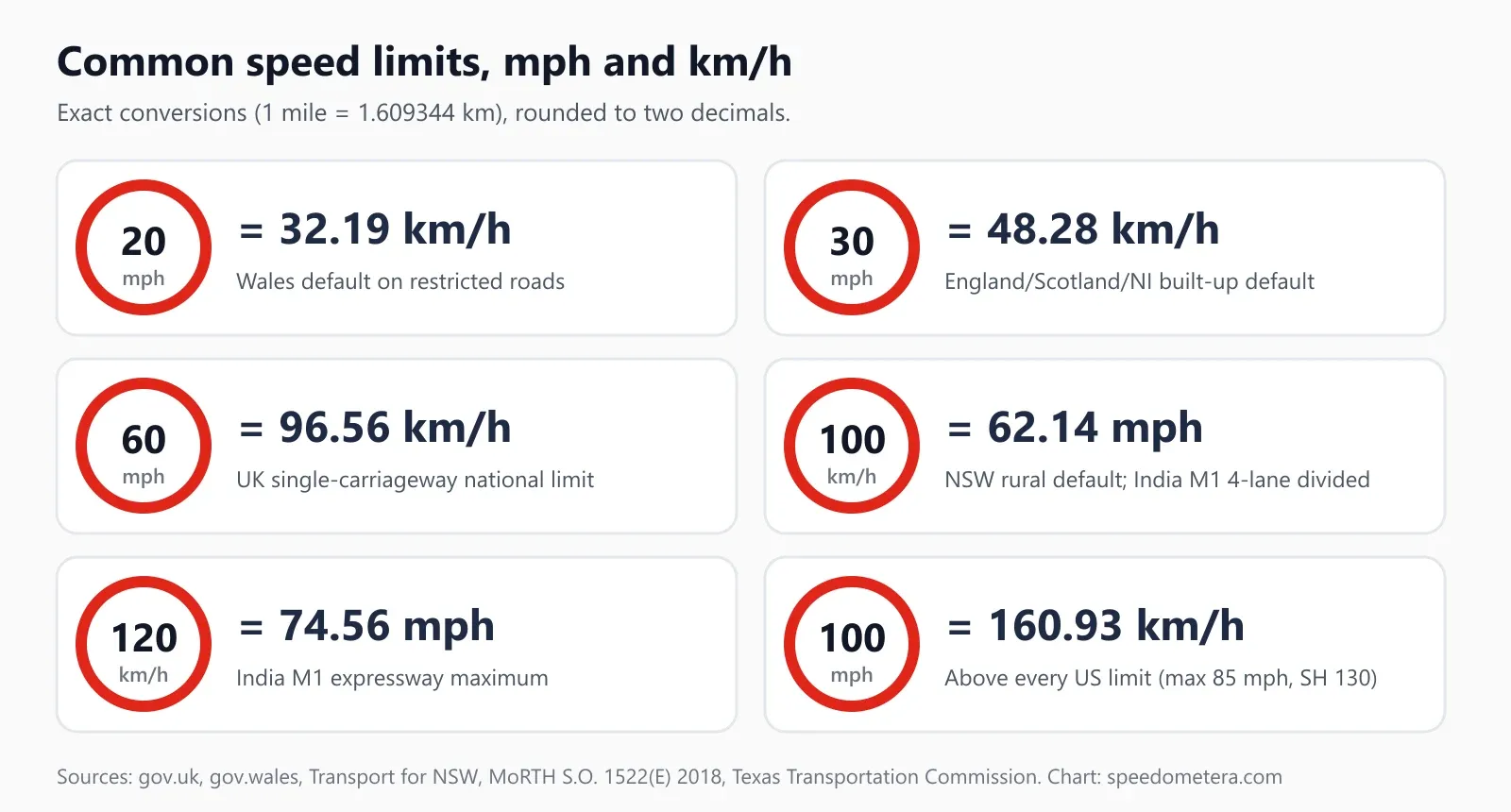
60 mph is 96.56 km/h. The exact figure is 96.561 km/h, since 60 × 1.609344 = 96.561. The converter above starts at 60 mph; enter any other speed, or open the full mph to km/h converter for a complete chart.
What is 60 mph in other units?
| Unit | 60 mph equals |
|---|---|
| Kilometers per hour | 96.561 km/h |
| Knots | 52.14 kn |
| Meters per second | 26.82 m/s |
| Feet per second | 88 ft/s (exact) |
| Miles per minute | 1 mi/min (exact) |
| Kilometers per minute | 1.609 km/min |
| Time per kilometer | 37.3 s |
60 mph is the one speed where two neat facts line up: it is exactly one mile per minute, and exactly 88 feet per second (5,280 ft ÷ 60 s). That second number is why US driver handbooks often say “at 60 mph you cover 88 feet every second”.
60 mph to km/h chart (40–80 mph)
| mph | km/h |
|---|---|
| 40 | 64.37 |
| 45 | 72.42 |
| 50 | 80.47 |
| 55 | 88.51 |
| 60 | 96.56 |
| 65 | 104.61 |
| 70 | 112.65 |
| 75 | 120.70 |
| 80 | 128.75 |
Computed with km/h = mph × 1.609344 and rounded to two decimals.
Where is 60 mph the speed limit?
In Great Britain and Northern Ireland, 60 mph is the “national speed limit” for cars on single-carriageway roads. GOV.UK lists the national limits for cars and motorcycles as:
| UK road type | Limit (mph) | Exact km/h | GOV.UK prints |
|---|---|---|---|
| Built-up areas (England, Scotland, NI) | 30 | 48.28 | 48 |
| Built-up areas (Wales) | 20 | 32.19 | 32 |
| Single carriageways | 60 | 96.56 | 96 |
| Dual carriageways | 70 | 112.65 | 112 |
| Motorways | 70 | 112.65 | 112 |
The national speed limit sign (a white disc with a black diagonal stripe) does not show a number, which confuses many visitors: on a single carriageway it means 60 mph for a car, but lower for a car towing a caravan or trailer (50 mph) and for most goods vehicles. Drivers from km/h countries should read it as “just under 100 km/h”.
In the US, limits are set by each state, and 60 mph appears on some rural highways and urban freeways; the most common higher limits are 65, 70 and 75 mph (104.61, 112.65 and 120.70 km/h).
What does the 0–60 mph time mean in km/h?
0–60 mph is 0 to 96.56 km/h, so it is a slightly shorter test than the metric 0–100 km/h (0–62.14 mph). US and UK magazines quote 0–60 mph; European, Australian and Indian makers quote 0–100 km/h. The extra 3.44 km/h comes at the top of the run, where acceleration is lowest, so a car’s 0–100 km/h time is usually a little longer than its 0–60 mph time. When comparing two cars, make sure both numbers use the same benchmark. See 100 km/h to mph for the metric side.
How far does a car travel and stop at 60 mph?
At 60 mph a car covers 26.8 m (88 ft) every second, and the UK Highway Code’s typical stopping distance is 73 m. Rule 126 of the Highway Code splits that into 18 m of thinking distance and 55 m of braking distance, on a dry road in a well-maintained car. That is roughly the length of 18 cars. The Code’s figures for nearby speeds show how fast the total grows:
| Speed | Thinking | Braking | Total stopping distance |
|---|---|---|---|
| 50 mph (80.47 km/h) | 15 m | 38 m | 53 m |
| 60 mph (96.56 km/h) | 18 m | 55 m | 73 m |
| 70 mph (112.65 km/h) | 21 m | 75 m | 96 m |
Going from 60 to 70 mph adds 17% to speed but 36% to braking distance, because braking distance rises with the square of speed. In the wet, the Code says stopping distances are at least double.
How do I convert 60 mph to km/h in my head?
- × 1.6: 60 × 1.6 = 96 km/h, about 0.6% low.
- Add 60%: 60 + 36 = 96 km/h (the same thing, said differently).
- Exact: 96.561 km/h.
Because 60 mph is one mile per minute, the time is also easy: 60 miles takes an hour and 100 km takes 62.1 minutes.
If your car’s speedometer reads 60 but GPS says 57 or 58, that is normal: dashboards are allowed to over-read. Our GPS vs car speedometer guide explains why, and the GPS speedometer on the homepage shows your true speed in mph or km/h. GPS speed is an estimate that depends on signal and sky view; mount the phone hands-free or let a passenger use it.
Related conversions
- 30 mph to km/h: 48.28 km/h, the UK built-up limit
- 100 km/h to mph: 62.14 mph
- Speed converter: mph, km/h, knots and m/s together
FAQ
Frequently asked questions
How fast is 60 mph in km/h?
60 mph is 96.56 km/h. Multiply 60 by 1.609344, the exact number of kilometers in a mile, to get 96.561 km/h. It is just under 100 km/h, a common open-road limit in km/h countries.
What is 60 mph in kph?
60 mph is 96.56 kph. kph and km/h mean the same thing: kilometers per hour.
Is 60 mph the same as 100 km/h?
No, but it is close. 60 mph is 96.56 km/h and 100 km/h is 62.14 mph. Driving at 100 km/h means going about 2 mph faster than 60 mph.
What is the speed limit on a UK single carriageway?
For cars and motorcycles it is 60 mph (96.56 km/h) unless signs show otherwise, according to GOV.UK. Vans, buses and lorries have lower limits, and many single carriageways are signed lower.
How long does it take to go 60 miles at 60 mph?
One hour. 60 mph is exactly one mile per minute, so the number of miles equals the number of minutes. 100 km at 60 mph takes 62.1 minutes.
How do I convert 60 mph to km/h in my head?
Multiply by 1.6: 60 × 1.6 = 96 km/h, about 0.6% low. The exact answer is 96.56 km/h.
Is 60 mph fast?
It is a normal open-road speed. 60 mph (96.56 km/h) is the UK national limit for cars on single carriageways. On a town street it is very fast: two to three times a typical 20–30 mph urban limit, with a stopping distance of about 73 m.
How long does it take to drive 100 miles at 60 mph?
1 hour 40 minutes. At 60 mph you travel exactly 1 mile per minute, so 100 miles takes 100 minutes before stops and traffic. 100 km at 60 mph takes about 62 minutes.
How fast is 70 mph in km/h?
70 mph is 112.65 km/h (70 × 1.609344). It is the UK limit for cars on motorways and dual carriageways. Nearby values: 50 mph is 80.47 km/h and 65 mph is 104.61 km/h; the chart on this page covers 40–80 mph.
How fast is 60 km/h in mph?
60 km/h is 37.28 mph (60 ÷ 1.609344), not 60 mph. Because a mile is longer than a kilometer, the same number in km/h is always the slower speed: 60 mph is 96.56 km/h, about 1.6 times faster than 60 km/h.
3 Sources
Last updated October 25, 2026 by Izhar Ahmad Danish. Found an error? Tell us.