



Key numbers
- 100 mph = 160.934 km/h = 86.90 knots = 44.70 m/s = 146.67 ft/s
- At 100 mph you cover 1 mile every 36 seconds and 44.7 m every second
- Highest US speed limit: 85 mph (136.79 km/h), Texas SH 130, approved 2012
- US passenger trains: 90 mph max on Class 5 track; 110 mph on Class 6 (49 CFR 213)
- 160 km/h is 99.42 mph, so a 160 km/h rail line speed is just under 100 mph
On this page
- How to use the 100 mph to km/h
- What is 100 mph in other units?
- 100 mph to km/h chart (80–120 mph)
- Is 100 mph legal anywhere in the US?
- Is 100 mph fast, and is it safe?
- How fast is 100 mph for a train?
- How does 100 mph compare with other speeds?
- How long does a trip take at 100 mph?
- How do I convert 100 mph to km/h in my head?
- Can a phone measure 100 mph accurately?
- Related conversions
- Frequently asked questions
How to use the 100 mph to km/h
- 1Type a speed in any boxEnter a number in mph, km/h, knots, m/s, ft/s or Mach. Every other box updates as you type.
- 2Read the other unitsResults use exact definitions: 1 mile = 1,609.344 m, 1 nautical mile = 1,852 m, 1 foot = 0.3048 m.
- 3Swap or copyUse Swap to flip the main pair and Copy to copy a result. The quick table below lists common speeds.
Works in any modern phone browser. Back to the tool ↑
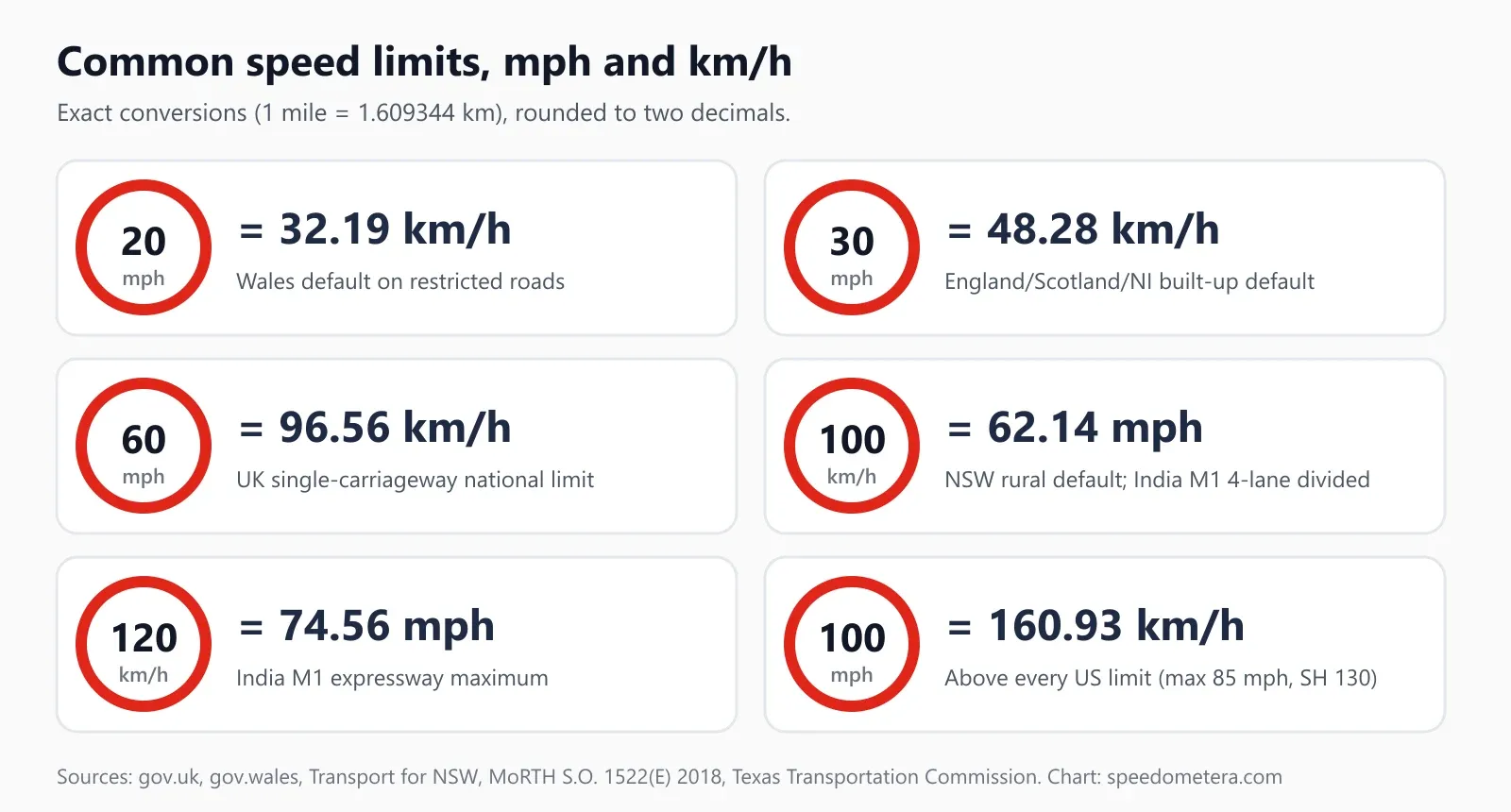
100 mph is 160.93 km/h. The exact figure is 160.934 km/h: 100 × 1.609344 = 160.934. The converter above starts at 100 mph; change it to convert any other speed, or use the full mph to km/h converter.
What is 100 mph in other units?
| Unit | 100 mph equals |
|---|---|
| Kilometers per hour | 160.934 km/h |
| Knots | 86.90 kn |
| Meters per second | 44.70 m/s |
| Feet per second | 146.67 ft/s |
| Miles per minute | 1.667 mi/min |
| Kilometers per minute | 2.682 km/min |
| Time per mile | 36 s |
| Time per kilometer | 22.4 s |
At 100 mph you travel 44.7 meters, nearly half a soccer pitch, every second. A one-second glance away from the road at that speed is the length of about ten cars.
100 mph to km/h chart (80–120 mph)
| mph | km/h |
|---|---|
| 80 | 128.75 |
| 85 | 136.79 |
| 90 | 144.84 |
| 95 | 152.89 |
| 100 | 160.93 |
| 105 | 168.98 |
| 110 | 177.03 |
| 115 | 185.07 |
| 120 | 193.12 |
Computed with km/h = mph × 1.609344, rounded to two decimals, using the same code as the converter.
Is 100 mph legal anywhere in the US?
No. The fastest posted limit in the United States is 85 mph (136.79 km/h), on a 41-mile toll section of State Highway 130 between Austin and Seguin, Texas. The Texas Transportation Commission approved it in September 2012, reported the Texas Tribune; Texas law allows 85 mph only where a road is designed for it and an engineering study finds it safe. Most other US limits top out at 70–80 mph (112.65–128.75 km/h).
So 100 mph is at least 15 mph (24.14 km/h) over any US limit. The IIHS speed-limit table shows nine states (Idaho, Montana, Nevada, North Dakota, Oklahoma, South Dakota, Texas, Utah and Wyoming) post 80 mph on at least some roads, and only Texas posts 85 mph.
Is 100 mph fast, and is it safe?
100 mph is very fast for a road vehicle and is not safe on a public road. At 44.7 m every second, a driver who takes one second to react has travelled almost half a football field before the brakes do anything. The Insurance Institute for Highway Safety explains why speed matters twice: high speeds make a crash more likely because drivers have less time to react, and they make collisions more deadly because modest increases in speed cause large increases in crash energy. In 2024, 11,288 people, 29% of all US motor vehicle deaths, died in speed-related crashes, according to IIHS.
Crash energy rises with the square of speed, so at 100 mph a car carries about 2.0 times the energy it has at 70 mph (100² ÷ 70² = 2.04), and 1.4 times the energy at the 85 mph Texas maximum (100² ÷ 85² = 1.38). That is the arithmetic behind “is 100 mph too fast”: on a road built and signed for 70–75 mph, it is.
| Reference speed | mph | km/h |
|---|---|---|
| Common US rural interstate limit | 70–75 | 112.65–120.70 |
| Highest US limit (Texas SH 130) | 85 | 136.79 |
| 100 mph | 100 | 160.93 |
| US passenger trains, Class 6 track | 110 | 177.03 |
How fast is 100 mph for a train?
On US railroads, 100 mph is a passenger-train speed that needs Class 6 track. Federal track-safety rules set the maximum operating speed by track class: 49 CFR 213.9 caps passenger trains at 90 mph (144.84 km/h) on Class 5 track, and 49 CFR 213.307 adds the high-speed classes:
| Track class | Max passenger speed | km/h |
|---|---|---|
| Class 4 | 80 mph | 128.75 |
| Class 5 | 90 mph | 144.84 |
| Class 6 | 110 mph | 177.03 |
| Class 7 | 125 mph | 201.17 |
| Class 8 (extra FRA approval) | 160 mph | 257.50 |
| Class 9 (extra FRA approval) | 220 mph | 354.06 |
In km/h countries the common equivalent is 160 km/h, which is 99.42 mph, just under 100 mph. Our guides to how fast trains go and the fastest trains in the world put these numbers next to real services.
How does 100 mph compare with other speeds?
100 mph sits between the fastest road cars are allowed to go and the slowest high-speed trains. Each figure below comes from a sourced page on this site and is converted exactly:
| Moving thing | Speed | km/h | vs 100 mph |
|---|---|---|---|
| Usain Bolt’s peak sprint speed | 27.8 mph | 44.72 | 28% |
| Most US passenger trains (top speed) | 79 mph | 127.14 | 79% |
| Highest US road limit | 85 mph | 136.79 | 85% |
| 100 mph | 100 mph | 160.93 | 100% |
| Chicago–St. Louis trains | 110 mph | 177.03 | 110% |
| Brightline, Florida | 125 mph | 201.17 | 125% |
| Amtrak NextGen Acela (short stretches) | 160 mph | 257.50 | 160% |
| Jet airliner at cruise | about 550 mph | about 885 | 5.5× |
Sources and context: how fast a human can run, how fast trains go and how fast planes fly.
How long does a trip take at 100 mph?
| Distance | Time at 100 mph |
|---|---|
| 1 mile | 36 s |
| 1 km | 22.4 s |
| 10 miles | 6 min |
| 100 km (62.14 mi) | 37.3 min |
| 100 miles (160.93 km) | 1 hour |
Use the speed, distance and time calculator for any other trip.
How do I convert 100 mph to km/h in my head?
- × 1.6: 100 × 1.6 = 160 km/h, about 0.6% low.
- Add 60%: 100 + 60 = 160 km/h.
- Exact: 160.934 km/h. The reverse, 160 km/h, is 99.42 mph.
Can a phone measure 100 mph accurately?
Yes, GPS speed works at any road or rail speed, but treat it as an estimate. Our GPS speedometer reads speed from your phone’s GPS Doppler data, which is accurate on an open-sky train or as a passenger, and less reliable in tunnels and deep cuttings. It is for information only, not legal evidence. Never handle a phone while driving.
Related conversions
- 120 km/h to mph: 74.56 mph
- 60 mph to km/h: 96.56 km/h
- Speed converter: mph, km/h, knots, m/s and Mach
FAQ
Frequently asked questions
How fast is 100 mph in km/h?
100 mph is 160.93 km/h. Multiply by 1.609344, the exact number of kilometers in a mile: 100 × 1.609344 = 160.934 km/h.
Is 100 mph legal anywhere in the US?
Not on a public road. The highest posted US limit is 85 mph (136.79 km/h) on a 41-mile toll section of Texas SH 130, approved by the Texas Transportation Commission in 2012. 100 mph is 15 mph above even that.
What is 100 mph in kph?
100 mph is 160.93 kph. kph and km/h both mean kilometers per hour.
How long does it take to go a mile at 100 mph?
36 seconds. 100 mph is 1.667 miles per minute, so one mile takes 0.6 minutes. One kilometer takes 22.4 seconds.
Is 160 km/h the same as 100 mph?
Nearly. 160 km/h is 99.42 mph, and 100 mph is 160.93 km/h. The difference is under 1 km/h, which is why 160 km/h and 100 mph are often treated as the same rail speed.
How fast can trains go in the US?
It depends on the track class set by federal rules (49 CFR 213). Passenger trains are limited to 90 mph on Class 5 track, 110 mph on Class 6 and 125 mph on Class 7; Classes 8 and 9 (160 and 220 mph) need extra FRA approval.
How far do you travel in one second at 100 mph?
44.7 meters (146.7 ft). 100 mph is 160.934 km/h, and dividing by 3.6 gives 44.70 m/s. A one-second glance away from the road at this speed covers almost half a football field (100 yd = 91.44 m).
Is it safe to drive 100 mph?
No. At 100 mph a car covers 44.7 m (146.7 ft) every second, so a one-second reaction uses almost half a football field before braking starts. IIHS notes that modest speed increases cause large increases in crash energy; speed-related crashes killed 11,288 people in the US in 2024, 29% of all road deaths.
Is 80 mph legal anywhere in the US?
Yes, in nine states. IIHS lists 80 mph limits on at least some roads in Idaho, Montana, Nevada, North Dakota, Oklahoma, South Dakota, Texas, Utah and Wyoming. Only Texas goes higher, with 85 mph (136.79 km/h) on SH 130. 80 mph is 128.75 km/h, still 20 mph below 100 mph.
7 Sources
- NIST SP 811, Appendix B.8: conversion factors (mile = 1,609.344 m exactly)
- Texas Tribune (6 Sep 2012): Texas Transportation Commission approves 85 mph limit on SH 130 toll road
- NBC News (2012): 85 mph Texas toll highway opens with the fastest speed limit in the nation
- 49 CFR 213.9: Classes of track, operating speed limits (Classes 1–5)
- 49 CFR 213.307: Classes of track, operating speed limits (Classes 6–9)
- IIHS: Speed limit laws by state (80 mph states; 85 mph on Texas SH 130)
- IIHS: Speed (2024: 11,288 deaths, 29% of US motor vehicle fatalities, in speed-related crashes)
Last updated October 25, 2026 by Izhar Ahmad Danish. Found an error? Tell us.