



Key numbers
- 30 mph = 48.280 km/h = 26.07 knots = 13.41 m/s = 44 ft/s exactly
- At 30 mph you cover 1 mile every 2 minutes
- UK: 30 mph built-up limit in England, Scotland and NI; Wales 20 mph since 2023
- Highway Code typical stopping distance at 30 mph: 23 m (9 m thinking + 14 m braking)
- 50 km/h, the common urban limit abroad, is 31.07 mph
On this page
- How to use the 30 mph to km/h
- What is 30 mph in other units?
- 30 mph to km/h chart (10–50 mph)
- Where is 30 mph the speed limit?
- What are the stopping distances at 30 mph and other speeds?
- Does 30 mph vs 40 mph make a big difference?
- How do I convert 30 mph to km/h in my head?
- Related conversions
- Frequently asked questions
How to use the 30 mph to km/h
- 1Type a speed in any boxEnter a number in mph, km/h, knots, m/s, ft/s or Mach. Every other box updates as you type.
- 2Read the other unitsResults use exact definitions: 1 mile = 1,609.344 m, 1 nautical mile = 1,852 m, 1 foot = 0.3048 m.
- 3Swap or copyUse Swap to flip the main pair and Copy to copy a result. The quick table below lists common speeds.
Works in any modern phone browser. Back to the tool ↑
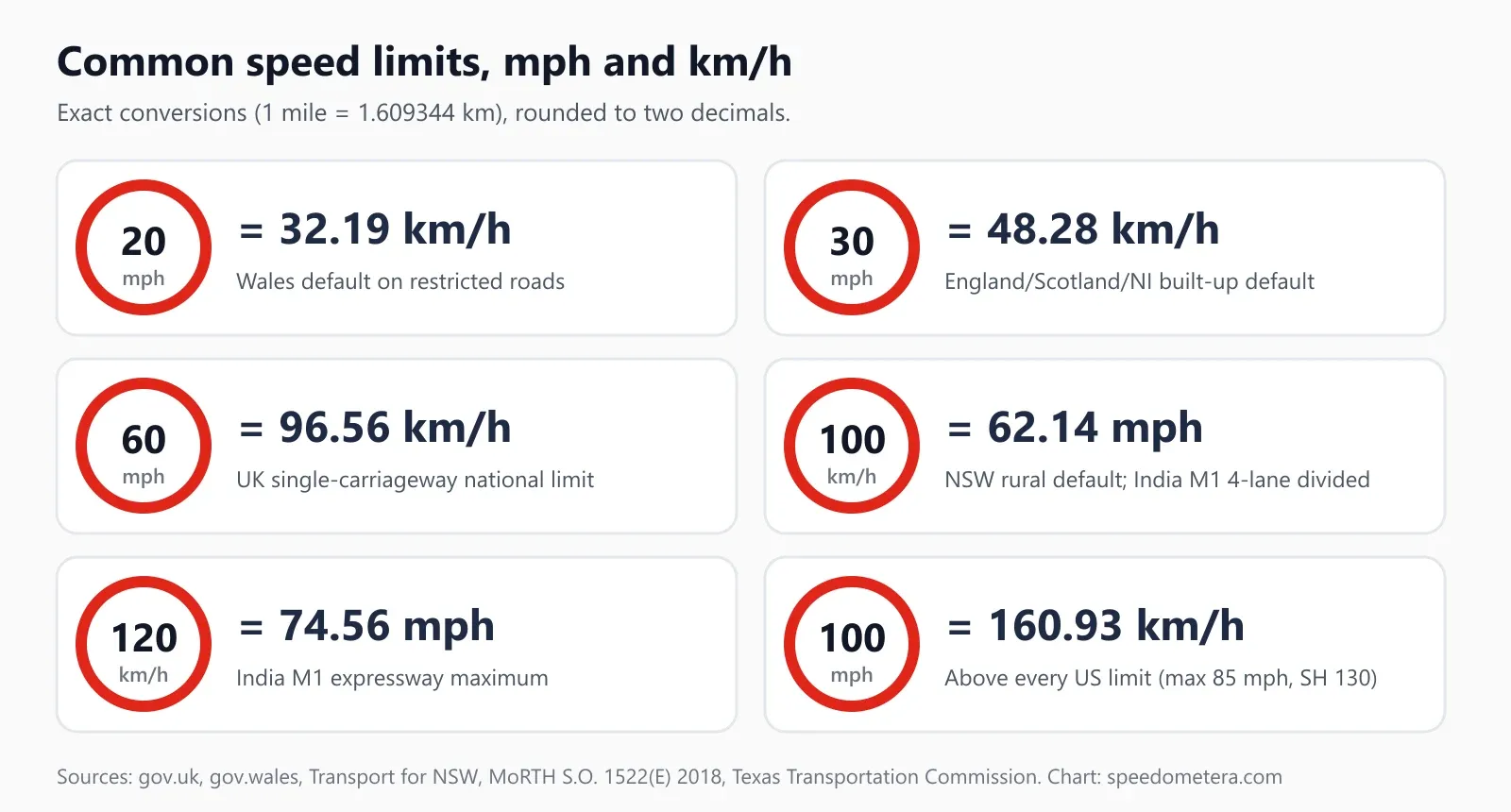
30 mph is 48.28 km/h. The exact figure is 48.280 km/h: 30 × 1.609344 = 48.280. The converter above starts at 30 mph; change the number to convert any other speed, or use the full mph to km/h converter.
What is 30 mph in other units?
| Unit | 30 mph equals |
|---|---|
| Kilometers per hour | 48.280 km/h |
| Knots | 26.07 kn |
| Meters per second | 13.41 m/s |
| Feet per second | 44 ft/s (exact) |
| Miles per minute | 0.5 mi/min |
| Time per mile | 2 min |
| Time per kilometer | 1 min 14.6 s |
44 feet (13.4 m) per second is the number to remember near schools and crossings: in the second it takes to notice a child stepping out, a car at 30 mph has already moved three car lengths.
30 mph to km/h chart (10–50 mph)
| mph | km/h |
|---|---|
| 10 | 16.09 |
| 15 | 24.14 |
| 20 | 32.19 |
| 25 | 40.23 |
| 30 | 48.28 |
| 35 | 56.33 |
| 40 | 64.37 |
| 45 | 72.42 |
| 50 | 80.47 |
Every row is mph × 1.609344, rounded to two decimals by the converter’s own code.
Where is 30 mph the speed limit?
30 mph is the default limit for cars in built-up areas of England, Scotland and Northern Ireland. GOV.UK lists it as “30 (48)”, the second number being km/h rounded down. Wales cut its default on restricted roads to 20 mph in September 2023, so a road signed 30 mph in Cardiff is now an exception rather than the rule; see 20 mph to km/h.
| Place | Typical urban limit | In the other unit |
|---|---|---|
| England, Scotland, Northern Ireland | 30 mph | 48.28 km/h |
| Wales (restricted roads) | 20 mph | 32.19 km/h |
| Many km/h countries | 50 km/h | 31.07 mph |
| US (set by states and cities) | often 25–35 mph | 40.23–56.33 km/h |
So a UK driver abroad can treat a 50 km/h sign as “about 30”, and a visitor to the UK can treat 30 mph as “just under 50”.
What are the stopping distances at 30 mph and other speeds?
At 30 mph the UK Highway Code’s typical stopping distance is 23 metres: 9 m while you react and 14 m while the brakes work. Here are all the Code’s figures from rule 126 of the Highway Code, with each speed converted to km/h and each total to feet:
| Speed | km/h | Thinking | Braking | Total | Total in feet |
|---|---|---|---|---|---|
| 20 mph | 32.19 | 6 m | 6 m | 12 m | 39 ft |
| 30 mph | 48.28 | 9 m | 14 m | 23 m | 75 ft |
| 40 mph | 64.37 | 12 m | 24 m | 36 m | 118 ft |
| 50 mph | 80.47 | 15 m | 38 m | 53 m | 174 ft |
| 60 mph | 96.56 | 18 m | 55 m | 73 m | 240 ft |
| 70 mph | 112.65 | 21 m | 75 m | 96 m | 315 ft |
Feet are our conversion of the Code’s metres (1 ft = 0.3048 m), rounded to the nearest foot. Two patterns stand out:
- Thinking distance grows in a straight line: 3 m for every extra 10 mph. Dividing it by speed gives the same reaction time, about 0.67 s, at every row.
- Braking distance grows with the square of speed: going from 30 to 60 mph doubles the speed but nearly quadruples braking distance, from 14 m to 55 m.
These are figures for a dry road, an alert driver and a well-maintained car; the Code warns that distances are far longer in the wet and on ice.
Does 30 mph vs 40 mph make a big difference?
Yes for safety, no for time. From the table, 40 mph needs 36 m to stop, 13 m more than 30 mph. On time, one mile takes 2 minutes at 30 mph and 1 min 30 s at 40 mph, a saving of 30 seconds per mile at most. Try your own route in the speed, distance and time calculator.
How do I convert 30 mph to km/h in my head?
- × 1.6: 30 × 1.6 = 48 km/h, about 0.6% low.
- Add 60%: 30 + 18 = 48 km/h.
- Exact: 48.280 km/h. The reverse, 50 km/h, is 31.07 mph (km/h to mph).
To see your true speed, open the GPS speedometer and set a speed alert at 30 mph or 50 km/h. GPS speed is an estimate that depends on signal and sky view; mount the phone hands-free or let a passenger use it, and follow local law.
Related conversions
- 20 mph to km/h: 32.19 km/h, the Welsh default
- 60 mph to km/h: 96.56 km/h
- Speed converter: mph, km/h, knots and m/s together
FAQ
Frequently asked questions
How fast is 30 mph in km/h?
30 mph is 48.28 km/h. Multiply 30 by 1.609344, the exact number of kilometers in a mile, to get 48.280 km/h, just under a 50 km/h town limit.
What is 30 mph in kph?
30 mph is 48.28 kph. kph and km/h are two spellings of kilometers per hour.
Is 30 mph the same as 50 km/h?
Nearly. 30 mph is 48.28 km/h and 50 km/h is 31.07 mph, a difference of about 1 mph. Both are the typical built-up-area limits in their countries.
What is the stopping distance at 30 mph?
The UK Highway Code gives a typical stopping distance of 23 metres at 30 mph: 9 m thinking distance plus 14 m braking distance, for a well-maintained car on a dry road. That is about six car lengths.
What is the speed limit in a UK built-up area?
30 mph (48.28 km/h) in England, Scotland and Northern Ireland, and 20 mph (32.19 km/h) in Wales, unless signs say otherwise. A built-up area is usually a road with street lights.
How do I convert 30 mph to km/h in my head?
Multiply by 1.6: 30 × 1.6 = 48 km/h, about 0.6% low. The exact answer is 48.28 km/h.
How fast is 30 km/h in mph?
30 km/h is 18.64 mph (30 ÷ 1.609344). That is a little slower than a UK 20 mph limit, which is 32.19 km/h, so the two speeds are close but not the same.
How fast is 40 mph in km/h?
40 mph is 64.37 km/h (40 × 1.609344). Each extra 10 mph adds 16.09 km/h, so 30, 40 and 50 mph are 48.28, 64.37 and 80.47 km/h.
Is 30 mph fast?
For a car it is a town speed: 30 mph (48.28 km/h) is the built-up limit in England, Scotland and Northern Ireland. For a person it is out of reach: no human has run 30 mph, and Usain Bolt's measured peak was 27.8 mph. On a bicycle it is far above the 10–12 mph most everyday riders average.
5 Sources
- NIST SP 811, Appendix B.8: conversion factors (mile = 1,609.344 m exactly)
- GOV.UK: Speed limits (national limits in mph and km/h)
- GOV.UK: The Highway Code, rules 103–158 (rule 126, typical stopping distances)
- Welsh Government: Introducing default 20mph speed limits
- World Athletics: Usain Bolt athlete profile, 100 m 9.58 world record (Berlin 2009)
Last updated October 25, 2026 by Izhar Ahmad Danish. Found an error? Tell us.