


Key numbers
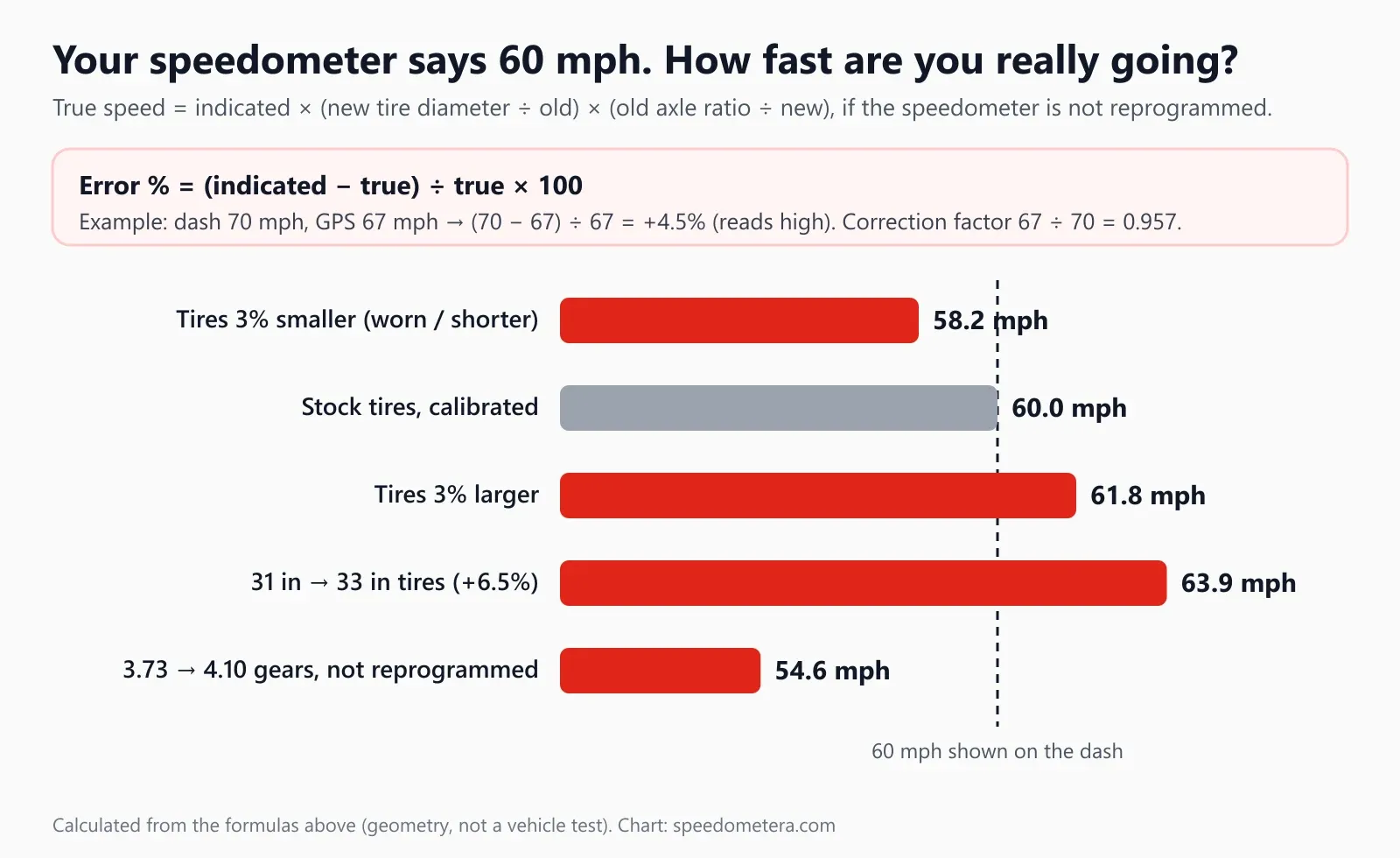
- Error % = (indicated − true) ÷ true × 100. Dash 70 mph, GPS 67 mph = +4.5%
- Timed mile: true mph = 3,600 ÷ seconds. 60 s = 60 mph; 51.4 s = 70 mph
- Trucks and buses must read within ±5 mph at 50 mph (49 CFR 393.82)
- No federal safety standard (FMVSS) sets a speedometer accuracy limit for passenger cars
- Going from 3.73 to 4.10 gears without reprogramming: an indicated 60 mph is really 54.6 mph
On this page
- How to use the Speedometer Calibration Calculator
- What is speedometer calibration?
- How to use the speedometer calibration calculator
- Speedometer calibration formulas, with worked examples
- What throws a speedometer out of calibration?
- How do shops calibrate a speedometer?
- Is it illegal to drive with an inaccurate speedometer?
- GPS vs timed mile: which check is more accurate?
- Speedometer calibration worked cases
- Frequently asked questions
How to use the Speedometer Calibration Calculator
- 1Measure your true speedHold a steady speed and read the GPS speedometer, or time a measured mile between mile markers (as a passenger).
- 2Enter indicated and true speedType what the dashboard showed and the GPS speed, or the seconds the mile took.
- 3Read the error and corrected tableSee the percent error, the correction factor and the true speed at common speedometer readings.
Works in any modern phone browser. Back to the tool ↑
What is speedometer calibration?
Speedometer calibration is the match between the speed your dashboard shows and the speed you are really traveling. A car doesn’t measure speed directly. It counts how fast the wheels, axle or transmission output shaft turn, then multiplies by a fixed number of tire revolutions per mile set at the factory. Anything that changes that relationship (taller or worn tires, a new axle ratio, a swapped transmission or a wrong computer setting) shifts every reading by the same percentage.
That last point is why this calculator works. Speedometer error is almost always proportional: if your speedometer reads 4.5% high at 70 mph, it reads about 4.5% high at 30 mph too. Measure once at a steady highway speed, and a single correction factor fixes every reading.
Key terms used on this page. Indicated speed: what the dashboard shows. True speed: what you are really doing, measured by GPS or a timed mile. Correction factor: true ÷ indicated. Vehicle speed sensor (VSS): the sensor on the transmission, axle or wheel hub that sends pulses to the computer. Pulses per mile: how many sensor pulses the computer expects per mile, the number a calibration actually changes. Revs per mile: tire revolutions per mile, the figure most programmers ask for. Driven gear: the small plastic gear in an older transmission that turns the speedometer cable.
How to use the speedometer calibration calculator
Pick a method, enter what your speedometer shows and what the true speed was, and read the error, true speed and correction factor.
- Choose GPS speed or Timed mile at the top of the calculator. GPS is quicker. A timed mile needs no phone signal.
- Drive at a steady speed. Use cruise control at 60 or 70 mph on a straight, level, dry road with light traffic. Steady speed matters more than the exact number.
- Let a passenger take the reading. For GPS, they open the online speedometer and read it when the dash shows your set speed. For a timed mile, they start a stopwatch at one mile marker and stop it at the next.
- Enter “Speedometer shows (mph)” and either the GPS mph or the seconds for one mile.
- Read the tiles. Error % tells you how far off you are; True speed is what you are really doing; the correction factor converts any reading.
- Check the corrected speed table for true speeds from 25 to 80 mph, so you know what to hold the needle at for a 55, 65 or 70 mph limit.
- Changed your gears? Open the “Changed axle gear ratio?” section and enter the old and new ratio to see the true speed at an indicated 60 mph.
Measure as a passenger, never as the driver
Reading a phone or a stopwatch while driving is distracting and illegal in many states. Have a passenger take the reading, or mount the phone and read it only at a safe moment. Never speed up past the limit to test a high reading.
New wheels with a different offset don’t change your speedometer reading; only a different tire diameter does. See the wheel offset calculator for fitment.
Speedometer calibration formulas, with worked examples
Three formulas cover every check this page does: percent error, timed-mile speed and the correction factor.
Error % = (indicated − true) ÷ true × 100
Worked example: the dash shows 70 mph and GPS shows 67 mph. (70 − 67) ÷ 67 × 100 = +4.5%. Positive means the speedometer reads high (you are slower than it says); negative means it reads low (you are faster than it says, which is the case that gets tickets).
True speed (mph) = 3,600 ÷ seconds for one mile
Worked example: with the dash at 70 mph, the mile takes 52.0 seconds. 3,600 ÷ 52.0 = 69.2 mph true, so the error is (70 − 69.2) ÷ 69.2 = +1.1%.
Correction factor = true ÷ indicated; true speed = reading × factor
Worked example: 67 ÷ 70 = 0.957. When the dash shows 55 mph, you are really doing 55 × 0.957 = 52.6 mph.
Timed-mile reference table
| Seconds for one mile | True speed (mph) | km/h |
|---|---|---|
| 72.0 | 50.0 | 80.5 |
| 65.5 | 55.0 | 88.5 |
| 60.0 | 60.0 | 96.6 |
| 55.4 | 65.0 | 104.6 |
| 51.4 | 70.0 | 112.7 |
| 48.0 | 75.0 | 120.7 |
| 45.0 | 80.0 | 128.7 |
Each second matters: at 70 mph, being 0.5 s late on the stopwatch changes the result by about 0.7 mph. That’s why you should time two or three consecutive miles and average them.
Corrected speed table for a speedometer reading 4.5% high
| Speedometer shows | True speed (factor 0.957) | Difference |
|---|---|---|
| 25 mph | 23.9 mph | −1.1 mph |
| 35 mph | 33.5 mph | −1.5 mph |
| 45 mph | 43.1 mph | −1.9 mph |
| 55 mph | 52.6 mph | −2.4 mph |
| 65 mph | 62.2 mph | −2.8 mph |
| 75 mph | 71.8 mph | −3.2 mph |
Notice the gap in mph grows with speed while the percentage stays the same. The calculator builds this table for your own numbers.
What throws a speedometer out of calibration?
Tire diameter and axle ratio cause most real-world speedometer error. Because the car counts revolutions, anything that changes distance per revolution changes the reading.
| Change | Effect on speedometer | True speed at an indicated 60 mph | Formula |
|---|---|---|---|
| Taller tires (31 in → 33 in) | Reads low | 63.9 mph | 60 × 33 ÷ 31 |
| Shorter tires (31 in → 30 in) | Reads high | 58.1 mph | 60 × 30 ÷ 31 |
| Worn tread (new 10/32 in → 2/32 in, 31.6 in tire) | Reads slightly high | 59.1 mph | 60 × 31.1 ÷ 31.6 |
| Higher (numerically) axle ratio (3.73 → 4.10) | Reads high | 54.6 mph | 60 × 3.73 ÷ 4.10 |
| Lower axle ratio (4.10 → 3.73) | Reads low | 66.0 mph | 60 × 4.10 ÷ 3.73 |
| Under-inflated tires | Reads slightly high | small, varies | smaller rolling radius |
The tread-wear row is geometry: 8/32 inch of tread lost on each side takes 0.5 inch off the diameter, about 1.6%. A full set of new tires can therefore make an older car’s speedometer read about 1 mph lower at 60 mph than it did on worn ones. Use the tire size calculator to get exact diameters from sizes like 265/70R17, and the combined formula on the chart above when you change both tires and gears.
How do shops calibrate a speedometer?
A shop calibrates a modern speedometer by changing a number in a computer, not by adjusting the gauge: it enters the new tire size, revs per mile or axle ratio so the computer expects the right pulses per mile. On older cable-driven cars it swaps the driven gear. Then it verifies on a chassis dynamometer or a GPS road test.
There are four ways the job gets done, depending on how the car measures speed.
- Dealer or shop scan tool (most cars and trucks since the late 1990s). The vehicle speed sensor sends a fixed number of pulses per turn, and a control module turns that into mph using a stored tire size and axle ratio. The technician plugs into the OBD-II port, enters the new tire size or ratio, and the speedometer, odometer and cruise control line up again; on many automatics the shift points do too. Because every reading comes from that one stored number, one setting fixes everything at once.
- Handheld programmer or tuner. Aftermarket programmers sold for trucks and SUVs do the same job from the driver’s seat (parked): plug in, pick “tire size” or “gear ratio,” type the new value and write it to the module. Many ask for tire height in inches or revs per mile, which is exactly the number in the table below. Check that your model year is supported before buying, and save the stock file first.
- Inline speedometer calibrator. On vehicles whose modules can’t be reprogrammed, or on kit cars and engine swaps, a small box spliced into the speed-sensor wire multiplies or divides the pulse count. You set it once by driving a measured mile or matching GPS.
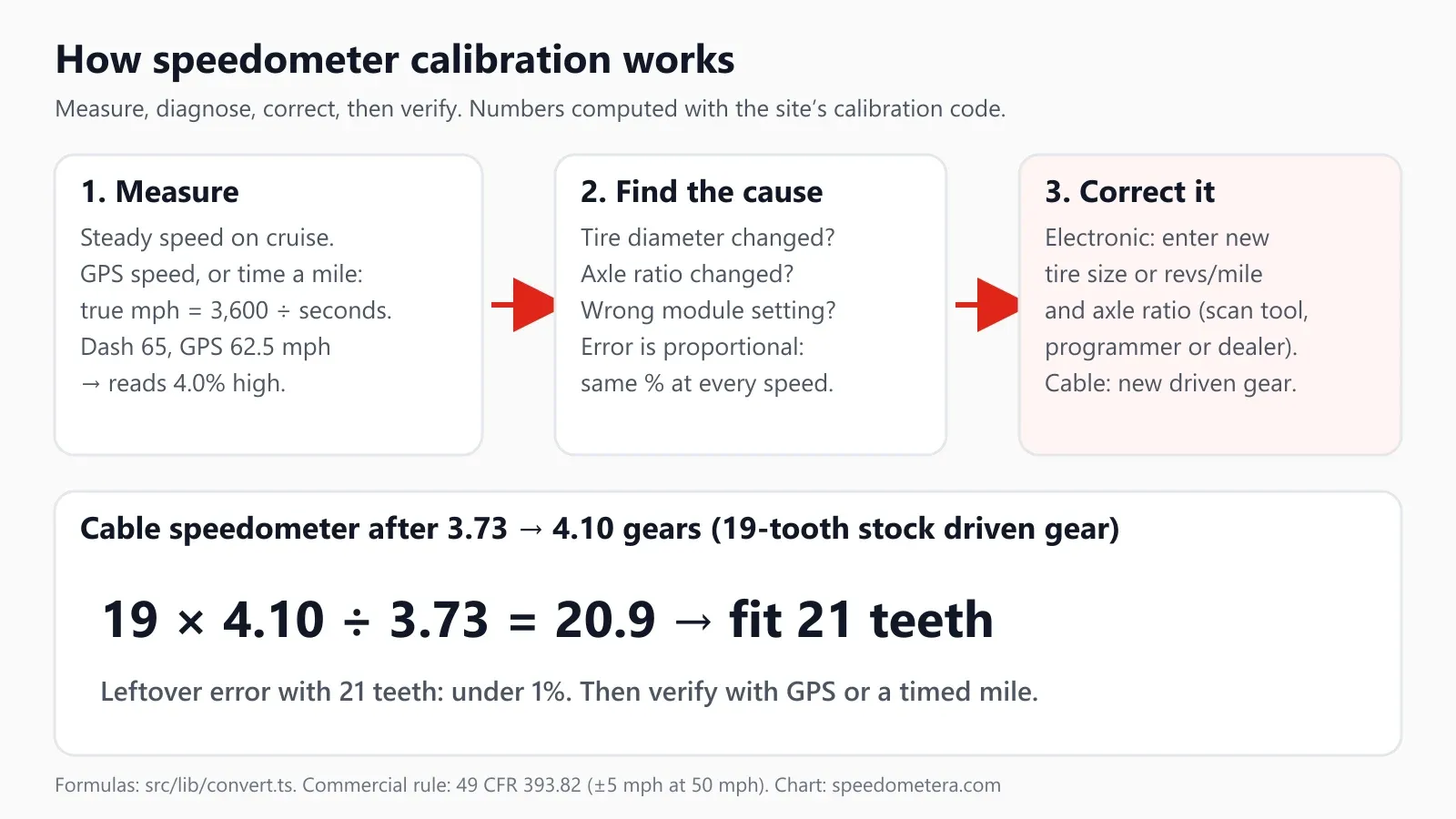
- Driven gear swap (cable speedometers). On older mechanical speedometers the transmission output shaft turns a drive gear, which turns a plastic driven gear and the cable. Indicated speed is inversely proportional to the driven gear’s tooth count, so the fix is a gear with a different number of teeth. Teeth only come in whole numbers, so a small error usually remains.
Revs per mile to enter after a tire change
These are nominal figures from the size code, computed with the same code as our tire size calculator, with a common half-ton pickup size, 265/70R17, as stock. Real tires vary by brand, tread depth and load, so verify after programming.
| Tire size | Diameter (in) | Revs per mile | True speed at an indicated 60 mph | Speedometer error |
|---|---|---|---|---|
| 265/70R17 (stock) | 31.6 | 638 | 60.0 mph | 0.0% |
| 285/70R17 | 32.7 | 617 | 62.1 mph | −3.4% |
| 315/70R17 | 34.4 | 587 | 65.2 mph | −8.0% |
| 35x12.50R17 | 35.0 | 576 | 66.4 mph | −9.7% |
| 37x12.50R17 | 37.0 | 545 | 70.2 mph | −14.6% |
A truck on 37s that was never reprogrammed is doing about 70 mph when the dash says 60, and its odometer under-counts every mile by the same 14.6%.
Driven gear needed for a cable speedometer
Required teeth = current teeth ÷ correction factor. The table assumes a 19-tooth stock driven gear as an illustration; read the tooth count stamped on your own gear.
| Change | Correction factor | Exact teeth needed | Gear to fit | True speed at an indicated 60 mph afterward |
|---|---|---|---|---|
| 31 → 33 in tires | 1.065 | 17.85 | 18 teeth | 60.5 mph (−0.8%) |
| 31 → 35 in tires | 1.129 | 16.83 | 17 teeth | 60.6 mph (−1.0%) |
| 3.73 → 4.10 axle | 0.910 | 20.88 | 21 teeth | 60.3 mph (−0.5%) |
| 3.55 → 4.10 axle | 0.866 | 21.94 | 22 teeth | 60.2 mph (−0.3%) |
A leftover error under about 1% is far better than the 6–15% that a skipped calibration leaves behind after a tire or gear change.
How a dynamometer test works
For paperwork, such as a court date, a shop with a chassis dynamometer puts the drive wheels on rollers, runs the car at set roller speeds (for example 30, 50 and 70 mph) and records what the speedometer showed at each. The printout is a calibration certificate. It tests the car as it sits, on its current tires, which is why you should not change tires or pressures between the ticket and the test.
Is it illegal to drive with an inaccurate speedometer?
For passenger cars there is no federal accuracy limit; for trucks and buses run by motor carriers, federal rules require ±5 mph at 50 mph.
- Commercial vehicles. The FMCSA’s equipment rule, 49 CFR 393.82, says each bus, truck and truck-tractor must have a speedometer in mph and/or km/h, “accurate to within plus or minus 8 km/hr (5 mph) at a speed of 80 km/hr (50 mph).” Part 393 applies to motor carriers operating commercial motor vehicles. At 50 mph, ±5 mph is a ±10% window.
- Passenger cars. NHTSA’s FMVSS No. 101 covers how controls and displays, including the speedometer, are identified and lit. It sets no accuracy tolerance. Manufacturers instead work to industry practice such as SAE J1226 (electric speedometers for cars, trucks and buses, issued 1983, stabilized 2011) and J2976 (speedometer accuracy and offset, odometer accuracy). These are voluntary, and their exact limits are behind SAE’s paywall, so we don’t quote figures for them here.
- Odometer law. Your odometer runs off the same pulses, so a speedometer error is also a mileage error. Federal law, 49 U.S.C. 32703, bars disconnecting, resetting or altering an odometer to change the mileage it shows. Recalibrating corrects the counting rate going forward and leaves the stored mileage alone. If a cluster is replaced and the old reading can’t be kept, 49 U.S.C. 32704 says it must be set to zero and a written notice with the prior mileage and the date attached to the left door frame.
- Speeding tickets. A speedometer that reads low isn’t a legal excuse in most places; you are responsible for your true speed. If you changed tires or gears, recalibrate (most modern trucks are reprogrammed with a dealer tool or a handheld tuner; older cable-driven units take a different driven gear) and keep the receipt.
Most cars leave the factory reading slightly high, so the realistic surprise is not “I was speeding” but “I’m slower than everyone else.” After a lift kit and big tires, the opposite becomes true.
GPS vs timed mile: which check is more accurate?
At a steady speed both are accurate to about 1%; GPS is faster, and the timed mile works without a signal.
| Method | Typical accuracy | Strengths | Watch out for |
|---|---|---|---|
| GPS speedometer | ~0.1–1 mph at steady speed | Instant, any speed, no markers needed | Lags 1–2 s when speed changes; weak in tunnels and urban canyons |
| Timed mile (1 mile) | ±1–2% | No phone needed | Stopwatch reaction time; marker placement |
| Timed miles (3–5 miles, averaged) | under ±0.5% | Averages out marker and timing error | Needs a long, steady stretch |
Phones get speed from the Doppler shift of satellite signals. GPS.gov gives the government’s signal-in-space commitment as a range-rate error of at most 0.006 m/s over any 3 seconds (95% probability), and typical smartphone position accuracy of 4.9 m (16 ft) under open sky. For the timed mile, the FHWA’s MUTCD (Section 2H.11) lets a mile marker be moved up to 50 feet from its true position when it can’t go in the right spot. Two markers off in opposite directions make a “mile” 100 feet long or short, a 1.9% error; over five miles that shrinks to 0.4%.
For a live comparison, the GPS speedometer on our homepage shows your speed, max and accuracy line. If you only need a unit change (say your car’s display is in km/h), use the speed converter.
Speedometer calibration worked cases
Four common situations show how the numbers play out, each computed with this page’s calculator code.
Case 1: newer car, dash reads high. On cruise at 65 mph, the GPS shows 62.5 mph. Error = (65 − 62.5) ÷ 62.5 = +4.0%, factor 0.962. Nothing is broken; the car simply reads high. If you wanted it exact, a setting stored as pulses per mile would need to rise by the same 4%, from 1,000 to 1,040 on a 1,000-count scale, because the computer must see more pulses before it counts a mile.
Case 2: timed mile, dash reads low. The dash shows 65 mph and the passenger times the mile at 53.6 seconds. True speed = 3,600 ÷ 53.6 = 67.2 mph, so the speedometer reads 3.2% low. This is the case that gets tickets: at an indicated 70 you are doing about 72.3 mph. Time two more miles before acting on it.
Case 3: lift kit and 33s, never reprogrammed. Tires went from 31 to 33 inches. True speed = indicated × 33 ÷ 31, so 60 on the dash is 63.9 mph and 70 on the dash is 74.5 mph. To actually go 65 mph, hold the needle at about 61. The odometer also misses about 6 miles in every 100, which matters for lease returns and service intervals; our GPS trip odometer logs true distance meanwhile.
Case 4: 33s plus 4.10 gears, the changes partly cancel. Taller tires make the speedometer read low; numerically higher gears make it read high. Combined factor = (33 ÷ 31) × (3.73 ÷ 4.10) = 0.968, so an indicated 60 is really 58.1 mph, about 3.3% high. Many owners re-gear to restore acceleration after bigger tires and are surprised the speedometer is still off, just in the other direction. Enter both changes when you reprogram.
Tips for a clean calibration run
- Use cruise control and check that the GPS accuracy line reads “good” or better before you compare.
- Pick a flat interstate stretch with mile markers and no construction. Hills change speed between markers.
- Set tire pressures to the door-jamb placard first, so you’re measuring the car, not a soft tire.
- Do runs in both directions to cancel wind and grade, then average.
- Re-check after any tire, wheel, gear or transmission change, and after reprogramming, to confirm the fix worked.
For a deeper look at why your phone and your dash disagree, read GPS vs car speedometer. The same GPS approach checks speed on anything with wheels or rails; on a train, see how fast trains go and test it yourself.
FAQ
Frequently asked questions
How do I check if my speedometer is accurate?
Hold a steady speed, ideally 60 mph on cruise control, on a straight, level road, and compare the dash with a GPS speedometer, or have a passenger time a measured mile between mile markers. Repeat two or three times and enter the average in the calculator above.
How do I work out speedometer error?
Error % = (indicated − true) ÷ true × 100. At 70 mph indicated and 67 mph true, the error is (70 − 67) ÷ 67 = +4.5%, meaning the speedometer reads high. A negative result means it reads low and you are going faster than it shows.
How do I calculate speed from a timed mile?
Divide 3,600 by the seconds it took. A mile in 60 seconds is 60 mph, a mile in 51.4 seconds is 70 mph, and a mile in 45 seconds is 80 mph. Time several miles and average them, because mile markers can sit up to 50 feet off their true spot.
Is it normal for a speedometer to read faster than you are going?
Yes. Many cars read slightly high at highway speed, because a new, full-tread tire is larger than a worn one and makers generally avoid speedometers that read low. Measure your own car rather than assuming a figure. A reading 5% or more high, or any reading low, is worth checking after a tire or gear change.
Does changing the axle gear ratio affect the speedometer?
Yes, if the speedometer is driven from the transmission and not reprogrammed. Going from 3.73 to 4.10 gears makes an indicated 60 mph about 54.6 mph (60 × 3.73 ÷ 4.10), so the speedometer reads about 10% high.
Do bigger tires make your speedometer read slower?
Yes. Taller tires cover more ground per turn, so the speedometer reads lower than your true speed. Going from 31-inch to 33-inch tires, an indicated 60 mph is really about 63.9 mph, a 6.1% under-read. Recalibrate or use a GPS speedometer.
What is a correction factor?
True speed divided by indicated speed. Multiply any speedometer reading by it to get your true speed. If GPS shows 67 mph at a dash reading of 70 mph, the factor is 0.957, so a dash reading of 55 mph is really about 52.6 mph.
How do you calibrate a speedometer after bigger tires?
On most cars built since the late 1990s, you reprogram the tire size or revolutions per mile with a dealer scan tool or a handheld programmer. Going from 265/70R17 to 35-inch tires drops revs per mile from about 638 to 576, a 9.7% under-read. Cable-driven speedometers need a new driven gear instead.
Why is my speedometer going up and down while I drive?
A needle that jumps or drops at a steady speed is a fault, not a calibration error. Common causes are a failing vehicle speed sensor, a loose connector or damaged wiring, or a worn cable on older cars. Recalibration only corrects a steady percentage error, so have the sensor and wiring checked first.
Why is my speedometer off by 20 mph?
An error that large is not tire wear or a small size change. At 60 mph, 20 mph is a 33% error; even 31 to 35-inch tires only make about 13%. Look for a wrong tire or gear setting in the module, a wrong driven gear on a cable unit, or a failing speed sensor.
Is it illegal to have an inaccurate speedometer?
For passenger cars, no federal rule sets an accuracy limit, but you are still responsible for your true speed. Trucks and buses run by motor carriers must read within 5 mph at 50 mph under 49 CFR 393.82. Some states have their own equipment rules, so check yours.
Can a speedometer calibration help fight a speeding ticket?
Sometimes. A dated test sheet from a shop with a chassis dynamometer shows what your speedometer read at known roller speeds. If it reads 4% low, that explains a gap of about 3 mph at 70 mph, but most courts still hold you to your true speed, so ask a local traffic attorney.
Does recalibrating the speedometer also fix the odometer?
Yes, on almost every car. Both count the same pulses per mile, so a 6% speedometer error after 31 to 33 inch tires is also a 6% odometer under-count, about 6,000 miles missing per 100,000. Federal law (49 U.S.C. 32703) bars altering stored mileage, so only the rate is corrected.
Is GPS more accurate than a car speedometer?
At a steady speed under open sky, usually yes. Phones measure speed from the Doppler shift of satellite signals, and the US government commits to a GPS signal range-rate error of at most 0.006 m/s (95% of the time), so your phone and sky view matter more. GPS lags 1–2 seconds when you accelerate or brake, so compare at a constant speed.
8 Sources
- 49 CFR 393.82: Speedometer, accuracy ±5 mph at 50 mph for buses, trucks and truck-tractors (FMCSA; Cornell LII)
- 49 CFR 571.101: FMVSS No. 101, Controls and displays (NHTSA; Cornell LII)
- SAE J1226: Electric Speedometer Specification, On Road (stabilized Aug 2011)
- SAE J2976: Speedometer and Odometer Systems for On-Highway Vehicles (reaffirmed May 2022)
- FHWA MUTCD 11th Edition, Chapter 2H: Reference Location (mile marker) signs, Section 2H.11
- GPS.gov: GPS accuracy (smartphones and speed accuracy)
- 49 U.S.C. 32703: Preventing odometer tampering (Cornell LII)
- 49 U.S.C. 32704: Service, repair and replacement of odometers, door-frame notice (Cornell LII)
Last updated October 25, 2026 by Izhar Ahmad Danish. Found an error? Tell us.