



Key numbers
- 1 knot = 1.15078 mph (1.852 km/h exactly, 0.5144 m/s)
- 1 mph = 0.86898 knots, so mph numbers are always about 15% bigger
- A nautical mile has been exactly 1,852 m since 1929 internationally and since July 1, 1954 in the US
- Hurricane-force wind starts at 64 knots (73.6 mph)
- US aircraft are limited to 250 knots (287.7 mph) indicated below 10,000 ft
On this page
- How to use the Knots to mph Converter
- How do you convert knots to mph?
- How fast is a knot?
- What is a nautical mile?
- Knots to mph chart: quick conversion table
- Is a knot faster than a mph?
- How do you convert knots to mph in your head?
- Why do boats and planes use knots instead of mph?
- Why is it called a knot? The log line and the nautical mile
- How fast are boats, winds and planes in knots and mph?
- Can I see my live speed in knots?
- How to use the knots to mph converter
- Frequently asked questions
How to use the Knots to mph Converter
- 1Type a speed in any boxEnter a number in mph, km/h, knots, m/s, ft/s or Mach. Every other box updates as you type.
- 2Read the other unitsResults use exact definitions: 1 mile = 1,609.344 m, 1 nautical mile = 1,852 m, 1 foot = 0.3048 m.
- 3Swap or copyUse Swap to flip the main pair and Copy to copy a result. The quick table below lists common speeds.
Works in any modern phone browser. Back to the tool ↑
How do you convert knots to mph?
To convert knots to mph, multiply the speed in knots by 1.15078. That one number is all you need, and the converter above does it as you type: enter knots on the left and read miles per hour on the right, or tap Swap to go from mph back to knots.
mph = knots × 1.15078 · knots = mph × 0.86898
The factor is not a rounded rule of thumb. It falls straight out of two exact definitions:
- 1 nautical mile = 1,852 meters, exactly (NIST lists the factor in bold as exact).
- 1 statute mile = 1,609.344 meters, exactly.
So 1 knot = 1,852 ÷ 1,609.344 = 1.150779448… mph. Rounded to five decimals that is 1.15078; to two, 1.15. Going the other way, 1 mph = 1,609.344 ÷ 1,852 = 0.868976… knots. Our converter keeps the full-precision ratio in memory (it is defined in the site’s conversion library through meters per second) and rounds only for display, so you never pick up rounding drift on large numbers.
Three worked examples, US style:
- A bass boat running 45 knots: 45 × 1.15078 = 51.8 mph.
- A Coast Guard forecast of 25-knot winds: 25 × 1.15078 = 28.8 mph, enough for a small craft advisory in many coastal zones.
- An airliner told to slow to 250 knots: 250 × 1.15078 = 287.7 mph indicated airspeed.
Definitions used on this page. Knot (kn or kt): one nautical mile per hour. Nautical mile (NM or nmi): exactly 1,852 m, about 6,076.1 ft, roughly one minute of latitude. Statute mile: the ordinary US land mile, 5,280 ft or 1,609.344 m. mph: statute miles per hour. Indicated airspeed (IAS): speed through the air as shown on a cockpit airspeed indicator. Speed over ground (SOG): true speed across the Earth’s surface, which is what GPS measures.
How fast is a knot?
One knot is one nautical mile per hour: exactly 1,852 meters per hour, which is 1.15078 mph, 1.852 km/h or 0.5144 meters per second. That is a slow walking pace on its own, so boat and wind speeds are quoted in tens of knots: 10 knots is 11.5 mph and 30 knots is 34.5 mph.
NOAA puts it the same way: a knot is “one nautical mile per hour, or roughly 1.15 statute mph”. Because it already includes “per hour”, a knot is a speed, not a distance, and “knots per hour” is wrong. For a feel of scale, a typical walking speed of about 3 mph is 2.6 knots, 5 knots is 5.8 mph, and a fast ferry cruising at 35 knots is doing 40.3 mph.
What is a nautical mile?
A nautical mile is exactly 1,852 meters (about 6,076 feet, or 1.1508 statute miles). It was originally based on one minute of latitude, so 60 nautical miles equal one degree of latitude. The 1,852 m value was set internationally in 1929 and adopted by the United States on July 1, 1954.
That link to latitude is why navigators still use it: NOAA notes the nautical mile is “based on the Earth’s longitude and latitude coordinates,” so a distance on a chart can be read straight off the latitude scale at the side. NIST lists 1,852 m as an exact definition, which makes every conversion on this page exact as well:
| Unit | Meters | Feet | Statute miles | Kilometers |
|---|---|---|---|---|
| 1 nautical mile | 1,852 (exact) | 6,076.115 | 1.15078 | 1.852 |
| 1 statute mile | 1,609.344 (exact) | 5,280 | 1 | 1.609344 |
| 1 kilometer | 1,000 | 3,280.84 | 0.62137 | 1 |
The ratio of the first two rows, 1,852 ÷ 1,609.344, is the 1.15078 factor that turns knots into mph.
Knots to mph chart: quick conversion table
Use the table below for the most common speeds: every value is computed from the exact factor (1 kn = 1.150779 mph, 1.852 km/h) and rounded to one decimal. The range runs from light winds at the top, through storms in the middle, to aircraft speeds at the bottom.
| Knots (kn) | Miles per hour (mph) | Kilometers per hour (km/h) | Official reference point |
|---|---|---|---|
| 1 kn | 1.2 mph | 1.9 km/h | Beaufort force 1 starts (light air, 1–3 kn) |
| 2 kn | 2.3 mph | 3.7 km/h | Beaufort force 1 (light air) |
| 3 kn | 3.5 mph | 5.6 km/h | Top of Beaufort force 1 |
| 5 kn | 5.8 mph | 9.3 km/h | Beaufort force 2 (light breeze, 4–6 kn) |
| 6 kn | 6.9 mph | 11.1 km/h | Top of Beaufort force 2 |
| 7 kn | 8.1 mph | 13.0 km/h | Beaufort force 3 starts (gentle breeze) |
| 10 kn | 11.5 mph | 18.5 km/h | Top of Beaufort force 3 |
| 12 kn | 13.8 mph | 22.2 km/h | Beaufort force 4 (moderate breeze, 11–16 kn) |
| 15 kn | 17.3 mph | 27.8 km/h | Beaufort force 4 |
| 20 kn | 23.0 mph | 37.0 km/h | NWS small craft advisory starts (20–33 kn) |
| 25 kn | 28.8 mph | 46.3 km/h | Beaufort force 6 (strong breeze, 22–27 kn) |
| 30 kn | 34.5 mph | 55.6 km/h | Beaufort force 7 (near gale, 28–33 kn) |
| 34 kn | 39.1 mph | 63.0 km/h | Gale warning and tropical storm threshold |
| 40 kn | 46.0 mph | 74.1 km/h | Gale warning range (34–47 kn) |
| 50 kn | 57.5 mph | 92.6 km/h | NWS storm warning range (48+ kn) |
| 64 kn | 73.6 mph | 118.5 km/h | Hurricane force (Category 1) |
| 80 kn | 92.1 mph | 148.2 km/h | Strong Category 1 hurricane |
| 100 kn | 115.1 mph | 185.2 km/h | Category 3 hurricane (96–112 kn) |
| 120 kn | 138.1 mph | 222.2 km/h | Category 4 hurricane (113–136 kn) |
| 150 kn | 172.6 mph | 277.8 km/h | Category 5 hurricane (137+ kn) |
| 200 kn | 230.2 mph | 370.4 km/h | FAA limit under Class B airspace |
| 250 kn | 287.7 mph | 463.0 km/h | FAA limit below 10,000 ft MSL |
| 300 kn | 345.2 mph | 555.6 km/h | Above the FAA limit below 10,000 ft |
| 450 kn | 517.9 mph | 833.4 km/h | Above the FAA limit below 10,000 ft |
| 500 kn | 575.4 mph | 926.0 km/h | Above the FAA limit below 10,000 ft |
Every reference point in the right-hand column comes from the NWS Beaufort table, the National Weather Service, the National Hurricane Center and the FAA’s 14 CFR 91.117, all linked in the sources. For a reverse chart, see our mph to knots converter.
Is a knot faster than a mph?
A knot is about 15% faster than one mile per hour: 1 knot = 1.15078 mph. That is why a speed in knots is always the smaller number. 20 knots and 23 mph describe the same speed.
The difference comes entirely from the length of the mile. The statute mile, the one on US road signs and in your car’s speedometer, is 5,280 feet. The nautical mile is 1,852 meters, which works out to 6,076.115 feet. Divide one by the other and you get the 1.15 ratio. The hour is the same in both units, so nothing else changes.
A practical way to see it: if a ferry and a car both travel for one hour, the ferry at 10 knots covers 10 nautical miles (11.5 statute miles), while a car at 10 mph covers only 10 statute miles. Over a three-hour crossing at 18 knots, the ferry covers 54 nautical miles, or 62.1 statute miles. Our speed, distance and time calculator accepts nautical miles directly if you want to plan a passage that way.
Knots also convert cleanly to metric. Because both the nautical mile and the kilometer are defined in meters, 1 knot = exactly 1.852 km/h, and a knot is 0.5144 meters per second. If you need the full set of units at once (km/h, m/s, ft/s and Mach), open the all-units speed converter.
How do you convert knots to mph in your head?
Add 15%: take one tenth of the knots, add half of that again, and add both to the original number. For 30 knots: 30 + 3 + 1.5 = 34.5 mph, which is exactly the precise answer to one decimal.
Here is how close the shortcuts get, computed against the exact factor:
| Knots | Exact mph | “Add 15%” (× 1.15) | Error | “Add 1/7” (× 8/7) |
|---|---|---|---|---|
| 10 kn | 11.51 mph | 11.50 mph | −0.01 mph | 11.43 mph |
| 25 kn | 28.77 mph | 28.75 mph | −0.02 mph | 28.57 mph |
| 40 kn | 46.03 mph | 46.00 mph | −0.03 mph | 45.71 mph |
| 100 kn | 115.08 mph | 115.00 mph | −0.08 mph | 114.29 mph |
| 500 kn | 575.39 mph | 575.00 mph | −0.39 mph | 571.43 mph |
The “add 15%” method stays within 0.1 mph up to about 100 knots, which is closer than any boat speedometer or weather forecast. Skip “add one seventh”: people sometimes quote it, but it runs low by about 0.7%.
For the reverse, subtract 13% to go from mph to knots (multiply by 0.87). A 60 mph wind gust is about 52 knots (exact: 52.1).
Why do boats and planes use knots instead of mph?
Boats and planes use knots because a nautical mile is tied to the shape of the Earth: it is about one minute of latitude, so on any chart 60 nautical miles is about one degree of latitude. A navigator can measure a distance with dividers straight off the chart’s latitude scale, then divide by speed in knots to get hours. No conversion is needed.
NOAA’s Ocean Service puts it plainly: nautical charts use latitude and longitude, so it is far easier for mariners to measure distance in nautical miles, and air and space navigation rely on the same coordinates. A speed in knots then plugs straight into the distance. At 15 knots, a 45-nautical-mile run to an offshore fishing ground takes three hours.
Who uses knots in the US today:
- Mariners. NOAA nautical charts measure distance in nautical miles, and NWS marine forecasts and warnings give wind in knots.
- Pilots and air traffic control. Airspeed indicators, FAA speed limits and ATC instructions (“reduce speed to two-one-zero knots”) are in knots. Distances on aeronautical charts are in nautical miles.
- Meteorologists. National Weather Service marine products define their warnings in knots; the National Hurricane Center publishes knots alongside mph and km/h.
- Everyone else uses mph: TV weather for the public, road signs and car speedometers. That split is exactly why a knots to mph converter gets searched so often.
Why is it called a knot? The log line and the nautical mile
The knot is named after the knots in a 17th-century ship’s log line: sailors threw a piece of wood tied to a knotted rope overboard and counted how many knots ran out during a timed interval. The number of knots counted was the ship’s speed.
According to NOAA, the device was a wooden board shaped like a slice of pie, weighted so it floated upright and stayed roughly in place in the water. Tied to it was a long rope with knots at regular intervals. A sailor dropped the board off the stern, let the line run free as the ship moved away, and timed it with a small sand glass. When the glass ran out, he counted the knots that had gone over the side. That count became the speed, and the term “knot” stuck even after mechanical and electronic logs replaced the rope.
The nautical mile itself took longer to settle, and its history explains why the conversion factor is now exact:
| Year | What changed | Length of 1 nautical mile |
|---|---|---|
| Before 1929 | Countries used their own approximations of one minute of arc | Varied by country |
| 1929 | International Extraordinary Hydrographic Conference in Monaco sets an international value (NOAA) | 1,852 m |
| 1893 to 1954 | US nautical mile in official use (Mendenhall Order era) | 1,853.248 m (6,080.21 ft) |
| July 1, 1954 | US Departments of Commerce and Defense adopt the international nautical mile | 1,852 m (6,076.115 ft) |
| Today | Exact definition used by NIST, NOAA and the FAA | 1,852 m exactly |
The old US nautical mile was 1.248 meters (about 4.1 ft) longer than today’s. That sounds trivial, but over a 3,000-nautical-mile ocean crossing it adds up to almost 3.7 km. Since 1954, a knot has meant the same speed in every US agency and almost every country: 1,852 meters per hour, or 1.15078 mph.
How fast are boats, winds and planes in knots and mph?
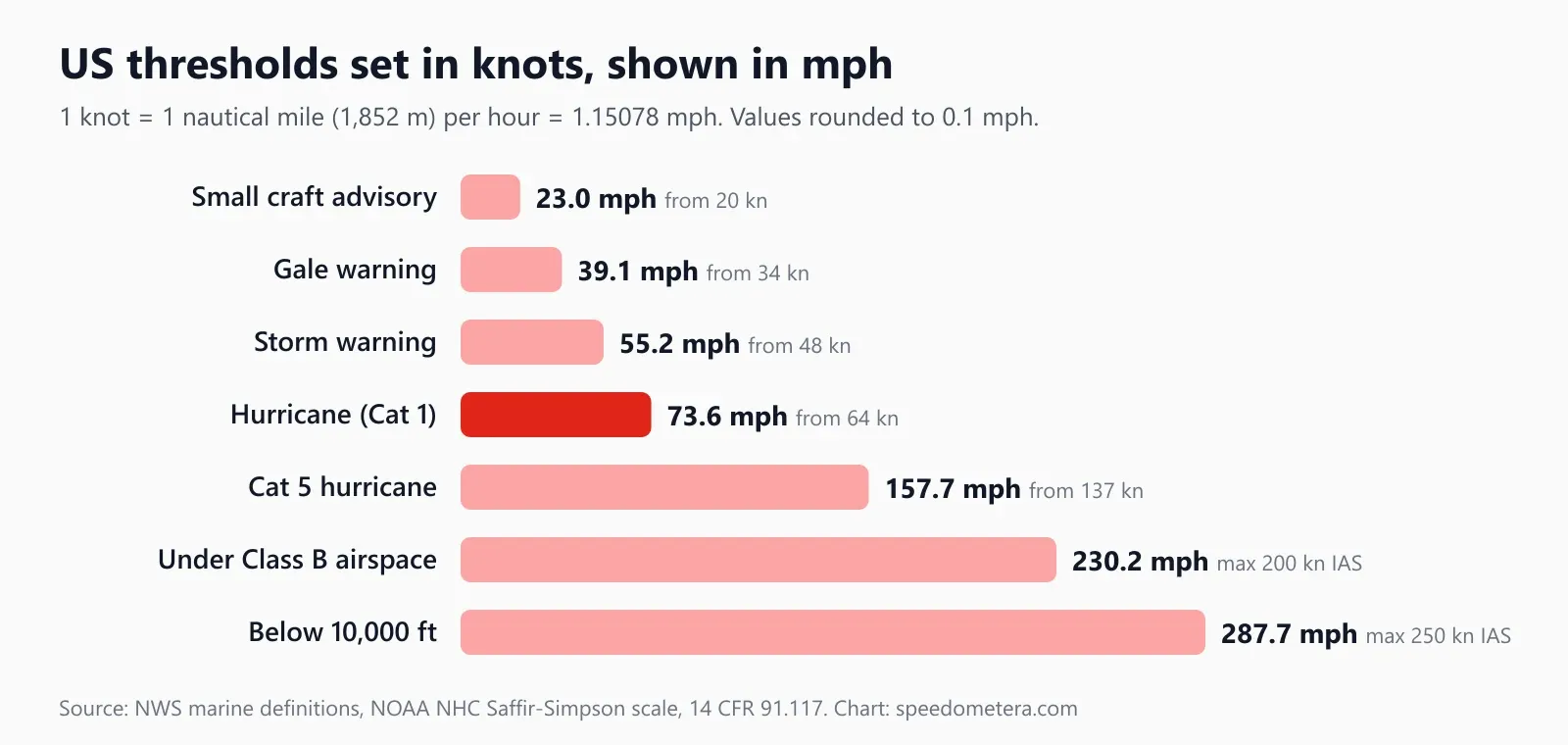
Small craft advisories start at 20 knots (23.0 mph), gales at 34 knots (39.1 mph), hurricane winds at 64 knots (73.6 mph), and the FAA’s low-altitude speed limit is 250 knots (287.7 mph). Here is how the official US thresholds read in both units.
Marine warnings (National Weather Service). The NWS defines a small craft advisory for coastal winds of 20 to 33 knots (23.0 to 38.0 mph), although some local offices set different wind or wave thresholds. A gale warning covers sustained winds of 34 to 47 knots (39.1 to 54.1 mph), a storm warning 48 knots and up (55.2 mph), and a hurricane warning sustained winds of 64 knots or more tied to a tropical cyclone.
Hurricanes (National Hurricane Center). The Saffir-Simpson scale is built in knots, and the NHC publishes the mph values alongside:
| Category | Sustained wind (knots) | Exact mph from knots | NHC published mph | km/h |
|---|---|---|---|---|
| 1 | 64–82 kn | 73.6–94.4 mph | 74–95 mph | 119–153 km/h |
| 2 | 83–95 kn | 95.5–109.3 mph | 96–110 mph | 154–177 km/h |
| 3 (major) | 96–112 kn | 110.5–128.9 mph | 111–129 mph | 178–208 km/h |
| 4 (major) | 113–136 kn | 130.0–156.5 mph | 130–156 mph | 209–251 km/h |
| 5 (major) | 137+ kn | 157.7+ mph | 157+ mph | 252+ km/h |
The published mph ranges are rounded to whole numbers so that the categories join without gaps, which is why 64 knots appears as 74 mph instead of 73.6. When a forecast quotes knots, multiplying by 1.15078 gives you the more exact figure.
Beaufort wind scale. The NWS Beaufort table pairs knots and mph: force 4 (moderate breeze) is 11 to 16 knots or 13 to 18 mph; force 6 (strong breeze) 22 to 27 knots, 25 to 31 mph; force 8 (gale) 34 to 40 knots, 39 to 46 mph.
Aviation (FAA). Under 14 CFR 91.117, aircraft may not fly faster than 250 knots indicated airspeed (287.7 mph) below 10,000 feet MSL, and 200 knots (230.2 mph) at or below 2,500 feet within 4 nautical miles of a Class C or D primary airport, or beneath Class B airspace, unless ATC authorizes otherwise. For cruise speeds by aircraft type, see how fast do planes fly.
Can I see my live speed in knots?
Yes. Our GPS speedometer on the home page shows your speed over ground live, and you can switch its unit to knots. On a boat it works like a basic chartplotter speed readout; on a plane, by a window, it shows ground speed rather than airspeed.
How to use it on the water:
- Open the speedometer while you still have signal at the dock or ramp.
- Tap Start and allow location access. The first GPS fix can take 10 to 60 seconds.
- Switch the unit to knots (kn). Keep mph visible in your head with the “add 15%” rule.
- Keep the phone where it can see the sky, ideally mounted near the helm, not in a cabin or a cooler.
- For a boat-specific setup with top speed and trip distance, use the boat speedometer.
Knots on a phone are speed over ground
GPS measures how fast you cross the Earth’s surface. A boat pushing against a 2-knot current at 8 knots through the water shows 6 knots on GPS; a plane with a 50-knot headwind shows 50 knots less ground speed than its airspeed. Phone GPS is also an estimate that can lag or jump near bridges, cliffs and tall buildings; GPS.gov explains the accuracy limits. Never rely on a phone as your only navigation or speed instrument, and keep it hands-free when you are at the helm.
This difference is also why your car’s speedometer and a GPS app disagree slightly; we explain the details in GPS vs car speedometer.
How to use the knots to mph converter
Type a number in the Knots box and the Miles per hour box updates instantly, rounded for display but calculated from the exact 1,852 ÷ 1,609.344 ratio.
- Enter knots. Type any value, including decimals (for example 17.5). The mph box updates as you type.
- Read the result. Miles per hour appears on the right. The kn to mph quick table under the tool lists nearby values for fast reference.
- Swap. Tap Swap to convert mph to knots instead, useful when you know a road-style speed and need to file it in knots.
- Copy result. Tap Copy result to paste the conversion into a log, text or flight plan.
- All units. Tap All units to open the full speed converter with km/h, m/s, ft/s and Mach.
Common slip-ups to avoid: don’t write “knots per hour” (a knot already means per hour); don’t confuse knots of airspeed with ground speed; and don’t use 1.151 for long passages if you need precision. It is close, but the converter’s full ratio is exact. If you are converting between km/h and mph instead, use the km/h to mph converter.
FAQ
Frequently asked questions
How many mph is 1 knot?
One knot is 1.15078 mph. A knot is one nautical mile per hour, and a nautical mile (1,852 m) is about 15% longer than a statute mile (1,609.344 m), so a speed in knots always gives a bigger number in mph.
How fast is 30 knots in mph?
30 knots is 34.5 mph (55.6 km/h). On the NWS Beaufort scale, 30 knots is a near gale (28 to 33 knots), and it falls inside the 20 to 33 knot small craft advisory range.
Is a knot faster than a mph?
Yes. One knot is 1.15 times faster than one mph, because a nautical mile (6,076 ft) is longer than a statute mile (5,280 ft). 20 knots is 23.0 mph, so the number in knots is always the smaller of the two.
Why do boats and planes use knots instead of mph?
Because 1 nautical mile is about one minute of latitude, so distances on a nautical or aeronautical chart can be measured straight off the latitude scale. NOAA notes that charts use latitude and longitude, which makes knots and nautical miles the practical units at sea and in the air.
How do you convert knots to mph in your head?
Add 15%. Take the knots, add one tenth, then add half of that tenth. For 40 knots: 40 + 4 + 2 = 46 mph, which matches the exact 46.0 mph. The shortcut is under 0.1 mph off for any speed up to about 100 knots.
How fast is 100 knots in mph?
100 knots is 115.1 mph (185.2 km/h). As a sustained wind it is a Category 3 hurricane, since the National Hurricane Center starts Category 3 at 96 knots. For an aircraft it is well under the FAA's 200-knot and 250-knot limits.
How many knots is a hurricane?
A hurricane has sustained winds of 64 knots (73.6 mph) or more. The National Hurricane Center rates Category 1 at 64 to 82 knots, Category 3 (major) from 96 knots, and Category 5 at 137 knots (157 mph) or higher.
Why is it called a knot?
It comes from 17th-century sailors, who threw a wooden board tied to a knotted rope off the stern and counted how many knots ran out during a fixed time on a sand glass. The count gave speed in knots, NOAA explains.
Is knots per hour correct?
No. A knot already means one nautical mile per hour, so 'knots per hour' would be a rate of acceleration. Say '25 knots' (25 kn or 25 kt), just as you would say '25 mph' and not '25 mph per hour'.
Is a nautical mile the same as a knot?
No. A nautical mile is a distance, exactly 1,852 meters (about 1.151 statute miles). A knot is a speed: one nautical mile per hour, exactly 1.852 km/h or about 1.151 mph. A boat doing 10 knots covers 10 nautical miles in an hour, as NOAA explains.
How fast is a 50-knot wind in mph?
A 50-knot wind is 57.5 mph (92.6 km/h). On the Beaufort scale used by the National Weather Service it is force 10, a storm (48 to 55 knots). A 40-knot wind is 46.0 mph, a force 8 gale (34 to 40 knots), and hurricane force starts at 64 knots, 73.6 mph.
8 Sources
- NOAA Ocean Service: What is the difference between a nautical mile and a knot? (1,852 m since 1929; origin of the knot)
- NIST SP 811 Appendix B.9: conversion factors (nautical mile = 1,852 m exact; knot = 0.514444 m/s)
- US Metric Association: US adoption of the international nautical mile, July 1, 1954 (old value 1,853.248 m)
- NOAA National Hurricane Center: Saffir-Simpson Hurricane Wind Scale (knots, mph, km/h)
- National Weather Service: Marine definitions (small craft advisory, gale, storm and hurricane warnings in knots)
- National Weather Service Miami: Beaufort wind scale in knots and mph
- 14 CFR 91.117: Aircraft speed (250 and 200 knot limits), Cornell LII
- GPS.gov: GPS accuracy (smartphone accuracy and speed)
Last updated October 25, 2026 by Izhar Ahmad Danish. Found an error? Tell us.