



Key numbers
- Fastest Shinkansen in service: E5 Hayabusa, 320 km/h (199 mph), Tohoku line since 16 March 2013
- Tokyo–Osaka (Tokaido): 285 km/h (177 mph) for all trains since 2020; fastest trip 2 h 21 min
- Maglev record: L0 Series, 603 km/h (375 mph), April 2015; Chuo Shinkansen planned at 500 km/h (311 mph)
- India MAHSR: 320 km/h design, about 300 km/h operating; first section targeted for 15 Aug 2027
- Tokaido punctuality: 1.4 minutes average delay per train (FY2024)
On this page
- How to use the Bullet Train Speed
- How fast does a bullet train go?
- Shinkansen speed by line (2026)
- How fast is the Tokyo to Osaka bullet train?
- How fast is Japan’s maglev train?
- What is the speed of India’s bullet train?
- Bullet train speed by country
- Is a bullet train faster than a plane?
- How to check bullet train speed with your phone
- Frequently asked questions
How to use the Bullet Train Speed
- 1Get a clear view of the skySit by a window: GPS needs a view of the sky and drops out in tunnels and deep cuttings.
- 2Tap Start and allow locationYour browser asks for location permission once. The first GPS fix usually arrives in 5–30 seconds.
- 3Pick your unitChoose km/h, mph, knots or m/s. Your choice is remembered on this device.
- 4Read speed, max, average and distanceThe gauge and digital readout update about once a second. Distance and average count only while you are moving.
- 5Stop or resetTap Stop to pause, Reset to clear the trip. Nothing is stored or sent anywhere.
Works in any modern phone browser. Back to the speedometer ↑
How fast does a bullet train go?
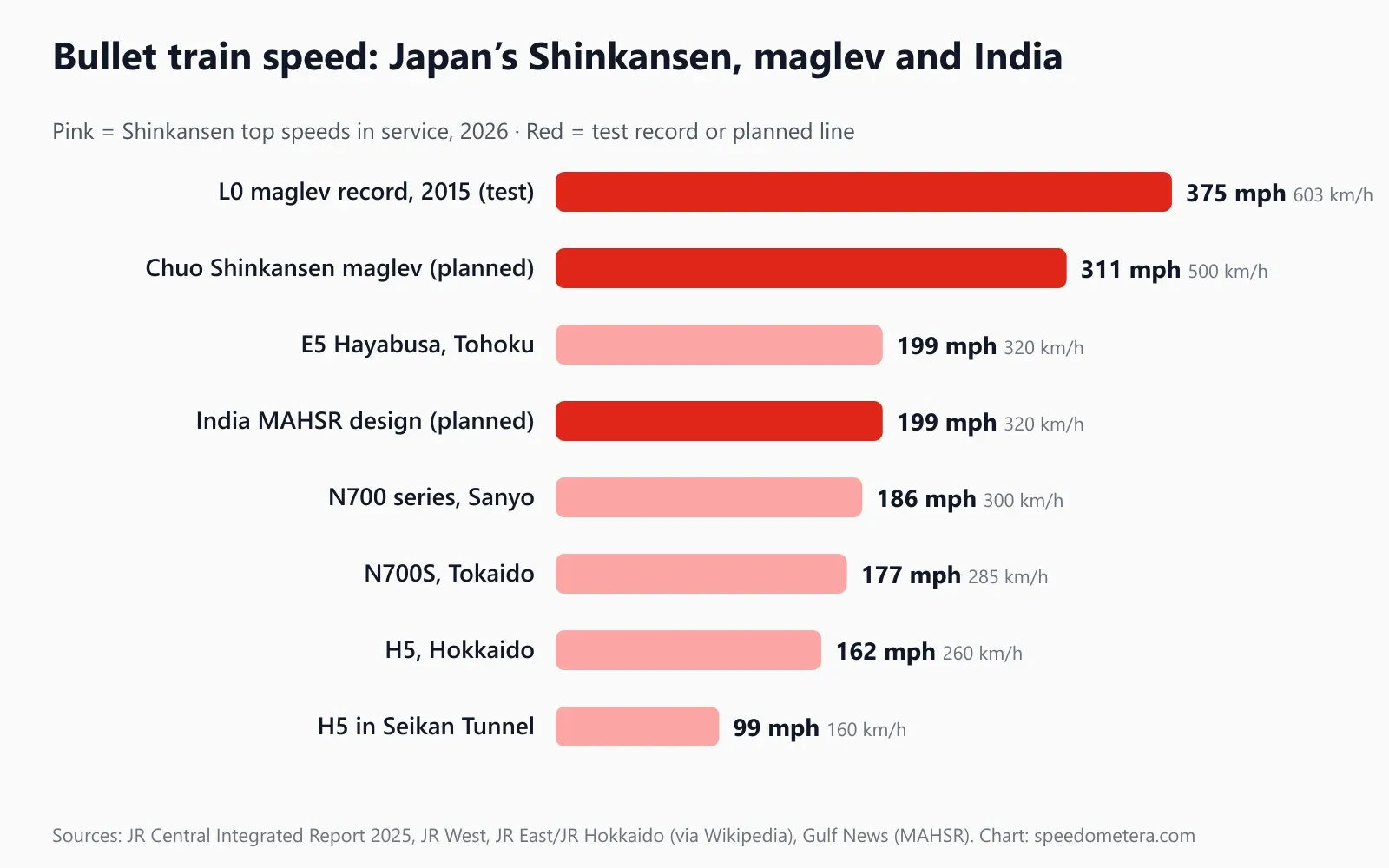
A bullet train in Japan runs at 285 to 320 km/h (177 to 199 mph) at the top of its run. The exact figure depends on the line, not just the train: the same N700-family trains that cruise at 300 km/h on the Sanyo Shinkansen are held to 285 km/h on the older, curvier Tokaido Shinkansen between Tokyo and Osaka.
“Bullet train” is the English nickname for the Shinkansen (Japanese for “new trunk line”), which opened between Tokyo and Osaka in 1964. The name has since spread to any dedicated high-speed train: China’s Fuxing, France’s TGV and India’s planned Mumbai–Ahmedabad line are all called bullet trains in the press. This page goes deep on Japan, maglev and India. For a ranking of every country’s fastest train, see the fastest trains in the world; for Amtrak, Brightline and freight, see how fast do trains go.
Three speeds get mixed up when people quote a bullet train speed:
- Maximum operating speed: the highest speed with paying passengers, set by the operator for each line. All the numbers in the table below are this kind.
- Average speed: distance divided by timetable time, always much lower because of stations, curves and acceleration.
- Test or record speed: a one-off run, often with a modified train. The L0 maglev’s 603 km/h is a record, not a service speed.
Shinkansen speed by line (2026)
The fastest Shinkansen in daily service is the E5 Hayabusa at 320 km/h (199 mph), on the Tohoku line north of Tokyo. The busiest line, Tokaido, is the slowest of the main trunk routes at 285 km/h, because it was built in the early 1960s with tighter curves.
Every mph value below is converted from the operator’s km/h figure with the site’s tested converter (1 mph = 1.609344 km/h exactly) and rounded to one decimal.
| Line | Train series | Max operating speed (mph) | Max operating speed (km/h) | Status | Source |
|---|---|---|---|---|---|
| Tohoku Shinkansen (Utsunomiya–Morioka) | E5 Hayabusa | 198.8 | 320 | Operating since 16 Mar 2013 | Railway Gazette (JR East timetable) |
| Sanyo Shinkansen (Shin-Osaka–Hakata) | N700 series | 186.4 | 300 | Operating | JR West |
| Tokaido Shinkansen (Tokyo–Shin-Osaka) | N700S | 177.1 | 285 | Operating; 285 km/h for all trains since 2020 | JR Central |
| Hokkaido Shinkansen | H5 | 161.6 | 260 | Operating | JR Hokkaido (via Wikipedia) |
| Seikan Tunnel section (shared with freight) | H5 / E5 | 99.4 | 160 | Operating, speed-restricted (higher on some holiday trains since 2024, when freight is paused) | Wikipedia |
| Mumbai–Ahmedabad HSR, India | Shinkansen-based | 198.8 design / 186.4 operating | 320 design / ~300 operating | Planned; first section targeted 15 Aug 2027 | Gulf News, citing Railways Minister |
| Chuo Shinkansen (Shinagawa–Nagoya) | L0 Series maglev | 310.7 | 500 | Under construction; no opening date | JR Central |
| Yamanashi Maglev Line (test) | L0 Series | 374.7 | 603 | World record, April 2015, not service | JR Central |
How fast is the Tokyo to Osaka bullet train?
The Tokaido Shinkansen’s top speed is 285 km/h (177 mph), and the fastest Nozomi links Tokyo and Shin-Osaka in 2 hours 21 minutes. JR Central’s Integrated Report 2025 traces how that happened: 4 hours at the 1964 opening, 3 hours 10 minutes later, then a maximum of 270 km/h, then 285 km/h on some trains in 2015 and on every train from 2020, when the N700S entered service.
The speed matters less than the frequency and punctuality. The same report says the line can run up to 12 Nozomi trains an hour at peak, roughly one every five minutes, with an average delay of 1.4 minutes per train in fiscal 2024, natural disasters included. JR Central also states that no passenger on board has been killed or injured in a train accident since the line opened.
At 285 km/h a train covers 100 miles in about 34 minutes (calculated). Try your own route with the speed, distance and time calculator.
How fast is Japan’s maglev train?
Japan’s L0 Series superconducting maglev reached 603 km/h (374.7 mph) on the Yamanashi test line in April 2015, the world speed record for a manned rail vehicle, according to JR Central. In 2004 two test trains also passed each other at a combined 1,026 km/h (637.5 mph).
The commercial version is the Chuo Shinkansen. JR Central’s Chuo Shinkansen section gives an operating speed of 500 km/h (310.7 mph), a maximum design speed of 505 km/h, and travel times of 40 minutes Shinagawa–Nagoya (285.6 km) and 67 minutes to Osaka. 285.6 km in 40 minutes is an average of 428.4 km/h (266.2 mph), faster than any wheeled bullet train’s top speed.
Planned, not open
JR Central says the planned 2027 opening of Shinagawa–Nagoya is no longer possible because tunnelling in Shizuoka Prefecture has been held up, and it gives no new date. Treat any “Japan’s 500 km/h train opens in 2027” headline as out of date.
What is the speed of India’s bullet train?
India’s Mumbai–Ahmedabad High Speed Rail (MAHSR) is designed for 320 km/h (198.8 mph) and is expected to operate at about 300 km/h (186.4 mph). It is built with Japanese Shinkansen technology and financing, run by the National High Speed Rail Corporation (NHSRCL), and will be 508 km long with a journey time of about two hours, an average near 254 km/h (158 mph, calculated).
Status as of October 2026: on 1 January 2026, Railways Minister Ashwini Vaishnaw gave 15 August 2027 as the target for the first operations, starting with Surat–Bilimora in Gujarat and opening in phases (Gulf News).
Earlier targets have already slipped, so read 2027 as a goal, not a timetable. The 320 km/h figure is a design speed; India’s first trains will run below it.
Bullet train speed by country
China runs the fastest bullet trains in daily service at 350 km/h (217 mph); Japan, France and Morocco follow at 320 km/h (199 mph). The US has no bullet train yet: its fastest train, the Acela, tops out at 160 mph.
| Country | Fastest train in service | Top service speed (mph) | km/h | Source |
|---|---|---|---|---|
| China | CR400 Fuxing | 217.5 | 350 | Xinhua via China Daily |
| Japan | E5 Hayabusa (Tohoku Shinkansen) | 198.8 | 320 | Railway Gazette |
| France | TGV on the fastest lines | 198.8 | 320 | Railway Technology |
| Morocco | Al Boraq | 198.8 | 320 | ONCF via Railway Gazette |
| Italy | Frecciarossa 1000 | 186.4 | 300 | FS Italiane |
| India | Mumbai–Ahmedabad HSR (planned) | 198.8 design | 320 design | Gulf News |
| United States | NextGen Acela (not a bullet-class train) | 160 | 257 | Amtrak |
| United States | Brightline West (under construction) | 200 design | 322 design | Brightline West |
mph values are converted from the operators’ km/h with the site’s exact factor; the Acela and Brightline West figures are given in mph by their operators. Most TGV services run at 300 km/h, with 320 km/h on the newest lines (Railway Technology). For the full world ranking, record runs and China’s 600 km/h maglev prototype, see fastest trains in the world.
Is a bullet train faster than a plane?
No, an airliner cruises at roughly three times bullet-train speed, but on routes under about 500 km (310 miles) the train is often faster door to door. A jet cruises at roughly 550 mph (885 km/h; see how fast planes fly), yet Shinkansen stations are in city centres, boarding takes minutes, and there is no airport security queue or transfer to a distant airport.
Over longer distances the plane wins. At 320 km/h a train needs about 30 minutes per 100 miles even at full speed (calculated), and real averages are lower.
How to check bullet train speed with your phone
Open this page before departure, sit by a window, tap Start and allow location: the GPS speedometer above shows live speed in mph or km/h and records your top speed. It needs no app, and once loaded it works without a data connection, which helps on rural Shinkansen stretches.
Tips from riding with GPS:
- Readings freeze in tunnels and catch up when you come out. The Tohoku and Hokkaido lines and the Sanyo line west of Okayama have long tunnel sections.
- Expect the top reading on long straight viaducts, not near stations.
- Switch units with the unit pill; use the km/h to mph converter or the speed converter to compare with the onboard display.
GPS speed is an estimate that depends on signal, sky view and device; GPS.gov explains why phone accuracy varies. Use it for curiosity, not as an official record.
FAQ
Frequently asked questions
How fast is a bullet train in mph?
Between 177 and 199 mph on Japan's main lines. The Tokaido Shinkansen runs at 285 km/h (177 mph), the Sanyo Shinkansen at 300 km/h (186 mph) and the E5 Hayabusa on the Tohoku line at 320 km/h (199 mph). China's fastest bullet trains run at 350 km/h (217 mph).
What is the top speed of the Shinkansen?
320 km/h (199 mph) in passenger service, reached by E5 and E6 trains on the Tohoku Shinkansen between Utsunomiya and Morioka since 16 March 2013. JR Central's L0 maglev went much faster, 603 km/h (375 mph), but only on a test line.
How fast is the Tokyo to Osaka bullet train?
Its top speed is 285 km/h (177 mph), set for every Tokaido Shinkansen train in 2020. The fastest Nozomi covers Tokyo–Shin-Osaka in 2 hours 21 minutes, according to JR Central, compared with 4 hours when the line opened in 1964.
What will be the speed of India's bullet train?
The Mumbai–Ahmedabad bullet train is designed for 320 km/h (199 mph) and is expected to run at about 300 km/h (186 mph). The full 508 km trip should take about two hours, an average near 254 km/h (158 mph). Service is targeted to start in phases from August 2027.
When will India's bullet train start?
Railways Minister Ashwini Vaishnaw has given 15 August 2027 as the target for the first section, starting with Surat–Bilimora in Gujarat. The rest of the 508 km Mumbai–Ahmedabad corridor opens in later phases. These are targets, not confirmed openings, and earlier dates have slipped.
How fast is the maglev train in Japan?
The L0 Series maglev reached 603 km/h (375 mph) with people on board on the Yamanashi test line in April 2015, a world record. The planned Chuo Shinkansen will run at 500 km/h (311 mph), but JR Central says its 2027 opening is no longer possible.
Why is it called a bullet train?
Bullet train is the English nickname for Japan's Shinkansen, which opened between Tokyo and Osaka in 1964. Today people use it for any high-speed train running above about 250 km/h (155 mph), in China, Europe or India.
Can I check a bullet train's speed on my phone?
Yes. Open this page, tap Start and allow location; the GPS speedometer shows live speed and keeps your top speed. It reads 177 mph on a Tokaido Nozomi as easily as 60 mph in a car, but signal drops in tunnels, which are common on Shinkansen lines.
Which bullet train is faster, Japan's or China's?
China's, in daily service. The CR400 Fuxing runs at 350 km/h (217 mph), against 320 km/h (199 mph) for Japan's fastest Shinkansen, the E5 Hayabusa. Japan holds the absolute record, though: its L0 maglev reached 603 km/h (375 mph) on a test line in 2015.
Which train goes 600 km/h?
Only test trains. Japan's L0 maglev reached 603 km/h (375 mph) with people on board in April 2015, the world record. China's CRRC unveiled a maglev designed for 600 km/h (373 mph) in July 2021, but it had not been tested at that speed and does not carry passengers.
Does the USA have a bullet train or maglev?
No true bullet train or high-speed maglev runs in the US yet. The fastest US train, Amtrak's NextGen Acela, tops out at 160 mph (257 km/h). Brightline West, designed for 200 mph (322 km/h) between Las Vegas and Southern California, is scheduled for completion by late 2029.
15 Sources
- JR Central Integrated Report 2025: Tokaido 285 km/h since 2020, Tokyo–Osaka 2 h 21 min, 1.4 min average delay, L0 603 km/h record (PDF)
- JR Central Integrated Report 2025, Chuo Shinkansen section: 500 km/h, 505 km/h design, 2027 opening not possible (PDF)
- JR West: Tokaido–Sanyo Shinkansen, maximum speed 300 km/h
- Railway Gazette: JR East introduces 320 km/h running (E5, Utsunomiya–Morioka, 16 March 2013)
- Wikipedia (secondary): E5 and H5 Series Shinkansen, 320 km/h from 16 March 2013, 260 km/h on Hokkaido, 160 km/h in Seikan Tunnel
- Gulf News: India bullet train set for 15 August 2027 debut, 320 km/h design, ~300 km/h operating, 508 km (1 Jan 2026)
- DeshGujarat: bullet train to run on Surat–Bilimora route from 15 August 2027, says Ashwini Vaishnaw (1 Jan 2026)
- China Daily / Xinhua: CR400 runs at 350 km/h; CR450 453 km/h in trials (21 Oct 2025)
- Railway Technology: TGV, maximum service speed 300 or 320 km/h
- FS Italiane: Frecciarossa 1000, certified for 300 km/h
- Railway Gazette: Al Boraq reaches a maximum of 320 km/h (ONCF)
- Caixin: CRRC rolls out 600 km/h maglev, not yet tested at 600 km/h (21 July 2021)
- Brightline West: project overview, trains up to 200 mph
- Amtrak Media: NextGen Acela, top speed 160 mph (May 2026)
- GPS.gov: GPS accuracy (smartphones and speed accuracy)
Last updated October 25, 2026 by Izhar Ahmad Danish. Found an error? Tell us.