



Key numbers
- 1 mile = 1.609344 km exactly (5,280 ft × 0.3048 m)
- 10 miles = 16.09 km, 50 miles = 80.47 km, 100 miles = 160.93 km
- Quick rule: miles × 1.6 (0.6% low); or add 60%
- Fibonacci trick: 5 mi ≈ 8 km, 8 ≈ 13, 13 ≈ 21, 55 ≈ 89 (within about 1%)
On this page
- How to use the miles to km Converter
- How do you use the miles to km converter?
- What is the formula for miles to km?
- Miles to km conversion table (1 to 1,000 miles)
- How does the Fibonacci trick convert miles to km?
- Where do miles show up, and when do you need km?
- Is 1 km half a mile? Quick size comparisons
- Statute miles vs nautical miles
- Common miles to km mistakes
- About this page
- Frequently asked questions
How to use the miles to km Converter
- 1Get a clear view of the skyMount your phone in a holder with a clear view of the sky before you set off.
- 2Tap Start and allow locationYour browser asks for location permission once. The first GPS fix usually arrives in 5–30 seconds.
- 3Pick your unitChoose km/h, mph, knots or m/s. Your choice is remembered on this device.
- 4Read speed, max, average and distanceThe gauge and digital readout update about once a second. Distance and average count only while you are moving.
- 5Stop or resetTap Stop to pause, Reset to clear the trip. Nothing is stored or sent anywhere.
Works in any modern phone browser. Back to the tool ↑
How do you use the miles to km converter?
Type a distance in the Miles box and the Kilometers box updates as you type; the line underneath reads “10 mi = 16.093 km”. It works offline once the page has loaded and sends nothing anywhere.
- Enter miles in the left box (it starts at 10).
- Read km on the right, to three decimals, and in the sentence below.
- Swap (⇄) to go from km to miles, or open the km to miles page, which leads with km and race distances.
- Copy result puts “10 mi = 16.093 km” on your clipboard.
- All units shows the same distance in meters, feet, yards and nautical miles.
- The quick table lists 1 to 1,000 miles without typing.
What is the formula for miles to km?
km = miles × 1.609344. That number is exact, not measured. A mile is 5,280 feet, and since 1959 the international foot has been defined as exactly 0.3048 m, so a mile is 5,280 × 0.3048 = 1,609.344 m. NIST lists the factor in its SI guide (SP 811, Appendix B.8), and since January 1, 2023 the older US survey foot is obsolete, so every US mile, on a map or a highway, is the same 1,609.344 m.
km = miles × 1.609344 · miles = km × 0.621371
Worked example: a 240-mile road trip
240 × 1.609344 = 386.24 km. Quick rule: 240 × 1.6 = 384 km, 2.2 km short. Fibonacci-style: 233 mi ≈ 377 km, plus 7 mi ≈ 11 km, gives 388 km.
Miles to km conversion table (1 to 1,000 miles)
Exact conversions rounded to two decimals, with the × 1.6 shortcut alongside so you can see how far off it is. The shortcut is always 0.58% low, which is under 1 km until you pass about 107 miles.
| Miles | km (exact) | × 1.6 shortcut (km) | Shortcut error (km) |
|---|---|---|---|
| 1 | 1.61 | 1.6 | −0.01 |
| 2 | 3.22 | 3.2 | −0.02 |
| 3 | 4.83 | 4.8 | −0.03 |
| 5 | 8.05 | 8 | −0.05 |
| 10 | 16.09 | 16 | −0.09 |
| 13.1 (half marathon) | 21.08 | 20.96 | −0.12 |
| 15 | 24.14 | 24 | −0.14 |
| 20 | 32.19 | 32 | −0.19 |
| 25 | 40.23 | 40 | −0.23 |
| 26.2 (marathon) | 42.16 | 41.92 | −0.24 |
| 30 | 48.28 | 48 | −0.28 |
| 50 | 80.47 | 80 | −0.47 |
| 60 | 96.56 | 96 | −0.56 |
| 100 | 160.93 | 160 | −0.93 |
| 150 | 241.40 | 240 | −1.40 |
| 200 | 321.87 | 320 | −1.87 |
| 300 | 482.80 | 480 | −2.80 |
| 500 | 804.67 | 800 | −4.67 |
| 1,000 | 1,609.34 | 1,600 | −9.34 |
The half and full marathon rows use the rounded mile figures runners quote; the official distances are 21.0975 km and 42.195 km, so “13.1” and “26.2” miles each fall a few dozen meters short.
How does the Fibonacci trick convert miles to km?
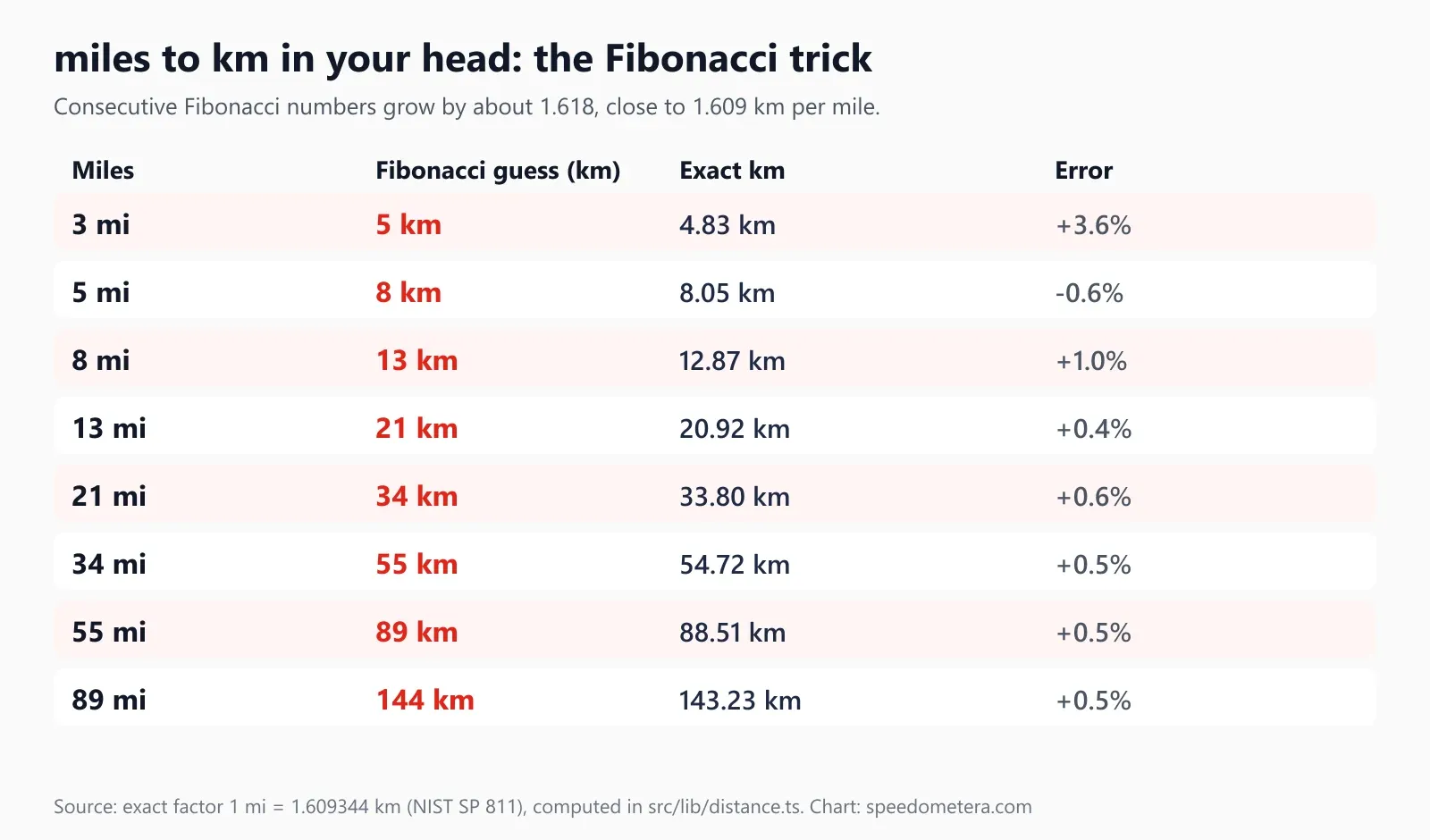
Take a Fibonacci number of miles and read the next Fibonacci number as km: 5 miles ≈ 8 km, 8 ≈ 13, 13 ≈ 21, 34 ≈ 55, 55 ≈ 89. It works because each Fibonacci number is about 1.618 times the one before (the golden ratio), and that is within 0.6% of 1.609 km per mile.
For numbers that are not in the sequence, split them into Fibonacci parts and add: 100 miles = 89 + 8 + 3 → 144 + 13 + 5 = 162 km (exact 160.93). 40 miles = 34 + 5 + 1 → 55 + 8 + 2 = 65 km (exact 64.37). Small numbers are rougher (3 → 5 is 3.6% high), so for short distances the × 1.6 rule is better.
Other quick methods:
- Add 60%. 45 miles: 45 + 27 = 72 km (exact 72.42).
- Double, then subtract a fifth. 50 → 100 − 20 = 80 km (exact 80.47). Same as × 1.6.
- For precision, add 1% back. × 1.6 then + 0.6% gets you within about 0.02%: 300 × 1.6 = 480, + 2.9 = 482.9 (exact 482.80).
Where do miles show up, and when do you need km?
US and UK roads, odometers and maps count miles; almost everyone else counts km. In the US, the federal Manual on Uniform Traffic Control Devices (MUTCD, Section 2H.05) has highway mileposts count miles from zero at the south and west state lines, with optional tenth-of-a-mile markers. Exit numbers on many interstates follow those mileposts, so exit 120 is about 120 miles, or 193 km, from the state line. UK signs use miles and yards too: the Highway Code traffic signs include “Road works 1 mile ahead” and motorway countdown markers of 100 yards each.
You need km when the other side does:
- Driving into Canada or Mexico. A US odometer counts miles while signs count km. If a sign says the next fuel is 80 km away, that is 49.7 miles; check your trip meter in miles against it. Our GPS odometer can show a trip in km directly.
- Speed signs at the border. Distances and speeds use the same factor. 60 mph is 96.56 km/h; for speed signs use mph to km/h.
- Running and cycling. Most race distances are metric. A 20-mile training run is 32.19 km; your pace calculator can switch between min/mile and min/km.
- Science, travel and school work. Physics problems, flight distances in many countries and most of the world’s maps are in km. A 2,500-mile coast-to-coast drive is 4,023 km.
Convert before you drive
Work out the distances and limits you need before setting off. Do not operate a phone while driving; let a passenger read the converter or mount the phone hands-free and follow local law.
Is 1 km half a mile? Quick size comparisons
Not quite: 1 km is 0.621 miles, a little more than half a mile, and half a mile is 0.805 km. These are the comparisons people check most often, computed exactly from 1 mile = 1.609344 km.
| Question | Exact answer | Short answer |
|---|---|---|
| Is 1 km half a mile? | 1 km = 0.621 mi; 0.5 mi = 0.805 km | No, 1 km is about 24% longer than half a mile |
| Does 2 km equal 1 mile? | 2 km = 1.243 mi | No, 2 km is about a quarter mile longer |
| Is 1 mile longer than 2 km? | 1 mi = 1.609 km | No, 2 km is longer |
| Is 2 miles a 5K? | 2 mi = 3.219 km | No, a 5K is 3.107 mi |
| Is 3 miles equal to 5 km? | 3 mi = 4.828 km | Close: 5 km is 0.107 mi (172 m) more |
| Is 5 km 1 mile? | 5 km = 3.107 mi | No, it is just over 3 miles |
| Is 10 km 1 mile? | 10 km = 6.214 mi | No, 1 mile is 1.609 km |
For walking or running times over these distances, the pace calculator turns any distance and pace into a finish time.
Statute miles vs nautical miles
A statute mile (the road mile) is 1.609344 km; a nautical mile is 1.852 km, about 15% longer. Both are exact definitions. Boats and aircraft use nautical miles because one nautical mile was originally tied to one minute of latitude. If a marine chart says 10 nmi, that is 18.52 km or 11.51 statute miles. Mixing them up adds or loses 15%. The All units panel in the converter shows nautical miles beside km and miles, and boat and plane speeds in knots are covered on knots to mph.
Common miles to km mistakes
The classic error is dividing by 1.609 instead of multiplying, which turns 10 miles into a bogus 6.2 km. The km number is always the bigger one.
- Rounding to 1.6 for long distances. Over 1,000 miles, that is 9.3 km short.
- Treating 26.2 miles as the exact marathon. It is 42.16 km; the official distance is 42.195 km.
- Reading a GPS trace as exact. Phone GPS distances can read long on twisty routes or short when the signal drops. For accuracy limits, see GPS vs car speedometer.
About this page
All conversions were computed with the site’s tested distance code (src/lib/distance.ts), using the exact NIST mile, and rounded only for display. Written by Izhar Ahmad Danish. For your live speed and trip distance, open the GPS speedometer on the homepage.
FAQ
Frequently asked questions
How many km are in a mile?
There are 1.609344 km in a mile, exactly. The figure follows from the mile being 5,280 feet and the international foot being exactly 0.3048 m since 1959. Rounded, a mile is 1.61 km, or 1,609 meters.
How do you convert miles to km?
Multiply the miles by 1.609344. For example, 30 miles × 1.609344 = 48.28 km, and 250 miles × 1.609344 = 402.34 km. For a fast estimate, multiply by 1.6 or add 60% to the miles: 30 + 18 = 48 km.
How far is 10 miles in km?
10 miles is 16.09 km (16.093). It is a common long-run distance and the length of popular 10-mile road races. At a steady 60 mph, 10 miles takes 10 minutes; in km/h that speed is 96.56 km/h.
How many km is 100 miles?
100 miles is 160.93 km. That is why 160 km is used as the metric equivalent for 100-mile ultramarathons and why 160 km/h is roughly 100 mph. Multiplying by 1.6 gives 160 km, just 0.93 km short.
How many km is 26.2 miles?
26.2 miles is 42.16 km. The official marathon is slightly longer, 42.195 km, which is 26.219 miles, so '26.2 miles' is a rounded figure that falls about 30 meters short of a full marathon.
Is 5 miles the same as 8 km?
Almost. 5 miles is 8.05 km, so 8 km is 4.97 miles, about 50 meters short of 5 miles. That near-match is the base of the Fibonacci trick, and why 8K and 5-mile road races are treated as similar efforts.
Is a mile longer than a kilometer?
Yes. A mile is about 1.6 times as long as a kilometer: 1,609.344 m versus 1,000 m. So the same trip shows a bigger number in km. A 60-mile drive is 96.56 km.
Why do the US and UK still use miles?
Because road law and signage kept customary units. US highway mileposts count miles from the south and west state lines under the federal MUTCD, and UK signs in the Highway Code show distances in miles and yards, even though both define the mile in metric terms.
Is miles divided by 5 times 8 accurate?
Close. Dividing by 5 and multiplying by 8 is the same as multiplying by 1.6, which reads 0.58% low. 50 miles gives 80 km against an exact 80.47 km. For trips under a few hundred miles the error stays under 2 km.
Is 2 km more than a mile?
Yes. 2 km is 1.243 miles, about a quarter mile more than one mile. One mile is 1.609 km, so 1 km is 0.621 mile, a little more than half a mile, and a 5K (5 km) is 3.107 miles.
4 Sources
- NIST SP 811, Appendix B.8: Factors for units listed alphabetically (mile = 1.609344 km, exact)
- NIST: international foot 0.3048 m exactly (1959); U.S. survey foot obsolete from January 1, 2023
- FHWA MUTCD 2009, Section 2H.05: Reference Location Signs (mileposts, zero at south and west state lines)
- AIMS: World Athletics road world record distances (Marathon 42.195 km)
Last updated October 25, 2026 by Izhar Ahmad Danish. Found an error? Tell us.