



Key numbers
- Fastest human speed measured: 27.8 mph (44.72 km/h, 12.42 m/s), Usain Bolt, 60–80 m, Berlin 2009
- 100 m world record 9.58 s = 23.4 mph average; women's record 10.49 s (Florence Griffith-Joyner) = 21.3 mph
- Marathon world record 2:00:35 (Kelvin Kiptum) = 13.0 mph, a 4:36 mile pace for 26.2 miles
- Typical recreational running: 5–7.5 mph (8–12 km/h), a 12:00 to 8:00 per-mile pace
- Lab research suggests muscle limits could allow 35–40 mph in theory; nobody has come close
On this page
- How to use the How Fast Can a Human Run?
- What is the fastest a human has ever run?
- How fast does Usain Bolt run in mph over a whole race?
- World record running speeds by distance
- How fast can the average person run?
- Is 4, 12 or 20 mph fast for a human?
- How fast can a human run in theory?
- How do you measure your running speed with your phone?
- How fast can a human run compared with walking, cycling and cars?
- How to run faster: what the speed data tells you
- Sources and method
- Frequently asked questions
How to use the How Fast Can a Human Run?
- 1Get a clear view of the skyHold the phone or keep it in an arm band; open the page before you start running.
- 2Tap Start and allow locationYour browser asks for location permission once. The first GPS fix usually arrives in 5–30 seconds.
- 3Pick your unitChoose km/h, mph, knots or m/s. Your choice is remembered on this device.
- 4Read speed, max, average and distanceThe gauge and digital readout update about once a second. Distance and average count only while you are moving.
- 5Stop or resetTap Stop to pause, Reset to clear the trip. Nothing is stored or sent anywhere.
Works in any modern phone browser. Back to the speedometer ↑
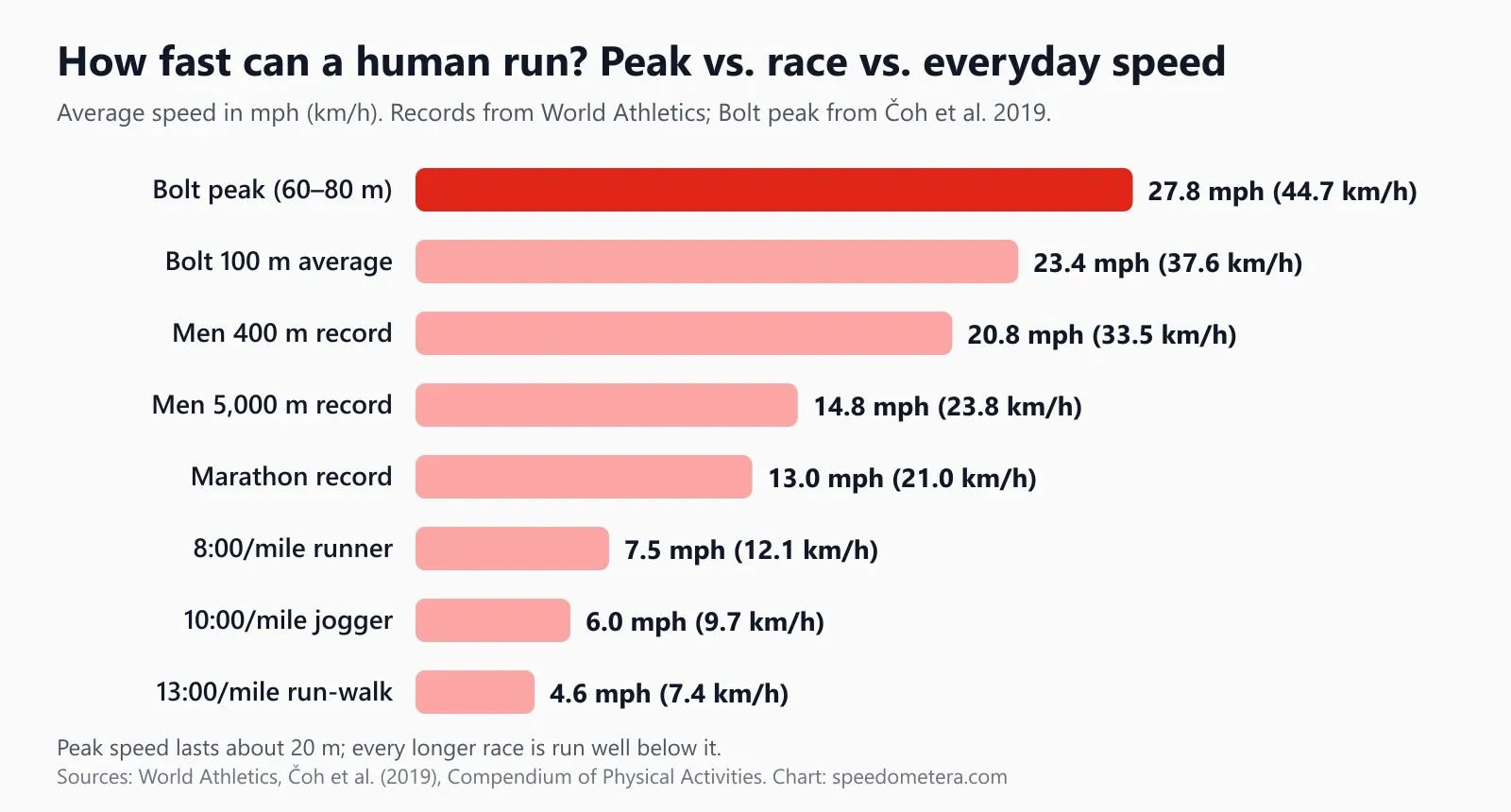
How fast can a human run? The fastest speed ever measured is 27.8 mph (44.72 km/h), reached by Usain Bolt for about 20 meters of his 100 m world record. That is the ceiling. Everyone else lives far below it: a fit recreational runner cruises at 6 to 7.5 mph, and the marathon world record averages 13.0 mph. This page puts those numbers side by side, from the 100 m to the marathon, and lets you measure your own speed live with the GPS running speedometer above.
Key terms used on this page. Peak speed (or top speed) is the highest speed over a short measured section, usually 10 or 20 meters. Average speed is race distance divided by finish time. Pace is the inverse of speed, in minutes per mile or per km. Stride length is the distance of one step, and stride frequency is steps per second. Speed always equals stride length × stride frequency. Every figure below comes from World Athletics record data, published sports science, or the site’s own pace and unit maths.
What is the fastest a human has ever run?
The fastest human running speed on record is 12.42 meters per second, which is 27.8 mph or 44.72 km/h, set by Usain Bolt in the 100 m final of the 2009 World Championships in Berlin. He covered the 20 meters between the 60 m and 80 m marks in 1.61 seconds, on his way to a 9.58-second world record run with a legal tailwind of 0.9 m/s.
The figure comes from a biomechanics study by Milan Čoh and colleagues at the University of Ljubljana, published in Facta Universitatis (2019), which compared Bolt’s major races. The arithmetic is simple and you can check it: 20 m ÷ 1.61 s = 12.42 m/s, and 12.42 × 3.6 = 44.72 km/h, which converts to 27.79 mph.
Speed (m/s) = distance (m) ÷ time (s) · mph = m/s × 2.23694 · km/h = m/s × 3.6
The same study shows how close Bolt came to that number in other championships. His peak speeds were remarkably consistent, which is why the Berlin figure is widely treated as the human benchmark rather than a fluke.
| Race (Usain Bolt) | 100 m time | Average speed | Peak speed | Peak section | Strides | Stride rate | Avg stride length |
|---|---|---|---|---|---|---|---|
| Beijing 2008 Olympics | 9.69 s | 23.1 mph (37.15 km/h) | 27.3 mph (43.91 km/h) | 60–80 m | 41.51 | 4.28 /s | 2.41 m |
| Berlin 2009 World Champs | 9.58 s | 23.3 mph (37.57 km/h) | 27.8 mph (44.72 km/h) | 60–80 m | 40.92 | 4.27 /s | 2.44 m |
| Zagreb 2011 | 9.85 s | 22.7 mph (36.54 km/h) | 27.2 mph (43.70 km/h) | 70–90 m | 41.00 | 4.16 /s | n/a |
| London 2012 Olympics | 9.63 s | 23.2 mph (37.36 km/h) | 27.8 mph (44.70 km/h) | 60–80 m | 41.30 | 4.37 /s | n/a |
km/h values and stride data from Čoh et al. (2019), Table 2; mph converted with 1 mph = 1.609344 km/h. The study rounds Berlin to 37.57 km/h (23.3 mph); 100 m ÷ 9.58 s exactly is 37.58 km/h, or 23.35 mph, which this page rounds to 23.4 mph elsewhere.
Two things stand out. First, Bolt covered 100 m in only about 41 strides; at 1.96 m (6 ft 5 in) tall, according to the study, he paired a very long stride with a stride rate above four steps per second. Second, even the greatest sprinter never runs at his peak for long. In three of the four races his fastest 20 m came between 60 and 80 meters, and in Zagreb between 70 and 90 meters, so most of the race is spent accelerating toward that peak or holding on after it.
How fast does Usain Bolt run in mph over a whole race?
Over the full 100 m, Bolt’s world record works out to an average of 23.4 mph (37.6 km/h), and his 200 m record of 19.19 seconds averages 23.3 mph. The average is about 4.4 mph below his peak because the first 20 meters, from a standing start in the blocks, are much slower.
This gap between average and peak is the most common source of confusion online. Sites that quote “Bolt runs 23 mph” and sites that quote “Bolt runs 28 mph” are both right; they are measuring different things. Use the peak figure when the question is the human speed limit, and the average when you compare races or your own runs.
The 200 m world record is the more surprising number. Bolt ran the second 100 m of that race with a flying start, so his 200 m average (23.3 mph) is almost identical to his 100 m average, even though the race is twice as long and includes a bend. Over 400 m, where fatigue builds, the men’s world record drops to 20.8 mph.
A human sprinter is no match for a cheetah, whose fastest timed run is 64.2 mph; see how fast animals run for horses, greyhounds and more. Bolt’s 9.58 s record averages 10.44 m/s; convert any sprint with the mph to m/s converter.
World record running speeds by distance
Average speed falls quickly as distance rises: from 23.4 mph at 100 m to about 14.8 mph at 5,000 m and 13.0 mph in the marathon. The table converts every current World Athletics record into average speed and pace per mile, so you can compare events directly with your own runs.
| Distance | Record | Holder, year | Average speed (mph) | Average speed (km/h) | Pace per mile |
|---|---|---|---|---|---|
| 100 m (men) | 9.58 | Usain Bolt (JAM), 2009 | 23.4 | 37.6 | 2:34.2 |
| 100 m (women) | 10.49 | Florence Griffith-Joyner (USA), 1988 | 21.3 | 34.3 | 2:48.8 |
| 200 m (men) | 19.19 | Usain Bolt (JAM), 2009 | 23.3 | 37.5 | 2:34.4 |
| 200 m (women) | 21.34 | Florence Griffith-Joyner (USA), 1988 | 21.0 | 33.7 | 2:51.7 |
| 400 m (men) | 43.03 | Wayde van Niekerk (RSA), 2016 | 20.8 | 33.5 | 2:53.1 |
| 1,500 m (women) | 3:48.68 | Faith Kipyegon (KEN), 2025 | 14.7 | 23.6 | 4:05.3 |
| 1 mile (women) | 4:07.64 | Faith Kipyegon (KEN), 2023 | 14.5 | 23.4 | 4:07.6 |
| 5,000 m (men) | 12:35.36 | Joshua Cheptegei (UGA), 2020 | 14.8 | 23.8 | 4:03.1 |
| 5,000 m (women) | 13:58.06 | Beatrice Chebet (KEN), 2025 | 13.3 | 21.5 | 4:29.7 |
| 10,000 m (men) | 26:11.00 | Joshua Cheptegei (UGA), 2020 | 14.2 | 22.9 | 4:12.8 |
| 10,000 m (women) | 28:54.14 | Beatrice Chebet (KEN), 2024 | 12.9 | 20.8 | 4:39.1 |
| Marathon (men) | 2:00:35 | Kelvin Kiptum (KEN), 2023 | 13.0 | 21.0 | 4:35.9 |
| Marathon (women) | 2:09:56 | Ruth Chepngetich (KEN), 2024 | 12.1 | 19.5 | 4:57.3 |
Marks from each holder’s World Athletics profile, checked 25 October 2026. Speeds and paces calculated with the site’s pace library (1 mile = 1,609.344 m, marathon = 42,195 m) and rounded at display.
A few notes on reading the table:
- The two American records are the oldest. Florence Griffith-Joyner’s 100 m and 200 m marks from 1988 are still the women’s world records, set in Indianapolis and at the Seoul Olympics.
- Three records were set in Eugene, Oregon. Kipyegon’s 1,500 m and Chebet’s 5,000 m came on the same day at Hayward Field (5 July 2025), and Chebet’s 10,000 m was run there in May 2024.
- Both marathon records were set in Chicago. Kiptum ran 2:00:35 on 8 October 2023 and Ruth Chepngetich 2:09:56 on 13 October 2024; World Athletics lists both marks on the athletes’ profiles.
- Kiptum ran a 4:36 mile pace for 26.2 miles. Most people could not hold that pace for a single lap of a track. He died in a road accident in February 2024, aged 24, months after setting the record.
The 400 m is the dividing line in the table. Every record up to 400 m averages above 20 mph; every record from 1,500 m up sits between 12.1 and 14.8 mph. The longer the effort, the more of the energy must come from aerobic metabolism, and that caps speed even for the world’s best.
To turn any of these marks into splits for your own race, use the pace calculator; to solve a speed, distance or time problem in any unit, use the speed, distance and time calculator.
How fast can the average person run?
A typical recreational runner moves at about 5 to 7.5 mph (8 to 12 km/h), a pace of 12:00 to 8:00 per mile. A short all-out sprint is much faster, but nobody can hold it for long. There is no official “average human running speed” because no agency measures the whole population, but race results and exercise-science reference tables give a clear picture.
The best reference for everyday speeds is the Compendium of Physical Activities, the research catalog exercise scientists use to estimate energy cost. Its level-ground running codes begin at 4 to 4.2 mph (a 13-minute mile) and step up through 5 mph (12-minute mile), 6 mph (10-minute mile), 7.5 mph (8-minute mile) and 10 mph (6-minute mile), up to 14 mph (a 4:17 mile).
US race data shows where real runners fall in that range. Running USA’s report on the top US races in the second half of 2024 notes that only two of the top 100 races had an average 5K finish time under 30 minutes. A 30-minute 5K is 6.2 mph, so the whole-field average at almost every big American 5K is slower than that. The fastest whole-field averages it reported were 57:22 for a 10K (6.5 mph), 1:55:02 for a half marathon (6.8 mph) and 3:43:21 for a marathon (7.0 mph). Those are the fastest fields; typical fields are slower.
This table converts common paces into speed and finish times, so you can see where you sit.
| Pace per mile | Speed (mph) | Speed (km/h) | Pace per km | 5K finish | Marathon finish | Typical runner |
|---|---|---|---|---|---|---|
| 6:00 | 10.0 | 16.1 | 3:44 | 18:38 | 2:37:19 | Competitive club or college runner |
| 7:00 | 8.6 | 13.8 | 4:21 | 21:45 | 3:03:32 | Strong amateur |
| 8:00 | 7.5 | 12.1 | 4:58 | 24:51 | 3:29:45 | Fit regular runner |
| 9:00 | 6.7 | 10.7 | 5:36 | 27:58 | 3:55:58 | Steady recreational runner |
| 10:00 | 6.0 | 9.7 | 6:13 | 31:04 | 4:22:11 | Easy jog, many race-day averages |
| 11:00 | 5.5 | 8.8 | 6:50 | 34:11 | 4:48:24 | Relaxed jog |
| 12:00 | 5.0 | 8.0 | 7:27 | 37:17 | 5:14:38 | Beginner running pace |
| 13:00 | 4.6 | 7.4 | 8:05 | 40:23 | 5:40:51 | Run-walk, new runner |
Speeds, km paces and finish times calculated with the site’s pace library at an even pace. The “typical runner” column is a descriptive guide, not a measured statistic.
If your goal is fitness rather than racing, the speed itself matters less than you might think. The Compendium rates running at 6 mph at 9.3 METs and at 8 mph at 12.0 METs, both far above brisk walking. For comparison, see how fast people walk on the average walking speed page, and how cycling compares on the average cycling speed page.
Sprint speed vs. cruising speed
Even Bolt’s race average was 4.4 mph below his peak, and anyone’s sprint speed fades within seconds. When people ask how fast they can run, they usually mean the pace they can hold, so time a mile or a 5K rather than a 50-yard dash.
Is 4, 12 or 20 mph fast for a human?
For running, 4 mph is a slow jog, 6 mph is a typical recreational pace, 12 mph is fast for anyone over distance, and 20 mph is a sprint that only trained athletes reach for a few seconds. These are the speeds people ask about most. The table places each one against measured reference points: the Compendium of Physical Activities running codes, US race averages, world records and NFL tracking data.
| Speed (mph) | km/h | Pace per mile | Pace per km | Is it fast? | Reference point |
|---|---|---|---|---|---|
| 4 | 6.4 | 15:00 | 9:19 | Slow jog | Slowest Compendium running code (4–4.2 mph); overlaps with power walking |
| 5 | 8.0 | 12:00 | 7:27 | Easy beginner run | Compendium code for a 12-minute mile |
| 6 | 9.7 | 10:00 | 6:13 | Typical recreational | A 31:04 5K, faster than the whole-field average at almost every big US 5K (Running USA) |
| 8 | 12.9 | 7:30 | 4:40 | Fast amateur | A 23:18 5K |
| 10 | 16.1 | 6:00 | 3:44 | Very fast; club racer | Compendium code for a 6-minute mile |
| 12 | 19.3 | 5:00 | 3:06 | Fast for anyone over distance | A 5-minute mile; the women’s mile world record (4:07.64) averages 14.5 mph |
| 13 | 20.9 | 4:37 | 2:52 | Elite marathon | Kelvin Kiptum’s 2:00:35 marathon record averaged 13.0 mph |
| 15 | 24.1 | 4:00 | 2:29 | Fast sprint for a fit adult | Non-athletes hold it only for seconds |
| 20 | 32.2 | 3:00 | 1:52 | Elite sprint | The fastest NFL ball carriers top out near 22–23 mph (Next Gen Stats) |
| 23.4 | 37.6 | 2:34 | 1:36 | World-record race average | Bolt’s 9.58 s 100 m, start to finish |
| 27.8 | 44.7 | 2:09 | 1:20 | Fastest ever measured | Bolt’s peak, 60–80 m into the 2009 final |
Paces calculated with the site’s pace library. The “Is it fast?” column is our descriptive guide; the reference points are measured.
Two things stand out. First, the gap between a fast recreational runner (8 mph) and the marathon world record (13 mph) is about the same as the gap between the marathon record and an elite sprint, yet the sprint lasts seconds and the marathon two hours. Second, “has anyone run 30 mph?” has a clear answer: no. Bolt’s 27.8 mph peak is the measured ceiling so far, and the lab estimates in the next section are a theoretical limit, not a speed anyone has reached.
How fast can a human run in theory?
Lab research suggests the human body could, in principle, run 35 to 40 mph (56 to 64 km/h), but no one has come within 7 mph of that. The limit is not how hard a sprinter can push against the ground but how quickly the muscles can apply that force.
In a 2010 study in the Journal of Applied Physiology, Peter Weyand of Southern Methodist University and colleagues from Rice University and the University of Wyoming had athletes run, hop on one leg and run backward on a high-speed force treadmill. According to the university’s release, one-legged hopping produced ground forces at least 30 percent higher than top-speed running, which shows the legs can push harder than they do in a sprint. What runners cannot do is apply that force fast enough: at top speed, each foot is on the ground for less than one-tenth of a second, and peak force arrives within one-twentieth of a second of touchdown.
The authors’ conclusion was that faster muscle contraction, not stronger muscles, would be the route to higher speed, and that muscle fibers able to apply near-maximal force in that short window could permit 35 to 40 mph “and conceivably faster.” Treat that as an upper bound from biology, not a forecast: the 27.8 mph peak and the 9.58 record have both stood since 2009.
What actually limits a real sprinter, in plain terms:
- Ground contact time. Less than 0.1 second per step leaves very little time to generate force.
- Stride length × stride rate. Bolt’s stride rate ranged from 4.16 to 4.37 per second across four races; speed rises only if one goes up without the other falling.
- Acceleration distance. Bolt’s fastest section came 60 to 90 meters into the race, so a 100 m shows only a short burst of top speed.
- Wind. World Athletics records the wind for every sprint result because a tailwind helps; Bolt’s 9.58 had a tailwind of 0.9 m/s.
How do you measure your running speed with your phone?
Open this page on your phone, tap Start above, allow location and run: the GPS speedometer shows your live speed in mph or km/h, your pace per mile or km, your top speed and the distance covered. No app or account is needed, and nothing is uploaded.
The running preset uses a gauge that tops out at 30 mph (60 km/h), comfortably above Bolt’s 27.8 mph, so you see a real fraction of the dial at jogging speed instead of a needle stuck near zero. Under the gauge, the pace line converts your speed into minutes per mile (or per km if you choose km/h), which is how most runners think about effort.
- Open the page before you start. Load it at home or at the trailhead so the page is cached; GPS itself needs no data connection.
- Get a clear view of the sky. Stand in the open for 10 to 30 seconds after tapping Start so the first fix settles. Tall buildings, dense trees and tunnels degrade accuracy.
- Hold the phone steady. An arm band or a hand at your side works better than a loose pocket. Keep the screen on and the tab open.
- Pick your unit. Choose mph for pace per mile or km/h for pace per km. Your choice is remembered on this device.
- Run at a steady effort. Read speed and pace after the first minute, when GPS smoothing has caught up with you.
- Check max speed and distance afterwards. Tap Stop to pause and Reset to clear the run.
Why your sprint top speed reads low on GPS
Phone GPS updates about once a second and smooths the signal to cut jitter, so a 5-second sprint is over before the reading catches up. GPS.gov notes that smartphone accuracy depends on the device and its view of the sky. For steady runs of a minute or more, readings are usually close; for peak sprint speed, a timed 20 m or 30 m section with a stopwatch, or timing gates, is far more accurate.
You can also measure speed without GPS on a standard 400 m track: time one lap and divide. A 2:00 lap is 7.5 mph (an 8:03 mile pace), and a 1:30 lap is 9.9 mph. To convert any reading between units, use the km/h to mph converter, or the full speed converter for m/s and ft/s.
How fast can a human run compared with walking, cycling and cars?
A recreational run at 6 mph covers a mile in 10 minutes, while a world-class sprinter’s 27.8 mph peak is faster than a car rolling along a 25 mph residential street. Putting human speed against familiar references makes the numbers easier to feel.
| Speed | mph | km/h | m/s | What it looks like |
|---|---|---|---|---|
| Slowest Compendium running code | 4.0 | 6.4 | 1.8 | 15:00 per mile |
| Easy run | 6.0 | 9.7 | 2.7 | 10:00 per mile |
| Fit runner | 7.5 | 12.1 | 3.4 | 8:00 per mile |
| Marathon world record | 13.0 | 21.0 | 5.8 | 2:00:35 for 26.2 miles |
| Men’s 400 m record | 20.8 | 33.5 | 9.3 | 43.03 s per lap |
| Bolt 100 m average | 23.4 | 37.6 | 10.4 | 9.58 s for 100 m |
| Bolt peak | 27.8 | 44.7 | 12.4 | 1.61 s for 20 m |
| Theoretical limit (Weyand) | 35–40 | 56–64 | 15.6–17.9 | Never observed |
Converted with the site’s unit library using exact definitions (1 mph = 1.609344 km/h, 1 m/s = 3.6 km/h).
The comparison also explains why running is a good test for a GPS speedometer. A phone that reads steadily at 6 mph while you jog is doing the same job it does at 60 mph in a car, just with smaller distances between fixes. If you want to see that difference in your own data, run a lap and then drive the same road as a passenger with the online speedometer open.
How to run faster: what the speed data tells you
Speed is stride length times stride rate, so every training method that makes you faster increases one of those without reducing the other. The record data above points to three practical lessons for everyday runners.
Build your aerobic base first. The records show that once a race lasts more than a minute or so, speed depends mostly on aerobic fitness. For a recreational runner, that means most training should be easy running at a conversational pace, which for many people is 1 to 2 minutes per mile slower than their 5K race pace.
Add short, fast work. Strides of 15 to 20 seconds at near-sprint effort, with full recovery, train you to apply force quickly, the same factor the Weyand research found limits elite sprinters. Hill sprints of 8 to 10 seconds do the same with less impact.
Measure, don’t guess. Use a fixed course or a track and time it every few weeks. A drop from a 10:00 to a 9:00 mile is a 0.7 mph gain (6.0 to 6.7 mph) and takes about 3 minutes off a 5K. Log your easy-run pace with the GPS speedometer and your race goals with the pace calculator.
Sources and method
Every record mark on this page comes from the holder’s World Athletics profile, checked on 25 October 2026; the peak-speed figure comes from Čoh et al. (2019); all speeds and paces are calculated with the site’s tested pace and unit-conversion code. Nothing on this page is estimated from secondary websites.
- Record marks, venues and dates: World Athletics athlete profiles for Usain Bolt, Florence Griffith-Joyner, Wayde van Niekerk, Faith Kipyegon, Joshua Cheptegei, Beatrice Chebet, Kelvin Kiptum and Ruth Chepngetich, plus the World Athletics obituary of Kelvin Kiptum.
- Peak speed, splits and stride data: Čoh M. et al., “Usain Bolt: biomechanical model of sprint technique,” Facta Universitatis, Series Physical Education and Sport 17(1), 2019, pp. 1–13.
- Everyday running speeds and MET values: the Compendium of Physical Activities, running codes 12026–12135.
- US race averages: Running USA, 2024 Top Races report, released February 2025.
- Theoretical limit: Weyand P.G., Sandell R.F., Prime D.N.L. and Bundle M.W., Journal of Applied Physiology, 2010, as summarized in the university’s release.
- Conversions use exact definitions: 1 mile = 1,609.344 m, so 1 mph = 1.609344 km/h and 1 m/s = 2.23694 mph. Values are rounded only for display.
This page is updated when a world record changes. If you spot a newer record or an error, the corrections policy on the About page explains how to report it.
FAQ
Frequently asked questions
How fast can the average person run?
Most healthy adults who run regularly cruise at about 5 to 7.5 mph (8 to 12 km/h), which is a 12:00 to 8:00 per-mile pace. An all-out sprint for an untrained adult is far faster but lasts only seconds. Measure your own pace with the live running speedometer on this page.
How fast does Usain Bolt run in mph?
Usain Bolt's peak speed was 27.8 mph (44.72 km/h), measured between 60 and 80 meters of his 9.58-second 100 m world record in Berlin in 2009. His average over the full 100 m was 23.4 mph, because the first strides out of the blocks are much slower.
What is the fastest a human has ever run?
About 27.8 mph (12.42 m/s), Usain Bolt's top speed in the 2009 World Championships 100 m final. He covered the 20 meters from 60 to 80 m in 1.61 seconds. No faster human running speed has been published since.
How fast can a human run a mile?
The women's mile world record is 4:07.64, set by Faith Kipyegon in Monaco in 2023, an average of 14.5 mph. Recreational runners typically finish a mile in 8 to 12 minutes, which is 7.5 to 5 mph.
Is 7 mph a good running speed?
Yes. 7 mph is an 8:34 per-mile pace and would finish a 5K in about 26:38. It is faster than the 8:31 to 9:39 per-mile averages implied by the quickest whole-field averages at big US races, so it is a solid pace for a recreational runner.
What is a good running speed for a beginner?
For a beginner, 4.5 to 6 mph (about a 13:00 to 10:00 mile) is a realistic starting range. The Compendium of Physical Activities lists running from 4 mph, and walk-run intervals are a normal way to build up. Speed comes from consistency, not from straining.
Has any human ever run 30 mph?
No. The fastest speed ever measured for a human is Usain Bolt's 27.8 mph (44.72 km/h), reached between 60 and 80 meters of his 9.58-second 100 m world record in Berlin in 2009. His average over the whole race was 23.4 mph. No timed sprint has come within 2 mph of 30 mph.
Is 20 mph fast for a human?
Yes, very. 20 mph (32.2 km/h) is a 3-minute-mile speed that only trained sprinters reach, and only for a few seconds. The fastest NFL ball carriers tracked by Next Gen Stats top out around 22 to 23 mph, and Usain Bolt averaged 23.4 mph over his 100 m world record.
Is 4 mph a slow jog?
Yes. 4 mph (6.4 km/h) is a 15-minute mile, the slowest running speed listed in the Compendium of Physical Activities (4 to 4.2 mph). It overlaps with fast walking: many people power-walk at 4 to 4.5 mph, so at this speed a shuffle-jog and a brisk walk feel similar.
How fast could humans theoretically run?
Possibly 35 to 40 mph. A 2010 Journal of Applied Physiology study led by Peter Weyand found that sprint speed is limited by how fast muscles can apply force in under a tenth of a second of ground contact, not by the force itself, and projected 35 to 40 mph as conceivable.
How fast do marathon runners run?
The men's world record of 2:00:35 averages 13.0 mph (4:36 per mile) and the women's record of 2:09:56 averages 12.1 mph (4:57 per mile). The fastest average finish time at any top US marathon in late 2024 was 3:43:21, about 7.0 mph.
Can I measure my running speed with my phone?
Yes. Open this page, tap Start and allow location: the GPS speedometer shows live speed in mph or km/h plus your pace per mile or km, top speed and distance. GPS needs open sky and takes a few seconds to settle, so short sprints read lower than true peak.
15 Sources
- World Athletics: Usain Bolt athlete profile, 100 m 9.58 (+0.9 m/s) and 200 m 19.19 world records, Berlin 2009
- Čoh M. et al. (2019): Usain Bolt biomechanical model of sprint technique, Facta Universitatis PES 17(1), Univ. of Ljubljana
- World Athletics: Florence Griffith-Joyner profile, 100 m 10.49 and 200 m 21.34 world records (1988)
- World Athletics: Wayde van Niekerk profile, 400 m 43.03 world record (Rio 2016)
- World Athletics: Faith Kipyegon profile, 1,500 m 3:48.68 (2025) and mile 4:07.64 (2023) world records
- World Athletics: Joshua Cheptegei profile, 5,000 m 12:35.36 and 10,000 m 26:11.00 world records (2020)
- World Athletics: Beatrice Chebet profile, 5,000 m 13:58.06 (2025) and 10,000 m 28:54.14 (2024) world records
- World Athletics: Kelvin Kiptum profile, marathon 2:00:35, Chicago, 8 Oct 2023
- World Athletics: Kelvin Kiptum obituary (Feb 2024), marathon world record 2:00:35
- World Athletics: Ruth Chepngetich profile, marathon 2:09:56, Chicago, 13 Oct 2024
- Running USA: 2024 Top Races report (Feb 2025), fastest average finish times at top US races
- Compendium of Physical Activities (Arizona State University et al.): running speeds and MET values
- Weyand P.G. et al. (2010), J Appl Physiol: biological limits to running speed (SMU release via ScienceDaily)
- NBC Sports Washington: fastest NFL ball carriers in the Next Gen Stats era (Raheem Mostert 23.09 mph, 2020)
- GPS.gov: GPS accuracy (smartphones and speed accuracy)
Last updated October 25, 2026 by Izhar Ahmad Danish. Found an error? Tell us.